


06 Aug RBI’s 2027 Loan Recovery Rules: Key Changes for UPSC & State PCS Aspirants
✎ RBI’s Amendment Directions (effective Jan 1, 2027) mandate ethical recovery practices, strict oversight of recovery agents, and compliance with technology-based recovery regulations to protect borrowers while ensuring responsible…
Subject Relevance — Where This Topic Fits
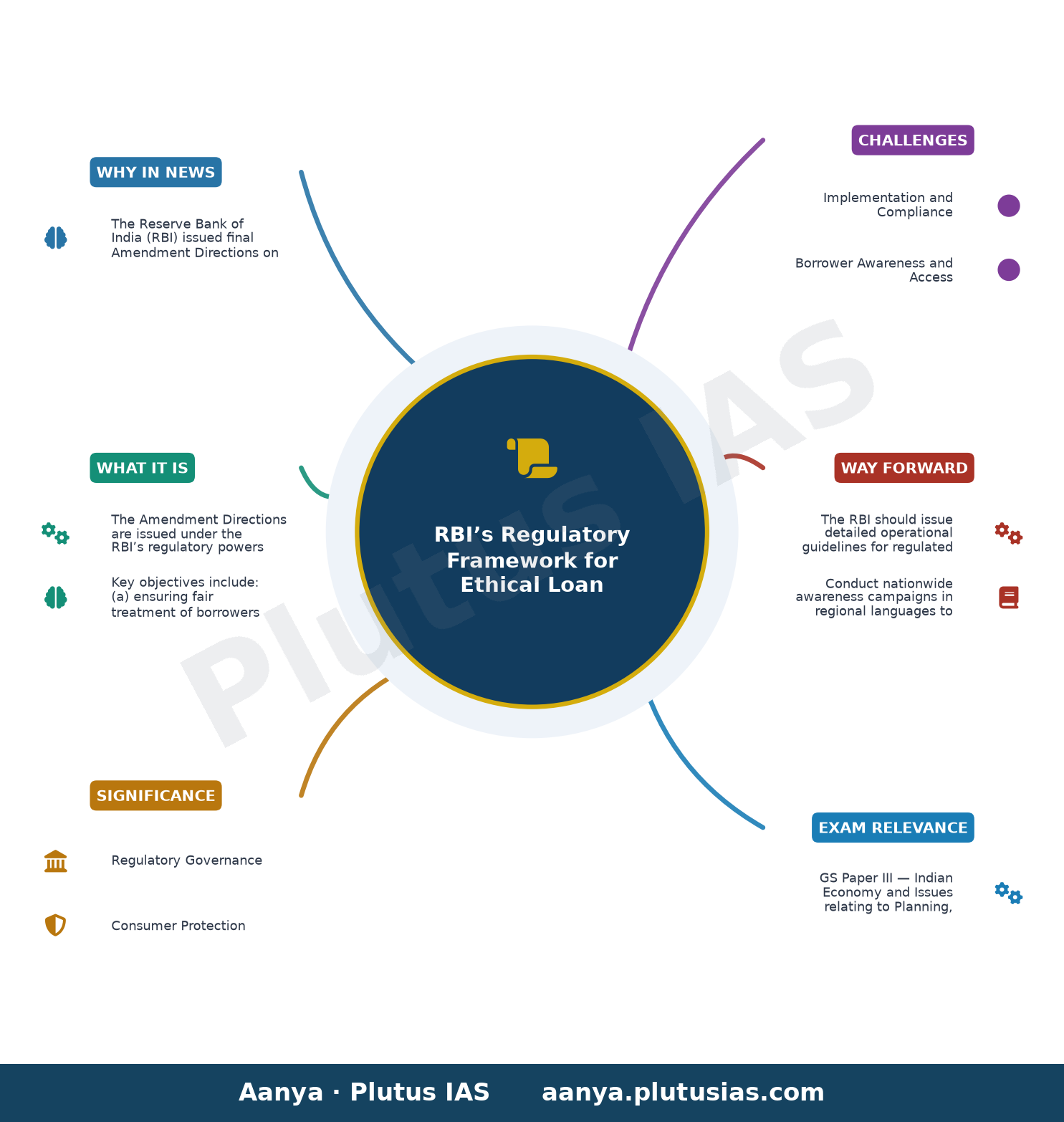
- GS Paper III — Indian Economy and Issues relating to Planning, Mobilisation of Resources, Growth, Development and Employment
- Prelims: Recovery of Loans, Fair Practices Code, RBI Directions, Regulated Entities, Recovery Agents, Responsible Business Conduct, Technology-based Recovery, Co-operative Banks, NBFCs, HFCs
- Essay: Ethical Governance in Financial Sector: Balancing Recovery Imperatives with Borrower Rights
Quick Revision: RBI’s Amendment Directions (effective Jan 1, 2027) mandate ethical recovery practices, strict oversight of recovery agents, and compliance with technology-based recovery regulations to protect borrowers while ensuring responsible business conduct.
Why is this in the news?
The Reserve Bank of India (RBI) issued final Amendment Directions on August 6, 2026, revising its framework governing the conduct of regulated entities (REs) in loan recovery and the engagement of recovery agents. These directions, effective from January 1, 2027, stem from stakeholder feedback on a draft issued in May 2026 and aim to strengthen borrower protection while ensuring responsible business conduct across all financial institutions, including banks, co-operative banks, NBFCs, and housing finance companies. The amendments reflect RBI’s ongoing efforts to harmonise recovery practices with evolving technological and ethical standards in the financial sector.
Background
- The RBI has progressively strengthened regulatory oversight over loan recovery practices to mitigate borrower harassment and ensure procedural fairness, as outlined in the Fair Practices Code (FPC) for lenders.
- The existing framework, while comprehensive, lacked granularity on the use of technology-based recovery mechanisms, particularly in mobile devices, necessitating updated guidelines.
- Stakeholder consultations over the draft amendments (May 2026) highlighted concerns regarding the conduct of recovery agents, transparency in recovery processes, and the need for uniform standards across diverse financial institutions.
- The amendments align with global best practices in responsible lending and recovery, as seen in frameworks like the UK’s Financial Conduct Authority (FCA) guidelines and the EU’s Consumer Credit Directive.
- The RBI’s move is part of a broader regulatory push to enhance consumer protection in financial services, following incidents of coercive recovery practices reported in various sectors.
- The directions apply to all regulated entities (REs), including commercial banks, co-operative banks, NBFCs, and housing finance companies, ensuring a level playing field in recovery practices.
What are the RBI’s Amendment Directions on Loan Recovery and Recovery Agents?
- The Amendment Directions are issued under the RBI’s regulatory powers to ensure responsible business conduct by regulated entities (REs) in loan recovery processes, including the engagement and oversight of recovery agents.
- Key objectives include: (a) ensuring fair treatment of borrowers during recovery, (b) preventing harassment or coercion, (c) establishing a robust code of conduct for recovery agents, and (d) regulating the use of technology-based recovery mechanisms (e.g., remote device access for loan recovery).
- The directions mandate that REs must conduct due diligence on recovery agents, including background checks, training on ethical practices, and adherence to a prescribed code of conduct issued by the RBI or self-regulatory organisations (SROs).
- Recovery agents are prohibited from using abusive language, making threats, or engaging in any form of physical coercion. All communications must be documented and traceable, with clear identification of the agent and the RE they represent.
- For technology-based recovery, REs must ensure that any remote access to a borrower’s mobile device complies with data privacy laws (e.g., Digital Personal Data Protection Act, 2023) and does not compromise the borrower’s personal or financial data.
- REs are required to establish grievance redressal mechanisms for borrowers, with a designated nodal officer to address complaints related to recovery practices. Timely resolution of grievances is mandated, with escalation pathways to the RBI if unresolved.
- The directions also impose stricter reporting requirements on REs, including periodic audits of recovery agent performance, training records, and compliance with the code of conduct. Non-compliance may attract penalties under the RBI Act, 1934.
- The amendments are part of the RBI’s broader Responsible Business Conduct (RBC) framework, which aims to foster ethical practices in the financial sector while balancing the need for efficient loan recovery.
Key Features
| Feature | Significance |
|---|---|
| Fair treatment of borrowers during recovery | Ensures protection of borrowers’ rights and prevents coercive practices, aligning with principles of responsible lending and financial inclusion. |
| Code of conduct for recovery agents | Establishes uniform ethical standards for agents, reducing harassment and malpractice while enhancing transparency in loan recovery processes. |
| Due diligence and training requirements for recovery agents | Mandates structured training programs to ensure agents are aware of legal and ethical boundaries, thereby reducing systemic risks in debt recovery. |
| Regulation of technology-based recovery mechanisms | Addresses concerns related to digital harassment, data privacy, and misuse of borrower data in automated recovery systems. |
| Comprehensive applicability across regulated entities | Extends uniform standards to all financial institutions, including banks, NBFCs, and co-operative banks, ensuring consistency in recovery practices. |
Why it Matters
Regulatory Governance
- Strengthens the Reserve Bank of India’s oversight of loan recovery practices, reinforcing its mandate to ensure fair and transparent financial operations.
- Introduces a structured framework for accountability among regulated entities, reducing regulatory arbitrage and enhancing compliance culture.
- Aligns with global best practices in debt recovery, such as the UK’s Financial Conduct Authority guidelines, to foster a more ethical financial ecosystem.
Consumer Protection
- Mitigates the risk of borrower harassment and coercive recovery tactics, which can lead to financial distress and social stigma.
- Enhances trust in formal financial institutions by ensuring borrowers are treated with dignity and fairness during recovery proceedings.
- Supports the RBI’s broader objective of promoting financial inclusion by reducing the fear of exploitative recovery practices.
Financial Stability
- Reduces systemic risks associated with unethical recovery practices, which can trigger defaults, legal disputes, and reputational damage to lenders.
- Encourages responsible lending and borrowing behavior by embedding ethical considerations into the recovery process.
- Supports the stability of co-operative and rural banks by ensuring their recovery practices adhere to national standards.
Technological Governance
- Addresses the ethical and legal challenges posed by digital recovery mechanisms, such as automated calls, messages, and data access.
- Ensures that technology-driven recovery does not infringe on borrowers’ privacy or lead to harassment through digital channels.
- Aligns with the RBI’s broader push for digital financial inclusion while safeguarding consumer rights in the digital economy.
Challenges
1. Implementation and Compliance
- Ensuring uniform adherence to the new directions across diverse regulated entities, including co-operative banks and NBFCs with varying operational capacities.
- Monitoring compliance through audits and inspections, which may strain the RBI’s supervisory resources.
- Addressing resistance from lenders accustomed to traditional, aggressive recovery methods.
UPSC Link: RBI Act, 1934; Banking Regulation Act, 1949
2. Borrower Awareness and Access
- Educating borrowers about their rights under the new framework, particularly in rural and semi-urban areas with limited financial literacy.
- Ensuring grievance redressal mechanisms are accessible and effective for borrowers facing recovery-related issues.
- Preventing misinformation or exploitation by recovery agents claiming the new rules do not apply to them.
UPSC Link: Financial Inclusion; RBI’s Consumer Protection Guidelines
3. Technological Risks in Digital Recovery
- Preventing misuse of borrower data in technology-based recovery systems, such as unauthorized access or sharing of personal information.
- Ensuring that automated recovery tools (e.g., AI-driven chatbots, SMS campaigns) do not violate privacy laws or ethical standards.
- Addressing the digital divide, where borrowers in remote areas may lack access to digital grievance redressal channels.
UPSC Link: IT Act, 2000; Data Protection Laws
4. Legal and Ethical Dilemmas
- Balancing the need for effective recovery with the prohibition of coercive practices, which may require judicial interpretation in borderline cases.
- Ensuring that recovery agents do not exploit loopholes in the code of conduct to continue unethical practices.
- Addressing conflicts between the new directions and existing state-level debt recovery laws.
UPSC Link: Contract Act, 1872; SARFAESI Act, 2002
Challenges — UPSC Perspective
| Issue | Concern |
|---|---|
| Uniform compliance across entities | Variations in operational capacity among banks, NBFCs, and co-operative banks may lead to inconsistent adherence. |
| Borrower awareness gaps | Low financial literacy in rural areas may prevent borrowers from leveraging new protections. |
| Digital harassment risks | Automated recovery tools could enable harassment if not strictly regulated. |
| Legal conflicts with state laws | State-level recovery laws may not align with RBI’s new directions, creating jurisdictional ambiguities. |
| Agent training effectiveness | Ensuring recovery agents internalize ethical standards and avoid circumvention of rules. |
| Supervisory resource constraints | The RBI may face challenges in monitoring compliance across all regulated entities effectively. |
Way Forward
- The RBI should issue detailed operational guidelines for regulated entities to facilitate smooth implementation by January 1, 2027.
- Conduct nationwide awareness campaigns in regional languages to educate borrowers about their rights under the new framework.
- Establish a dedicated grievance redressal portal for borrowers to report violations, with a focus on rural and underserved regions.
- Strengthen the RBI’s supervisory framework by deploying specialized teams to audit compliance in high-risk entities.
- Introduce a whistle-blower mechanism for recovery agents to report unethical practices within their organizations.
- Collaborate with state governments to harmonize state-level debt recovery laws with the RBI’s directions.
- Develop a standardized training curriculum for recovery agents, with mandatory certification before deployment.
- Publish an annual report on compliance trends and enforcement actions to enhance transparency and accountability.
UPSC Value Addition
Keywords for Mains Answer-Writing
RBI regulatory directions · Responsible Business Conduct · Recovery of Loans · Engagement of Recovery Agents · Fair treatment of borrowers · Code of Conduct for Recovery Agents · Technology-based loan recovery mechanisms · Regulated Entities (REs) · Urban Co-operative Banks · Non-Banking Financial Companies (NBFCs) · Fourth Amendment Directions 2026 · Consumer protection in financial services
Concept Flow
RBI identifies systemic issues in loan recovery practices → Consultation with stakeholders via draft directions → Incorporation of feedback into final directions → Issuance of amendment directions → Implementation by regulated entities → Monitoring and enforcement by RBI → Borrower protection and financial stability outcomes.
Prelims Practice Questions
Q1. Consider the following statements regarding the RBI’s Amendment Directions on ‘Conduct of Regulated Entities in Recovery of Loans and Engagement of Recovery Agents’:
1. The directions apply exclusively to commercial banks.
2. The directions mandate fair treatment of borrowers during the recovery process.
3. The directions prohibit the use of technology-based mechanisms for loan recovery.
4. The directions include provisions for the conduct of recovery agents.
How many of the above statements are correct?
- Only one
- Only two
- Only three
- All four
Answer: Only three — Statements 2 and 4 are correct as the directions emphasize fair treatment and regulate recovery agents. Statement 1 is incorrect as the directions apply to multiple regulated entities including NBFCs and co-operative banks. Statement 3 is incorrect as the directions explicitly address the conduct of technology-based recovery mechanisms.
Q2. Assertion (A): The RBI’s Amendment Directions on loan recovery aim to enhance consumer protection in financial services.
Reason (R): The directions mandate due diligence and training for recovery agents, and regulate their engagement.
Options:
A. Both A and R are true, and R is the correct explanation of A.
B. Both A and R are true, but R is not the correct explanation of A.
C. A is true, but R is false.
D. A is false, but R is true.
Answer: ? — Both the assertion and reason are correct. The directions are designed to protect borrowers by ensuring fair treatment and regulating recovery agents, making R the correct explanation of A.
Q3. Match the following regulated entities with the RBI Amendment Directions they are subject to:
Column I (Regulated Entity) | Column II (Amendment Directions)
1. Commercial Banks | A. Reserve Bank of India (Commercial Banks – Responsible Business Conduct) Fourth Amendment Directions, 2026
2. Non-Banking Financial Companies (NBFCs) | B. Reserve Bank of India (Non-Banking Financial Companies – Responsible Business Conduct) Third Amendment Directions, 2026
3. Urban Co-operative Banks | C. Reserve Bank of India (Urban Co-operative Banks – Responsible Business Conduct) Fourth Amendment Directions, 2026
4. Regional Rural Banks | D. Reserve Bank of India (Regional Rural Banks – Responsible Business Conduct) Fourth Amendment Directions, 2026
- 1-A, 2-B, 3-C, 4-D
- 1-B, 2-A, 3-D, 4-C
- 1-C, 2-D, 3-A, 4-B
- 1-D, 2-C, 3-B, 4-A
Answer: 1-A, 2-B, 3-C, 4-D — The correct matches are: Commercial Banks (1-A), NBFCs (2-B), Urban Co-operative Banks (3-C), and Regional Rural Banks (4-D).
Mains Practice Question
✍ The Reserve Bank of India (RBI) has recently issued Amendment Directions to regulate the conduct of Regulated Entities (REs) in loan recovery and the engagement of recovery agents. Critically examine the significance of these directions in ensuring consumer protection and ethical lending practices in India’s financial sector. Also, analyse the potential challenges in their effective implementation. (15 Marks)
Approach: MODEL-ANSWER SKELETON:
1. **Introduction (2 marks)**:
– Briefly state the context: RBI’s Amendment Directions (Fourth Amendment Directions, 2026) for REs, effective from January 1, 2027.
– Highlight the core objective: to ensure fair treatment of borrowers and regulate the conduct of recovery agents.
2. **Significance in Consumer Protection (5 marks)**:
– **Fair Treatment**: Directions mandate ethical practices, prohibiting harassment, misrepresentation, and undue coercion during recovery.
– **Code of Conduct for Recovery Agents**: Mandates due diligence, training, and adherence to a standardized code, reducing exploitative practices.
– **Technology-Based Recovery**: Regulates the use of technology (e.g., financed mobile devices) to prevent privacy violations and ensure transparency.
– **Institutional Accountability**: REs must ensure compliance, with potential penalties for non-adherence, enhancing accountability.
– **Comparison with Existing Frameworks**: Contrast with the earlier guidelines (e.g., RBI’s 2015 circular on recovery agents) to highlight improvements in consumer safeguards.
3. **Ethical Lending Practices (4 marks)**:
– **Preventing Exploitation**: Directions curb unethical practices like third-party harassment, which disproportionately affect vulnerable borrowers.
– **Transparency and Disclosure**: Mandates clear communication of recovery processes, reducing information asymmetry.
– **Role of REs**: REs must adopt responsible business conduct, aligning with global best practices (e.g., OECD principles on consumer protection).
– **Impact on Financial Inclusion**: Ensures borrowers, including those in rural and semi-urban areas, are not deterred by exploitative recovery practices.
4. **Challenges in Implementation (4 marks)**:
– **Enforcement Mechanisms**: Limited RBI resources for monitoring compliance across diverse REs (banks, NBFCs, co-operative banks).
– **Cultural and Ground-Level Resistance**: Recovery agents and REs may resist changes due to entrenched practices or profit motives.
– **Technology Adoption**: Smaller REs may lack infrastructure to comply with technology-based recovery regulations, leading to exclusion.
– **Jurisdictional Ambiguities**: Overlap with other laws (e.g., SARFAESI Act, 2002) may create confusion in enforcement.
– **Borrower Awareness**: Low financial literacy may prevent borrowers from utilizing these protections effectively.
5. **Conclusion (2 marks)**:
– Reiterate the importance of these directions in balancing lender rights and borrower protections.
– Suggest measures: Strengthening RBI’s supervisory role, public awareness campaigns, and periodic reviews of the directions.
Source: RBI
Generated by AanyaAi for educational purpose.


No Comments