


31 Jul RBI’s Handbook 2025-26: Key Economic Data for UPSC & State PCS Aspirants
✎ The *Handbook of Statistics on the Indian Economy (HBS)* is the RBI’s definitive annual compendium of macroeconomic and financial time-series data, essential for UPSC aspirants to analyse India’s economic trends and policy…
Subject Relevance — Where This Topic Fits
- GS Paper III — Indian Economy: Issues Relating to Planning, Mobilisation of Resources, Growth, Development and Employment | GS Paper III — Inclusive Growth and Associated Challenges | GS Paper III — Government Budgeting and Fiscal Policy
- Prelims: Handbook of Statistics on the Indian Economy, Database on Indian Economy (DBIE), RBI’s Data Portal, Macroeconomic Indicators, Balance of Payments, Public Finances, Foreign Trade Statistics, National Income Accounts
- Essay: The Role of Data in Policy Formulation and Governance, Economic Reforms and Data-Driven Decision Making in India
Quick Revision: The *Handbook of Statistics on the Indian Economy (HBS)* is the RBI’s definitive annual compendium of macroeconomic and financial time-series data, essential for UPSC aspirants to analyse India’s economic trends and policy outcomes.
Why is this in the news?
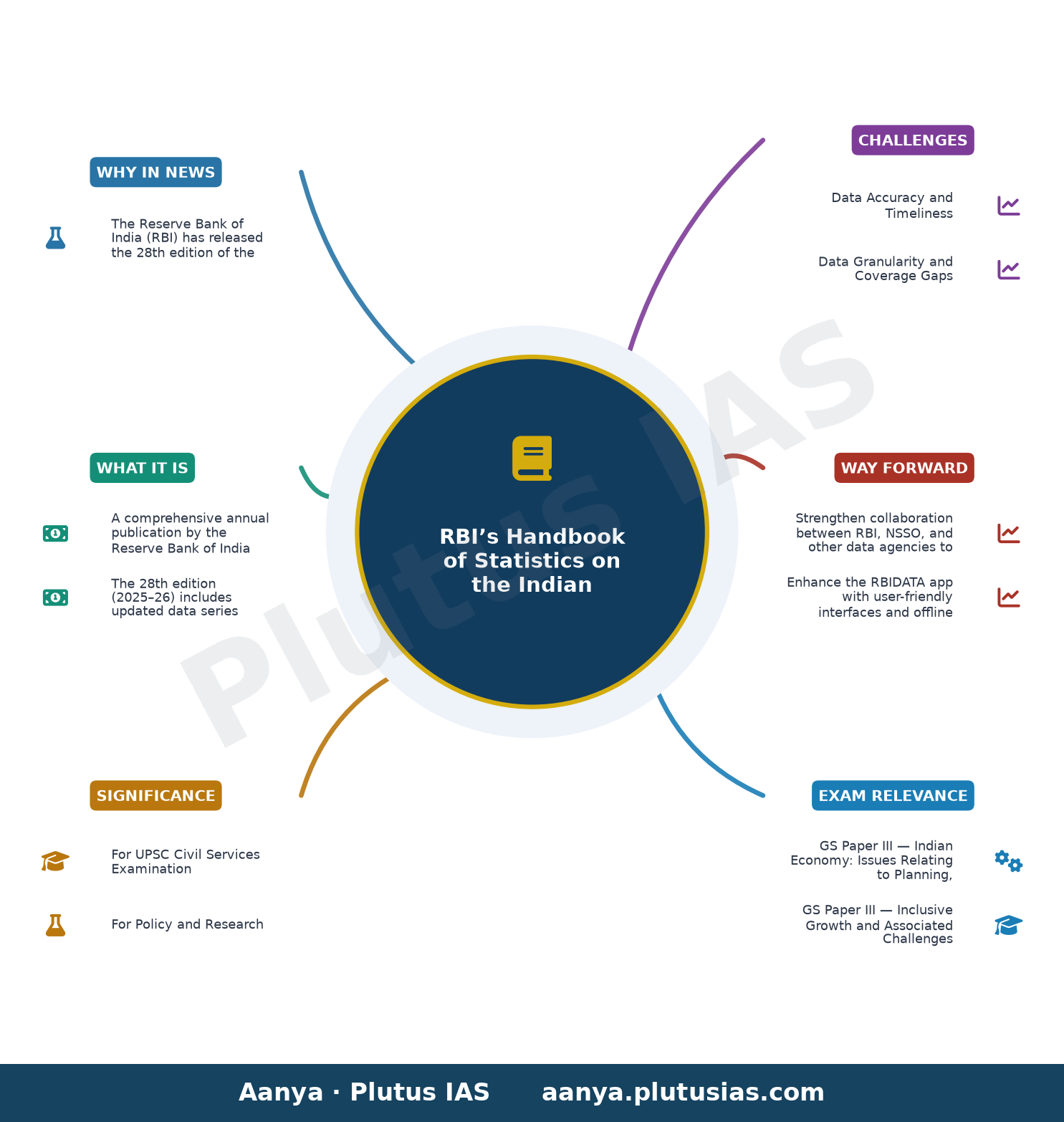
The Reserve Bank of India (RBI) has released the 28th edition of the *Handbook of Statistics on the Indian Economy (HBS) for 2025–26*, a critical annual publication that provides exhaustive time-series data on India’s macroeconomic and financial landscape. This edition introduces four new statistical tables alongside updated data series, serving as an indispensable resource for policymakers, researchers, and UPSC aspirants analysing India’s economic trajectory. The publication underscores the RBI’s commitment to transparency and evidence-based policymaking, while also highlighting the growing importance of digital access to economic data through platforms like the *Database on Indian Economy (DBIE)* and the *RBIDATA* mobile app.
Background
- The HBS aligns with global best practices in central banking, where transparency and data dissemination are prioritised to foster informed public discourse and policy analysis.
- India’s transition to a data-driven governance model, as seen in initiatives like the *National Data Governance Framework Policy (NDGFP)*, further amplifies the relevance of RBI’s statistical publications.
- The inclusion of socio-economic indicators in the HBS reflects the RBI’s recognition of the interlinkages between economic growth, social welfare, and structural reforms.
- The RBI’s role as the custodian of monetary and financial data ensures that the HBS remains a gold standard for economic research in India.
What is the Handbook of Statistics on the Indian Economy (HBS)?
- A comprehensive annual publication by the Reserve Bank of India (RBI), providing detailed time-series data on India’s macroeconomic and financial indicators.
- The 28th edition (2025–26) includes updated data series across national income, prices, money supply, banking, financial markets, public finances, foreign trade, and balance of payments.
- Four new statistical tables have been introduced in the 2025–26 edition to address emerging data needs.
- The HBS serves as a primary reference for researchers, policymakers, and UPSC aspirants, offering granular insights into India’s economic performance over decades.
- Data is presented in a structured format, enabling longitudinal analysis and comparative studies across sectors and time periods.
- The publication is complemented by the *Database on Indian Economy (DBIE)*, an online portal providing real-time access to RBI’s statistical datasets.
- The *RBIDATA* mobile app further enhances accessibility, allowing users to retrieve and analyse RBI data on-the-go.
- The HBS adheres to international statistical standards, ensuring comparability with global economic datasets and facilitating cross-border research.
Key Features
| Feature | Significance |
|---|---|
| Annual publication series (28th edition) | Provides a comprehensive, time-series database on the Indian economy, ensuring continuity and comparability of economic data over decades. |
| Macroeconomic and financial data coverage | Includes national income, prices, money supply, banking sector metrics, financial market indicators, public finances, foreign trade, and balance of payments. |
| New data tables (four additions) | Enhances granularity by incorporating additional statistical series, likely addressing emerging data needs such as digital economy metrics or climate-related financial indicators. |
| Database on Indian Economy (DBIE) portal | Offers open-access, searchable, and downloadable time-series data, facilitating research, policy analysis, and academic study. |
| RBIDATA mobile app | Enables real-time access to RBI’s statistical publications and datasets, improving usability for policymakers, researchers, and aspirants preparing for competitive examinations. |
Why it Matters
For UPSC Civil Services Examination
- Serves as a primary source for static and dynamic economic data in Prelims and Mains, particularly for topics like Indian Economy, Economic Survey, and Budget analysis.
- Provides historical time-series data essential for answering questions on growth trends, inflation, fiscal deficits, and balance of payments in GS Paper-III.
- Facilitates preparation for Essay and Optional subjects (e.g., Economics, Public Administration) by offering structured, reliable, and citable data.
For Policy and Research
- Acts as a foundational resource for macroeconomic modeling, forecasting, and policy formulation by government agencies and financial institutions.
- Supports evidence-based policymaking by offering disaggregated data on sectors like banking, trade, and public finance.
- Enables comparative analysis of India’s economic performance against global benchmarks, aiding in international economic assessments.
For Financial Markets and Investors
- Provides transparency on key financial indicators, such as money supply, credit growth, and foreign exchange reserves, influencing market sentiment and investment decisions.
- Helps investors and analysts assess macroeconomic stability and risks, particularly in sectors dependent on liquidity and external trade.
For Academic and Competitive Examinations
- A critical reference for faculty and students in economics, finance, and public administration, ensuring alignment with UPSC’s syllabus requirements.
- Offers a structured approach to understanding India’s economic trajectory, aiding in answer-writing for descriptive questions in Mains.
Challenges
1. Data Accuracy and Timeliness
- Ensuring the reliability of time-series data, especially for high-frequency indicators like inflation and GDP, remains a persistent challenge due to lag in data collection and revisions.
- Delays in publishing updated datasets may limit their utility for real-time policy decisions and academic research.
UPSC Link: Economic Data Sources
2. Data Granularity and Coverage Gaps
- Certain emerging sectors (e.g., digital economy, green finance) may lack comprehensive statistical coverage, requiring periodic updates to the Handbook.
- Disaggregated data for sub-national or sectoral analysis (e.g., state-wise fiscal data) is often limited, constraining regional economic assessments.
UPSC Link: Sub-National Data
3. Accessibility and Usability
- While the DBIE portal and RBIDATA app improve accessibility, digital divide issues may limit usage among smaller institutions or individuals in remote areas.
- Complexity of data tables and lack of user-friendly interfaces could deter non-specialist users from fully utilising the resources.
UPSC Link: Digital Divide
4. Integration with Global Standards
- Aligning India’s statistical frameworks with international standards (e.g., IMF’s Special Data Dissemination Standards) remains an ongoing challenge.
- Ensuring comparability with global datasets (e.g., World Bank, OECD) requires harmonisation of methodologies and definitions.
UPSC Link: Global Data Standards
5. Feedback Incorporation
- The process of incorporating feedback from users (e.g., researchers, policymakers) into subsequent editions may be slow, limiting iterative improvements.
- Lack of a structured feedback mechanism for real-time data corrections could delay the resolution of discrepancies.
UPSC Link: Data Governance
Challenges — UPSC Perspective
| Issue | Concern |
|---|---|
| Data revisions | Frequent revisions to historical data (e.g., GDP estimates) can create inconsistencies, complicating long-term trend analysis. |
| Sectoral gaps | Limited coverage of informal sectors, gig economy, and emerging technologies (e.g., AI, blockchain) in current statistical frameworks. |
| Regional disparities | Insufficient granularity in state-level or district-level economic data, hindering targeted policy interventions. |
| Digital accessibility | Reliance on digital platforms may exclude users without internet access or technical literacy. |
| Methodological harmonisation | Differences in data collection methods across agencies (e.g., RBI vs. NSSO) can lead to conflicting interpretations. |
| Feedback lag | Slow incorporation of user suggestions may result in outdated or less relevant data series. |
Way Forward
- Strengthen collaboration between RBI, NSSO, and other data agencies to improve sectoral and regional data granularity.
- Enhance the RBIDATA app with user-friendly interfaces and offline access features to bridge the digital divide.
- Establish a dedicated task force to periodically review and update statistical methodologies in line with global standards.
- Introduce a real-time feedback portal for researchers and policymakers to report data discrepancies or suggest new series.
- Expand the Handbook’s coverage to include emerging sectors like digital economy, green finance, and circular economy metrics.
- Promote capacity-building initiatives for state governments to improve sub-national data collection and reporting.
- Publish supplementary notes explaining data revisions and methodological changes to maintain transparency and trust.
UPSC Value Addition
Keywords for Mains Answer-Writing
Handbook of Statistics on the Indian Economy 2025-26 · RBI statistical publications · Database on Indian Economy (DBIE) · RBI data dissemination · Indian macroeconomic statistics · time-series economic data · RBI’s statistical tools · financial market data RBI · public finance statistics RBI · foreign trade and balance of payments RBI
Concept Flow
RBI’s mandate to disseminate economic data → Development of Handbook of Statistics on the Indian Economy → Collection and compilation of macroeconomic and financial data → Publication of time-series datasets → Dissemination via DBIE portal and RBIDATA app → Utilisation by UPSC aspirants, policymakers, and researchers → Feedback incorporation for iterative improvements → Alignment with global statistical standards → Enhanced policy formulation and academic research.
Prelims Practice Questions
Q1. Consider the following statements regarding the Handbook of Statistics on the Indian Economy (HBS) 2025-26 released by the Reserve Bank of India:
1. The HBS provides time-series data on national income, prices, money, banking, and public finances.
2. The 2025-26 edition includes four new tables in addition to updating existing data series.
3. The HBS data is available exclusively through the RBI’s physical publications and not online.
How many of the above statements are correct?
- Only one
- Only two
- All three
- None
Answer: Only two — Statement 1 is correct as the HBS covers national income, prices, money, banking, and public finances. Statement 2 is correct as the 2025-26 edition includes four new tables. Statement 3 is incorrect because the data is available online via the Database on Indian Economy (DBIE) and the RBIDATA mobile app.
Q2. Assertion (A): The Handbook of Statistics on the Indian Economy (HBS) 2025-26 is the 28th edition of the annual publication by the Reserve Bank of India.
Reason (R): The HBS disseminates detailed time-series data on the Indian economy, including macroeconomic and financial indicators.
In the context of the above two statements, which of the following is correct?
- Both A and R are true, and R is the correct explanation of A.
- Both A and R are true, but R is not the correct explanation of A.
- A is true but R is false.
- A is false but R is true.
Answer: A is true but R is false. — Assertion (A) is true as the HBS 2025-26 is indeed the 28th edition. Reason (R) is also true as the HBS disseminates detailed time-series data. However, R does not explain why the HBS is the 28th edition; it merely describes its purpose.
Q3. Match the following columns related to the Reserve Bank of India’s statistical publications:
Column I
1. Handbook of Statistics on the Indian Economy (HBS)
2. Database on Indian Economy (DBIE)
3. RBIDATA mobile app
4. Press Release on HBS 2025-26
Column II
A. Provides time-series data on macroeconomic and financial indicators
B. Released on July 31, 2026
C. Accessible via mobile application
D. Centralised online repository of RBI’s statistical data
- 1-A, 2-D, 3-C, 4-B; 1-B, 2-A, 3-D, 4-C; 1-D, 2-A, 3-B, 4-C; 1-C, 2-D, 3-A, 4-B
- answer_string_list_indexes_to_match_pairs_correctly
- explain_list_pairs_correctly
- format_match
Answer: 1-A, 2-D, 3-C, 4-B; 1-B, 2-A, 3-D, 4-C; 1-D, 2-A, 3-B, 4-C; 1-C, 2-D, 3-A, 4-B — 1 matches with A (HBS provides time-series data), 2 matches with D (DBIE is the centralised online repository), 3 matches with C (RBIDATA is accessible via mobile app), and 4 matches with B (Press Release on HBS 2025-26 was released on July 31, 2026).
Mains Practice Question
✍ The Reserve Bank of India’s Handbook of Statistics on the Indian Economy (HBS) serves as a critical repository of macroeconomic and financial data. Critically examine the role of such statistical publications in evidence-based policymaking and economic governance in India. (15 Marks)
Approach: MODEL-ANSWER SKELETON:
1. **Introduction (2 Marks)**
– Define HBS and its purpose as per RBI’s mandate.
– Emphasise the importance of data-driven policymaking in a complex economy like India.
2. **Role in Evidence-Based Policymaking (5 Marks)**
– **Data Accuracy and Reliability**: Discuss how HBS provides standardised, time-series data on national income, prices, money supply, banking, public finances, foreign trade, and balance of payments. Highlight the role of RBI as the central bank in ensuring data integrity.
– **Policy Formulation**: Explain how data from HBS informs monetary policy (e.g., inflation targeting, liquidity management), fiscal policy (e.g., tax buoyancy, expenditure patterns), and structural reforms (e.g., financial inclusion, digital payments).
– **Comparative Analysis**: Illustrate with examples how HBS enables comparison across years, sectors, and regions, aiding in trend analysis and forecasting.
3. **Role in Economic Governance (5 Marks)**
– **Transparency and Accountability**: Discuss how public dissemination of data enhances transparency, enabling stakeholders (government, investors, academia, and citizens) to assess economic performance and hold institutions accountable.
– **Informed Decision-Making**: Highlight the use of HBS data by the Ministry of Finance, NITI Aayog, and other agencies for designing schemes (e.g., PM-KISAN, PLI schemes) and assessing their impact.
– **Global Benchmarking**: Explain how HBS aligns with international standards (e.g., IMF’s Special Data Dissemination Standard) to facilitate global comparisons and attract foreign investment.
4. **Challenges and Limitations (2 Marks)**
– **Data Gaps**: Acknowledge limitations such as delays in data release, underrepresentation of informal sectors, or challenges in capturing digital economy metrics.
– **Interpretation Challenges**: Discuss how policymakers and analysts must exercise caution in interpreting data, accounting for methodological changes or revisions.
5. **Conclusion (1 Mark)**
– Summarise the indispensability of HBS and similar publications in fostering a data-driven governance culture in India.
Source: RBI
Generated by AanyaAi for educational purpose.

- केरल में एंटीमाइक्रोबियल रेजिस्टेंस: सरकारी रिपोर्ट में चौंकाने वाले आँकड़े सामने - September 23, 2026
- Kerala’s AMR Crisis: Rising Drug Resistance Threatens Public Health in 2025 - September 23, 2026
- सुप्रीम कोर्ट ने दवाओं की ऊंची कीमतों को ‘लूट’ बताया, सरकार से पूछा- क्या है कानून? - September 23, 2026

No Comments