


22 Sep RBI’s Supervisory Data Quality Index for Banks: June 2026 Insights for UPSC
✎ The Supervisory Data Quality Index (sDQI) is a RBI framework to evaluate the accuracy, timeliness, completeness, and consistency of data submitted by banks in their supervisory returns, ensuring robust financial oversight.
Subject Relevance — Where This Topic Fits
- GS Paper III — Indian Economy and Issues Relating to Planning, Mobilisation of Resources, Growth, Development and Employment
- Prelims: Supervisory Data Quality Index (sDQI), Reserve Bank of India (RBI), Scheduled Commercial Banks (SCBs), Data Accuracy, Timeliness, Completeness, Consistency, Supervisory Returns Directions
- Essay: The Role of Data Integrity in Financial Governance, Regulatory Mechanisms and Financial Stability
Quick Revision: The Supervisory Data Quality Index (sDQI) is a RBI framework to evaluate the accuracy, timeliness, completeness, and consistency of data submitted by banks in their supervisory returns, ensuring robust financial oversight.
Why is this in the news?
The Reserve Bank of India (RBI) released the Supervisory Data Quality Index (sDQI) for Scheduled Commercial Banks (SCBs) for June 2026, marking a significant step in strengthening the quality and reliability of financial data submitted by banks. This initiative underscores the RBI’s commitment to enhancing supervisory oversight through systematic evaluation of data attributes such as accuracy, timeliness, completeness, and consistency, in alignment with the Reserve Bank of India (Commercial Banks – Supervisory Returns) Directions, 2026 and similar directives for Small Finance Banks.
Background
- The RBI, as the central bank and primary regulator of the banking sector, is mandated to ensure financial stability and systemic resilience through robust supervisory mechanisms.
- Supervisory returns—mandatory periodic reports submitted by banks—form the backbone of the RBI’s monitoring framework, enabling assessment of financial health, risk exposure, and compliance with prudential norms.
- Historically, discrepancies in reported data have posed challenges to effective supervision, necessitating a structured approach to data quality assessment.
- The introduction of the sDQI aligns with global best practices in financial regulation, where data integrity is prioritised to mitigate systemic risks and enhance transparency.
- The RBI’s supervisory framework is governed by statutory directions issued under the Banking Regulation Act, 1949, which empowers the central bank to prescribe reporting formats and standards.
- The sDQI is part of a broader digital transformation in banking supervision, leveraging technology to automate data validation and reduce human error.
What is the Supervisory Data Quality Index (sDQI)?
- The sDQI is a composite metric introduced by the RBI to evaluate the quality of data submitted by Scheduled Commercial Banks (SCBs) and Small Finance Banks (SFBs) in their supervisory returns.
- It assesses four critical dimensions of data quality: Accuracy (correctness of reported figures), Timeliness (adherence to submission deadlines), Completeness (coverage of required data points), and Consistency (logical coherence across reports and time periods).
- The index is designed to provide a quantitative measure of data reliability, enabling the RBI to identify systemic weaknesses, prioritise supervisory interventions, and enhance risk-based oversight.
- The sDQI is computed using a weighted scoring system, where each dimension contributes to an overall index score, facilitating comparative analysis across banks and over time.
- The framework is anchored in the Reserve Bank of India (Commercial Banks – Supervisory Returns) Directions, 2026, and analogous directives for Small Finance Banks, which mandate compliance with reporting standards.
- Banks are expected to maintain high sDQI scores to demonstrate adherence to regulatory expectations, with suboptimal performance potentially triggering enhanced scrutiny or corrective actions.
- The sDQI complements existing supervisory tools such as on-site inspections and off-site monitoring, providing a data-driven lens to assess financial stability risks.
- The index is part of the RBI’s broader strategy to integrate technology and analytics into regulatory processes, reducing reliance on manual verification and improving efficiency.
Key Features
| Feature | Significance |
|---|---|
| Accuracy | Ensures that supervisory data submitted by banks reflects true financial positions, reducing systemic risks and enhancing the reliability of RBI’s risk assessments. |
| Timeliness | Facilitates real-time or near-real-time monitoring of banks’ financial health, enabling prompt regulatory interventions to prevent crises. |
| Completeness | Guarantees that all required data fields are submitted, preventing gaps that could obscure critical vulnerabilities in the banking sector. |
| Consistency | Ensures uniformity in data reporting across banks and over time, allowing for accurate trend analysis and comparative assessments. |
| Adherence to Directions | Measures compliance with RBI’s regulatory frameworks, reinforcing the legal and procedural discipline in banking supervision. |
Why it Matters
Regulatory Governance
- Strengthens the RBI’s supervisory capacity by providing a quantitative metric to evaluate data quality across all scheduled commercial banks.
- Enhances the credibility of India’s banking sector by demonstrating robust oversight mechanisms to international stakeholders.
- Supports the RBI’s mandate under the Reserve Bank of India Act, 1934, to regulate and supervise the banking system.
Financial Stability
- Reduces the likelihood of systemic risks arising from poor-quality or delayed data submissions by banks.
- Improves the accuracy of stress tests and macroprudential assessments conducted by the RBI.
Operational Efficiency
- Streamlines the RBI’s supervisory processes by automating data validation and reducing manual errors in assessments.
- Encourages banks to adopt standardized data reporting practices, improving interoperability and comparability.
Stakeholder Confidence
- Builds trust among depositors, investors, and rating agencies by ensuring transparency and reliability in financial reporting.
- Enhances the RBI’s ability to communicate risks to the public and policymakers with greater precision.
Challenges
1. Data Fragmentation Across Banks
- Variations in IT infrastructure and legacy systems among banks may lead to inconsistencies in data submission.
- Smaller banks may lack resources to upgrade systems, creating disparities in data quality.
UPSC Link: Economic Development – Banking Sector Reforms
2. Regulatory Compliance Burden
- Frequent updates to reporting requirements may impose operational challenges on banks.
- Ensuring adherence to multiple directives (e.g., for commercial banks vs. small finance banks) requires significant administrative effort.
UPSC Link: Financial Sector Regulation – RBI Powers
3. Human Resource Constraints
- Banks may face shortages of skilled personnel to manage data quality and compliance processes.
- Training and capacity-building initiatives are essential but resource-intensive.
UPSC Link: Human Resource Development – Skill Gaps
4. Technological Lag
- Banks with outdated technology may struggle to meet timeliness and accuracy benchmarks.
- Cybersecurity risks associated with digital reporting systems require continuous monitoring.
UPSC Link: Digital Infrastructure – Banking Sector
5. Cross-Border Data Challenges
- Global banks operating in India may face difficulties in aligning domestic reporting standards with international frameworks.
- Data localization requirements could add complexity to reporting processes.
UPSC Link: International Financial Institutions – Compliance
Challenges — UPSC Perspective
| Issue | Concern |
|---|---|
| Legacy Systems | High costs and operational disruptions in upgrading outdated IT infrastructure. |
| Resource Allocation | Small and regional banks may lack financial and technical resources for compliance. |
| Regulatory Overlap | Multiple reporting directives (e.g., for SCBs vs. SFBs) increase administrative burden. |
| Data Security | Increased digital reporting raises risks of cyber threats and data breaches. |
| Skill Deficits | Shortage of trained personnel to manage complex data reporting and validation processes. |
| Standardization Gaps | Lack of uniform data formats across banks hinders comparability and analysis. |
Way Forward
- Establish a phased roadmap for banks to upgrade IT infrastructure, prioritizing high-risk and systemically important banks.
- Develop a centralized data repository for RBI to streamline validation and reduce duplication of efforts.
- Introduce incentives (e.g., lower compliance costs) for banks achieving high sDQI scores to encourage voluntary improvements.
- Enhance capacity-building programs through collaborations with industry bodies (e.g., IBA) and academic institutions.
- Strengthen cybersecurity frameworks for digital reporting systems to mitigate data breach risks.
- Promote the adoption of fintech solutions for automated data validation and real-time monitoring.
- Conduct periodic reviews of reporting directives to align with evolving global standards (e.g., Basel III).
- Encourage peer-learning initiatives among banks to share best practices in data quality management.
UPSC Value Addition
Keywords for Mains Answer-Writing
Supervisory Data Quality Index (sDQI) · Reserve Bank of India (RBI) · Scheduled Commercial Banks (SCBs) · Commercial Banks – Supervisory Returns Directions, 2026 · Small Finance Banks – Supervisory Returns Directions, 2026 · Data governance in banking sector · Regulatory compliance in financial sector · Accuracy, Timeliness, Completeness, Consistency (ATCC) framework · Microdata quality for supervisory assessments · Financial stability and systemic risk · Basel Committee on Banking Supervision (BCBS) standards · Regulatory reporting framework in India · Digital transformation in banking supervision
Concept Flow
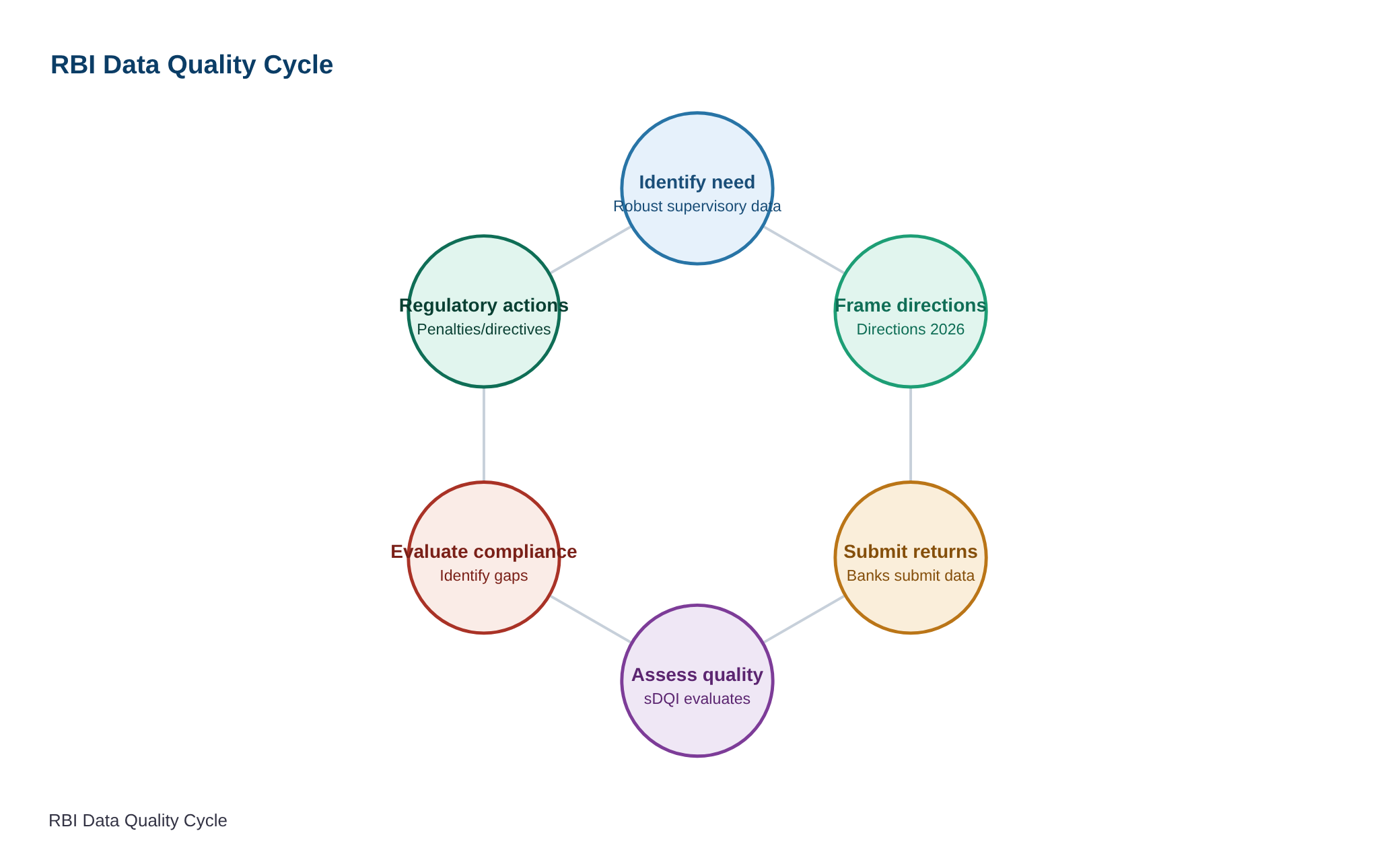
RBI identifies need for robust supervisory data → Frames ‘Reserve Bank of India (Commercial Banks – Supervisory Returns) Directions, 2026’ → Banks submit returns and microdata → sDQI assesses data quality (Accuracy, Timeliness, Completeness, Consistency) → RBI evaluates compliance and identifies gaps → Regulatory actions (e.g., penalties, directives) for non-compliance → Banks improve systems and processes → Enhanced financial stability and supervisory effectiveness.
Prelims Practice Questions
Q1. Consider the following statements regarding the Supervisory Data Quality Index (sDQI) released by the Reserve Bank of India (RBI):
1. The sDQI measures data quality in terms of Accuracy, Timeliness, Completeness, and Consistency.
2. It is applicable only to Scheduled Commercial Banks (SCBs) and not to Small Finance Banks.
3. The sDQI is designed to assess adherence to the principles enunciated in the Reserve Bank of India (Commercial Banks – Supervisory Returns) Directions, 2026.
How many of the above statements are correct?
- Only one
- Only two
- All three
- None
Answer: Only two — Statement 1 is correct as the sDQI measures data quality using the ATCC (Accuracy, Timeliness, Completeness, Consistency) framework. Statement 2 is incorrect because the sDQI applies to both Scheduled Commercial Banks (SCBs) and Small Finance Banks as per the RBI press release. Statement 3 is correct as the sDQI is aligned with the Directions issued by RBI for supervisory returns.
Q2. Assertion (A): The Supervisory Data Quality Index (sDQI) is a tool used by the RBI to assess the quality of data submitted by banks for supervisory purposes.
Reason (R): The sDQI evaluates data based on four parameters: Accuracy, Timeliness, Completeness, and Consistency, as mandated by the Basel Committee on Banking Supervision (BCBS).
- Both A and R are true, and R is the correct explanation of A
- Both A and R are true, but R is NOT the correct explanation of A
- A is true, but R is false
- A is false, but R is true
Answer: A is true, but R is false — Assertion (A) is true as the sDQI is indeed used by the RBI to assess data quality for supervisory returns. Reason (R) is also true as the sDQI evaluates data based on the ATCC framework, but the BCBS is not the source of this mandate; rather, it is the RBI’s own Directions that specify these parameters.
Q3. Match the following parameters of the Supervisory Data Quality Index (sDQI) with their respective definitions:
Column I (Parameter)
A. Accuracy
B. Timeliness
C. Completeness
D. Consistency
Column II (Definition)
1. The extent to which data is free from errors and represents the true state of affairs.
2. The degree to which data is submitted within the prescribed timeframes.
3. The extent to which all required data elements are present without omission.
4. The degree to which data is uniform and coherent across different submissions and time periods.
- A-1, B-2, C-3, D-4; A-2, B-1, C-4, D-3; A-3, B-4, C-1, D-2; A-4, B-3, C-2, D-1
- answer_indexed_answer_indexed_answer_indexed_answer_indexed_answer_indexed_answer_indexed_answer_indexed_indexed_answer_indexed_answer
- explain_match_pairs_exact
- format_match
Answer: A-1, B-2, C-3, D-4; A-2, B-1, C-4, D-3; A-3, B-4, C-1, D-2; A-4, B-3, C-2, D-1 —
Mains Practice Question
✍ The Reserve Bank of India (RBI) has introduced the Supervisory Data Quality Index (sDQI) to enhance the quality of data submitted by Scheduled Commercial Banks (SCBs) and Small Finance Banks. Critically examine the significance of the sDQI in the context of financial stability and systemic risk management in India. Also, analyse how the sDQI aligns with global best practices in banking supervision. (15 Marks)
Approach: MODEL-ANSWER SKELETON:
1. **Introduction (2 marks)**: Define the sDQI and its objective (to assess data quality using ATCC framework) and its legal basis (RBI Directions, 2026 for SCBs and SFBs).
2. **Significance for Financial Stability (5 marks)**:
– Explain how high-quality data is critical for the RBI’s supervisory functions (e.g., risk assessment, early warning systems, macroprudential oversight).
– Link to systemic risk: Poor data quality can lead to mispricing of risks, regulatory arbitrage, or inadequate capital buffers.
– Reference the role of the RBI as the regulator and supervisor under the Reserve Bank of India Act, 1934, and the Banking Regulation Act, 1949.
– Cite examples of past financial crises (e.g., 2008 Global Financial Crisis) where data gaps contributed to instability.
3. **Systemic Risk Management (4 marks)**:
– Discuss how the sDQI supports the RBI’s mandate under the Financial Stability and Development Council (FSDC) framework.
– Explain the link between data quality and the Basel III norms (e.g., Liquidity Coverage Ratio, Net Stable Funding Ratio) which rely on accurate reporting.
– Highlight the role of the sDQI in enabling the RBI to detect emerging risks (e.g., asset quality deterioration, liquidity mismatches) in a timely manner.
4. **Alignment with Global Best Practices (4 marks)**:
– Compare the sDQI with the Basel Committee on Banking Supervision (BCBS) principles on data quality (e.g., BCBS 239).
– Discuss how the ATCC framework mirrors international standards (e.g., accuracy, timeliness, completeness, consistency).
– Reference the RBI’s participation in global forums (e.g., Financial Stability Board) and its adoption of international standards.
5. **Conclusion (2 marks)**: Summarise the transformative potential of the sDQI in strengthening India’s banking supervision framework and its role in maintaining financial stability. Acknowledge challenges such as digital transformation in banking and the need for continuous capacity-building.
Source: RBI
Generated by AanyaAi for educational purpose.
Related guides on our sites
- Current affairs for upsc 2026
- Best PSIR optional coaching for upsc
- Best economics optional coaching for upsc
- Best PSIR optional teacher for upsc

- RBI’s Supervisory Data Quality Index for Banks: June 2026 Insights for UPSC - September 22, 2026
- एनटीए में बड़ा बदलाव: सीआईएसएफ सुरक्षा और एआई निगरानी, जानिए पूरा प्लान - September 22, 2026
- NTA Overhaul 2026: CISF, AI & Nandan Nilekani’s Role After NEET Leak - September 22, 2026

No Comments