


23 Apr Recusal Process in India
This article covers “Daily Current Affairs”
SYLLABUS MAPPING : GS-2 : Polity and Governance
FOR PRELIMS : Recusal Provisions in India, Global Practices, etc.
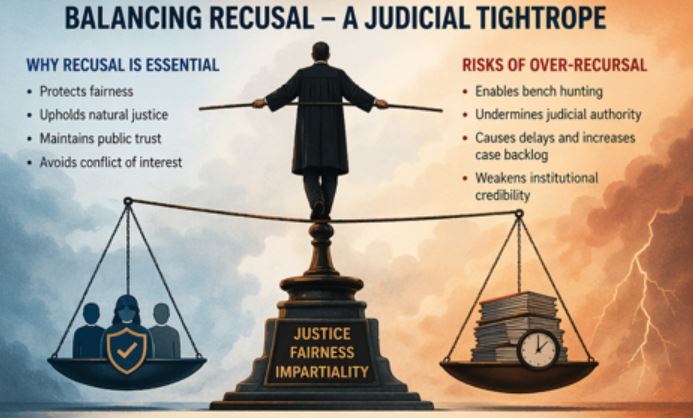
FOR MAINS : Critically examine the tension between a judge’s “duty to sit” and the “reasonable apprehension of bias” standard. How has the Indian Supreme Court balanced these competing values in its recent jurisprudence?
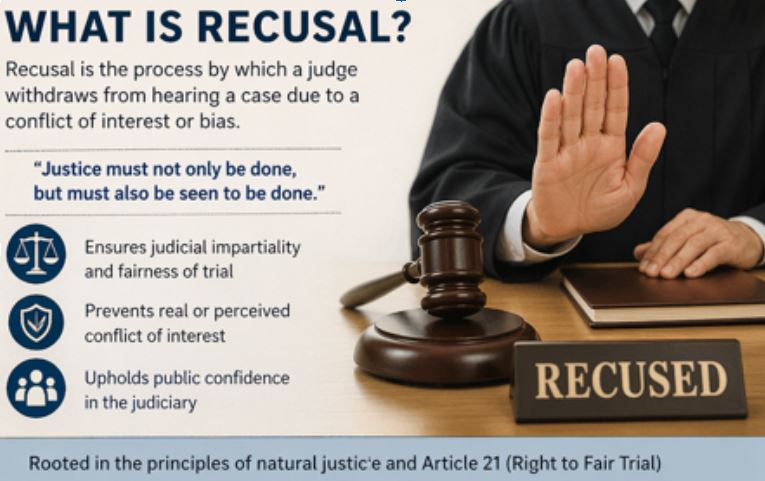
Recusal refers to the process by which a judge withdraws from hearing a case due to a real or perceived conflict of interest or bias. It is rooted in the principle: “Justice must not only be done, but must also be seen to be done.” It ensures:
- Judicial impartiality
- Fair trial (Article 21 – due process)
- Public confidence in judiciary
👉 Legally, recusal is: Not codified strictly in India (no comprehensive statute). It is Governed by:
- Judicial precedents
- Ethical norms (Restatement of Judicial Values, 1997)
- Individual judge’s discretion
📌 Types of bias:
- Actual bias (proved prejudice)
- Apparent bias (reasonable apprehension)
- Automatic disqualification (financial/personal interest)
Why is Recusal in News?
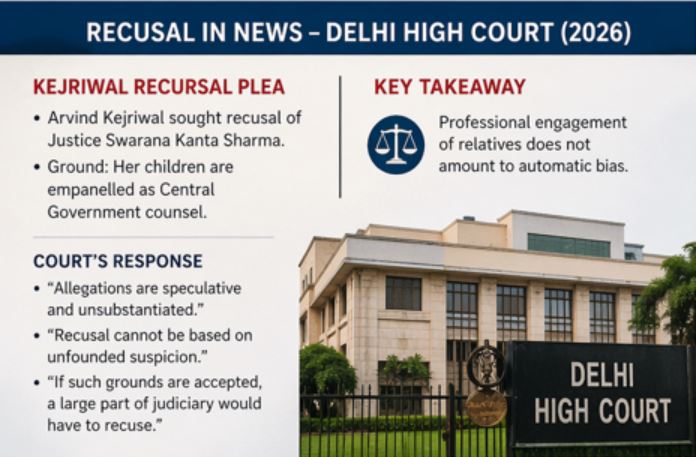
A) Delhi High Court – Kejriwal Recusal Plea
- A plea was filed by Arvind Kejriwal seeking recusal of Justice Swarana Kanta Sharma.
- Ground: Her children were empanelled as Central Government counsel → alleged conflict of interest.
Court’s Response : Rejected the plea, stating:
- Allegations were “speculative and unsubstantiated”
- Recusal cannot be based on “unfounded suspicion”
- If such grounds are accepted, “a large part of judiciary would have to recuse”
B) Recent News
- Another Delhi HC judge recused on 22/04/26 from a PIL involving Kejriwal Recusal issue also linked to:
- Political sensitivity of cases, Public perception and media scrutiny.
Key Principles Governing Recusal
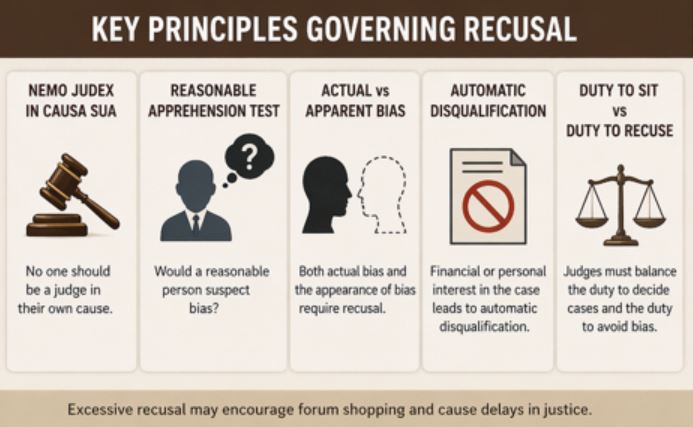
(i) Nemo Judex in Causa Sua : “No one should be a judge in their own cause”
(ii) Reasonable Apprehension Test : Would a reasonable person suspect bias?
(iii) Duty to Sit vs Duty to Recuse : Judges must balance:
- Duty to recuse (avoid bias)
- Duty to sit (avoid forum shopping & delays)
Issues related to Recusal
(1) Judicial Independence vs Accountability
- Recusal protects impartiality
- But frequent recusal : Weakens institutional authority
(2) Misuse of Recusal Petitions : Used as a litigation strategy to:
- Delay proceedings
- Avoid unfavourable judges
(3) Lack of Transparency in India
- Judges often do not give reasons for recusal
- Leads to: Speculation , Reduced accountability
(4) Global Practices (Comparative Insight)
- USA: Codified recusal statutes (28 U.S.C. §455)
- UK: Clear “real possibility of bias” test
- India: More judge-centric & discretionary
Prelims Practice Questions
Question 1: Regarding the process of judicial recusal in India, consider the following statements:
- The Constitution of India explicitly provides for the grounds under which a Supreme Court judge must recuse themselves.
- A party to a legal proceeding has a statutory right to compel a judge to recuse if a conflict of interest is proven.
- The Supreme Court has ruled that a judge who recuses is constitutionally obligated to record the specific reasons for their withdrawal.
Which of the statements given above is/are correct?
A) 1 and 2 only
B) 3 only
C) 1 and 3 only
D) None of the above
The correct answer is D) None of the above.
Here is the explanation for why each statement is incorrect:
- Statement 1 is Incorrect: The Constitution of India does not contain any provisions or grounds for the recusal of judges. Recusal is a practice rooted in the principles of natural justice and conventions, rather than a codified constitutional mandate.
- Statement 2 is Incorrect: There is no statutory right (law passed by Parliament) that allows a litigant to force a judge to recuse. While a party can request a recusal due to a conflict of interest, the final decision rests entirely with the discretion and conscience of the judge concerned.
- Statement 3 is Incorrect: There is no constitutional or legal obligation for a judge to provide reasons for their recusal. While some judges choose to record their reasons for the sake of transparency, the Supreme Court has not established a rule making it mandatory. Often, judges recuse themselves by simply stating they are “not inclined to hear the matter.”
Mains Practice Questions
Q : “Recusal is an act of individual judicial conscience, yet its frequent use without recorded reasons can lead to institutional uncertainty.” Discuss the challenges posed by the lack of a codified framework for judicial recusal in India. (10 Marks):

- India’s Youth Unemployment and Education Crisis - August 5, 2026
- India’s Sports Infrastructure and the 2036 Olympics Ambition - August 5, 2026
- Critical Minerals: The Foundation of Strategic Power - August 4, 2026

No Comments