


30 Jul RERA Implementation: Key Provisions & UPSC Relevance for 2026 Exam
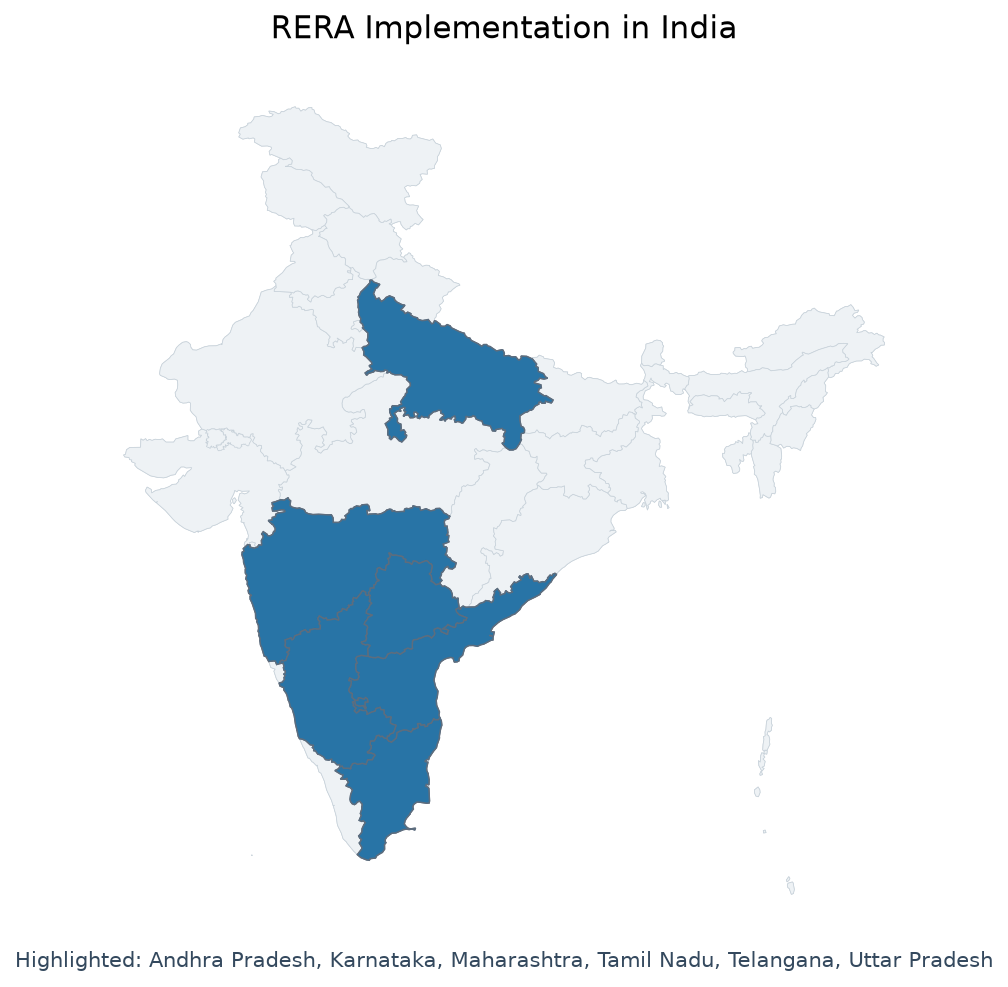
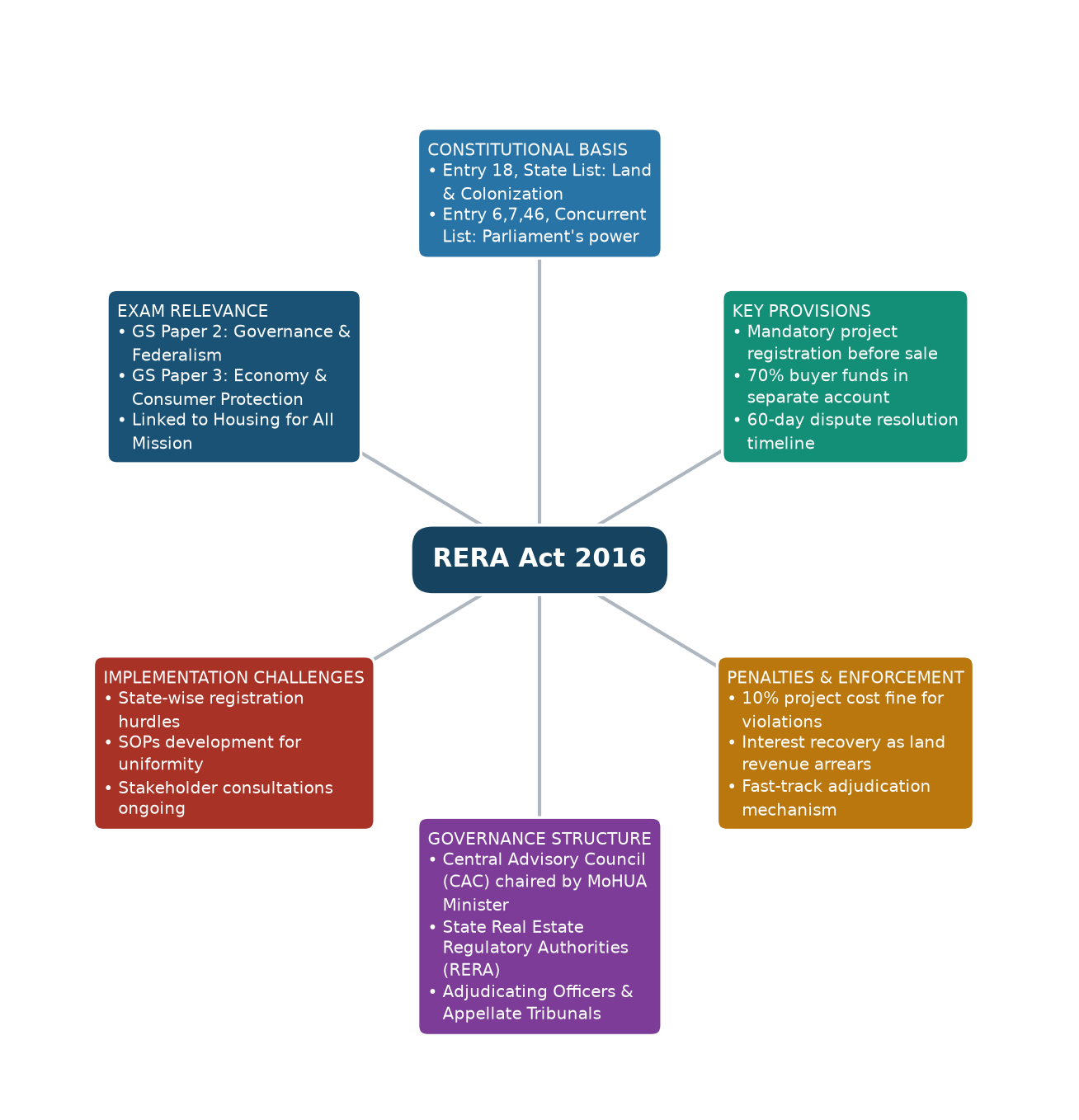
Map & concept mind-map: RERA Implementation in India
Subject Relevance — Where This Topic Fits
- GS Paper II — Constitutional and Non-Constitutional Bodies | GS Paper III — Infrastructure: Issues and Developments | GS Paper III — Government Budgeting and Financial Accountability
- Prelims: RERA, Seventh Schedule, Concurrent List, Entry 6, 7, 46, State List Entry 18 (Land and Colonisation), Homebuyer protection, promoter accountability, Escrow account (70% rule), Fast-track dispute resolution (60-day limit), Central Advisory Council (CAC), Adjudicating Officer, Regulatory Authority, Appellate Tribunal
- Essay: The role of statutory regulation in balancing economic growth and consumer protection, Federalism in India: Centre-State dynamics in policy implementation
Quick Revision: RERA mandates project registration, escrow account compliance (70% rule), and time-bound dispute resolution (60 days) to ensure transparency, accountability, and timely delivery in the real estate sector.
Why is this in the news?
The Ministry of Housing and Urban Affairs has reiterated the implementation status of the Real Estate (Regulation and Development) Act, 2016 (RERA), highlighting recent administrative measures to strengthen its enforcement, including the constitution of a high-level committee to address registration challenges, the development of Standard Operating Procedures (SOPs), and sustained consultations with stakeholders to enhance transparency and accountability in the real estate sector. This renewed emphasis underscores RERA’s critical role in safeguarding homebuyers’ interests amid persistent regulatory and operational hurdles.
Background
- The Constitution of India, through the Seventh Schedule, distributes legislative powers between the Union and the States; ‘land’ and ‘colonisation’ fall under the State List (Entry 18), while ‘contracts’ and ‘property’ are governed by the Concurrent List (Entries 6, 7, and 46), enabling Parliament to legislate on real estate regulation.
- The real estate sector in India has historically been plagued by delays, fund mismanagement, and lack of transparency, leading to widespread grievances among homebuyers against promoters for non-delivery of projects, diversion of funds, and misleading advertisements.
- Prior to RERA, homebuyers had limited legal recourse, relying primarily on civil courts, which resulted in protracted litigation and delayed justice.
- RERA was enacted in 2016 to address these systemic failures by introducing a robust regulatory framework, mandating project registration, financial discipline, and time-bound dispute resolution.
- The Act operationalises the constitutional principle of cooperative federalism, wherein the Union provides a legislative framework while states implement and enforce it through their respective Real Estate Regulatory Authorities (RERAs).
- Recent administrative actions, such as the formation of a committee to resolve registration challenges and the issuance of SOPs, reflect ongoing efforts to refine RERA’s implementation and address operational bottlenecks.
What is the Real Estate (Regulation and Development) Act, 2016 (RERA)?
- RERA is a comprehensive legislation enacted by Parliament under the Concurrent List (Entries 6, 7, and 46) to regulate the real estate sector and protect the interests of homebuyers by ensuring transparency, accountability, and timely delivery of projects.
- The Act mandates the registration of all real estate projects and real estate agents with the State Real Estate Regulatory Authority (RERA) before any advertisement, marketing, booking, or sale can commence, failing which promoters are liable to penalties up to 10% of the project cost.
- Promoters are required to deposit 70% of the funds received from homebuyers into a separate escrow account, which can only be utilised for land acquisition and construction, thereby preventing fund diversion and ensuring financial discipline.
- The Act imposes strict disclosure requirements on promoters, including the publication of all project-related information such as sanctioned plans, layout plans, land title status, and approvals on the RERA website to enhance transparency.
- The Act empowers the Regulatory Authority to impose penalties, including interest, fines, or compensation, which can be recovered as arrears of land revenue, ensuring enforceability of orders.
- A Central Advisory Council (CAC), chaired by the Union Minister of Housing and Urban Affairs, has been constituted under Section 41 to advise the Central Government on matters related to the implementation of RERA, including the protection of homebuyers’ interests and coordination with state governments.
- The Act also promotes cooperative federalism by mandating regular dialogue between the Ministry and state governments to strengthen the functional and administrative autonomy of RERAs and ensure adequate staffing for effective implementation.
Key Features
| Feature | Significance |
|---|---|
| Mandatory registration of real estate projects | Ensures transparency by requiring all projects to be registered with the Regulatory Authority before advertisement, marketing, or sale, preventing fraudulent or incomplete projects from entering the market. |
| 70% of buyer funds in a separate escrow account | Mandates segregation of funds to prevent diversion for unrelated purposes, ensuring financial discipline and reducing the risk of project delays or abandonment. |
| Disclosure of all project-related information | Promotes transparency by requiring promoters to disclose approvals, land titles, layout plans, and completion timelines, empowering buyers to make informed decisions. |
| Fast-track dispute resolution within 60 days | Reduces litigation delays for homebuyers by providing a statutory timeframe for resolving disputes, enhancing legal certainty and trust in the sector. |
| Penalties for non-compliance (up to 10% of project cost) | Acts as a deterrent against violations of RERA provisions, ensuring accountability and compliance with regulatory norms. |
Why it Matters
Economic
- Enhances investor confidence in the real estate sector by reducing information asymmetry and fraudulent practices, thereby attracting institutional investments.
- Stabilizes the housing market by ensuring timely project completion and delivery, reducing speculative bubbles and financial distress for homebuyers.
- Contributes to formalization of the real estate sector, reducing cash transactions and improving tax compliance.
Legal & Regulatory
- Provides a statutory framework for contractual relationships between promoters and homebuyers, reducing disputes and litigation.
- Empowers regulatory authorities with enforcement mechanisms, including penalties, interest recovery, and project cancellation for non-compliance.
- Establishes a centralized advisory mechanism (Central Advisory Council) to guide policy implementation and address systemic challenges.
Social
- Protects homebuyers from exploitation by unscrupulous developers through mandatory disclosures, escrow safeguards, and dispute resolution mechanisms.
- Promotes equitable access to housing by ensuring fair contractual terms and reducing the risk of financial loss for middle- and lower-income groups.
- Enhances consumer trust in the real estate sector, encouraging broader participation in home ownership.
Challenges
1. State-level implementation gaps
- Inconsistent enforcement across states due to varying administrative capacities and political priorities, leading to uneven protection of homebuyers.
- Delays in setting up State Real Estate Regulatory Authorities (RERAs) and appointment of adjudicating officers, undermining the Act’s effectiveness.
- Lack of uniformity in interpretation of RERA provisions, resulting in legal ambiguities and forum shopping by promoters.
UPSC Link: GS-II (Governance)
2. Compliance and monitoring challenges
- Inadequate tracking of funds in escrow accounts, with reports of promoters diverting money for unrelated projects despite regulatory oversight.
- Slow pace of dispute resolution due to limited manpower in RERAs and lack of specialized training for adjudicating officers.
- Resistance from developers’ associations and industry lobbies, which often challenge RERA’s provisions in courts, delaying implementation.
UPSC Link: GS-III (Economy)
3. Awareness and capacity-building deficits
- Low awareness among homebuyers about their rights under RERA, leading to underutilization of dispute resolution mechanisms.
- Insufficient sensitization of state officials and judicial officers on RERA’s provisions, resulting in inconsistent adjudication.
- Limited digital infrastructure for project registration and grievance redressal, particularly in rural and semi-urban areas.
UPSC Link: GS-II (Governance)
4. Jurisdictional and legal ambiguities
- Overlap with other laws (e.g., Insolvency and Bankruptcy Code, Consumer Protection Act) leading to conflicting interpretations and legal conflicts.
- Ambiguity in defining ‘ongoing projects’ and ‘new projects’ under RERA, causing disputes over applicability and transition provisions.
- Lack of clarity on the role of local authorities in approving projects, leading to delays in regulatory approvals.
UPSC Link: GS-II (Governance)
Challenges — UPSC Perspective
| Issue | Concern |
|---|---|
| State-level enforcement inconsistencies | Uneven protection of homebuyers due to varying administrative capacities and political will. |
| Escrow fund diversions | Risk of promoters using buyer funds for unrelated projects despite regulatory safeguards. |
| Slow dispute resolution | Limited manpower and training in RERAs delays justice for homebuyers. |
| Low consumer awareness | Homebuyers unaware of their rights, leading to underutilization of RERA mechanisms. |
| Legal ambiguities | Conflicting interpretations of RERA provisions with other laws, causing disputes. |
| Digital infrastructure gaps | Limited online project registration and grievance redressal in rural areas. |
Way Forward
- Strengthen state-level RERA authorities by increasing manpower, training adjudicating officers, and ensuring timely appointments of regulatory bodies.
- Enhance digital infrastructure for project registration, fund tracking, and grievance redressal to improve transparency and accessibility.
- Conduct nationwide awareness campaigns to educate homebuyers about their rights under RERA and the dispute resolution process.
- Establish a centralized monitoring mechanism to track compliance across states and identify enforcement gaps for corrective action.
- Harmonize interpretations of RERA provisions with other laws (e.g., IBC, Consumer Protection Act) to reduce legal conflicts and ensure consistency.
- Mandate periodic audits of escrow accounts to prevent fund diversions and ensure compliance with RERA’s financial safeguards.
- Encourage state governments to allocate dedicated budgets for RERA implementation, including infrastructure and capacity-building initiatives.
UPSC Value Addition
Keywords for Mains Answer-Writing
Real Estate (Regulation and Development) Act, 2016 (RERA) · Constitutional provisions under Seventh Schedule · Homebuyers’ protection · Regulatory Authority under RERA · Transparency and accountability in real estate · Fast-track dispute resolution mechanism · Central Advisory Council (CAC) under RERA · Role of Ministry of Housing and Urban Affairs · State List vs Concurrent List in land regulation · Financial safeguards for homebuyers
Constitutional & Policy Linkages
- {‘Article 246’: ‘Division of legislative powers (State List Entry 18, Concurrent List Entries 6, 7, 46)’}
- {‘Seventh Schedule’: ‘Distribution of subjects between Union and State governments’}
Concept Flow
Constitutional mandate (Seventh Schedule) → Parliament’s legislative power (Concurrent List) → Enactment of RERA 2016 → Mandatory project registration and escrow norms → Enhanced transparency and accountability → Protection of homebuyers’ interests → Improved investor confidence → Formalization of real estate sector → Economic stability and growth.
Prelims Practice Questions
Q1. Consider the following statements regarding the Real Estate (Regulation and Development) Act, 2016 (RERA):
1. RERA is enacted under the Concurrent List entries 6, 7, and 46 of the Seventh Schedule of the Indian Constitution.
2. The Act mandates that 70% of the funds collected from homebuyers must be deposited in a separate bank account for project completion.
3. RERA allows for the recovery of dues as land revenue under Section 40.
4. The Act does not provide for any penalties for non-compliance by promoters.
How many of the above statements are correct?
- Only one
- Only two
- Only three
- All four
Answer: Only three — Statements 1, 2, and 3 are correct. Statement 4 is incorrect as RERA imposes penalties up to 10% of the project cost for non-compliance.
Q2. Assertion (A): The Real Estate (Regulation and Development) Act, 2016 (RERA) is enacted under the Concurrent List of the Seventh Schedule of the Indian Constitution.
Reason (R): Land and colonisation are subjects under the State List, but RERA regulates contractual relationships between promoters and homebuyers, necessitating parliamentary intervention.
- Both A and R are true, and R is the correct explanation of A.
- Both A and R are true, but R is not the correct explanation of A.
- A is true, but R is false.
- A is false, but R is true.
Answer: Both A and R are true, but R is not the correct explanation of A. — RERA is enacted under Concurrent List entries 6, 7, and 46 to regulate contractual relationships, while land and colonisation remain State subjects.
Q3. Match the following provisions of the Real Estate (Regulation and Development) Act, 2016 (RERA) with their respective sections:
Column I (Provision) | Column II (Section)
———————|——————-
A. Registration of real estate projects | 1. Section 40
B. Fast-track dispute resolution | 2. Section 41
C. Recovery of dues as land revenue | 3. Section 3
D. Central Advisory Council (CAC) | 4. Section 12
- A-3, B-4, C-1, D-2
- A-4, B-3, C-1, D-2
- A-3, B-4, C-2, D-1
- A-4, B-3, C-2, D-1
Answer: A-3, B-4, C-1, D-2 — A-3 (Registration under Section 3), B-4 (Dispute resolution under Section 12), C-1 (Recovery of dues under Section 40), D-2 (CAC under Section 41).
Mains Practice Question
✍ The Real Estate (Regulation and Development) Act, 2016 (RERA) was enacted to address systemic failures in the real estate sector by ensuring transparency, accountability, and timely delivery of projects. Critically examine the constitutional basis of RERA, its key provisions, and the challenges in its implementation. Also, assess the effectiveness of the fast-track dispute resolution mechanism and the role of the Central Advisory Council (CAC) in protecting homebuyers’ interests. (15 Marks)
Approach: MODEL-ANSWER SKELETON:
1. Constitutional Basis (3 Marks):
– Seventh Schedule: State List (Entry 18: land and colonisation) vs Concurrent List (Entries 6, 7, 46: economic and social planning).
– Parliamentary intervention justified under Concurrent List to regulate contractual relationships and protect homebuyers.
– Judicial precedents: *S.R. Bommai v. Union of India* (1994) on federalism and *State of West Bengal v. Union of India* (1995) on Concurrent List powers.
2. Key Provisions (5 Marks):
– Mandatory registration of projects under Section 3; penalties for non-compliance (up to 10% of project cost).
– Financial safeguards: 70% of homebuyer funds in separate escrow account (Section 4(2)(l)(D)).
– Disclosure of project details, approvals, and promoter accountability.
– Fast-track dispute resolution: 60-day timeline for resolution (Section 12).
– Recovery of dues as land revenue (Section 40) and powers of regulatory authorities.
3. Implementation Challenges (4 Marks):
– State-level autonomy vs centralised regulation: delays in setting up State RERA authorities.
– Lack of uniformity in rules across states (e.g., Maharashtra RERA vs Delhi RERA).
– Inadequate staffing and infrastructure for dispute resolution.
– Resistance from developers due to stricter compliance requirements.
– Limited awareness among homebuyers about their rights and grievance redressal mechanisms.
4. Effectiveness of Mechanisms (3 Marks):
– Fast-track dispute resolution: Mixed success; delays persist due to backlog and procedural complexities.
– Central Advisory Council (CAC): Advisory role only; limited executive powers to enforce uniformity.
– Data: As of 2023, ~70,000 projects registered under RERA, but only ~20% disputes resolved within 60 days (NITI Aayog report).
– Homebuyers’ protection: Improved transparency but challenges in enforcement and compensation.
Balance of Views:
– Supporters argue RERA has reduced fraud and delayed projects, citing increased homebuyer confidence.
– Critics highlight implementation gaps, lack of teeth in penalties, and slow judicial processes.
Conclusion: RERA is a progressive step but requires stronger enforcement, state-level coordination, and capacity-building for regulatory authorities to fully realise its objectives.
Source: PIB (Press Information Bureau)
Generated by AanyaAi for educational purpose.

- तमिलनाडु निजी विश्वविद्यालय संशोधन विधेयक 2026: विवाद क्यों? - September 21, 2026
- Tamil Nadu Private Universities Bill 2026: Key Amendments & Controversy Explained for UPSC - September 21, 2026
- स्वच्छ सागर सुरक्षित सागर 5.0: 15 लाख लोगों ने ली महासागर संरक्षण की शपथ, जानें पूरा विवरण - September 21, 2026

No Comments