


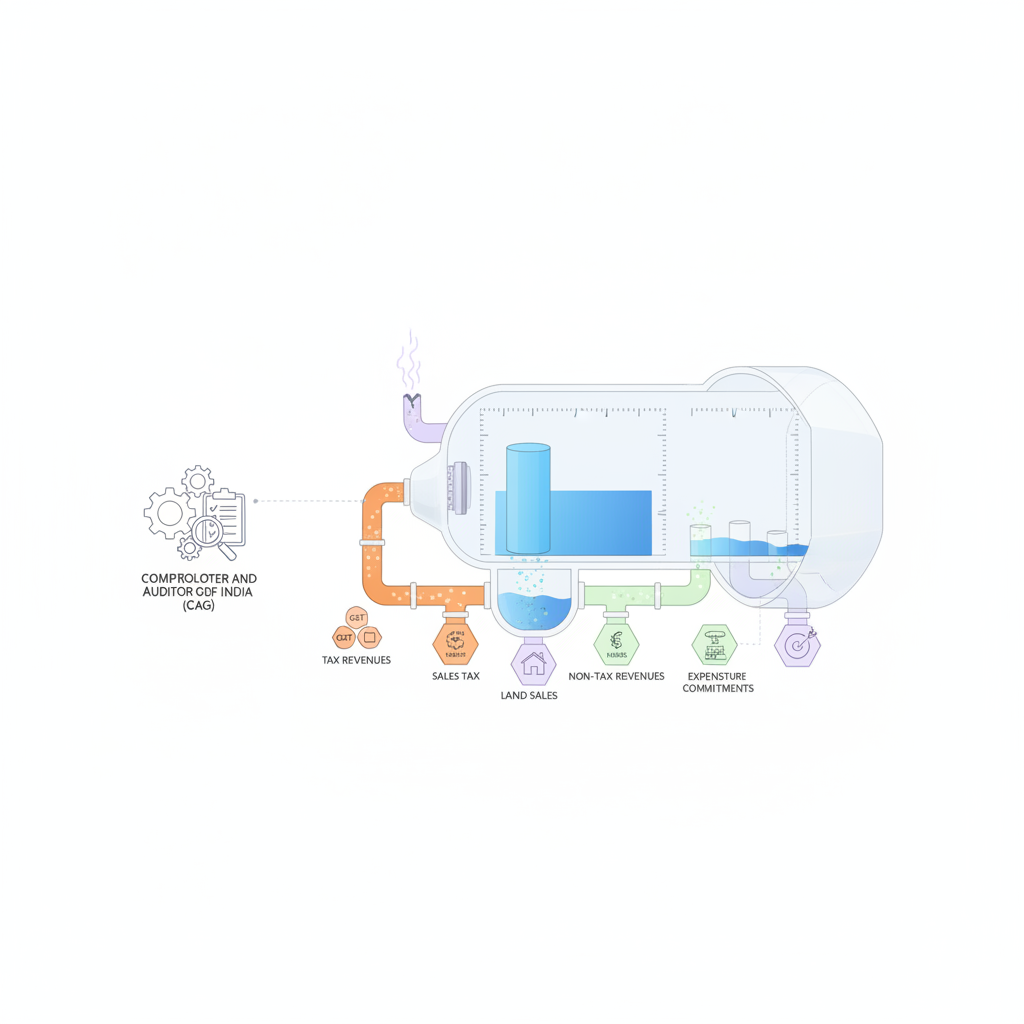
18 Sep Revenue Receipts Lag 32% in Current Fiscal: Key Implications for UPSC Exams
✎ Revenue receipts are the lifeblood of government operations; their shortfall triggers fiscal imbalances, necessitating disciplined tax administration, expenditure rationalisation, and adherence to FRBM norms.
Subject Relevance — Where This Topic Fits
- GS Paper III — Indian Economy: Issues relating to Planning, Mobilisation of Resources, Growth, Development and Employment
- Prelims: Revenue Receipts, Fiscal Deficit, Primary Deficit, Comptroller and Auditor General of India (CAG), Goods and Services Tax (GST), Grants-in-Aid, Fiscal Responsibility and Budget Management (FRBM) Act
- Essay: Fiscal discipline and sustainable public finance
Quick Revision: Revenue receipts are the lifeblood of government operations; their shortfall triggers fiscal imbalances, necessitating disciplined tax administration, expenditure rationalisation, and adherence to FRBM norms.
Why is this in the news?
The article highlights a significant shortfall in revenue receipts for a state government in India, with only 32.14% of the annual target achieved after five months of the financial year. This sluggish revenue mobilisation, particularly in non-tax revenues and grants-in-aid, poses challenges to fiscal sustainability, expenditure commitments, and the achievement of budgetary targets, warranting an analysis of its causes, consequences, and policy responses.
Background
- Revenue receipts constitute the primary source of funds for government operations, excluding borrowings. They include tax revenues (e.g., GST, sales tax, excise duties) and non-tax revenues (e.g., land sales, dividends, fees).
- The Comptroller and Auditor General of India (CAG) monitors fiscal performance through periodic audits, ensuring compliance with budgetary provisions and fiscal rules.
- The Fiscal Responsibility and Budget Management (FRBM) Act, 2003 (amended in 2018), mandates fiscal discipline by setting targets for revenue deficit, fiscal deficit, and debt levels to ensure macroeconomic stability.
- State governments rely heavily on tax devolution from the Union (e.g., share in Union taxes) and grants-in-aid from the Centre, particularly for centrally sponsored schemes and developmental expenditures.
- Public expenditure commitments, such as salaries, pensions, and interest payments, form a significant portion of state budgets, often leading to rigid expenditure patterns.
- Economic slowdowns, structural rigidities in tax administration, and delays in policy implementation can adversely impact revenue mobilisation.
What are Revenue Receipts and Why Do They Matter?
- Revenue receipts are the income generated by the government from its regular operations, excluding borrowings. They are classified into tax revenues (e.g., GST, income tax, excise duties) and non-tax revenues (e.g., dividends, fees, fines, land sales).
- Tax revenues, particularly GST and sales tax, form the bulk of revenue receipts for state governments, reflecting economic activity and consumption patterns.
- Non-tax revenues, including grants-in-aid from the Centre, are critical for funding social sector schemes, infrastructure development, and administrative expenses, but are often volatile and dependent on external factors.
- Revenue receipts are essential for meeting the government’s day-to-day expenditure commitments, such as salaries, pensions, interest payments, and operational costs, without resorting to excessive borrowing.
- A shortfall in revenue receipts can lead to revenue deficits (expenditure exceeding revenue receipts), forcing governments to rely on borrowings or asset sales to bridge the gap, which may compromise long-term fiscal sustainability.
- The FRBM Act and state-level fiscal rules aim to curb revenue deficits by promoting efficient tax administration, broadening the tax base, and rationalising non-essential expenditures.
- Delays in tax collection, economic downturns, or policy implementation gaps (e.g., GST reforms, land revenue reforms) can exacerbate revenue shortfalls, as seen in the current fiscal scenario.
- Monitoring revenue receipts is a key function of the CAG, which audits fiscal performance to ensure transparency, accountability, and adherence to budgetary provisions.
Key Features
| Feature | Significance |
|---|---|
| Revenue Receipts | Primary source of government funding for operational expenditures, including salaries, pensions, and welfare schemes. |
| Tax Revenue | Dominant component of revenue receipts, critical for fiscal sustainability and resource allocation. |
| Non-Tax Revenue | Includes land sales and other miscellaneous receipts, often volatile and dependent on market conditions. |
| Grants-in-Aid | Transfers from the Union government, essential for states with fiscal deficits to meet expenditure commitments. |
| Borrowings and Liabilities | Used to bridge fiscal gaps but increases debt burden and future repayment obligations. |
Why it Matters
Fiscal Management
- Revenue receipts falling short of estimates indicate weaker economic activity or collection inefficiencies, necessitating corrective fiscal measures.
- Underperformance in tax and non-tax revenue receipts may constrain the state’s ability to fund developmental and welfare expenditures.
- High pension and interest payments, consuming a significant portion of revenue, highlight the need for pension reforms and debt restructuring.
- Revenue deficit exceeding budgeted surplus suggests structural fiscal imbalances requiring policy interventions.
Economic Implications
- Sluggish revenue receipts may reduce public investment, impacting economic growth and employment generation.
- Dependence on borrowings for operational expenses could lead to unsustainable debt levels and crowding out of private investment.
- Lower-than-expected GST and sales tax collections may reflect subdued consumption or compliance issues in the tax system.
Policy and Governance
- The state’s ability to meet fiscal targets depends on efficient tax administration, economic revival, and prudent expenditure management.
- Delays in implementing pay revision recommendations or pending dearness allowance instalments exacerbate fiscal pressure.
- Grants-in-aid shortfalls may indicate delays in Union government transfers or non-compliance with central schemes.
Challenges
1. Revenue Collection Shortfalls
- Tax and non-tax revenue collections lagging behind estimates due to economic slowdown or administrative inefficiencies.
- GST and sales tax underperformance may reflect structural issues in tax compliance or consumption patterns.
UPSC Link: GS3: Fiscal Policy; Taxation
2. Fiscal Deficit Management
- Excessive reliance on borrowings to meet expenditure obligations risks long-term debt sustainability.
- Revenue deficit exceeding projections undermines fiscal discipline and macroeconomic stability.
UPSC Link: GS3: Fiscal Policy; Public Finance
3. Expenditure Pressures
- Pension and interest payments consuming a disproportionate share of revenue receipts limit fiscal flexibility.
- Pending dearness allowance instalments and pay revision recommendations add to fiscal strain.
UPSC Link: GS3: Public Finance; Welfare Schemes
4. Grants-in-Aid Shortfalls
- Lower-than-expected transfers from the Union government may disrupt planned expenditures in social sectors.
- Delays in grants disbursement can strain state finances and delay critical developmental projects.
UPSC Link: GS2: Centre-State Relations; Finance Commission
Challenges — UPSC Perspective
| Issue | Concern |
|---|---|
| Tax Revenue Shortfall | Reduced fiscal capacity to fund public services and developmental schemes. |
| Non-Tax Revenue Underperformance | Volatility in land sales and other receipts affects budgetary stability. |
| High Pension and Interest Payments | Limits fiscal space for capital expenditure and welfare initiatives. |
| Grants-in-Aid Delays | Disrupts planned expenditures in education, health, and infrastructure. |
| Borrowing Dependence | Increases debt burden and future repayment obligations, risking fiscal sustainability. |
Way Forward
- Enhance tax administration and compliance mechanisms to improve GST and sales tax collections.
- Rationalise pension and interest payments through structural reforms and debt restructuring.
- Accelerate implementation of pending dearness allowance instalments and pay revision recommendations.
- Strengthen non-tax revenue streams by diversifying sources and improving land monetisation processes.
- Ensure timely disbursement of grants-in-aid by coordinating with the Union government and Finance Commission.
- Conduct a mid-year fiscal review to reallocate resources and prioritise critical expenditures.
- Explore public-private partnerships for revenue generation in infrastructure and service delivery.
UPSC Value Addition
Keywords for Mains Answer-Writing
Revenue receipts · Fiscal management · Budget estimates · Tax revenue · Non-tax revenue · Grants-in-aid · Fiscal deficit · Revenue deficit · Primary deficit · Comptroller and Auditor General of India · Fiscal Responsibility and Budget Management Act · Union and State tax devolution · Public Finance Management · State finances · Expenditure management
Constitutional & Policy Linkages
- [‘Article 293: Borrowing by States’, ‘Fiscal autonomy and debt limits for state governments.’]
- [‘Article 280: Finance Commission’, ‘Determines fiscal transfers and grants-in-aid to states.’]
Concept Flow
Economic slowdown or compliance issues → Lower tax and non-tax revenue collections → Shortfall in revenue receipts → Reduced fiscal capacity to meet expenditure commitments → Increased reliance on borrowings → Higher debt burden and interest payments → Pension and interest payments consuming revenue → Limited fiscal space for development → Grants-in-aid shortfalls → Disruptions in planned social sector expenditures → Revenue deficit exceeding projections → Structural fiscal imbalances → Need for corrective fiscal measures → Policy interventions in tax administration and expenditure management
Prelims Practice Questions
Q1. Consider the following statements regarding revenue receipts in the context of Indian public finance:
1. Revenue receipts include tax revenue, non-tax revenue, and grants-in-aid.
2. Revenue receipts are used to finance capital expenditure.
3. The Comptroller and Auditor General of India (CAG) audits the revenue receipts of the Union and State governments.
How many of the above statements are correct?
- Only one
- Only two
- All
- None
Answer: All — Statement 1 is correct: Revenue receipts comprise tax revenue (e.g., GST, income tax), non-tax revenue (e.g., dividends, fees), and grants-in-aid. Statement 2 is incorrect: Revenue receipts finance revenue expenditure (e.g., salaries, pensions), not capital expenditure. Statement 3 is correct: The CAG audits the accounts of the Union and State governments, including revenue receipts.
Q2. Assertion (A): The Fiscal Responsibility and Budget Management (FRBM) Act, 2003 mandates that the Union government must maintain a revenue deficit of zero by 2023.
Reason (R): The FRBM Act was amended in 2018 to relax the fiscal deficit targets due to economic slowdowns and the need for increased public expenditure.
- Both A and R are true, and R is the correct explanation of A
- Both A and R are true, but R is not the correct explanation of A
- A is true, but R is false
- A is false, but R is true
Answer: ? — Assertion (A) is false: The FRBM Act does not mandate a zero revenue deficit by 2023; it sets targets for fiscal deficit and revenue deficit reduction but allows flexibility. Reason (R) is true: The FRBM Act was amended in 2018 to provide more flexibility in fiscal deficit targets due to economic challenges.
Q3. Match the following heads of revenue receipts with their primary sources:
Column I (Head of Revenue Receipt) | Column II (Primary Source)
———————————–|———————————-
A. Goods and Services Tax (GST) | 1. Dividends from public sector undertakings
B. Non-tax revenue | 2. Devolution from the Union government
C. Grants-in-aid | 3. Tax on goods and services
D. State’s share of Union taxes | 4. Transfers from the Union government for specific schemes
- A-3, B-1, C-4, D-2
- A-2, B-1, C-3, D-4
- A-3, B-4, C-1, D-2
- A-1, B-3, C-2, D-4
Answer: A-3, B-1, C-4, D-2 — A. Goods and Services Tax (GST) is a tax on goods and services (Column I-A matches Column II-3). B. Non-tax revenue includes dividends, fees, and fines (Column I-B matches Column II-1). C. Grants-in-aid are transfers from the Union government for specific schemes (Column I-C matches Column II-4). D. State’s share of Union taxes is a devolution of tax revenue from the Union to the State (Column I-D matches Column II-2).
Mains Practice Question
✍ The sluggish performance of revenue receipts vis-à-vis budget estimates poses significant challenges to fiscal management in Indian states. Critically examine the implications of this trend for public finance, with particular reference to the principles of fiscal federalism and the Fiscal Responsibility and Budget Management (FRBM) Act. Also, outline the role of the Comptroller and Auditor General of India (CAG) in ensuring fiscal accountability. (15 Marks)
Approach: MODEL-ANSWER SKELETON:
1. **Introduction (2 marks)**: Define revenue receipts and their components (tax revenue, non-tax revenue, grants-in-aid). Highlight the constitutional framework of fiscal federalism (Articles 279A, 280, 293) and the FRBM Act’s objectives (targets for fiscal deficit, revenue deficit, and debt).
2. **Implications of Sluggish Revenue Receipts (5 marks)**:
– **Fiscal Federalism**: Reduced revenue receipts strain states’ ability to meet expenditure commitments, undermining cooperative federalism. Cite the 15th Finance Commission’s recommendations on tax devolution and grants-in-aid.
– **FRBM Compliance**: Slippage in revenue receipts may lead to higher fiscal deficits, violating FRBM targets. Discuss the 2018 amendments to FRBM and their impact on fiscal discipline.
– **Expenditure Management**: Compulsory expenditures (e.g., salaries, pensions, interest payments) consume a larger share of revenue, crowding out developmental spending. Reference the data on pensions and interest payments in the given story.
– **Debt Sustainability**: Lower revenue receipts may force states to borrow more, increasing debt-to-GDP ratios and raising concerns about debt sustainability.
3. **Role of CAG (4 marks)**:
– **Audit Mandate**: CAG audits the accounts of the Union and State governments (Article 148) and reports on the receipts and expenditures under Article 151.
– **Fiscal Accountability**: CAG’s reports on revenue receipts highlight deviations from budget estimates, ensuring transparency and accountability (e.g., CAG’s audit of GST collections).
– **Recommendations**: CAG’s observations often lead to corrective measures, such as improving tax administration or rationalizing non-tax revenue sources.
4. **Way Forward (4 marks)**:
– **Revenue Enhancement**: Strengthen tax administration (e.g., GST reforms, widening the tax base), and diversify non-tax revenue sources (e.g., asset monetization, user charges).
– **Fiscal Reforms**: Align FRBM targets with economic realities, and adopt medium-term fiscal frameworks to improve predictability.
– **Institutional Mechanisms**: Strengthen the role of State Finance Commissions and local bodies in revenue mobilization.
– **Data Transparency**: Improve the timeliness and accuracy of revenue data to enable better fiscal planning.
Balance of views: Acknowledge that while fiscal discipline is essential, rigid adherence to FRBM targets during economic downturns may require flexibility to support growth.
Source: The Hindu
Generated by AanyaAi for educational purpose.
Related guides on our sites
- Current affairs for upsc 2026
- Best economics optional coaching for upsc
- Best economics optional teacher for upsc
- How to prepare for GS paper 1 for UPSC CSE mains exam

- Revenue Receipts Lag 32% in Current Fiscal: Key Implications for UPSC Exams - September 18, 2026
- यूपी सीएम योगी और केंद्रीय पर्यावरण मंत्री की बैठक: एनसीआर प्रदूषण नियंत्रण पर ध्यान - September 18, 2026
- Yogi Adityanath, Union Minister discuss NCR pollution plan: Key focus areas - September 18, 2026

No Comments