


05 Aug Rijiju-Rahul meet to break Parliament deadlock: Key updates for UPSC
✎ The Foreign Contribution (Regulation) Amendment Bill, 2026, aims to tighten regulations on foreign funding in India, enhancing transparency and national security, but risks stifling legitimate civil society activities if…
Subject Relevance — Where This Topic Fits
- GS Paper II — Parliament and State Legislatures — Structure, Functioning, Conduct of Business, Powers & Privileges and Issues Arising Out of these | GS Paper II — Role of Opposition Parties in Indian Democracy | GS Paper IV — Ethical Issues in Governance: Disruption of Parliamentary Proceedings and Democratic Accountability
- Prelims: Lok Sabha, Rajya Sabha, Monsoon Session, Question Hour, Zero Hour, Delimitation Commission, Foreign Contribution (Regulation) Act (FCRA), Women’s Reservation Bill, Parliamentary Privileges, Adjournment Motion, Leader of Opposition, Parliamentary Affairs Minister
- Essay: Parliamentary democracy in India: Challenges of legislative productivity and institutional credibility, The role of opposition in a parliamentary system: Between disruption and constructive engagement
Quick Revision: The Foreign Contribution (Regulation) Amendment Bill, 2026, aims to tighten regulations on foreign funding in India, enhancing transparency and national security, but risks stifling legitimate civil society activities if provisions are overly restrictive.
Why is this in the news?
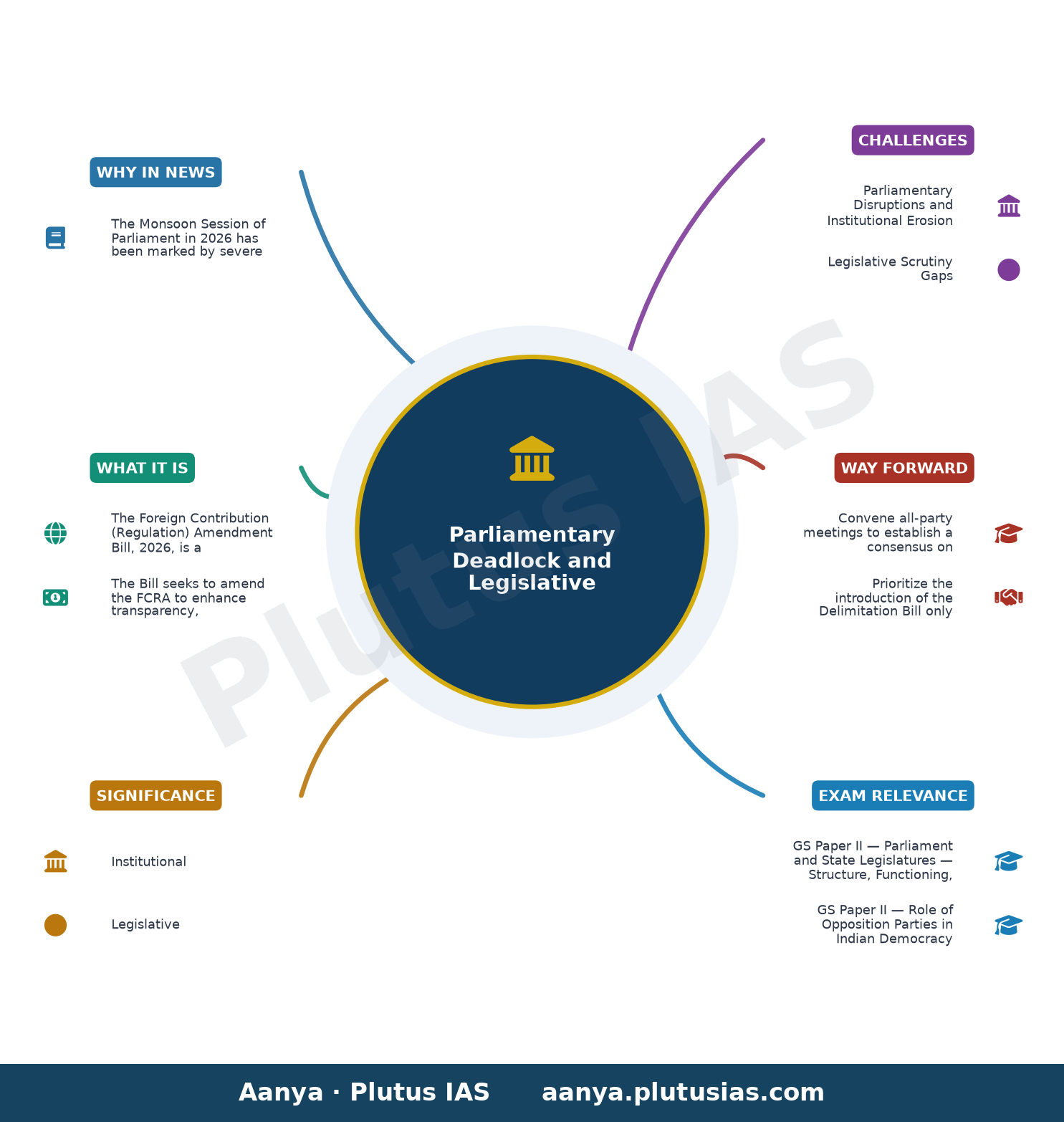
The Monsoon Session of Parliament in 2026 has been marked by severe disruptions, including repeated adjournments of the Lok Sabha, failure to conduct Question Hour, and the passage of five bills without discussion. This deadlock has intensified political tensions, with Opposition leaders demanding statements from the Prime Minister and Home Minister, and the government engaging in high-level parleys to restore legislative functioning. The impasse centres on issues such as police action during a protest, and opposition to the Delimitation Bill and FCRA Amendment Bill, raising concerns about democratic norms and institutional credibility.
Background
- The Monsoon Session of Parliament, which began on July 20, 2026, has been disrupted repeatedly due to Opposition protests, leading to the adjournment of the Lok Sabha on multiple occasions.
- The Opposition has demanded statements from the Prime Minister and Union Home Minister on alleged police excesses during a protest at Jantar Mantar on July 20, 2026.
- Five bills have been passed without discussion in the Lok Sabha, highlighting the breakdown of parliamentary deliberation and scrutiny.
- The government has proposed the Foreign Contribution (Regulation) Amendment Bill, 2026, which seeks to amend the FCRA, 2010, and is expected to be discussed by the Home Minister in the coming days.
- The Opposition has also raised concerns over the proposed Delimitation Bill, which could potentially alter the electoral map of the country, and the long-pending Women’s Reservation Amendment Bill, which remains pending despite constitutional provisions for reservation in legislatures.
- Parliamentary Affairs Minister Kiren Rijiju held a meeting with Leader of Opposition Rahul Gandhi to break the logjam, indicating high-level efforts to restore legislative functioning.
What is the Foreign Contribution (Regulation) Amendment Bill, 2026?
- The Foreign Contribution (Regulation) Amendment Bill, 2026, is a proposed amendment to the Foreign Contribution (Regulation) Act (FCRA), 2010, which regulates the acceptance and utilisation of foreign contributions by individuals, associations, and companies in India.
- The Bill seeks to amend the FCRA to enhance transparency, accountability, and national security by imposing stricter conditions on the receipt and utilisation of foreign funds, particularly by non-governmental organisations (NGOs) and other entities.
- Key provisions likely include stricter reporting requirements, a reduction in the administrative expenses that can be incurred from foreign contributions, and enhanced powers for the government to cancel or suspend FCRA registrations in case of violations.
- The Bill is part of a broader effort by the government to regulate foreign funding and prevent misuse, particularly in the context of national security and sovereignty.
- The FCRA was originally enacted in 1976 and has been amended several times, most recently in 2020, to tighten regulations on foreign funding and enhance oversight by the Ministry of Home Affairs.
- The Bill is expected to be discussed in Parliament following the Home Minister’s intervention, as part of efforts to break the legislative deadlock.
- The Bill has been criticised by civil society organisations and opposition parties, who argue that it could stifle legitimate foreign funding for social and developmental activities, particularly in areas such as human rights, environmental conservation, and public health.
Key Features
| Feature | Significance |
|---|---|
| Parliamentary Deadlock | Undermines legislative productivity, delays policy implementation, and erodes public trust in democratic institutions. |
| Delimitation Bill | Impacts electoral representation, demographic balance, and political power distribution across states. |
| Foreign Contribution (Regulation) Amendment Bill, 2026 | Aims to regulate foreign funding of NGOs, ensuring transparency and national security while balancing civil society engagement. |
| Question Hour Disruptions | Hinders accountability, delays legislative scrutiny, and obstructs the government’s ability to address public grievances. |
| Opposition Protests | Highlights institutional distrust, amplifies political polarization, and signals governance challenges ahead of elections. |
Why it Matters
Institutional
- The deadlock reflects a crisis of parliamentary functioning, where legislative business is stalled due to political disagreements, undermining the core mandate of Parliament as the supreme law-making body.
- Repeated adjournments and disruptions in the Monsoon Session indicate a systemic erosion of decorum, which is essential for constructive debate and consensus-building in a parliamentary democracy.
- The Speaker’s intervention underscores the role of the presiding officer in maintaining order, though it also highlights the limits of institutional mechanisms in resolving deep-seated political conflicts.
Legislative
- The absence of Question Hour for an entire session deprives MPs of their constitutional right to seek accountability from the executive, thereby weakening parliamentary oversight.
- The passage of five Bills without discussion raises concerns about the quality of legislation, as scrutiny and debate are critical to ensuring that laws align with constitutional principles and public interest.
- The proposed Delimitation Bill, if introduced, could have far-reaching implications for electoral representation, particularly in states with significant demographic shifts.
Political
- The meeting between Rijiju and Rahul Gandhi signals an attempt to bridge the gap between the ruling dispensation and the Opposition, but the lack of immediate resolution suggests entrenched political differences.
- The Opposition’s protest march and demands for statements from the Prime Minister and Home Minister reflect a broader narrative of institutional confrontation, which could escalate ahead of the 2029 general elections.
- The BJP’s internal interactions with MPs, such as the breakfast meeting hosted by the Prime Minister, indicate efforts to consolidate party cohesion amid external pressures.
Constitutional
- The disruption of parliamentary proceedings raises questions about the balance between parliamentary privileges and the need for decorum, as enshrined in Article 105 of the Constitution.
- The Opposition’s demand for statements from the Prime Minister and Home Minister touches upon the principle of ministerial responsibility under Article 75(3), which requires the executive to be accountable to Parliament.
Challenges
1. Parliamentary Disruptions and Institutional Erosion
- Repeated adjournments and disruptions obstruct legislative business, delaying critical reforms and policy decisions.
- The erosion of parliamentary decorum undermines public confidence in democratic institutions and the rule of law.
- The lack of consensus-building mechanisms exacerbates political polarization, making governance increasingly difficult.
UPSC Link: Parliamentary functioning and constitutional provisions
2. Legislative Scrutiny Gaps
- The passage of Bills without discussion compromises the quality of legislation, as scrutiny and debate are essential for ensuring constitutional validity and public interest alignment.
- The absence of Question Hour deprives MPs of their constitutional right to hold the executive accountable, weakening parliamentary oversight.
- The lack of deliberation on key Bills, such as the Delimitation Bill, risks unintended consequences for electoral representation and demographic balance.
UPSC Link: Parliamentary scrutiny and legislative process
3. Political Polarization and Opposition Strategy
- The Opposition’s protest strategies, including marches and sloganeering, reflect a broader narrative of institutional confrontation, which could escalate ahead of elections.
- The demand for statements from the Prime Minister and Home Minister highlights the Opposition’s attempt to leverage parliamentary platforms for political messaging.
- The lack of immediate resolution in meetings between the ruling party and Opposition suggests entrenched political differences that are difficult to bridge.
UPSC Link: Political parties and parliamentary democracy
4. Executive-Legislative Relations
- The deadlock underscores the tension between the executive and legislative branches, particularly in a parliamentary system where the executive is drawn from and accountable to the legislature.
- The Opposition’s demand for statements from the Prime Minister and Home Minister raises questions about the balance between executive authority and parliamentary accountability.
- The lack of constructive engagement between the ruling party and Opposition risks undermining the stability and effectiveness of governance.
UPSC Link: Separation of powers and parliamentary accountability
5. Electoral Representation and Delimitation
- The proposed Delimitation Bill, if introduced, could have significant implications for electoral representation, particularly in states with demographic shifts.
- The lack of deliberation on the Delimitation Bill risks unintended consequences for political power distribution and demographic balance.
- The Opposition’s focus on the Delimitation Bill highlights its strategic importance in shaping electoral outcomes ahead of future elections.
UPSC Link: Delimitation and electoral reforms
Challenges — UPSC Perspective
| Issue | Concern |
|---|---|
| Parliamentary Deadlock | Delays legislative business, undermines accountability, and erodes public trust in democratic institutions. |
| Lack of Question Hour | Denies MPs the constitutional right to seek accountability from the executive, weakening parliamentary oversight. |
| Passage of Bills Without Discussion | Compromises the quality of legislation due to lack of scrutiny and debate, risking unintended consequences. |
| Opposition Protests | Amplifies political polarization and institutional confrontation, potentially escalating ahead of elections. |
| Delimitation Bill | Raises concerns about electoral representation and demographic balance if introduced without deliberation. |
| Executive-Legislative Tensions | Undermines the stability and effectiveness of governance in a parliamentary system. |
Way Forward
- Convene all-party meetings to establish a consensus on parliamentary decorum and the conduct of legislative business.
- Prioritize the introduction of the Delimitation Bill only after extensive consultations with stakeholders and Opposition parties to ensure transparency and public buy-in.
- Restore Question Hour in the next session to enable MPs to hold the executive accountable and restore parliamentary oversight.
- Establish a parliamentary committee to review the functioning of the Monsoon Session and recommend reforms to prevent future disruptions.
- Encourage informal dialogues between the ruling party and Opposition to bridge political divides and foster consensus on key legislative issues.
- Strengthen institutional mechanisms, such as the Speaker’s powers, to enforce decorum and ensure constructive debate in Parliament.
- Address the Opposition’s demands for statements from the Prime Minister and Home Minister through formal parliamentary channels to reduce institutional confrontation.
- Enhance transparency in the legislative process by ensuring that all Bills are subjected to rigorous scrutiny and public consultation before passage.
UPSC Value Addition
Keywords for Mains Answer-Writing
Parliamentary deadlock · Delimitation Bill · Foreign Contribution Regulation Act (FCRA) · Parliamentary procedures · Opposition-Parliament relations · Monsoon Session 2026 · Speaker’s role in maintaining decorum · Women’s Reservation Amendment Bill · Parliamentary Affairs Minister · Leader of Opposition · Parliamentary sovereignty · Legislative gridlock · Parliamentary ethics · Parliamentary committees · Constitutional provisions on parliamentary proceedings
Concept Flow
Political disagreements over the Delimitation Bill and FCRA Amendment → Opposition protests and sloganeering → Disruptions in parliamentary proceedings → Adjournment of Lok Sabha without legislative business → Meeting between Rijiju and Rahul Gandhi to break logjam → Potential intervention by Home Minister Shah on FCRA Bill → Continuation of institutional confrontation and governance challenges
Prelims Practice Questions
Q1. Consider the following statements regarding the Foreign Contribution (Regulation) Amendment Bill, 2026:
1. The Bill seeks to amend the Foreign Contribution (Regulation) Act, 2010.
2. It proposes to prohibit public servants from receiving foreign contributions.
3. The Bill mandates that all foreign contributions must be routed through the State Bank of India.
How many of the above statements are correct?
- Only one
- Only two
- All
- None
Answer: All — Statements 1 and 2 are correct as per the FCRA framework and the proposed amendments. Statement 3 is incorrect because the Bill does not mandate routing through SBI exclusively; it may involve designated banks.
Q2. Assertion (A): The Speaker of the Lok Sabha has the power to adjourn the House sine die under the Constitution of India.
Reason (R): The Constitution grants the Speaker the authority to decide on the adjournment of the House as part of parliamentary procedures.
In the context of the above two statements, which one of the following is correct?
- Both A and R are true, and R is the correct explanation of A
- Both A and R are true, but R is not the correct explanation of A
- A is true, but R is false
- A is false, but R is true
Answer: Both A and R are true, but R is not the correct explanation of A — The Speaker indeed has the constitutional power to adjourn the House sine die (indefinitely), and the reason correctly explains the assertion under Article 93 and Rules of Procedure.
Q3. Match the following parliamentary terms with their correct descriptions:
Column I (Term)
A. Delimitation
B. Question Hour
C. Zero Hour
D. Calling Attention
Column II (Description)
1. Time allocated for members to raise matters of urgent public importance without prior notice.
2. Process of redrawing boundaries of electoral constituencies.
3. Period during which ministers answer questions raised by members.
4. Procedure to draw the attention of the House to a matter of public importance.
Select the correct match:
- A-2, B-3, C-1, D-4; A-3, B-2, C-4, D-1; A-1, B-4, C-2, D-3; A-4, B-1, C-3, D-2
- answer_ixs_ixs_ixs_ixs_ixs_ixs_ixs_ixs_ixs_ixs_ixs_ixs_ixs_0
- explain_ixs_ixs_ixs_ixs_ixs_ixs_ixs_ixs_ixs_ixs_ixs_ixs_0
- format_ixs_ixs_ixs_ixs_ixs_ixs_ixs_ixs_ixs_ixs_0
Answer: A-2, B-3, C-1, D-4; A-3, B-2, C-4, D-1; A-1, B-4, C-2, D-3; A-4, B-1, C-3, D-2 — A-2 (Delimitation is the process of redrawing constituency boundaries), B-3 (Question Hour is the time for ministers to answer questions), C-1 (Zero Hour is for raising matters of urgent public importance without notice), D-4 (Calling Attention is to draw attention to a matter of public importance).
Mains Practice Question
✍ The disruption of parliamentary proceedings during the Monsoon Session 2026 reflects deeper structural and ethical challenges in India’s legislative process. Critically analyse the causes of such disruptions and evaluate the role of the Speaker in maintaining parliamentary decorum. Also, examine the implications of repeated adjournments on the legislative output and democratic accountability. (15 Marks)
Approach: MODEL-ANSWER SKELETON:
1. **Causes of Parliamentary Disruptions** (4 points, 60 words):
– Political polarization and adversarial politics (e.g., Opposition-Centre tensions over FCRA, police action on protests).
– Lack of consensus on key bills (Delimitation Bill, Women’s Reservation Amendment Bill) leading to Opposition obstruction.
– Institutional distrust (e.g., allegations of executive overreach, demands for PM/Union Home Minister statements).
– Public mobilisation outside Parliament (e.g., protests at Jantar Mantar, sloganeering) influencing legislative behaviour.
2. **Role of the Speaker in Maintaining Decorum** (3 points, 45 words):
– Constitutional mandate under Article 93 and Rules of Procedure to ensure orderly conduct.
– Powers to name members, suspend proceedings, or adjourn sine die (e.g., Speaker Om Birla’s admonitions during the session).
– Limitations: Speaker’s impartiality often questioned in polarized contexts; reliance on consensus-building over coercion.
3. **Implications of Repeated Adjournments** (4 points, 60 words):
– **Legislative Output**: Five bills passed without discussion undermines deliberative democracy (e.g., FCRA Amendment Bill 2026).
– **Democratic Accountability**: Absence of Question Hour and Zero Hour reduces parliamentary scrutiny of executive actions.
– **Public Trust**: Erosion of faith in institutions due to perceived dysfunction (e.g., Opposition’s demand for PM statements).
– **Precedent**: Normalisation of disruptions risks institutional decay (e.g., comparison with 2010-2020 trends in parliamentary productivity).
4. **Way Forward** (3 points, 30 words):
– Strengthening parliamentary committees for pre-legislative scrutiny (e.g., Department-related Standing Committees).
– Institutionalising consensus-building mechanisms (e.g., all-party meetings before sessions).
– Media and civil society role in holding both sides accountable for disruptions.
Source: Times of India
Generated by AanyaAi for educational purpose.

- मुख्यमंत्री माझी बोले, शिक्षकों की समस्याओं पर त्रिपाठी पैनल की रिपोर्ट के बाद होगी निर्णय - September 21, 2026
- Odisha CM Majhi to Decide on Teachers’ Issues via Tripathy Panel Report - September 21, 2026
- एनएससी ने हरियाणा में कुरुक्षेत्र आईटीआई क्लस्टर के लिए ₹320 करोड़ मंजूर किए, जिंदल नवीन साझेदार - September 21, 2026

No Comments