


11 Sep Russia Showcases Cultural Heritage at BRICS Summit 2026 in Delhi
✎ Cultural diplomacy at BRICS Summits enhances soft power and fosters mutual understanding through art, music, and traditional crafts, complementing economic and political cooperation.
Subject Relevance — Where This Topic Fits
- GS Paper II — International Relations: Multilateral Organisations, Cultural Diplomacy, Soft Power | GS Paper II — International Relations: Bilateral and Regional Groupings, BRICS | GS Paper III — Economy: International Trade Fairs, Technology Transfer
- Prelims: BRICS, Cultural Diplomacy, Soft Power, Fedoskino Miniatures, Gzhel Ceramics, Balalaika, Nevalyashka, INNOPROM India, BRICS Symphony Orchestra
- Essay: The Role of Cultural Diplomacy in Strengthening Multilateral Alliances, Soft Power and International Relations: A Case Study of BRICS
Quick Revision: Cultural diplomacy at BRICS Summits enhances soft power and fosters mutual understanding through art, music, and traditional crafts, complementing economic and political cooperation.
Why is this in the news?
The 18th BRICS Summit in New Delhi (September 2026) has provided a platform for Russia to showcase its cultural heritage through art, music, and traditional crafts, demonstrating the role of cultural diplomacy in multilateral engagements. This initiative, including exhibitions of Fedoskino miniatures, Gzhel ceramics, and performances by the BRICS Symphony Orchestra, underscores the convergence of tradition and modernity in international relations.
Background
- The BRICS grouping, comprising Brazil, Russia, India, China, and South Africa, was established in 2006 to promote economic cooperation, political dialogue, and people-to-people exchanges among member states.
- Cultural diplomacy, as a tool of foreign policy, leverages art, music, and heritage to foster mutual understanding and strengthen bilateral and multilateral ties.
- Russia has historically employed cultural diplomacy as a means to project its soft power, particularly through traditional art forms, music, and technological exhibitions.
- The International Industrial Trade Fair ‘INNOPROM India’ (September 9–11, 2026) aligns with the summit’s objectives by promoting industrial collaboration and technological exchange among BRICS nations.
- The BRICS Run & Ride event (August 30, 2026) symbolised the grouping’s commitment to health, fitness, and inclusive participation, reflecting broader socio-economic priorities.
What is the significance of Russia’s cultural engagement at the BRICS Summit?
- Russia’s cultural showcases at the BRICS Summit, including Fedoskino miniatures and Gzhel ceramics, highlight traditional Russian art forms that have been preserved through generations, thereby promoting inter-cultural appreciation.
- The nevalyashka doll, a traditional Russian tumbler toy, has been reimagined in an Indian context (e.g., draped in a saree), symbolising cross-cultural adaptation and the fusion of heritage with contemporary expressions.
- The BRICS Symphony Orchestra, featuring Russian folk instruments like the balalaika, domra, and bayan, represents a collaborative effort to blend diverse musical traditions, reinforcing the grouping’s cultural synergy.
- The BRICS mural project, involving Russian artists, serves as a visual metaphor for the unity and diversity of member states, aligning with the summit’s theme of inclusive multilateralism.
- The International Industrial Trade Fair ‘INNOPROM India’ underscores Russia’s emphasis on technological collaboration, particularly in sectors like medical equipment and robotics, aligning with BRICS’s economic agenda.
- Cultural diplomacy in multilateral forums like BRICS enhances soft power, fosters trust, and creates avenues for people-to-people exchanges, thereby complementing traditional diplomatic and economic engagements.
- Such initiatives also provide platforms for artisans, musicians, and entrepreneurs to showcase their work, thereby supporting cultural preservation and economic opportunities within member states.
- The BRICS Run & Ride event, with participation from diplomats and fitness enthusiasts, reflects the grouping’s commitment to health, wellness, and inclusive public engagement.
Key Features
| Feature | Significance |
|---|---|
| Nevalyashka doll (Russian tumbler toy) | Symbolises cross-cultural exchange and soft power diplomacy through traditional art forms. |
| Fedoskino miniatures | Demonstrates Russian decorative artistry and precision, fostering cultural appreciation among BRICS members. |
| Gzhel ceramic painting | Showcases Russian folk art traditions, providing hands-on cultural engagement for summit participants. |
| BRICS Symphony Orchestra | Reinforces cultural diplomacy via traditional Russian instruments (balalaika, domra, bayan) and international collaboration. |
| International Industrial Trade Fair ‘INNOPROM. India’ | Highlights technological collaboration and industrial partnerships between Russian and Indian enterprises ahead of the BRICS Summit. |
Why it Matters
Diplomatic and Soft Power Significance
- Demonstrates BRICS’s emphasis on cultural and people-to-people exchanges as a pillar of multilateral cooperation.
- Enhances India’s role as a host nation by showcasing its ability to integrate diverse cultural expressions within a multilateral framework.
- Promotes mutual understanding among BRICS member states through shared artistic and technological heritage.
- Reinforces the summit’s theme of inclusivity and collaboration beyond purely economic or political agendas.
Economic Significance
- Facilitates trade and technological partnerships via the ‘INNOPROM. India’ fair, aligning with BRICS’s economic cooperation goals.
- Showcases Russia’s advanced sectors such as medical equipment and robotics, potentially expanding bilateral trade opportunities.
- Encourages industrial collaboration, which may lead to joint ventures or technology transfer between Russian and Indian firms.
Cultural Diplomacy
- Leverages traditional art forms (e.g., Fedoskino miniatures, Gzhel) to project cultural richness and foster goodwill among BRICS nations.
- Uses music and visual arts (BRICS mural, Symphony Orchestra) to create a shared narrative of cultural synergy.
- Provides a platform for Russian artists to engage with Indian audiences, strengthening cultural ties.
Challenges
1. Cultural Integration Challenges
- Ensuring equitable representation of all BRICS member states’ cultural expressions without favouring one over others.
- Balancing the showcasing of traditional art forms with modern interpretations to appeal to diverse audiences.
- Overcoming language and logistical barriers in organising cross-cultural events and exhibitions.
UPSC Link: GS Paper 2: International Relations – Soft Power and Cultural Diplomacy
2. Economic and Trade Barriers
- Addressing regulatory and tariff disparities between Russia and India that may hinder seamless trade during the fair.
- Ensuring the visibility and accessibility of the ‘INNOPROM. India’ fair to attract maximum participation from both public and private sectors.
- Mitigating supply chain disruptions that could affect the display and demonstration of technological products.
UPSC Link: GS Paper 3: Economy – Bilateral Trade and Investment
3. Logistical and Security Concerns
- Managing large-scale public events (e.g., BRICS Run & Ride) with stringent security protocols to ensure participant safety.
- Coordinating between multiple stakeholders (government agencies, private organisers, international participants) for smooth event execution.
UPSC Link: GS Paper 3: Disaster Management and Security
4. Sustainability of Cultural Exchanges
- Ensuring that the cultural exchanges initiated during the summit translate into long-term collaborations or institutional partnerships.
- Avoiding superficial engagement by fostering deeper, sustained cultural diplomacy beyond the event.
UPSC Link: GS Paper 2: International Organisations – Role of Cultural Exchanges
Challenges — UPSC Perspective
| Issue | Concern |
|---|---|
| Representation Equity | Risk of overemphasising Russian cultural elements at the expense of other BRICS members. |
| Language and Communication | Potential barriers in conveying the significance of art forms and technological products to diverse audiences. |
| Regulatory Hurdles | Trade and customs regulations may complicate the smooth conduct of the industrial fair. |
| Security Management | Large-scale public events require robust planning to prevent disruptions or security incidents. |
| Sustainability of Initiatives | Ensuring that cultural and economic collaborations initiated during the summit endure beyond the event. |
| Logistical Coordination | Managing multiple events across different venues with diverse requirements. |
Way Forward
- Establish a dedicated BRICS Cultural Exchange Secretariat to institutionalise ongoing cultural diplomacy beyond summits.
- Create a digital repository of BRICS cultural artefacts and traditional art forms to facilitate virtual exchanges.
- Encourage joint research and development projects between Russian and Indian firms showcased at ‘INNOPROM. India’ to foster innovation.
- Develop a BRICS Youth Cultural Ambassador Programme to sustain long-term cultural engagement among member states.
- Strengthen bilateral trade agreements to reduce regulatory barriers for future industrial collaborations.
- Incorporate cultural diplomacy modules in BRICS working groups to ensure continuity in soft power initiatives.
- Enhance public-private partnerships to sustain the momentum of cultural and economic exchanges post-summit.
- Document and analyse the outcomes of the summit’s cultural and trade initiatives to inform future BRICS agendas.
UPSC Value Addition
Keywords for Mains Answer-Writing
BRICS Summit 2026 · soft power diplomacy · cultural diplomacy · multilateralism · international trade fairs · INNOPROM India · BRICS Symphony Orchestra · Fedoskino miniatures · Gzhel ceramics · balalaika and domra · nevalyashka doll · BRICS Run & Ride · public diplomacy · people-to-people exchanges · BRICS institutional architecture · cross-cultural heritage
Concept Flow
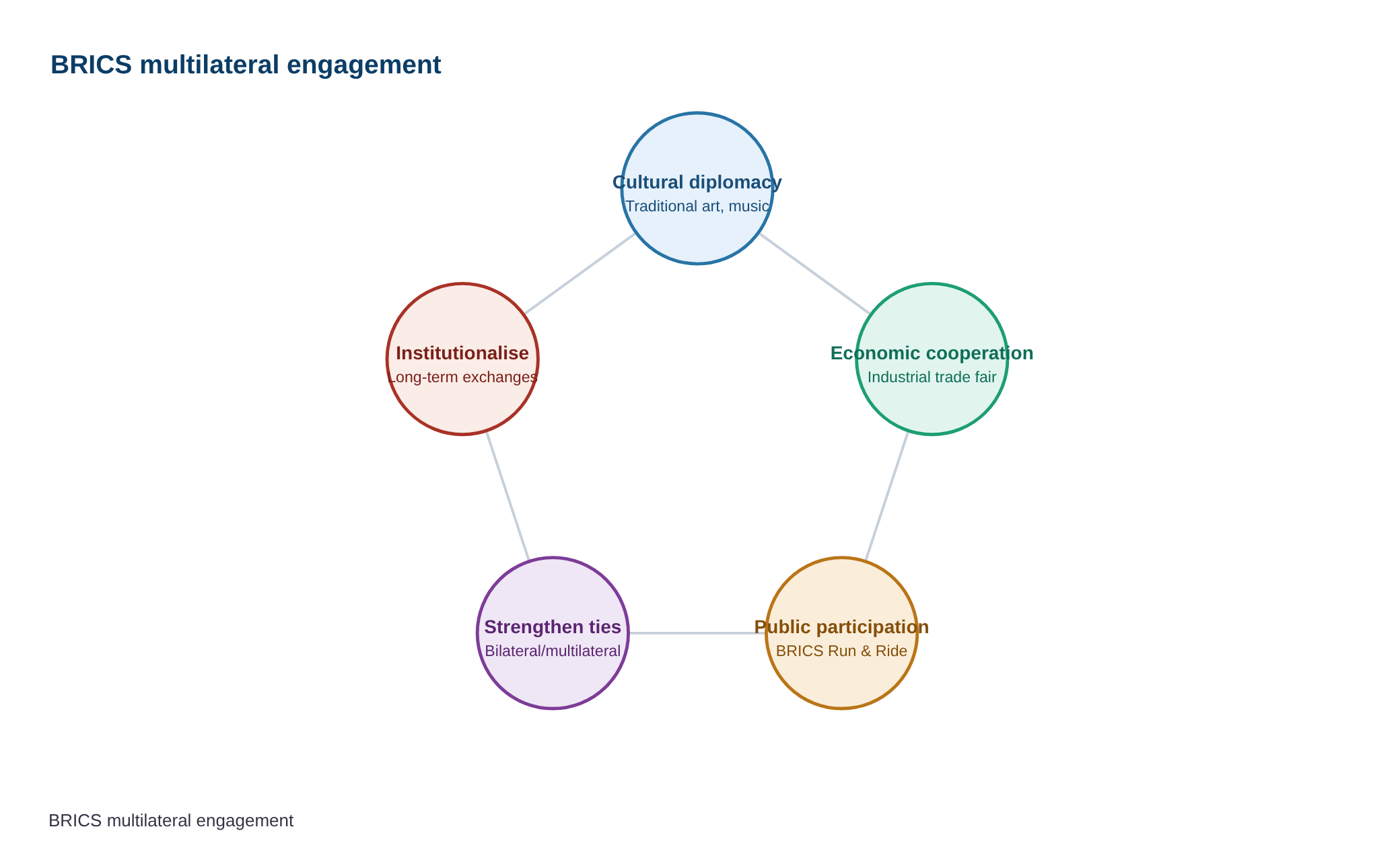
BRICS Summit as a platform for multilateral engagement → Cultural diplomacy through traditional art forms and music → Economic cooperation via industrial trade fair → Public participation in cultural and fitness events → Strengthening bilateral and multilateral ties → Institutionalisation of cultural and economic exchanges for long-term collaboration
Prelims Practice Questions
Q1. Consider the following statements regarding the BRICS Summit 2026 hosted by India:
1. The BRICS Symphony Orchestra performed traditional Russian folk instruments such as the balalaika and domra at the summit venue.
2. The INNOPROM India trade fair showcased medical equipment and robotics as part of Russia’s participation.
3. The BRICS Run & Ride event included only cycling activities, with no provision for running or yoga sessions.
How many of the above statements are correct?
- Only one
- Only two
- All three
- None
Answer: Only two — Statement 1 is correct as the BRICS Symphony Orchestra featured Russian folk instruments. Statement 2 is correct as the INNOPROM India fair included medical equipment and robotics. Statement 3 is incorrect as the event included cycling, running, zumba, and yoga sessions.
Q2. Assertion (A): The nevalyashka doll, a traditional Russian tumbler toy, was displayed at the BRICS Summit 2026 in Delhi, draped in an Indian saree.
Reason (R): Cultural diplomacy through tangible and intangible heritage is a key component of soft power in international relations, particularly in multilateral summits.
- Both A and R are true, and R is the correct explanation of A
- Both A and R are true, but R is not the correct explanation of A
- A is true, but R is false
- A is false, but R is true
Answer: Both A and R are true, and R is the correct explanation of A — Assertion (A) is factually accurate as the nevalyashka doll was displayed in a saree at the BRICS Summit. Reason (R) correctly explains the broader context of cultural diplomacy and soft power in multilateral engagements.
Q3. Match the following cultural artifacts/activities associated with Russia with their descriptions:
Column I (Artifact/Activity) | Column II (Description)
1. Fedoskino miniatures | A. Traditional Russian blue-and-white ceramic painting style
2. Gzhel ceramics | B. Layered oil paint on papier-mâché creating detailed, pocket-sized boxes
3. Balalaika | C. Traditional Russian stringed musical instrument
4. Nevalyashka | D. Iconic tumbler toy that wobbles and bounces back when nudged
- 1-B, 2-A, 3-C, 4-D
- 1-A, 2-B, 3-D, 4-C
- 1-C, 2-D, 3-A, 4-B
- 1-D, 2-C, 3-B, 4-A
Answer: 1-B, 2-A, 3-C, 4-D — Fedoskino miniatures (1-B) involve layered oil paint on papier-mâché. Gzhel ceramics (2-A) are known for blue-and-white designs. The balalaika (3-C) is a stringed instrument, and the nevalyashka (4-D) is a tumbler toy.
Mains Practice Question
✍ The BRICS Summit 2026 in Delhi exemplifies the strategic use of soft power through cultural diplomacy and people-to-people exchanges. Critically examine the role of cultural diplomacy in enhancing the effectiveness of multilateral institutions like BRICS. (15 Marks)
Approach: MODEL-ANSWER SKELETON:
1. Define soft power and cultural diplomacy (Joseph Nye; Joseph Samuel Nye, ‘Soft Power: The Means to Success in World Politics’).
2. Link to BRICS: institutional objectives (economic cooperation, political dialogue) and the role of cultural exchanges in building trust and mutual understanding.
3. Examine mechanisms:
a. Tangible heritage (Fedoskino miniatures, Gzhel ceramics, nevalyashka doll).
b. Intangible heritage (balalaika, domra performances; BRICS Symphony Orchestra).
c. Public diplomacy (BRICS Run & Ride; INNOPROM India trade fair).
4. Evaluate effectiveness:
a. Enhances people-to-people ties and long-term cooperation.
b. Complements hard power (economic and security cooperation) within BRICS.
c. Challenges: cultural homogenization, unequal representation, and sustainability of initiatives.
5. Case study: Russia’s cultural diplomacy at BRICS Summit 2026 as a model for other member states.
6. Conclude with a balanced view: cultural diplomacy is a force multiplier but not a substitute for institutional mechanisms.
Source: The Indian Express
Generated by AanyaAi for educational purpose.
Related guides on our sites
- Best PSIR optional coaching in delhi
- Best PSIR optional coaching in delhi for UPSC
- Anthropology VS PSIR
- Best PSIR optional coaching online

- Piyush Goyal Attends G20 Trade Ministers’ Meeting in Milwaukee - October 1, 2026
- विशेष अभियान-6: कोल इंडिया लिमिटेड की तैयारी पर केंद्र सरकार की निगरानी - October 1, 2026
- ECL’s Action Plan for Special Campaign 6: A UPSC Governance Case Study - October 1, 2026

No Comments