


24 Jul SagarMala Project: Modernizing Ports & Boosting India’s Logistics Efficiency
Subject Relevance — Where This Topic Fits
- GS Paper III — Economy: Ports, Logistics, Infrastructure, Sagarmala Programme | GS Paper III — Infrastructure: Sagarmala Programme and Port Connectivity
- Prelims: Sagarmala Programme, Major Ports Authority Act 2021, National Waterways, One Nation One Port Process, Inland Waterways Authority of India, Multi-Modal Logistics Parks, Dedicated Freight Corridors, Vessel Turnaround Time, Capital Dredging, Ro-Ro Terminals
- Essay: India’s Logistics Revolution: The Role of Sagarmala in Economic Transformation, Coastal Development and Inclusive Growth: Balancing Port Modernisation with Community Upliftment
Quick Revision: Sagarmala Programme (2015) is a MoPSW-led initiative to modernise India’s ports, enhance connectivity, and reduce logistics costs by leveraging coastal shipping and inland waterways under five strategic pillars.
Why is this in the news?
The Press Information Bureau (PIB), Ministry of Ports, Shipping and Waterways (MoPSW), released a detailed progress report on 24 July 2026 regarding the Sagarmala Programme, highlighting the modernisation of ports, enhancement of port connectivity, and the developmental impact on coastal communities. The report underscores the programme’s role in reducing logistics costs, improving cargo handling capacity, and fostering industrialisation through port-led development. This update is significant for UPSC aspirants as it reflects the government’s strategic focus on infrastructure-led growth and aligns with the broader economic reforms in India’s logistics sector.
Background
- The Sagarmala Programme was launched in 2015 as a flagship initiative of the Ministry of Ports, Shipping and Waterways (MoPSW) to promote port-led development and enhance the country’s logistics efficiency.
- India’s major ports handle over 70% of the country’s trade by volume, making their efficiency critical for economic growth and global competitiveness.
- Prior to Sagarmala, India’s port infrastructure suffered from inefficiencies such as congestion, outdated equipment, and poor connectivity, leading to higher logistics costs and delays.
- The programme was conceptualised under the National Perspective Plan for Sagarmala, which identified 14 coastal economic regions, 6 new major ports, and 12 coastal economic zones to drive industrialisation.
- The programme operates under five pillars: port modernisation, port connectivity, port-led industrialisation, coastal community development, and coastal shipping and inland water transport (IWT).
- The programme is aligned with the National Logistics Policy (2022) and the Maritime India Vision 2030, which aim to reduce logistics costs from 13-14% of GDP to single digits.
What is the Sagarmala Programme?
- A Central Sector Scheme under the Ministry of Ports, Shipping and Waterways (MoPSW), launched in 2015 to promote port-led development and reduce logistics costs.
- Aims to modernise existing ports, develop new ports, and enhance port connectivity through road, rail, and inland waterways.
- Focuses on five key pillars: (i) Port Modernisation, (ii) Port Connectivity, (iii) Port-led Industrialisation, (iv) Coastal Community Development, and (v) Coastal Shipping and Inland Water Transport (IWT).
- Port Modernisation includes deepening of drafts, mechanisation of berths, automation of processes, and development of auxiliary facilities like parking plazas.
- Coastal Community Development focuses on skill development, livelihood enhancement, and socio-economic upliftment of coastal populations.
- Coastal Shipping and IWT aim to shift cargo from congested road/rail routes to waterways, reducing logistics costs and environmental impact.
Key Features
| Feature | Significance |
|---|---|
| Port Modernisation under SagarMala | Enhances cargo handling capacity, reduces turnaround time, and improves operational efficiency through mechanisation, deepening of drafts, and process streamlining (e.g., One Nation One Port Process). |
| Port Connectivity Infrastructure | Reduces logistics costs by strengthening road, rail, and inland waterway linkages between ports and hinterlands, integrating multimodal transport networks. |
| Coastal Community Development | Promotes socio-economic uplift of coastal communities via skill development, fisheries infrastructure, and port-adjacent industrialisation. |
| Inland Waterways Development | Expands multimodal terminals (e.g., NW-1, NW-2) and roll-on/roll-off terminals to shift freight from congested roads to cost-effective waterways. |
| Port-Based Industrialisation | Facilitates establishment of coastal economic zones, reducing import dependency and enhancing value-addition in trade. |
Why it Matters
Economic Efficiency
- Reduces logistics cost from ~14-16% of GDP to global benchmarks (~8-10%) via improved port connectivity and cargo throughput.
- Increases port capacity from 1,400 MTPA (2013-14) to 2,818 MTPA (2026), aligning with India’s export-import growth trajectory.
- Enhances competitiveness of Indian goods in global markets by lowering transit time and costs for exporters.
Strategic Logistics
- Reduces dependence on overland routes by leveraging coastal shipping and inland waterways, mitigating road congestion and fuel costs.
- Strengthens supply chain resilience by diversifying transport modes, particularly for bulk commodities and perishable goods.
- Supports ‘Make in India’ and ‘Atmanirbhar Bharat’ by integrating ports with industrial corridors (e.g., DMIC, CBIC).
Regional Development
- Accelerates economic growth in coastal districts through port-led industrialisation and ancillary employment generation.
- Promotes inclusive development by integrating marginalised coastal communities via skill training and fisheries infrastructure.
- Facilitates hinterland connectivity for landlocked states (e.g., Madhya Pradesh, Chhattisgarh) via riverine and rail linkages.
Environmental Sustainability
- Shifts freight from road to waterways, reducing carbon emissions by ~30-40% per tonne-km compared to road transport.
- Minimises coastal erosion and pollution through regulated dredging and adoption of green port practices.
Challenges
1. Land Acquisition and R-o-R Delays
- Prolonged land acquisition processes under the Right to Fair Compensation and Transparency in Land Acquisition Act (2013) delay port connectivity projects.
- Resistance from local communities due to displacement concerns and inadequate rehabilitation mechanisms.
UPSC Link: Land Reforms; Coastal Regulation Zone (CRZ) 2019
2. Infrastructure Financing Gaps
- High capital intensity of port projects (e.g., ₹1,286 crore for Andhra Pradesh projects) requires sustained public-private partnerships (PPP).
- Limited appetite among private investors for greenfield port projects due to long gestation periods and regulatory uncertainties.
UPSC Link: PPP Models; Infrastructure Financing
3. Inter-Ministerial Coordination
- Fragmented governance between MoPSW, MoRTH, MoR, and state governments leads to delays in project approvals and implementation.
- Lack of a unified digital platform for real-time monitoring of port connectivity projects.
UPSC Link: Centre-State Relations; E-Governance
4. Technological Adoption Barriers
- Slow uptake of automation and AI in port operations due to high initial costs and skill shortages in maritime logistics.
- Inadequate integration of IoT and blockchain for cargo tracking and customs clearance.
UPSC Link: Digital India; Maritime Technology
5. Environmental and Regulatory Constraints
- Strict compliance with CRZ norms and environmental impact assessments (EIAs) increases project costs and timelines.
- Climate change-induced coastal erosion and extreme weather events threaten port infrastructure stability.
UPSC Link: Environmental Governance; Disaster Management
Challenges — UPSC Perspective
| Issue | Concern |
|---|---|
| Land Acquisition | Delays due to legal disputes, inadequate compensation, and CRZ restrictions. |
| Financing | High upfront costs deter private investment; reliance on budgetary allocations limits scalability. |
| Multi-Modal Integration | Poor coordination between road, rail, and waterway authorities hampers seamless connectivity. |
| Skill Gaps | Shortage of trained manpower in port operations, logistics, and maritime technology. |
| Regulatory Bottlenecks | Overlapping jurisdictions of MoPSW, MoRTH, and state agencies create compliance hurdles. |
| Climate Vulnerability | Rising sea levels and cyclones pose risks to port infrastructure and hinterland connectivity. |
Government Initiatives — Must-Memorise for Prelims
- SagarMala Programme (Central Sector Scheme, 2015)
- Sagarmala Development Company Limited (SDCL) for project implementation
- Bharatmala Pariyojana (for port connectivity road projects)
- Sagarmala National Perspective Plan (NPP) 2035
Way Forward
- Accelerate land acquisition for port connectivity projects through expedited CRZ clearances and compensation reforms.
- Expand PPP frameworks to attract private investment in port modernisation and hinterland logistics.
- Establish a unified digital dashboard for real-time monitoring of Sagarmala projects across ministries.
- Invest in skill development programmes for port operations, coastal shipping, and inland waterway logistics.
- Strengthen inter-ministerial coordination via a dedicated Sagarmala Implementation Authority (SIA).
- Adopt green port practices, including solar-powered terminals and zero-emission dredging.
- Develop climate-resilient infrastructure by integrating disaster risk reduction (DRR) into port design.
- Enhance coastal shipping competitiveness by rationalising GST on bunker fuels and port dues.
UPSC Value Addition
Keywords for Mains Answer-Writing
SagarMala Project · Port Modernisation · Logistics Cost Reduction · Coastal Shipping · Inland Water Transport (IWT) · Port Connectivity · One Nation One Port Process (ONOPP) · Multi-Modal Logistics · Port-Based Industrialisation · Coastal Community Development · Capital Dredging · Turnaround Time (TAT) · National Waterways · Port Connectivity Plan (PCP) · Port Capacity Enhancement
Concept Flow
Port congestion and inefficiency in 2013 → Launch of Sagarmala Programme (2015) → Port modernisation and connectivity enhancement → Expansion of cargo handling capacity (1,400 → 2,818 MTPA) → Reduction in logistics costs → Increased export competitiveness → Regional economic growth via port-led industrialisation → Socio-economic uplift of coastal communities
Prelims Practice Questions
Q1. Which of the following is NOT one of the five pillars under the SagarMala Project?
- A. Port Modernisation
- B. Coastal Community Development
- C. Greenfield Airport Development
- D. Port Connectivity
Answer: C. Greenfield Airport Development — The SagarMala Project operates under five pillars: Port Modernisation, Port Connectivity, Port-Based Industrialisation, Coastal Community Development, and Coastal Shipping & Inland Water Transport (IWT). Greenfield airport development is not a component of this scheme.
Q2. The ‘One Nation One Port Process (ONOPP)’ initiative is primarily aimed at:
- A. Reducing customs clearance time at airports
- B. Streamlining port processes to improve efficiency
- C. Standardising container sizes across ports
- D. Promoting coastal shipping over rail transport
Answer: B. Streamlining port processes to improve efficiency — ONOPP is implemented to streamline port processes, reduce bureaucratic delays, and enhance the turnaround time of vessels by standardising and simplifying procedures across all major ports in India.
Q3. Which ministry is responsible for the implementation of the SagarMala Project?
- A. Ministry of Road Transport and Highways
- B. Ministry of Ports, Shipping and Waterways
- C. Ministry of Commerce and Industry
- D. Ministry of Rural Development
Answer: B. Ministry of Ports, Shipping and Waterways — The SagarMala Project is a centrally sponsored scheme implemented by the Ministry of Ports, Shipping and Waterways (MoPSW), Government of India.
Q4. The ‘Port Connectivity Plan (PCP)’ under SagarMala was formulated in collaboration with:
- A. Ministry of Railways and Ministry of Road Transport and Highways
- B. Ministry of Urban Development and Ministry of Environment
- C. NITI Aayog and Ministry of Finance
- D. Ministry of Defence and Ministry of External Affairs
Answer: A. Ministry of Railways and Ministry of Road Transport and Highways — The Port Connectivity Plan (PCP) was developed by the Department for Promotion of Industry and Internal Trade (DPIIT) in collaboration with the Ministry of Railways and the Ministry of Road Transport and Highways to improve connectivity to ports.
Mains Practice Question
✍ Critically evaluate the role of the SagarMala Project in reducing logistics costs in India. How does it address the challenges of multimodal logistics and port efficiency? Substantiate your answer with relevant data and examples.
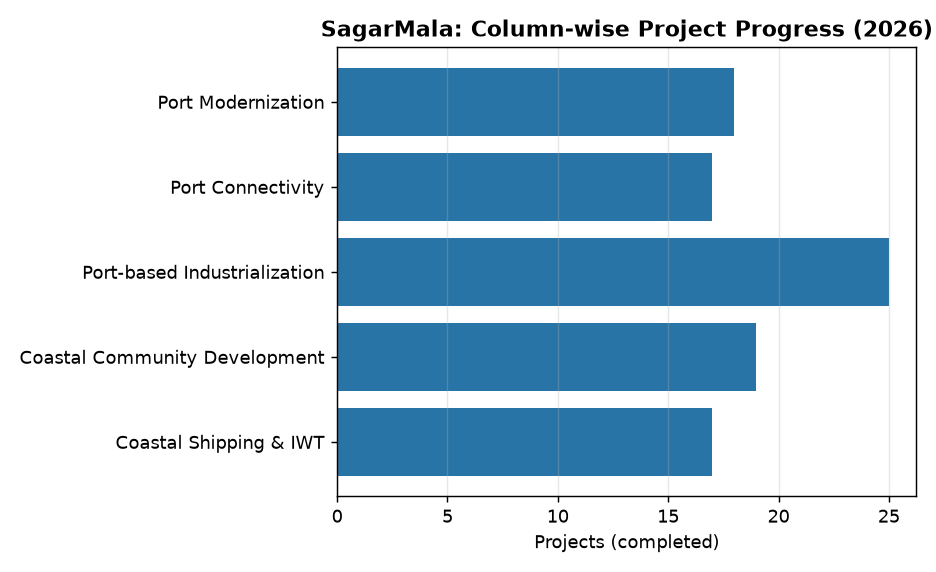
Approach: The answer must first define the SagarMala Project and its five-pillar framework, emphasising its objective of reducing logistics costs through port modernisation, connectivity enhancement, and coastal shipping promotion. Analyse how port modernisation (e.g., mechanisation, capital dredging) and the implementation of ONOPP have improved turnaround time (TAT) and cargo handling capacity (from 1,400 MTPA in 2013-14 to 2,818 MTPA in March 2026). Evaluate the Port Connectivity Plan (PCP) and its 294 identified projects (84 completed, 66 ongoing, 144 planned), highlighting the role of road, rail, and inland waterways in integrating ports with economic hubs. Discuss the impact of coastal shipping and IWT (e.g., 25 completed and 17 ongoing projects under this pillar) in decongesting rail and road networks. Conclude by assessing limitations such as land acquisition delays, inter-ministerial coordination challenges, and the need for further integration with industrial corridors. Use static syllabus knowledge on logistics infrastructure, multimodal transport, and port-led development to strengthen the analysis.
Source: PIB (Press Information Bureau)
Generated by AanyaAi for educational purpose.

- पेरियार टाइगर रिजर्व में 6 नई प्रजातियाँ खोजी गईं, जानिए क्या हैं विशेषताएँ - September 22, 2026
- Six New Species Discovered in Periyar Tiger Reserve: UPSC & PCS Key Biodiversity Insights - September 22, 2026
- तमिलनाडु में बस किराए में संशोधन: सरकार को चार सप्ताह और समय मिला, उच्च न्यायालय का फैसला - September 22, 2026

No Comments