


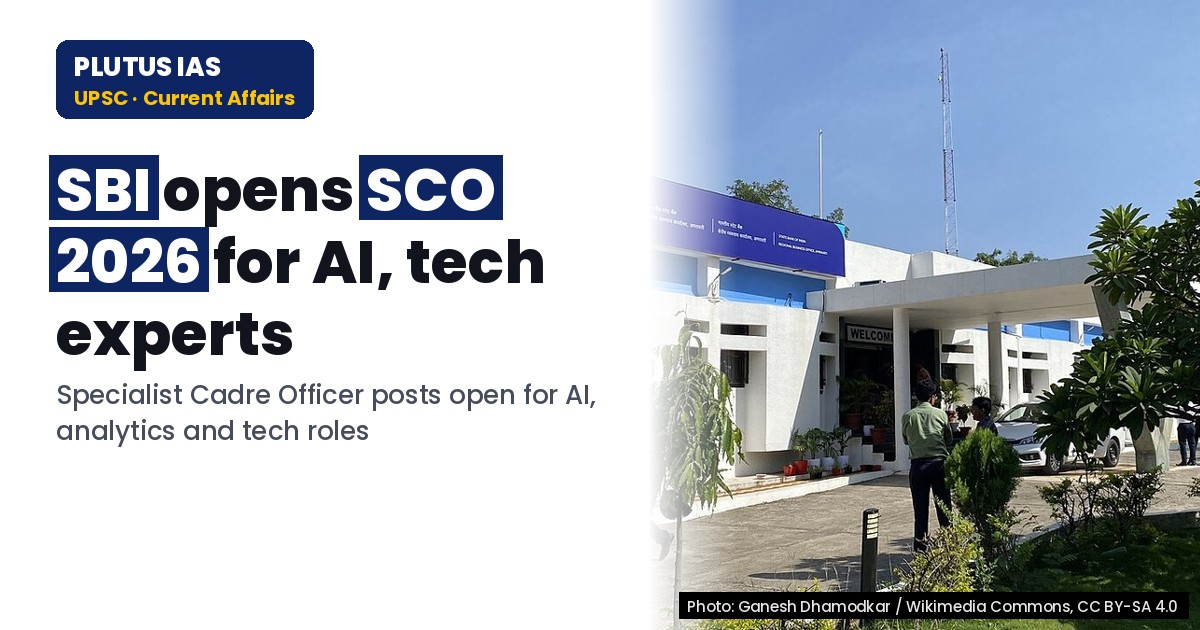
20 Oct SBI SCO 2026 Recruitment: AI & Tech Posts Open for Experts
✎ The SBI’s Specialist Cadre Officer recruitment for AI, analytics, and technology roles is a strategic move to integrate specialised expertise into the banking sector, supporting India’s digital transformation agenda.
Subject Relevance — Where This Topic Fits
- GS Paper III — Indian Economy: Banking Sector Reforms and Digitalisation | GS Paper III — Science and Technology: Emerging Technologies and their Applications | GS Paper IV — Ethics, Integrity and Aptitude: Professional Ethics in Public Institutions
- Prelims: Specialist Cadre Officer (SCO), State Bank of India (SBI), Artificial Intelligence (AI) Governance, Data Analytics in Banking, Technology Architecture, Fixed-term employment in PSUs, B.E./B.Tech./M.Tech. in Computer Science, MCA/M.Sc. in Statistics
- Essay: The role of artificial intelligence in transforming public sector enterprises, Ethical governance of emerging technologies in financial institutions
Quick Revision: The SBI’s Specialist Cadre Officer recruitment for AI, analytics, and technology roles is a strategic move to integrate specialised expertise into the banking sector, supporting India’s digital transformation agenda.
Why is this in the news?
The State Bank of India (SBI) has initiated a recruitment drive for Specialist Cadre Officer (SCO) positions in artificial intelligence, data analytics, data engineering, AI governance, and technology architecture. This initiative underscores the growing emphasis on digital transformation within India’s largest public sector bank and aligns with broader national objectives of leveraging technology for inclusive financial growth and operational efficiency.
Background
- The State Bank of India (SBI), established under the SBI Act, 1955, is the largest commercial bank in India, with a significant role in the country’s financial ecosystem.
- The banking sector in India has been undergoing rapid digitalisation, driven by initiatives such as the Digital India programme, the Reserve Bank of India’s (RBI) guidelines on digital lending, and the push for a cashless economy.
- The Reserve Bank of India (RBI) has emphasised the need for banks to adopt emerging technologies like AI and data analytics to enhance customer service, risk management, and fraud detection.
- The Union Government’s National Strategy for Artificial Intelligence (NSAI) highlights the importance of AI in public sector governance, including financial services, to improve efficiency and accessibility.
- The SBI has previously recruited specialists for digital roles, reflecting its commitment to modernising its technological infrastructure and workforce.
- The recruitment of SCOs on a fixed-term basis allows the bank to bring in specialised expertise without altering its permanent cadre structure, providing flexibility in addressing evolving technological demands.
What is the Specialist Cadre Officer (SCO) Recruitment in SBI?
- The Specialist Cadre Officer (SCO) recruitment by SBI is a specialised hiring initiative aimed at appointing professionals with expertise in artificial intelligence (AI), data analytics, data engineering, AI governance, and technology architecture.
- The positions are offered on a fixed-term employment basis, allowing the bank to engage specialists for defined durations to address specific technological and strategic needs.
- The recruitment includes senior-level roles such as General Manager and Chief AI Officer, Deputy General Manager, and specialised roles in AI architecture and governance.
- Candidates are required to meet stringent educational and professional qualifications, including degrees in Computer Science, Information Technology, Electronics, Statistics, or equivalent disciplines, along with relevant work experience.
- The selection process typically involves shortlisting based on qualifications and experience, followed by interviews or assessments to evaluate domain expertise and problem-solving abilities.
- The initiative reflects SBI’s strategic focus on digital transformation, aligning with national policies promoting the adoption of AI and data-driven decision-making in the banking sector.
- The recruitment process is conducted online, with applicants required to submit detailed applications, including educational and employment records, via the bank’s official portal (sbi.bank.in).
Key Features
| Feature | Significance |
|---|---|
| Fixed-term employment basis | Provides a structured yet flexible hiring mechanism for specialised roles, enabling SBI to access niche expertise without permanent commitments. |
| AI, analytics, and technology architecture posts | Reflects the bank’s strategic shift toward digital transformation, leveraging advanced data-driven decision-making and automation. |
| Senior-level positions (e.g., General Manager, Chief AI Officer) | Indicates a high-level institutional commitment to integrating AI governance and leadership into core banking operations. |
| Prescribed educational qualifications (B.E./B.Tech./M.Tech. in relevant fields) | Ensures technical rigour in recruitment, aligning with industry standards for AI and data science roles. |
| Online application process | Enhances accessibility, transparency, and efficiency in recruitment, aligning with modern governance practices. |
Why it Matters
Economic and Financial Sector
- Demonstrates the Indian banking sector’s adoption of AI and data analytics to improve operational efficiency, risk management, and customer service.
- Highlights the growing demand for specialised talent in financial technology (FinTech) and digital banking, contributing to India’s broader digital economy goals.
- Positions SBI as a leader in leveraging emerging technologies to enhance competitiveness in the global financial landscape.
Governance and Institutional Capacity
- Reflects the State Bank of India’s proactive approach to institutional capacity-building through targeted recruitment of domain experts.
- Underscores the importance of governance frameworks in AI deployment, particularly in regulated sectors like banking.
- Illustrates the role of public sector undertakings (PSUs) in driving India’s technological self-reliance (Atmanirbhar Bharat) agenda.
Human Resource Management
- Introduces a fixed-term employment model for specialised roles, balancing flexibility with institutional stability.
- Emphasises the need for continuous upskilling and reskilling of banking professionals to adapt to evolving technological demands.
- Sets a precedent for other public sector banks to adopt similar recruitment strategies for niche roles.
Challenges
1. Talent Acquisition and Retention
- Competition with private sector firms and global tech companies for skilled AI and data science professionals.
- Ensuring competitive compensation packages while adhering to public sector remuneration norms.
- Addressing the gap between academic qualifications and industry-specific skills required for AI roles.
UPSC Link: GS-III: Science & Technology, Human Resource Development
2. Regulatory and Ethical Compliance
- Navigating evolving regulatory frameworks for AI governance, data privacy, and cybersecurity in the banking sector.
- Ensuring transparency and accountability in AI-driven decision-making processes.
- Balancing innovation with compliance to RBI guidelines on technology adoption in banking.
UPSC Link: GS-II: Government Policies & Interventions
3. Integration with Legacy Systems
- Overcoming challenges in integrating AI and data analytics tools with existing banking infrastructure.
- Ensuring interoperability between new technologies and traditional banking systems.
- Mitigating risks of operational disruptions during the transition to AI-driven processes.
UPSC Link: GS-III: Technology & Economic Development
4. Data Governance and Security
- Safeguarding sensitive financial data against cyber threats and breaches.
- Establishing robust data governance frameworks to ensure ethical use of customer data.
- Complying with global data protection standards such as GDPR and India’s DPDP Act.
UPSC Link: GS-II: Governance, Transparency & Accountability
Challenges — UPSC Perspective
| Issue | Concern |
|---|---|
| Talent scarcity in AI and data science | Limited availability of professionals with domain-specific expertise in banking applications. |
| Regulatory ambiguity in AI governance | Lack of clear guidelines on accountability, bias mitigation, and explainability in AI systems. |
| Legacy system compatibility | Technical challenges in integrating modern AI tools with outdated banking infrastructure. |
| Data privacy and security risks | Potential vulnerabilities in handling sensitive financial data in digital ecosystems. |
| Resistance to organisational change | Cultural barriers within traditional banking institutions toward adopting new technologies. |
Way Forward
- Strengthen collaboration between SBI, IITs, and other premier institutions to develop industry-ready AI and data science professionals.
- Establish dedicated training programmes for existing SBI employees to bridge skill gaps in AI and analytics.
- Formulate a clear AI governance framework in alignment with RBI guidelines to ensure ethical and compliant deployment.
- Invest in modernising legacy banking systems to facilitate seamless integration with AI and data analytics tools.
- Enhance cybersecurity measures to protect customer data and mitigate risks associated with digital banking.
- Promote research and development in AI-driven banking solutions through partnerships with academia and startups.
- Develop a robust performance evaluation framework for AI systems to ensure transparency and accountability.
- Encourage public-private partnerships to accelerate the adoption of cutting-edge technologies in the banking sector.
UPSC Value Addition
Keywords for Mains Answer-Writing
State Bank of India (SBI) · Specialist Cadre Officer (SCO) recruitment · Artificial Intelligence (AI) governance · Data analytics in banking · Technology architecture in financial institutions · Fixed-term employment in public sector · Digital public infrastructure · Government of India’s AI Mission · Regulatory sandbox for fintech · Public sector bank reforms · Cybersecurity in banking · Data-driven governance
Concept Flow
SBI identifies strategic need for AI and data analytics expertise → → Publication of SCO recruitment notice for fixed-term specialised roles → → Candidates apply with prescribed qualifications and experience → → Selection process evaluates technical and domain-specific competencies → → Appointment of AI and technology specialists to drive digital transformation → → Integration of AI tools into banking operations for enhanced efficiency and customer service → → Ongoing governance and compliance to ensure ethical and regulatory adherence.
Prelims Practice Questions
Q1. Consider the following statements about the State Bank of India (SBI) Specialist Cadre Officer (SCO) recruitment 2026:
1. The recruitment includes positions such as General Manager and Chief AI Officer.
2. Candidates for these posts must be between 40 and 55 years of age.
3. The required educational qualification includes a B.E./B.Tech./M.Tech. in Computer Science or an equivalent discipline.
How many of the above statements are correct?
- Only one
- Only two
- All three
- None
Answer: All three — Statements 1 and 3 are correct. Statement 2 is incorrect as the age limit for General Manager and Chief AI Officer posts is between 40 and 55 years, which is explicitly mentioned in the recruitment details.
Q2. Assertion (A): The State Bank of India (SBI) has initiated a recruitment drive for Specialist Cadre Officers (SCOs) in artificial intelligence, data analytics, and technology architecture.
Reason (R): This initiative aligns with the Government of India’s Digital India Mission and the National AI Strategy to enhance data-driven governance in the banking sector.
- Both A and R are true, and R is the correct explanation of A.
- Both A and R are true, but R is not the correct explanation of A.
- A is true, but R is false.
- A is false, but R is true.
Answer: Both A and R are true, but R is not the correct explanation of A. — Both the assertion and reason are true. The SBI’s recruitment of SCOs in AI and analytics is indeed aligned with the broader national strategies for digital transformation and AI adoption in governance.
Q3. Match the following columns related to the SBI SCO recruitment 2026:
Column I (Post) | Column II (Specialisation Area)
—————-|—————————
A. General Manager and Chief AI Officer | 1. Data Engineering
B. Deputy General Manager | 2. Technology Architecture
C. AI Governance Specialist | 3. Artificial Intelligence
D. Data Analyst | 4. Analytics
- A-3, B-2, C-1, D-4
- A-3, B-2, C-4, D-1
- A-2, B-3, C-1, D-4
- A-1, B-2, C-3, D-4
Answer: A-3, B-2, C-1, D-4 — The correct matching is: A-3 (General Manager and Chief AI Officer specialises in Artificial Intelligence), B-2 (Deputy General Manager in Technology Architecture), C-4 (AI Governance Specialist in Analytics), and D-1 (Data Analyst in Data Engineering).
Mains Practice Question
✍ Examine the significance of the State Bank of India’s (SBI) recruitment of Specialist Cadre Officers (SCOs) in artificial intelligence, data analytics, and technology architecture for the Indian banking sector. Also, discuss the broader implications of such initiatives for India’s digital public infrastructure and governance. (15 Marks)
Approach: MODEL-ANSWER SKELETON:
1. **Introduction**: Briefly contextualise the SBI SCO recruitment 2026 within the broader framework of India’s digital transformation initiatives, such as the Digital India Mission, National AI Strategy, and the Reserve Bank of India’s (RBI) regulatory sandbox for fintech innovations.
2. **Significance for the Banking Sector**:
– Enhancing operational efficiency through AI-driven automation and predictive analytics.
– Strengthening cybersecurity frameworks using advanced data analytics.
– Improving customer experience via personalised banking solutions and fraud detection systems.
– Aligning with global best practices in technology adoption by public sector banks.
3. **Broader Implications for Digital Public Infrastructure**:
– Contribution to India’s vision of a ‘Digital Public Infrastructure’ (DPI) as outlined in the G20 Digital Economy Working Group reports.
– Role in fostering a data-driven governance ecosystem, including the use of AI in policy formulation and implementation.
– Potential to serve as a model for other public sector undertakings (PSUs) to adopt similar technological advancements.
4. **Challenges and Considerations**:
– Data privacy and security concerns under the Digital Personal Data Protection Act, 2023.
– Need for upskilling the existing workforce to handle advanced technological roles.
– Ensuring equitable access to digital banking services across socio-economic strata.
5. **Conclusion**: Summarise the transformative potential of such initiatives while acknowledging the need for robust regulatory frameworks and capacity-building measures to realise their full benefits.
Source: Times of India
Generated by AanyaAi for educational purpose.
Related guides on our sites
- Best PSIR optional coaching for upsc
- Best PSIR optional teacher for upsc
- Best teacher of PSIR optional for upsc
- Best PSIR optional coaching in delhi for UPSC

- आरबीआई की 63वीं बैठक: रेपो रेट में 25 आधार अंकों की बढ़ोतरी, जानें पूरा विवरण - October 21, 2026
- Pakistan Army’s Plan to Redraw Provincial Map: UPSC Security Analysis - October 21, 2026
- आईसीएआर के स्वच्छता अभियान 6.0 में 4000 से अधिक अभियान, जानिए मुख्य उपलब्धियां - October 21, 2026

No Comments