


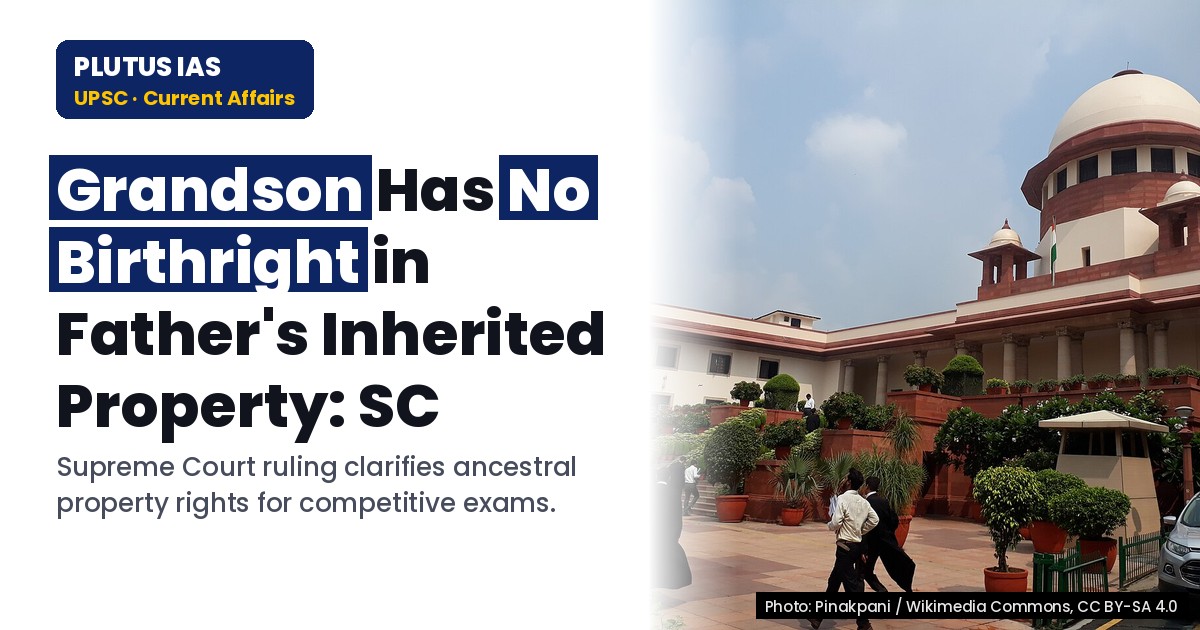
11 Nov SC: Grandson No Birthright in Father’s Inherited Property
✎ Property received by a father through the partition of ancestral property becomes his self-acquired property, over which his son does not have a birthright.
Subject Relevance — Where This Topic Fits
- GS Paper II — Governance, Constitution, Polity, Social Justice
- Prelims: Hindu Succession Act, 1956, Coparcenary property, Self-acquired property, Partition of property, Birthright in property, Supreme Court judgments
- Essay: Evolution of property rights in India and its societal implications, Judicial interpretation and its role in shaping personal laws
Quick Revision: Property received by a father through the partition of ancestral property becomes his self-acquired property, over which his son does not have a birthright.
Why is this in the news?
The Supreme Court recently ruled that a grandson does not acquire a birthright in property inherited by his father through a partition of the grandfather’s estate. The apex court clarified that such property, once partitioned and allotted to the father, assumes the character of his personal property, thereby negating any automatic coparcenary rights for the grandson. This decision upheld the Madras High Court’s ruling and dismissed an appeal by a son seeking a share in property his father had sold.
Background
- Hindu law traditionally distinguishes between ‘ancestral property’ and ‘self-acquired property’ for succession purposes.
- Under the Mitakshara school of Hindu law, a son, grandson, and great-grandson acquire an interest by birth in ancestral property, forming a coparcenary.
- A coparcenary property is one that is inherited by a Hindu from his father, grandfather, or great-grandfather, and in which sons acquire an interest by birth.
- The Hindu Succession Act, 1956, significantly reformed Hindu personal law, particularly concerning women’s property rights and the devolution of property.
- The Hindu Succession (Amendment) Act, 2005, further equalized the rights of daughters with sons in coparcenary property.
- Partition refers to the division of joint family property among coparceners, leading to the cessation of the joint family status.
Understanding Property Rights under Hindu Law
- Ancestral property is property inherited by a Hindu from his father, father’s father, or father’s father’s father, in which sons acquire an interest by birth.
- Self-acquired property is any property obtained by an individual through his own efforts, without the aid of ancestral funds, or inherited from sources other than the direct male lineal ascendants.
- A coparcener is a person who shares equally with others in the inheritance of an undivided estate, specifically referring to male lineal descendants under Mitakshara law (now including daughters post-2005 amendment).
- The recent Supreme Court judgment clarifies that when ancestral property is partitioned and a share is allotted to a coparcener (the father in this case), that share ceases to be ‘ancestral property’ for his own sons.
- Instead, the property received by the father through partition transforms into his ‘self-acquired property’ in relation to his own children, over which he has absolute disposal rights.
- This distinction is crucial because coparcenary rights, including birthright, apply only to ancestral property, not to the self-acquired property of an individual.
- The ruling reinforces the principle that once a partition occurs, the character of the property changes, impacting the rights of subsequent generations.
- This judgment provides clarity on the scope of birthright claims in property that has undergone partition within a Hindu Undivided Family (HUF) context.
Key Features
| Feature | Significance |
|---|---|
| Nature of Inherited Property | Property received by a father through the partition of ancestral property is classified as his self-acquired property, not joint family property. |
| Grandson’s Right | A grandson does not possess a birthright (Janam Siddh Adhikar) in property that his father inherited through the partition of ancestral assets. |
| Father’s Discretionary Power | The father has the absolute right to dispose of such self-acquired property as he deems fit, including selling it, without requiring the consent of his son or grandson. |
| Legal Precedent | This ruling clarifies the distinction between ancestral property and self-acquired property in the context of inheritance rights under Hindu law. |
| Impact on Succession | It reinforces the principle that once ancestral property is partitioned and allotted to an individual, it loses its character as joint family property for that individual’s descendants. |
Why it Matters
Socio-Legal Implications
- The ruling provides clarity on the inheritance rights of grandsons in properties acquired by their fathers through partition, potentially reducing intra-family disputes.
- It reinforces the legal distinction between ancestral property, where a birthright exists, and self-acquired property, where it does not, thereby streamlining property transactions.
- The decision may influence family property planning and succession strategies, encouraging clearer demarcation of property types.
Property Rights and Transactions
- By affirming the father’s absolute right over partitioned property, the judgment enhances the marketability and alienability of such assets, as purchasers can be more confident in the title.
- It reduces the legal complexities and potential challenges to property sales initiated by fathers, thereby facilitating economic activity related to real estate.
- The clarity provided by the Supreme Court can lead to more efficient resolution of property-related litigation in lower courts.
Judicial Interpretation
- The Supreme Court’s interpretation clarifies a nuanced aspect of Hindu Succession Law, specifically concerning the character of property obtained through partition.
- It upholds previous judicial precedents that distinguish between property inherited directly from an ancestor and property received as a share in a partition.
- The judgment contributes to the evolving jurisprudence on property rights and family law in India, providing a definitive stance on this particular issue.
Challenges
1. Complexity of Hindu Succession Law
- The Hindu Succession Act, 1956, while comprehensive, still presents complexities in its application, particularly concerning the classification of property (ancestral vs. self-acquired) and the rights of various heirs.
- Varying interpretations by different courts and the existence of customary practices can lead to prolonged legal battles and uncertainty regarding property titles.
UPSC Link: GS-II: Governance, Social Justice
2. Awareness and Legal Literacy
- A significant portion of the population, especially in rural areas, lacks adequate awareness of their property rights and the legal nuances of inheritance, leading to exploitation and disputes.
- The distinction between different types of property and the rights associated with them often remains unclear to common citizens, necessitating extensive legal literacy initiatives.
UPSC Link: GS-II: Social Justice, Governance
3. Gender Disparities in Inheritance
- Despite reforms, challenges persist in ensuring equitable inheritance rights for women, particularly in practice, due to societal norms and lack of enforcement.
- The focus on male lineal descendants in traditional inheritance structures can inadvertently perpetuate gender-based inequalities in property ownership and control.
UPSC Link: GS-I: Society; GS-II: Social Justice
4. Prolonged Litigation
- Property disputes often result in protracted legal proceedings across multiple judicial tiers, consuming significant time and resources for litigants and burdening the judicial system.
- The high volume of property-related cases contributes to judicial backlogs, delaying justice and impacting economic productivity.
UPSC Link: GS-II: Governance, Judiciary
Challenges — UPSC Perspective
| Issue | Concern |
|---|---|
| Property Classification Ambiguity | Distinguishing between ancestral and self-acquired property can be challenging, leading to disputes over inheritance rights. |
| Lack of Public Awareness | Many citizens are unaware of their specific inheritance rights, making them vulnerable to legal complexities and potential exploitation. |
| Judicial Backlog | The high volume of property-related cases contributes to delays in justice delivery and strains judicial resources. |
| Enforcement of Judgments | Ensuring the effective implementation of court rulings, especially in complex family property matters, can be a challenge. |
| Societal Norms vs. Legal Provisions | Traditional practices and societal expectations sometimes conflict with modern legal provisions, complicating property distribution. |
Way Forward
- Promote comprehensive legal literacy campaigns to educate the public on Hindu Succession Law, property rights, and the distinction between various property types.
- Encourage the use of alternative dispute resolution mechanisms, such as mediation and conciliation, for family property disputes to reduce litigation burden.
- Strengthen land record management and digitization to ensure accurate and accessible property information, thereby minimizing disputes over ownership and classification.
- Review and simplify existing inheritance laws to address ambiguities and ensure equitable distribution, particularly for vulnerable sections of society.
- Implement fast-track courts or specialized benches for property-related cases to expedite their resolution and reduce judicial backlogs.
- Encourage the drafting of wills and clear succession plans within families to prevent future disputes and ensure smooth transfer of assets.
- Provide legal aid and counseling services to individuals, especially women and marginalized groups, to help them understand and assert their property rights effectively.
UPSC Value Addition
Keywords for Mains Answer-Writing
Hindu Succession Act · Coparcenary property · Ancestral property · Self-acquired property · Joint family property · Partition of property · Inheritance law · Supreme Court judgments
Constitutional & Policy Linkages
- Article 14: Equality before law and equal protection of laws.
- Article 300A: Persons not to be deprived of property save by authority of law.
Concept Flow
Ancestral property exists as joint family property. → Partition of ancestral property occurs among coparceners. → Father receives a share in the partition. → The received share transforms into the father’s self-acquired property. → Grandson does not acquire a birthright in this self-acquired property. → Father has absolute right to dispose of this property.
Prelims Practice Questions
Q1. Consider the following statements regarding Hindu Undivided Family (HUF) property:
1. Under Mitakshara law, a son acquires a right in ancestral property by birth.
2. Property received by a father in a partition of ancestral property becomes his self-acquired property.
3. The Hindu Succession Act, 1956, abolished the concept of coparcenary property.
How many of the above statements are correct?
- Only one
- Only two
- Only three
- None
Answer: Only one — Statement 1 is correct: Under Mitakshara coparcenary, a son acquires an interest in ancestral property by birth. Statement 2 is correct: As per the recent Supreme Court ruling, property received by a father in a partition of ancestral property is considered his separate and self-acquired property, over which his son does not have a birthright. Statement 3 is incorrect: The Hindu Succession Act, 1956, modified but did not abolish the concept of coparcenary property; it primarily reformed succession rules, including granting coparcenary rights to daughters.
Q2. Which of the following legal systems primarily governs the inheritance and succession rights within a Hindu family, including concepts like coparcenary property?
- Sharia Law
- Mitakshara School
- Dayabhaga School
- Both Mitakshara and Dayabhaga Schools
Answer: Both Mitakshara and Dayabhaga Schools — Hindu law of succession is primarily governed by two main schools: Mitakshara and Dayabhaga. While the Mitakshara school (prevalent in most of India) recognizes birthright in ancestral property, the Dayabhaga school (prevalent in Bengal and Assam) does not, with the son acquiring rights only upon the father’s death. The Hindu Succession Act, 1956, codified and reformed these traditional laws.
Mains Practice Question
✍ Examine the concept of coparcenary property under Hindu law, distinguishing it from self-acquired property. Discuss the implications of recent Supreme Court judgments on the rights of descendants in property inherited by their father through partition. (15 Marks)
Approach: Define coparcenary property, highlighting its key features (birthright, joint ownership, survivorship) and its distinction from self-acquired property (absolute ownership, testamentary disposition). Explain the traditional Mitakshara view. Discuss the impact of the Hindu Succession Act, 1956, and its 2005 amendment. Detail the recent Supreme Court judgment, emphasizing that property received by a father in a partition of ancestral property becomes his separate property, over which his son has no birthright. Analyze the implications of this ruling on family property disputes, testamentary freedom, and the evolving nature of Hindu family law.
Source: amarujala.com
Generated by AanyaAi for educational purpose.
Related guides on our sites
- Best PSIR optional coaching for upsc
- Best Law optional coaching for upsc
- Best PSIR optional teacher for upsc
- Best teacher of PSIR optional for upsc

- Garh Ganga Mela: Yogi’s Directives for ‘Mini Kumbh’ - November 11, 2026
- दिल्ली में दिवाली प्रदूषण: पटाखों का 71%, वाहनों का 7% योगदान - November 11, 2026
- Elephants Return to Bandhavgarh: UPSC Environment Update - November 11, 2026

No Comments