


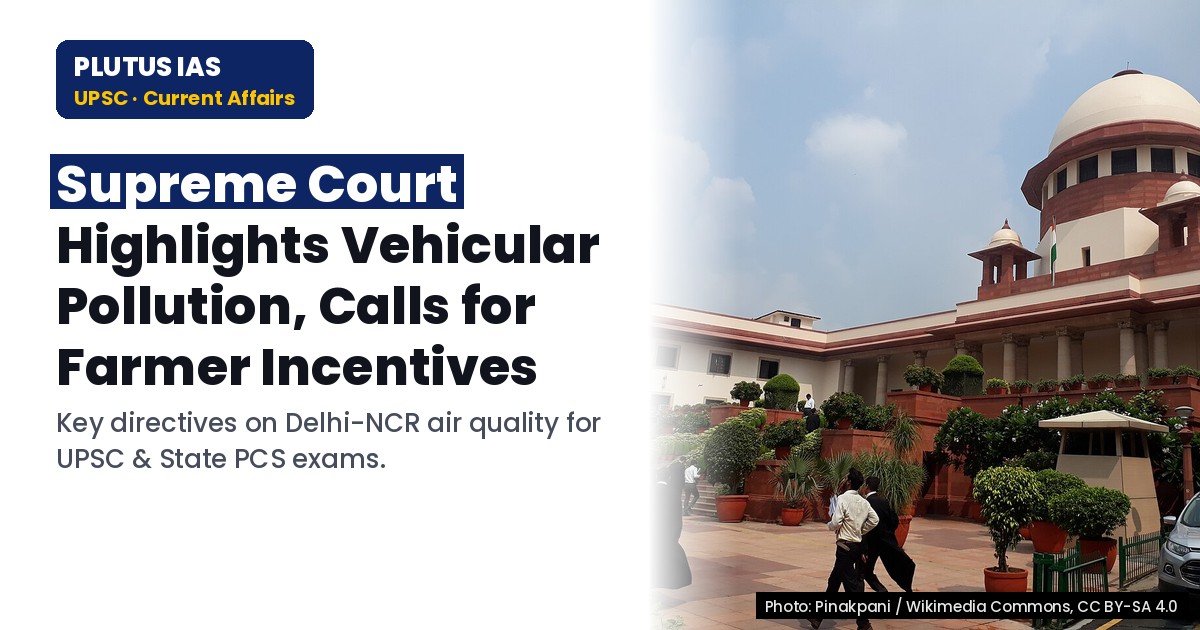
07 Nov SC on Delhi Pollution: Vehicular Emissions & Stubble Burning
✎ The Supreme Court has highlighted vehicular pollution and stubble burning as critical contributors to Delhi-NCR's air quality crisis, advocating for comprehensive policy interventions including economic incentives for farmers and…
Subject Relevance — Where This Topic Fits
- GS Paper II — Governance; Government Policies and Interventions; Role of Supreme Court | GS Paper III — Environment; Conservation, Environmental Pollution and Degradation; Environmental Impact Assessment
- Prelims: Vehicular Pollution, Air Quality Index (AQI), Graded Response Action Plan (GRAP), Commission for Air Quality Management (CAQM), Stubble Burning, Suo Motu Case
- Essay: Environmental Governance and Sustainable Development in India, Balancing Economic Growth with Environmental Protection: Challenges and Solutions
Quick Revision: The Supreme Court has highlighted vehicular pollution and stubble burning as critical contributors to Delhi-NCR’s air quality crisis, advocating for comprehensive policy interventions including economic incentives for farmers and improved urban transport infrastructure.
Why is this in the news?
The Supreme Court of India recently observed that vehicular emissions constitute a significant contributor to the deteriorating air quality in the Delhi-National Capital Region (NCR), expressing concern over the extensive traffic congestion. Concurrently, the Court also deliberated on the issue of stubble burning, advocating for the provision of economic incentives and viable alternatives to farmers to mitigate this practice.
Background
- Delhi-NCR consistently experiences severe air pollution, particularly during the winter months, attributed to a confluence of factors including vehicular emissions, industrial pollution, construction dust, and agricultural stubble burning.
- The Graded Response Action Plan (GRAP) is an emergency measure implemented in the NCR to combat air pollution, with various stages triggered based on the Air Quality Index (AQI) levels.
- The Commission for Air Quality Management (CAQM) in NCR and Adjoining Areas is a statutory body established to coordinate efforts and formulate strategies for air quality improvement in the region.
- Vehicular pollution is exacerbated by the high density of vehicles, inadequate public transport infrastructure, and the movement of vehicles from other states into the Capital.
- Stubble burning, primarily in Punjab and Haryana, involves farmers setting fire to crop residue after harvest, contributing significantly to regional air pollution.
- The Supreme Court is currently hearing a suo motu case concerning the regulatory framework governing air pollution, indicating its proactive judicial intervention in environmental matters.
Understanding Air Pollution and Mitigation Strategies
- Air pollution refers to the presence of harmful substances in the atmosphere, including particulate matter (PM2.5, PM10), nitrogen oxides (NOx), sulfur oxides (SOx), carbon monoxide (CO), and volatile organic compounds (VOCs).
- Vehicular emissions are a major source of urban air pollution, resulting from the combustion of fossil fuels in internal combustion engines, releasing pollutants such as PM, NOx, CO, and unburnt hydrocarbons.
- The Air Quality Index (AQI) is a tool for communicating air quality status to the public, indicating how clean or polluted the air currently is, and what associated health effects might be a concern.
- The Graded Response Action Plan (GRAP) is a set of emergency measures implemented in Delhi-NCR, categorised into four stages (Stage I – Poor, Stage II – Very Poor, Stage III – Severe, Stage IV – Severe Plus), with progressively stringent actions.
- Stubble burning is an agricultural practice where farmers burn crop residue, particularly paddy stubble, after harvesting, to clear fields quickly for the next crop, leading to significant smoke and particulate matter emissions.
- Mitigation strategies for vehicular pollution include promoting public transport, improving fuel quality, implementing stricter emission norms (e.g., Bharat Stage VI), encouraging electric vehicles, and improving traffic management.
- Addressing stubble burning requires a multi-pronged approach, including providing economic incentives for farmers, promoting in-situ crop residue management (e.g., using Happy Seeder machines), and establishing ex-situ residue utilisation facilities (e.g., for biomass energy production).
Key Features
| Feature | Significance |
|---|---|
| Vehicular Pollution | Identified as a major contributor to deteriorating air quality in Delhi-NCR, exacerbated by high vehicle density and bumper-to-bumper traffic. |
| Stubble Burning | Recognised as another significant source of air pollution, particularly during specific periods, necessitating economic incentives and practical alternatives for farmers. |
| Public Transport System Deficiencies | Highlighted as a reason for increased reliance on private vehicles, contributing to vehicular congestion and pollution. |
| Inter-State Vehicular Movement | Poses a challenge to monitoring and regulating vehicle emissions, as vehicles registered outside Delhi enter the capital without consistent oversight. |
| Graded Response Action Plan (GRAP) | A set of emergency measures implemented to combat air pollution, with Stage-III invoked when air quality reaches ‘Very Poor’ levels. |
Why it Matters
Environmental Significance
- The Supreme Court’s observations underscore the severe environmental degradation caused by air pollution, impacting public health and ecological balance.
- The focus on vehicular emissions and stubble burning highlights key anthropogenic sources requiring urgent mitigation strategies.
Governance and Policy Significance
- The Court’s suo motu case indicates judicial oversight on executive actions concerning environmental protection and public welfare.
- The discussion on public transport deficiencies points to the need for comprehensive urban planning and infrastructure development to reduce private vehicle dependency.
- The emphasis on economic incentives for farmers to manage crop residue suggests a policy shift towards sustainable agricultural practices.
Public Health Significance
- Deteriorating air quality directly correlates with increased respiratory and cardiovascular diseases, posing a significant public health crisis in Delhi-NCR.
- The ‘free-for-all’ scenario regarding vehicles implies a failure in regulatory enforcement, which has direct public health consequences.
Economic Significance
- The economic incentives for stubble burning alternatives could create new markets for crop residue and support agricultural diversification.
- The costs associated with air pollution, including healthcare expenditures and productivity losses, represent a substantial economic burden.
Challenges
1. Controlling Vehicular Emissions
- High density of vehicles, including those from other states, makes monitoring and enforcement of emission norms difficult.
- Lack of adequate public transport infrastructure compels reliance on private vehicles, exacerbating congestion and pollution.
UPSC Link: Environmental Pollution & Degradation
2. Managing Agricultural Waste
- Stubble burning persists due to economic disincentives for farmers to adopt alternative methods of crop residue management.
- Ensuring timely procurement and processing of crop residue requires robust logistical and financial mechanisms.
UPSC Link: Agriculture & Allied Sectors
3. Enforcement and Regulation
- Despite existing measures like geo-tagged pollution certificates, effective enforcement against polluting vehicles remains a challenge.
- Coordination among multiple agencies (CAQM, MCD, state transport departments) is crucial for integrated pollution control.
UPSC Link: Government Policies & Interventions
4. Public Behavioural Change
- Promoting a shift from private vehicle usage to public transport requires sustained public awareness campaigns and improved service quality.
- Encouraging adoption of cleaner fuels and electric vehicles necessitates supportive infrastructure and incentives.
UPSC Link: Human Behaviour & Environment
Challenges — UPSC Perspective
| Issue | Concern |
|---|---|
| Vehicular Overpopulation | Uncontrolled increase in private vehicles, leading to severe traffic congestion and elevated emission levels. |
| Inadequate Public Transport | Limited accessibility and efficiency of public transportation systems, forcing citizens to rely on personal vehicles. |
| Inter-State Vehicle Monitoring | Difficulty in regulating emission standards and vehicle conditions for vehicles entering Delhi from other states. |
| Stubble Burning Incentives | Lack of viable economic alternatives for farmers, perpetuating the practice of burning crop residue. |
| Enforcement Gaps | Ineffective implementation of existing pollution control measures and monitoring mechanisms. |
Government Initiatives — Must-Memorise for Prelims
- Graded Response Action Plan (GRAP)
Way Forward
- Enhance the public transport network’s reach, frequency, and comfort to provide a viable alternative to private vehicles.
- Implement stringent enforcement of vehicular emission norms, including real-time monitoring and penalties for non-compliance.
- Provide direct economic incentives and accessible technological alternatives to farmers for in-situ or ex-situ crop residue management.
- Strengthen inter-state coordination mechanisms to monitor and control emissions from vehicles entering Delhi-NCR.
- Promote the adoption of electric vehicles through supportive infrastructure development, subsidies, and awareness campaigns.
- Invest in advanced air quality monitoring systems and data analytics for evidence-based policy formulation and targeted interventions.
- Develop and implement comprehensive urban planning strategies that prioritise pedestrian and cycling infrastructure, reducing short-distance vehicular travel.
- Foster public awareness and participation in pollution control efforts through educational campaigns on sustainable commuting and lifestyle choices.
UPSC Value Addition
Keywords for Mains Answer-Writing
Vehicular pollution · Air quality management · Stubble burning mitigation · Graded Response Action Plan (GRAP) · Commission for Air Quality Management (CAQM) · Sustainable urban transport · Economic incentives for farmers · Crop residue management · Pollution Under Control (PUC) certificate · Environmental governance · Public transport infrastructure · Inter-state pollution challenges
Constitutional & Policy Linkages
- {‘article’: ‘Article 21’, ‘note’: ‘Right to life and personal liberty’}
- {‘article’: ‘Article 48A’, ‘note’: ‘Protection and improvement of environment’}
- {‘article’: ‘Article 51A(g)’, ‘note’: ‘Duty to protect natural environment’}
Concept Flow
Increased vehicular density and traffic congestion → Elevated emissions of pollutants (PM2.5, PM10, NOx) → Deterioration of ambient air quality (High AQI) → Adverse impacts on public health and environment → Judicial intervention and policy review for mitigation
Prelims Practice Questions
Q1. Consider the following statements regarding air pollution in the National Capital Region (NCR):
1. The Graded Response Action Plan (GRAP) is implemented by the Central Pollution Control Board (CPCB).
2. Vehicular emissions are a significant contributor to air pollution in Delhi-NCR.
3. Stubble burning primarily affects air quality during the post-monsoon period.
How many of the above statements are correct?
- Only one
- Only two
- All three
- None
Answer: All three — Statement 1 is incorrect: GRAP is implemented by the Commission for Air Quality Management (CAQM) in NCR, not directly by CPCB. Statement 2 is correct: Vehicular emissions are a major identified source of air pollution. Statement 3 is correct: Stubble burning is a seasonal phenomenon, predominantly occurring in the post-monsoon period (October-November) in agricultural states surrounding Delhi.
Q2. Which of the following measures are typically part of the Graded Response Action Plan (GRAP) Stage-III for air quality management in the NCR?
1. Ban on construction and demolition activities.
2. Restriction on the entry of non-essential trucks into Delhi.
3. Implementation of odd-even scheme for private vehicles.
4. Closure of brick kilns and hot mix plants.
Select the correct answer using the code given below:
- 1 and 2 only
- 1, 2 and 4 only
- 3 and 4 only
- 1, 2, 3 and 4
Answer: 1, 2 and 4 only — Statements 1, 2, and 4 are typically part of GRAP Stage-III measures. The odd-even scheme (Statement 3) is a measure that has been implemented in Delhi but is not a standard, automatic part of GRAP Stage-III; it is often considered for higher pollution levels or as an additional measure.
Mains Practice Question
✍ Despite various regulatory frameworks and policy interventions, vehicular pollution remains a significant challenge in urban agglomerations like Delhi-NCR. Examine the effectiveness of existing measures and suggest comprehensive strategies to mitigate vehicular emissions. (15 Marks)
Approach: Introduction: Briefly state the problem of vehicular pollution in Delhi-NCR and its impact on air quality.
Body Paragraph 1: Examine the effectiveness of existing measures. This should cover:
– Regulatory frameworks: BS emission norms, PUC certificates, fuel quality standards (e.g., BS-VI).
– Policy interventions: GRAP (specific to vehicular aspects like truck entry restrictions), promotion of electric vehicles (FAME India Scheme), public transport initiatives (metro expansion, bus fleet augmentation).
– Challenges: Enforcement gaps (inter-state vehicles), inadequate public transport infrastructure, rapid increase in vehicle population, traffic congestion (‘bumper-to-bumper traffic’).
Body Paragraph 2: Suggest comprehensive strategies for mitigation. This should include:
– Technological advancements: Faster adoption of EVs, stricter emission testing, retrofitting older vehicles.
– Infrastructure development: Expansion and integration of public transport (metro, electric buses), dedicated cycling and walking paths, smart traffic management systems.
– Economic incentives and disincentives: Scrappage policy, differential parking charges, congestion pricing, subsidies for EV adoption.
– Behavioural change: Public awareness campaigns, promotion of carpooling.
– Inter-state coordination: Standardized enforcement mechanisms for vehicles entering NCR from other states.
– Urban planning: Promoting compact, mixed-use development to reduce travel distances.
Conclusion: Summarize the need for a multi-pronged, integrated approach involving technology, infrastructure, policy, and public participation to achieve sustainable air quality.
Source: The Indian Express
Generated by AanyaAi for educational purpose.
Related guides on our sites
- Best PSIR optional coaching in delhi
- Best PSIR optional coaching in delhi for UPSC
- Anthropology VS PSIR
- Best PSIR optional coaching online

- आरबीआई द्वारा 91, 182 और 364 दिनीय ट्रेजरी बिलों की नीलामी: प्रमुख तथ्य - November 7, 2026
- Shram Samvad: Capacity Building on Labour Codes in Ujjain - November 7, 2026
- पटना में ठोस अपशिष्ट प्रबंधन: नगर निगम की नई योजना - November 7, 2026

No Comments