


23 Sep SC Takes Suo Motu Cognisance of Patna HC Rape Judgment: Key Analysis for UPSC
✎ The Supreme Court’s suo motu intervention in the Patna High Court rape judgment highlights the judicial duty to ensure that legal principles governing gender-based offences are consistently applied, balancing judicial restraint…
Subject Relevance — Where This Topic Fits
- GS Paper II — Judiciary and Constitutional Framework | GS Paper III — Criminal Justice System and Gender Justice
- Prelims: Section 354 IPC (Outraging modesty of a woman), Section 376 IPC (Punishment for rape), Section 511 IPC (Punishment for attempt to commit offences), Suo motu cognisance, Judicial activism vs judicial restraint, Patna High Court, Supreme Court Writ Jurisdiction, Criminal Appeal, Charge sheet, Medical evidence in rape cases
- Essay: Judicial Activism and the Balance of Powers, Gender Justice and the Role of the Judiciary in Upholding Constitutional Safeguards
Quick Revision: The Supreme Court’s suo motu intervention in the Patna High Court rape judgment highlights the judicial duty to ensure that legal principles governing gender-based offences are consistently applied, balancing judicial restraint with the need to uphold constitutional safeguards for women.
Why is this in the news?
The Supreme Court of India, exercising its suo motu jurisdiction, has taken cognisance of a judgment delivered by the Patna High Court on 9 July 2026, which acquitted an accused in a case of alleged attempted rape. The Supreme Court has raised concerns over the High Court’s observations and the legal reasoning employed, particularly regarding the distinction between the offence of ‘outraging the modesty of a woman’ under Section 354 of the Indian Penal Code (IPC) and the offence of ‘attempt to commit rape’ under Section 376 read with Section 511 IPC. This intervention underscores the apex court’s role in ensuring consistency in judicial interpretation of gender-based offences and the protection of constitutional rights of women.
Background
- The case originated from an incident reported in 2008 at Amarpur police station in Banka district, Bihar, where the victim alleged that the accused, a photography studio owner, attempted to remove her salwar and undressed himself with the intent to commit rape.
- The trial court convicted the accused under Sections 376/511 (attempt to commit rape) and Section 342 (wrongful confinement) of the IPC, sentencing him to three years of rigorous imprisonment and six months of simple imprisonment, respectively.
- The Patna High Court, in its judgment dated 9 July 2026, acquitted the accused, holding that the prosecution failed to establish the ingredients of an attempt to commit rape due to the absence of evidence of penetration and lack of medical evidence supporting the allegation.
- The Supreme Court had previously intervened in suo motu proceedings concerning a similar issue arising from an Allahabad High Court judgment, highlighting the recurring judicial dilemma in distinguishing between preparation and attempt in rape cases.
- The Supreme Court’s suo motu cognisance in this matter is rooted in the constitutional obligation to ensure uniformity in judicial interpretation and adherence to legal principles governing gender justice.
- The case exemplifies the tension between judicial restraint (deference to trial court findings) and judicial activism (intervention to correct perceived legal errors) in the higher judiciary.
What is Suo Motu Cognisance in the Context of Judicial Review?
- Suo motu cognisance refers to the power of a higher court—particularly the Supreme Court or High Courts—to initiate legal proceedings on its own motion, without a formal petition from any party. This power is derived from the inherent powers of the court and is exercised to ensure justice.
- In the present case, the Supreme Court took cognisance of the Patna High Court’s judgment not on a direct appeal by the prosecution or victim, but on its own initiative, highlighting the gravity of the legal issues involved and the need for judicial clarification.
- The power of suo motu cognisance is not unbridled; it must be exercised judiciously and in furtherance of public interest or constitutional values, rather than as a substitute for the appellate process.
- The Supreme Court’s intervention in this case underscores its role as the guardian of constitutional morality and the final arbiter of legal principles, particularly in matters concerning gender justice and the protection of women’s rights.
- The case also reflects the dynamic interplay between the trial court, High Court, and Supreme Court in the criminal justice system, where higher courts may review lower court judgments to ensure consistency in legal interpretation and adherence to procedural safeguards.
- The Supreme Court’s notice to the accused and the Bihar government indicates the procedural fairness embedded in suo motu proceedings, ensuring that all parties are heard before any substantive order is passed.
Key Features
| Feature | Significance |
|---|---|
| Suo Motu Cognisance by Supreme Court | Demonstrates the apex court’s proactive role in safeguarding constitutional rights and ensuring judicial accountability, particularly in cases involving gender-based violence. |
| Re-examination of High Court Judgment | Highlights the hierarchical judicial review process where the Supreme Court can correct erroneous interpretations of law, especially in matters of grave societal concern. |
| Legal Distinction: Attempt to Rape vs. Outraging Modesty (Section 354 IPC) | Reinforces the need for precise legal classification of offences, as misclassification can lead to inadequate justice for victims of sexual violence. |
| Presence of Medical and Forensic Evidence | Underscores the critical role of corroborative evidence in sexual offence trials, where physical proof often determines the conviction or acquittal. |
| Judicial Observations on Gender Justice | Exposes potential gaps in judicial reasoning that may inadvertently dilute the gravity of sexual offences, necessitating higher judicial scrutiny. |
Why it Matters
Judicial Process & Rule of Law
- The Supreme Court’s suo motu intervention ensures that judicial errors do not perpetuate impunity, reinforcing public trust in the judiciary.
- The case exemplifies the principle of judicial review, where higher courts correct lower court misinterpretations to uphold constitutional morality.
- It highlights the judiciary’s responsibility to protect the rights of marginalised groups, particularly women, in a patriarchal societal framework.
- The matter underscores the importance of procedural fairness, including the examination of witnesses and admissibility of evidence, in criminal trials.
Gender Justice & Legal Reforms
- The case prompts a re-evaluation of legal standards in sexual offence trials, particularly the distinction between ‘attempt to rape’ and ‘outraging modesty’ under the IPC.
- It raises questions about the adequacy of Section 354 IPC in addressing non-penetrative sexual violence, suggesting a need for legislative or judicial clarification.
- The acquittal underscores the systemic challenges in securing convictions in sexual offence cases, often due to weak prosecution or evidentiary gaps.
- The Supreme Court’s scrutiny may catalyse reforms in how sexual offence cases are investigated, prosecuted, and adjudicated in lower courts.
Institutional Accountability
- The Patna High Court’s judgment reflects potential judicial bias or oversight, necessitating higher judicial scrutiny to prevent miscarriage of justice.
- The case highlights the role of the Attorney General and State Advocate Generals in representing public interest during judicial proceedings.
- It demonstrates the Supreme Court’s supervisory jurisdiction over High Courts, ensuring uniformity in the application of criminal law.
- The matter may lead to the formulation of guidelines for High Courts in re-appreciating evidence in sexual offence cases.
Challenges
1. Inadequate Prosecution in Sexual Offence Cases
- Failure to examine key witnesses, such as the investigating officer, weakens the prosecution’s case and leads to acquittals.
- Lack of medical and forensic evidence in sexual offence trials often results in acquittals, despite credible victim testimonies.
- Inconsistent judicial interpretations of ‘attempt to rape’ vs. ‘outraging modesty’ create ambiguity in legal standards.
UPSC Link: https://upsc.gov.in/sites/default/files/AnnualReport_2022/Chapter-11.pdf
2. Judicial Bias and Gender Stereotypes
- Erroneous judicial observations may reflect underlying gender biases, such as the assumption that non-penetrative acts are less grave.
- High Courts may inadvertently dilute the severity of sexual offences due to inadequate sensitisation of judges on gender justice issues.
- The lack of uniformity in judicial reasoning across High Courts exacerbates disparities in justice delivery.
UPSC Link: https://nalsa.gov.in/sites/default/files/2023-07/Report%20of%20the%20Committee%20on%20Gender%20Sensitisation.pdf
3. Evidentiary Gaps in Sexual Offence Trials
- Insufficient medical or forensic evidence often leads to acquittals, despite victim testimonies being credible.
- Delays in forensic analysis and inadequate forensic infrastructure in lower courts hamper timely justice.
- The reliance on victim testimonies alone, without corroborative evidence, increases the risk of acquittals in sexual offence cases.
UPSC Link: https://ncrb.gov.in/sites/default/files/2023-02/Chapter-5%20-%20Crime%20against%20Women.pdf
4. Hierarchical Judicial Review and Delayed Justice
- The time lag between trial court convictions, High Court acquittals, and Supreme Court interventions delays justice for victims.
- The absence of a time-bound appellate process in sexual offence cases exacerbates the trauma for victims.
- The Supreme Court’s suo motu intervention, while commendable, highlights the systemic delays in the judicial process.
UPSC Link: https://supremecourtofindia.nic.in/supremecourt/2005/10838/10838_2005_Judgement_12-Dec-2012.pdf
Challenges — UPSC Perspective
| Issue | Concern |
|---|---|
| Misclassification of Offences | Leads to inadequate punishment and undermines the gravity of sexual offences. |
| Weak Prosecution | Failure to examine witnesses and present medical evidence results in acquittals. |
| Judicial Stereotypes | Erroneous observations may reflect gender biases, affecting justice delivery. |
| Evidentiary Deficiencies | Lack of forensic and medical evidence hampers convictions in sexual offence cases. |
| Hierarchical Delays | Time lag in judicial review processes delays justice for victims. |
| Inconsistent Judicial Standards | Variations in High Court interpretations create disparities in justice delivery. |
Way Forward
- The Supreme Court should issue detailed guidelines for High Courts on the re-appreciation of evidence in sexual offence cases to prevent miscarriage of justice.
- State governments must ensure that investigating officers in sexual offence cases are adequately trained in forensic and medical evidence collection.
- The Union Government should expedite the establishment of fast-track courts for sexual offence cases to reduce delays in justice delivery.
- Judicial academies should conduct mandatory gender sensitisation programmes for judges to mitigate biases in judicial reasoning.
- The Law Commission of India should review the adequacy of Section 354 IPC in addressing non-penetrative sexual violence and recommend legislative reforms if necessary.
- Forensic infrastructure in lower courts must be strengthened to ensure timely and accurate forensic analysis in sexual offence cases.
- Victim support mechanisms, including legal aid and counselling, should be institutionalised to reduce trauma and improve prosecution outcomes.
- The Supreme Court’s suo motu intervention should be followed by a comprehensive study on the efficacy of judicial review in sexual offence cases to inform systemic reforms.
UPSC Value Addition
Keywords for Mains Answer-Writing
Supreme Court suo motu jurisdiction · Patna High Court judgment on rape attempt · Section 354 IPC (outraging modesty of women) · Section 376/511 IPC (attempt to commit rape) · distinction between preparation and attempt to commit rape · judicial review of High Court judgments · gender justice and judicial interpretation · right to fair trial vs. victim protection · judicial activism in criminal law · evidentiary standards in sexual offences · constitutional morality in judicial decisions · judicial discipline and consistency in criminal jurisprudence
Constitutional & Policy Linkages
- Article 14 (Right to Equality)
- Article 21 (Right to Life and Personal Liberty)
- Article 39A (Equal Justice and Free Legal Aid)
- Article 51A(e) (Fundamental Duty to Renounce Practices Derogatory to the Dignity of Women)
Concept Flow
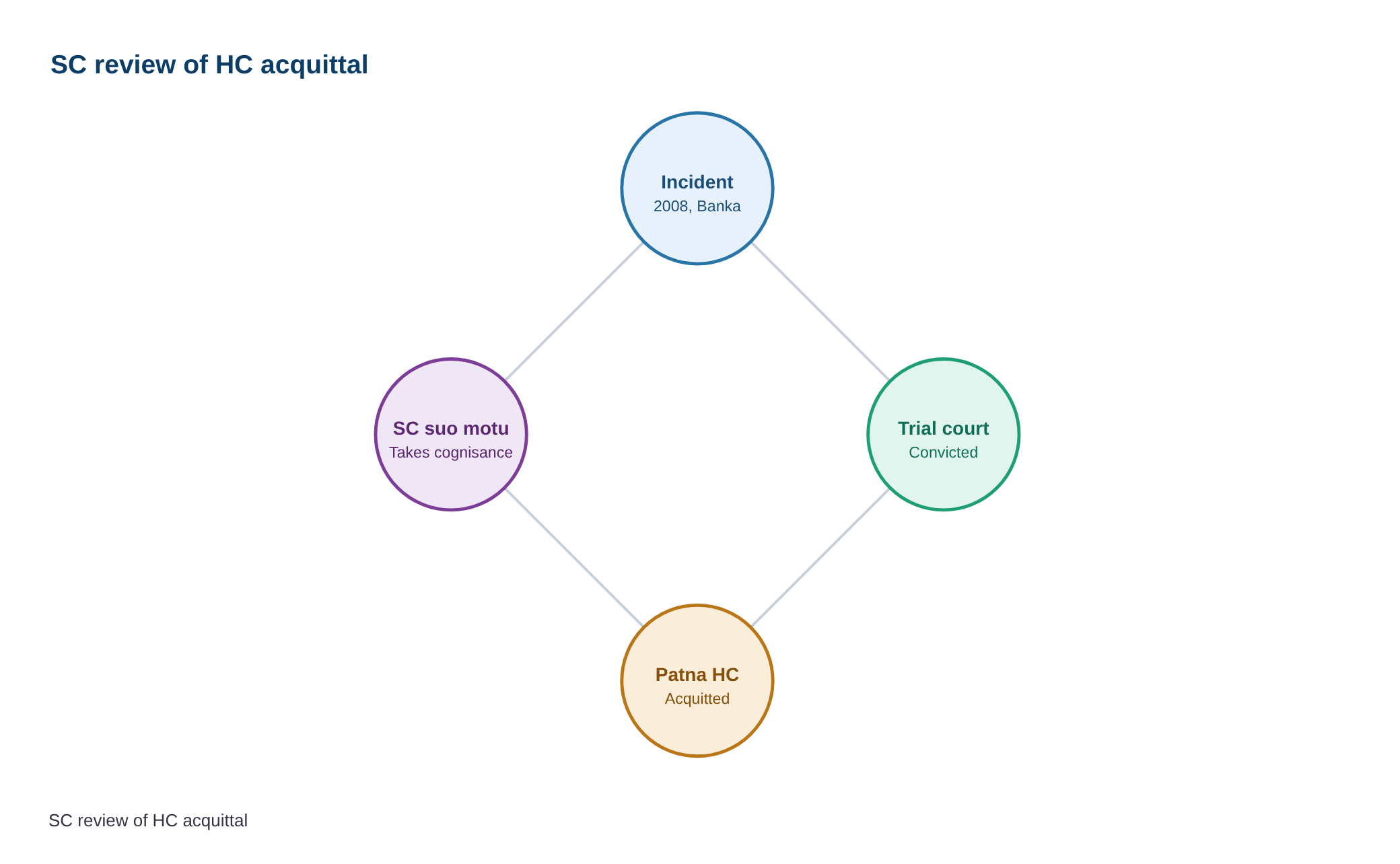
Incident of Alleged Sexual Assault (2008) → Trial Court Conviction (Sections 376/511, 342 IPC) → Patna High Court Acquittal (July 2026) → Supreme Court Suo Motu Cognisance (September 2026) → Judicial Review of High Court Judgment → Potential Setting Aside of Observations → Reaffirmation of Legal Standards in Sexual Offence Cases
Prelims Practice Questions
Q1. Consider the following statements regarding the Supreme Court’s suo motu jurisdiction in criminal matters:
1. The Supreme Court can take suo motu cognisance of a matter only if it involves a substantial question of law or constitutional importance.
2. The Supreme Court’s suo motu power is explicitly conferred by Article 136 of the Constitution of India.
3. The Supreme Court has the power to set aside observations made by a High Court in a judgment while exercising suo motu jurisdiction.
How many of the above statements are correct?
- Only one
- Only two
- All three
- None
Answer: Only two — Statement 1 is correct: Suo motu jurisdiction is exercised when the Court finds a matter of public importance or constitutional significance. Statement 2 is incorrect: Article 136 confers appellate jurisdiction, not suo motu jurisdiction; the latter is derived from Article 32 and Article 142. Statement 3 is correct: The Supreme Court can review and set aside observations made by High Courts under suo motu jurisdiction.
Q2. Assertion (A): Section 354 of the Indian Penal Code (IPC) punishes the offence of outraging the modesty of a woman.
Reason (R): The offence under Section 354 IPC requires proof of actual physical contact with the victim’s body.
Options:
A. Both A and R are true, and R is the correct explanation of A.
B. Both A and R are true, but R is not the correct explanation of A.
C. A is true, but R is false.
D. A is false, but R is true.
Answer: ? — Assertion (A) is correct: Section 354 IPC criminalises outraging the modesty of a woman. Reason (R) is incorrect: The offence under Section 354 does not require proof of physical contact; even gestures, words, or actions that outrage modesty can constitute the offence.
Q3. Match the following legal provisions with their corresponding descriptions:
Column I (Provision)
A. Section 376 IPC
B. Section 511 IPC
C. Section 342 IPC
D. Section 354 IPC
Column II (Description)
1. Punishes attempt to commit an offence punishable with imprisonment for life or imprisonment
2. Punishes sexual intercourse by a man with a woman against her will
3. Punishes wrongful confinement
4. Punishes outraging the modesty of a woman
Options:
A. A-2, B-1, C-3, D-4
B. A-1, B-2, C-3, D-4
C. A-2, B-4, C-3, D-1
D. A-4, B-1, C-2, D-3
Answer: ? — Correct matching: A (Section 376 IPC) → 2 (Punishes sexual intercourse by a man with a woman against her will); B (Section 511 IPC) → 1 (Punishes attempt to commit an offence punishable with imprisonment for life or imprisonment); C (Section 342 IPC) → 3 (Punishes wrongful confinement); D (Section 354 IPC) → 4 (Punishes outraging the modesty of a woman).
Mains Practice Question
✍ The Supreme Court’s suo motu intervention in the Patna High Court’s judgment acquitting an accused in a sexual offence case underscores the tension between judicial discipline and victim-centric justice. Critically examine the constitutional and jurisprudential foundations of suo motu jurisdiction in criminal matters, with particular reference to the balance between judicial activism and the doctrine of separation of powers. Also, analyse the implications of the Supreme Court’s observations on the evidentiary standards in sexual offence cases. (15 Marks)
Approach: MODEL-ANSWER SKELETON:
1. **Introduction (2 marks)**: Define suo motu jurisdiction and its constitutional basis (Article 142, Article 32, and judicial precedents such as *Bandhua Mukti Morcha v. Union of India*).
2. **Constitutional and Jurisprudential Foundations (4 marks)**:
– Article 142: Power to do complete justice.
– Article 32: Writ jurisdiction for enforcement of fundamental rights.
– *In Re: Crl. Appeal No. 1 of 2012* (Nirbhaya case): Precedent for suo motu intervention in sexual offence cases.
– Separation of powers: Judicial review vs. executive/legislative domain.
3. **Judicial Activism vs. Judicial Discipline (4 marks)**:
– *S.P. Gupta v. Union of India* (Judges’ Transfer Case): Limits of judicial activism.
– *In Re: Special Courts Bill, 1978*: Judicial restraint in policy matters.
– *State of West Bengal v. Committee for Protection of Democratic Rights*: Scope of suo motu jurisdiction.
4. **Evidentiary Standards in Sexual Offence Cases (3 marks)**:
– *State of Punjab v. Iqbal Singh*: No absolute rule that medical evidence is mandatory.
– *Ramesh B. Patel v. State of Gujarat*: Reliance on circumstantial evidence.
– *Sakshi v. Union of India*: Judicial sensitivity vs. rigorous standards.
5. **Conclusion (2 marks)**: Balancing victim protection with due process; need for consistency in judicial interpretation of sexual offence laws.
Source: orissapost.com
Bihar PCS (BPSC) — State PCS Practice
Prelims: Recently, the Supreme Court took suo motu cognisance of a Patna High Court judgment related to which of the following cases?
- A. Unnao rape case (2017)
- B. Muzaffarpur shelter home sexual abuse case (2018)
- C. Dhanbad rape and murder case (2020)
- D. Arrah medical college rape case (2021)
Answer: B. Muzaffarpur shelter home sexual abuse case (2018) — The suo motu cognisance was taken by the Supreme Court regarding the Patna High Court’s judgment in the Muzaffarpur shelter home sexual abuse case (2018), which involved widespread sexual violence against minor girls.
Mains: Critically examine the role of the Supreme Court in taking suo motu cognisance of the Patna High Court’s judgment in the Muzaffarpur shelter home sexual abuse case. How does this intervention reflect the judiciary’s responsibility towards ensuring justice for victims of sexual violence in Bihar? Discuss with reference to constitutional provisions and judicial precedents. [‘Introduction: Brief background of the Muzaffarpur shelter home case and the suo motu action by the Supreme Court.’, “Judicial activism vs. judicial restraint: Debate on the Supreme Court’s suo motu power under Article 32 of the Constitution.”, ‘Constitutional provisions: Article 32 (Right to Constitutional Remedies) and Article 21 (Right to Life and Personal Liberty).’, ‘Judicial precedents: Reference to cases like Vishaka Guidelines (1997) and recent judgments on sexual violence.’, ‘Impact on Bihar: Role of state institutions, delays in justice, and measures for victim rehabilitation.’, “Conclusion: Balancing judicial intervention with institutional accountability in Bihar’s context.”]
Generated by AanyaAi for educational purpose.
Related guides on our sites
- Current affairs for upsc 2026
- Best PSIR optional coaching for upsc
- Best Law optional coaching for upsc
- Best PSIR optional teacher for upsc

- SC Takes Suo Motu Cognisance of Patna HC Rape Judgment: Key Analysis for UPSC - September 23, 2026
- सुप्रीम कोर्ट का सीईसी नियुक्ति कानून पर विभाजित फैसला, संविधान पीठ को भेजने पर मतभेद - September 23, 2026
- Supreme Court Split Verdict on CEC, EC Appointment Law: Key UPSC Analysis - September 23, 2026

No Comments