


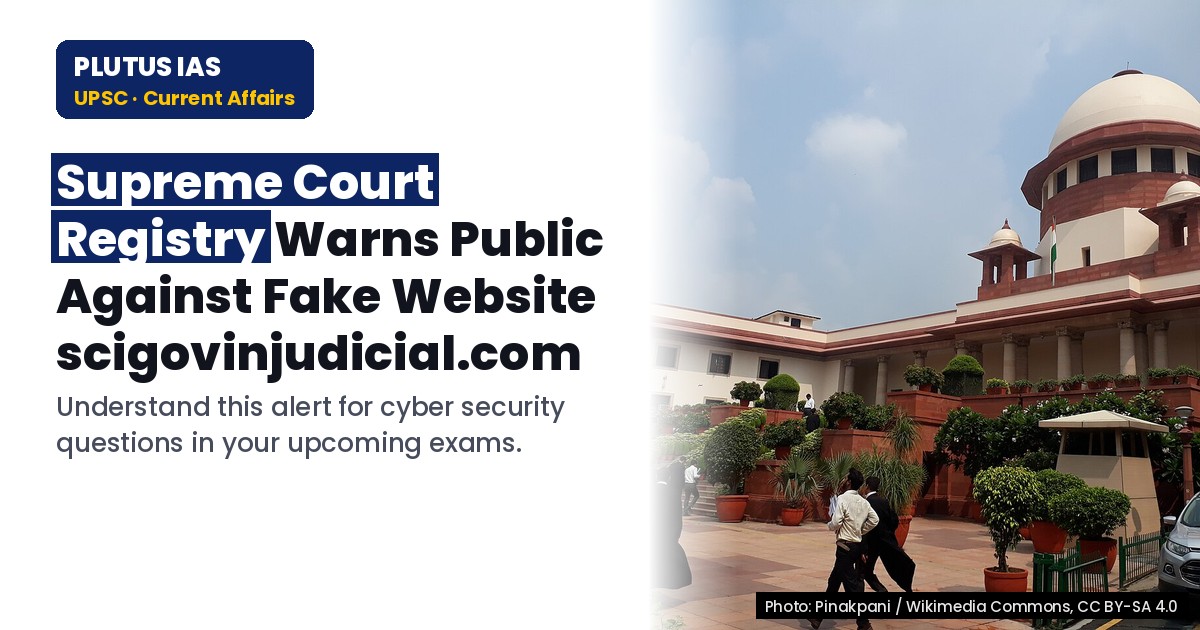
03 Nov SC Warns Public Against Fake Website: UPSC Polity
✎ The Supreme Court's warning against fake websites highlights the critical importance of digital vigilance and robust cybersecurity protocols to combat phishing and protect sensitive personal and financial data.
Subject Relevance — Where This Topic Fits
- GS Paper II — Governance, Constitution, Polity | GS Paper III — Internal Security, Cyber Security, Science and Technology
- Prelims: Supreme Court of India, Cybercrime, Phishing, Digital security, Data theft, Fraudulent websites, Cybersecurity advisories, Registry of the Supreme Court
- Essay: The imperative of digital literacy and cybersecurity in an increasingly online world., Challenges and strategies for safeguarding public institutions and citizens from cyber threats.
Quick Revision: The Supreme Court’s warning against fake websites highlights the critical importance of digital vigilance and robust cybersecurity protocols to combat phishing and protect sensitive personal and financial data.
Why is this in the news?
The Supreme Court Registry has issued a public notice regarding a newly identified fraudulent domain, ‘scigovinjudicial.com’, which is impersonating the official website of the Supreme Court of India. This advisory, building upon previous warnings, cautions the public against divulging personal or financial information to such deceptive websites, which are designed to defraud individuals through targeted phishing mechanisms, thereby highlighting the persistent threat of cybercrime targeting governmental institutions and citizens.
Background
- The Supreme Court of India’s official domain is ‘sci.gov.in’, which is a critical identifier for authentic communications and services.
- Phishing attacks involve cybercriminals attempting to acquire sensitive information such as usernames, passwords, and credit card details by masquerading as a trustworthy entity in an electronic communication.
- Impersonation of governmental and judicial websites is a common tactic used by cybercriminals to exploit public trust and legitimacy.
- The Supreme Court Registry has previously issued multiple public notices concerning similar fraudulent websites, indicating a recurring pattern of cyber threats.
- Such incidents underscore the broader challenge of maintaining digital security and integrity in the public sector and protecting citizens from online fraud.
- The proliferation of digital services necessitates heightened vigilance and robust cybersecurity measures from both institutions and individual users.
Understanding Phishing and Cyber Security Measures
- Phishing is a form of cybercrime where attackers attempt to trick individuals into revealing sensitive information by posing as a legitimate entity, often through fraudulent emails, messages, or websites.
- These attacks typically create a sense of urgency or fear to prompt immediate action from the victim, such as clicking a malicious link or downloading an infected attachment.
- Common indicators of a phishing attempt include suspicious URLs, grammatical errors, unsolicited requests for personal information, and generic greetings.
- Cybersecurity measures involve a combination of technologies, processes, and controls designed to protect systems, networks, and data from cyber threats.
- For individuals, key cybersecurity practices include verifying URLs, using strong and unique passwords, enabling multi-factor authentication, and regularly updating software.
- Institutions, particularly governmental bodies, must implement robust network security, conduct regular security audits, and issue public advisories to mitigate risks.
- The ‘gov.in’ domain is exclusively reserved for government entities in India, serving as a crucial indicator of authenticity for official websites.
- Reporting suspected phishing attempts to relevant authorities, such as the Indian Cyber Crime Coordination Centre (I4C), is essential for collective security.
Key Features
| Feature | Significance |
|---|---|
| Impersonation of Official Websites | Cybercriminals create fraudulent domains that closely mimic legitimate government or institutional websites, such as that of the Supreme Court of India, to deceive the public. |
| Phishing Mechanisms | These fraudulent websites are employed as tools for phishing attacks, aiming to solicit sensitive personal data and confidential credentials from unsuspecting individuals. |
| Data Theft and Financial Fraud | The primary objective of such cyberattacks is to facilitate the theft of personal and financial information, which can subsequently be used for identity theft, financial fraud, or other malicious activities. |
| Public Advisories and Vigilance | Authorities, including the Supreme Court Registry, issue public notices and advisories to caution citizens against these deceptive practices and to promote digital literacy and vigilance. |
| Verification of URLs | A key preventive measure involves encouraging users to verify the authenticity of Uniform Resource Locators (URLs) by hovering over them before engaging with any electronic communication or website. |
Why it Matters
Governance and Public Trust
- The integrity of governmental and judicial institutions is paramount for maintaining public trust. Impersonation of official websites erodes this trust, potentially leading to a loss of faith in digital governance mechanisms.
- Such incidents highlight the critical need for robust cybersecurity infrastructure and proactive measures by government bodies to protect their digital assets and the citizens they serve.
Cybersecurity and Digital Safety
- The proliferation of fake websites underscores the evolving landscape of cyber threats, necessitating continuous updates in cybersecurity protocols and public awareness campaigns.
- It emphasizes the importance of digital literacy among citizens, enabling them to identify and avoid phishing attempts and other online scams, thereby enhancing overall digital safety.
Legal and Regulatory Framework
- These incidents often fall under the purview of cybercrime, necessitating stringent enforcement of existing laws and potentially the development of new legal instruments to combat sophisticated digital fraud.
- The repeated issuance of advisories by a judicial body like the Supreme Court highlights the systemic challenge posed by cybercriminals and the ongoing efforts required to protect citizens’ rights in the digital sphere.
Challenges
1. Sophistication of Cyberattacks
- Cybercriminals are employing increasingly sophisticated techniques, including advanced phishing and domain spoofing, making it difficult for the average user to distinguish between legitimate and fraudulent websites.
- The rapid evolution of these methods often outpaces the development of detection and prevention mechanisms, posing a continuous challenge to cybersecurity agencies.
UPSC Link: Cybersecurity challenges
2. Public Digital Literacy
- A significant portion of the population lacks adequate digital literacy to identify subtle indicators of phishing attempts or fraudulent websites, making them vulnerable targets.
- Bridging this knowledge gap across diverse demographics presents a substantial educational and outreach challenge for government and civil society organizations.
UPSC Link: Digital literacy and inclusion
3. Jurisdictional Issues in Cybercrime
- Cybercriminals often operate across national borders, complicating investigations and prosecutions due to varying legal frameworks and challenges in international cooperation.
- Tracing and apprehending perpetrators who exploit global digital infrastructure requires robust international collaboration, which is often complex to achieve effectively.
UPSC Link: International cooperation in cybercrime
4. Resource Allocation for Cybersecurity
- Government bodies and public institutions require significant financial and human resources to establish and maintain advanced cybersecurity infrastructure, including threat intelligence and incident response teams.
- Ensuring adequate investment in these areas, particularly for critical public services, remains a persistent challenge amidst competing budgetary priorities.
UPSC Link: Government resource management
Challenges — UPSC Perspective
| Issue | Concern |
|---|---|
| Impersonation of Official Identities | Erosion of public trust in government and judicial institutions, leading to reluctance in engaging with legitimate online services. |
| Data Breaches and Identity Theft | Significant financial losses for individuals and potential misuse of personal information for criminal activities. |
| Difficulty in Attribution and Prosecution | Anonymity provided by the internet and cross-border operations complicate the identification and legal action against cybercriminals. |
| Scalability of Awareness Campaigns | Effectively disseminating cybersecurity advisories to a vast and diverse population, especially those with limited digital access or literacy. |
| Maintaining Digital Infrastructure Security | Ensuring that official government websites and digital platforms are continuously updated and secured against emerging cyber threats. |
Way Forward
- Implement advanced threat detection systems, including AI-driven anomaly detection and real-time monitoring, to identify and neutralize fraudulent websites and phishing attempts proactively.
- Launch comprehensive national digital literacy campaigns, utilizing various media channels, to educate citizens on identifying phishing attempts, verifying URLs, and practicing secure online habits.
- Strengthen inter-agency coordination and international cooperation mechanisms for intelligence sharing and joint operations to combat cross-border cybercrime effectively.
- Establish a centralized national portal for reporting cybercrime, ensuring prompt action and providing clear guidance to victims on steps to mitigate damage.
- Mandate regular cybersecurity audits and penetration testing for all government websites and digital services to identify vulnerabilities and ensure compliance with best security practices.
- Develop and enforce stricter legal provisions and penalties for cyber impersonation and data theft, ensuring that perpetrators face swift and appropriate legal consequences.
- Promote public-private partnerships to leverage expertise and resources from the cybersecurity industry in developing robust defense mechanisms and innovative solutions against cyber threats.
UPSC Value Addition
Keywords for Mains Answer-Writing
Cybersecurity · Phishing attacks · Digital fraud · Supreme Court Registry · Information technology law · Data protection · Public awareness campaigns · Online vigilance · Cybercrime prevention · Judicial infrastructure security
Concept Flow
Cybercriminals create fake websites impersonating official entities. → These sites are used for phishing, soliciting personal and financial data. → Unsuspecting users divulge sensitive information. → Data theft occurs, leading to potential financial fraud and identity theft. → Authorities issue public advisories to caution citizens and promote vigilance. → Citizens are advised to verify URLs and update security credentials.
Prelims Practice Questions
Q1. Consider the following statements regarding cybersecurity and digital fraud:
1. Phishing is a type of cyber attack where malicious actors attempt to trick users into divulging sensitive information by impersonating a legitimate entity.
2. The Supreme Court of India’s official domain is sci.gov.in.
3. The Information Technology Act, 2000, provides legal provisions to address cybercrimes in India.
- Only one
- Only two
- All three
- None
Answer: All three — Statement 1 is correct: Phishing involves deceptive communication to obtain personal data. Statement 2 is correct: The news explicitly states sci.gov.in as the Supreme Court’s official domain. Statement 3 is correct: The IT Act, 2000, is the primary legislation in India dealing with cybercrime and e-commerce.
Q2. Which of the following measures is NOT typically recommended for preventing phishing attacks?
- Verifying the authenticity of URLs by hovering over them.
- Regularly updating passwords for all online accounts.
- Clicking on suspicious links to check their content.
- Notifying banks immediately in case of suspected compromise.
Answer: Clicking on suspicious links to check their content. — Clicking on suspicious links is a dangerous practice that can lead to malware installation or data theft. The other options are standard and effective preventive measures.
Mains Practice Question
✍ Examine the challenges posed by evolving cyber threats, such as phishing and website impersonation, to critical public institutions in India. Discuss the multi-pronged approach required to safeguard digital infrastructure and public trust. (15 Marks)
Approach: MODEL-ANSWER SKELETON:
1. **Introduction:** Define cyber threats like phishing and website impersonation, highlighting their increasing sophistication and targeting of public institutions.
2. **Challenges Posed:**
* **Data Breach and Privacy Concerns:** Risk of sensitive personal and financial data compromise.
* **Erosion of Public Trust:** Damage to the credibility and authority of institutions like the Supreme Court.
* **Operational Disruption:** Potential to disrupt essential services and judicial processes.
* **Financial Fraud:** Direct monetary losses to individuals and potential economic impact.
* **Reputational Damage:** Long-term negative perception of institutional security and reliability.
* **Legal and Regulatory Burden:** Challenges in prosecuting cybercriminals across jurisdictions.
3. **Multi-pronged Approach for Safeguarding:**
* **Technological Measures:** Implementation of advanced cybersecurity protocols (e.g., firewalls, intrusion detection systems, multi-factor authentication, secure coding practices).
* **Legal and Regulatory Framework:** Strengthening the Information Technology Act, 2000, and related rules; international cooperation for cybercrime prosecution.
* **Public Awareness and Education:** Regular advisories, campaigns (e.g., CERT-In initiatives) to educate citizens on identifying and reporting cyber fraud.
* **Institutional Capacity Building:** Training of personnel in cybersecurity, establishment of dedicated cyber cells within institutions.
* **Proactive Monitoring and Threat Intelligence:** Continuous surveillance for fraudulent domains and phishing attempts, sharing threat intelligence among agencies.
* **Incident Response and Recovery:** Developing robust plans for rapid response to cyber incidents and ensuring business continuity.
* **Collaboration:** Enhanced coordination between government agencies, law enforcement, and private cybersecurity firms.
4. **Conclusion:** Emphasize the need for a dynamic, adaptive, and collaborative strategy to counter cyber threats, ensuring the integrity of digital governance and protecting citizens.
Source: orissapost.com
Generated by AanyaAi for educational purpose.
Related guides on our sites
- Best PSIR optional coaching for upsc
- Best PSIR optional teacher for upsc
- Best teacher of PSIR optional for upsc
- Best PSIR optional coaching in delhi for UPSC

- SC Warns Public Against Fake Website: UPSC Polity - November 3, 2026
- डीजीपी नियुक्ति नियम: सुप्रीम कोर्ट ने सभी राज्यों से मांगा ब्योरा - November 3, 2026
- Telangana Egg Harvesting Racket: Governance & Women’s Rights - November 3, 2026

No Comments