


17 Jul SEBI Streamlines Mutual Fund Transmission for Ease of Claim
Subject Relevance — Where This Topic Fits
- GS Paper III — Economy (Indian Economy and issues relating to planning, mobilization of resources, growth, development and employment; Inclusive growth and issues arising from it; Government Budgeting; Investment models) | GS Paper II — Governance (Government policies and interventions for development in various sectors and issues arising out of their design and implementation)
- Prelims: SEBI, Mutual Funds, Transmission Claim, Investor Protection, Asset Management Companies (AMCs), Registrar and Transfer Agents (RTAs), KYC, Nomination Facility, Securities Market, Financial Inclusion
- Essay: The Role of Regulatory Bodies in Fostering Financial Inclusion and Investor Confidence in India, Balancing Ease of Doing Business with Robust Consumer Protection: A Regulatory Imperative
Quick Revision: SEBI’s recent measures aim to simplify mutual fund transmission claims, bolstering investor protection, market efficiency, and financial inclusion by standardizing processes and leveraging technology.
Why is this in the news?
The Securities and Exchange Board of India (SEBI) recently announced measures aimed at streamlining the mutual fund process for ease of transmission claims. This initiative, articulated in PR No. 41/2026 on July 17, 2026, underscores SEBI’s continuous commitment to enhancing investor protection, reducing operational complexities, and improving the overall efficiency of the Indian securities market, particularly concerning the transfer of assets to legal heirs or nominees upon the demise of an investor.
Background
- The Indian mutual fund industry has witnessed significant growth, with Assets Under Management (AUM) reaching unprecedented levels, attracting a diverse investor base.
- Despite this growth, challenges related to the transmission of units upon the death of an investor have persisted, often leading to delays, procedural hurdles, and distress for claimants.
- Existing regulations, while providing a framework, sometimes lacked uniformity and clarity across different Asset Management Companies (AMCs) and Registrar and Transfer Agents (RTAs).
- The absence of a standardized, simplified process often resulted in multiple documentation requirements and extended processing times, impacting investor confidence.
- SEBI, as the primary regulator of the securities market, has a mandate to protect the interests of investors and promote the development and regulation of the securities market.
- Previous regulatory interventions have focused on various aspects of mutual fund operations, including KYC norms, disclosure requirements, and investor grievance redressal mechanisms.
What is a Mutual Fund Transmission Claim?
- A mutual fund transmission claim refers to the process by which the legal heirs or nominees of a deceased unitholder claim the units held in a mutual fund scheme.
- This process involves transferring the ownership of mutual fund units from the deceased investor to the rightful claimant(s).
- The primary objective is to ensure that the assets of the deceased are seamlessly transferred to their beneficiaries, as per legal provisions or nomination details.
- It is distinct from a ‘redemption’ where an investor sells their units back to the fund house.
- The claim process typically requires submission of specific documents such as the death certificate, proof of identity of claimants, and legal heirship certificates or nomination forms.
- The process is governed by SEBI regulations and guidelines issued to Asset Management Companies (AMCs) and their Registrar and Transfer Agents (RTAs).
- Effective transmission mechanisms are crucial for maintaining investor trust and ensuring the long-term viability of the mutual fund industry.
- The complexity often arises from varying documentation requirements, especially in cases without a valid nomination.
Key Features
| Feature | Significance |
|---|---|
| Standardized Documentation | Reduces ambiguity and varying requirements across AMCs/RTAs, simplifying the claimant’s burden. |
| Online Submission Facility | Enhances accessibility and convenience, allowing claimants to initiate and track claims digitally, reducing physical visits. |
| Time-bound Processing | Mandates specific timelines for claim processing, ensuring prompt settlement and reducing distress for beneficiaries. |
| Single Point of Contact | Potentially designates a single entity (e.g., RTA) for all claims related to a deceased investor, irrespective of multiple fund houses. |
| Enhanced Nomination Facility | Promotes wider adoption and clarity of nomination, which significantly simplifies the transmission process. |
| Clarified Role of RTAs | Streamlines the responsibilities of Registrar and Transfer Agents, who are central to processing these claims. |
Why it Matters
Investor Protection and Confidence
- Simplifying transmission claims directly addresses a major pain point for investors and their families, thereby bolstering confidence in mutual funds as a viable investment avenue.
- Ensures that the rightful beneficiaries receive the assets without undue hardship, upholding the principle of investor welfare.
Market Efficiency and Development
- Reduced procedural complexities lead to faster processing, freeing up operational resources for AMCs and RTAs, enhancing overall market efficiency.
- A more robust and transparent transmission mechanism contributes to the orderly development of the securities market by fostering trust and participation.
Financial Inclusion
- Easier processes encourage wider participation from diverse investor segments, including those from semi-urban and rural areas who may be deterred by complex procedures.
- Contributes to the broader goal of financial inclusion by making financial products more accessible and user-friendly.
Regulatory Alignment
- Aligns SEBI’s regulatory framework with global best practices in investor protection and asset transmission.
- Demonstrates SEBI’s proactive approach in adapting regulations to evolving market needs and technological advancements.
Challenges
1. Awareness and Education
- Many investors are unaware of the importance of nomination or the transmission process, leading to complications post-demise.
- Lack of financial literacy, especially in rural and semi-urban areas, can hinder understanding and compliance with procedural requirements.
UPSC Link: Financial Literacy, Investor Education
2. Data Management and Digitization
- Ensuring secure and interoperable digital platforms for document submission and verification across all AMCs and RTAs remains a technical challenge.
- Maintaining updated investor data, including nominee details, is crucial but often overlooked by investors.
UPSC Link: Digital Infrastructure, Data Security
3. Legal and Heirship Complexities
- In the absence of a nomination, determining legal heirs can be a protracted legal process, often involving courts and multiple legal documents.
- Disputes among legal heirs can further complicate and delay the transmission process, despite simplified regulatory frameworks.
UPSC Link: Legal Frameworks, Succession Laws
4. Operational Implementation
- Ensuring uniform implementation of new guidelines across all AMCs and RTAs, particularly smaller entities, can be challenging.
- Training and equipping personnel to handle the streamlined processes effectively requires significant investment.
UPSC Link: Regulatory Compliance, Institutional Capacity
Challenges — UPSC Perspective
| Issue | Concern |
|---|---|
| Varying Documentation | Claimants face confusion and delays due to inconsistent requirements across different fund houses. |
| Lack of Nomination | Absence of a nominee necessitates complex legal procedures for heirship determination. |
| Manual Processes | Reliance on physical documents and in-person submissions leads to inefficiencies and delays. |
| Investor Awareness | Many investors are unaware of the importance of nomination or the transmission process itself. |
| Data Inconsistencies | Outdated or incorrect investor data can complicate verification and processing. |
| Grievance Redressal | Inefficient mechanisms for addressing claimant grievances can erode trust. |
Government Initiatives — Must-Memorise for Prelims
- SEBI (Mutual Funds) Regulations, 1996
- Investor Protection and Education Fund (IPEF)
- SEBI Investor Charter
- KYC Registration Agency (KRA) framework
- Unified Payments Interface (UPI) for mutual fund transactions
- Online Dispute Resolution (ODR) mechanism for securities market
- Account Aggregator Framework
- Digital India Programme
- Jan Dhan-Aadhaar-Mobile (JAM) Trinity
- National Strategy for Financial Education (NSFE)
Way Forward
- **Enhanced Investor Awareness Campaigns:** SEBI, in collaboration with AMCs and industry bodies, must launch extensive campaigns to educate investors on the importance of nomination and the simplified transmission process.
- **Robust Digital Infrastructure:** Further investment in secure, interoperable digital platforms for end-to-end transmission claim processing, including digital verification of documents.
- **Standardization and Harmonization:** Continue to standardize documentation and procedural requirements across all market intermediaries to eliminate inconsistencies.
- **Capacity Building:** Provide training and resources to AMC and RTA personnel to ensure effective implementation of the new guidelines and empathetic handling of claims.
- **Leveraging Technology:** Explore the use of Artificial Intelligence and Machine Learning for faster document verification and fraud detection in transmission claims.
- **Periodic Review and Feedback:** Establish a mechanism for periodic review of the new processes and incorporate feedback from claimants and intermediaries for continuous improvement.
- **Strengthening Grievance Redressal:** Ensure efficient and time-bound grievance redressal mechanisms for transmission-related issues.
- **Collaboration with Legal Authorities:** Facilitate better coordination with legal authorities for quicker issuance of heirship certificates where nominations are absent.
UPSC Value Addition
Keywords for Mains Answer-Writing
Investor Protection · Market Efficiency · Financial Inclusion · Regulatory Reforms · Digital Transformation · Ease of Doing Business · Securities Market Development · Consumer Confidence · Governance in Finance · Systemic Risk Mitigation · Operational Streamlining · Heirship Challenges
Constitutional & Policy Linkages
- SEBI Act, 1992: Statutory body for securities market regulation
- Companies Act, 2013: Provisions related to share transfers and nominee rights
- Indian Succession Act, 1925: Governs succession in absence of a will/nomination
- Information Technology Act, 2000: Legal framework for digital transactions and records
- Constitution of India (Article 19(1)(g)): Right to practice any profession, or to carry on any occupation, trade or business (indirectly related to market freedom)
- Constitution of India (Directive Principles of State Policy): Promoting welfare of the people (Article 38)
Concept Flow
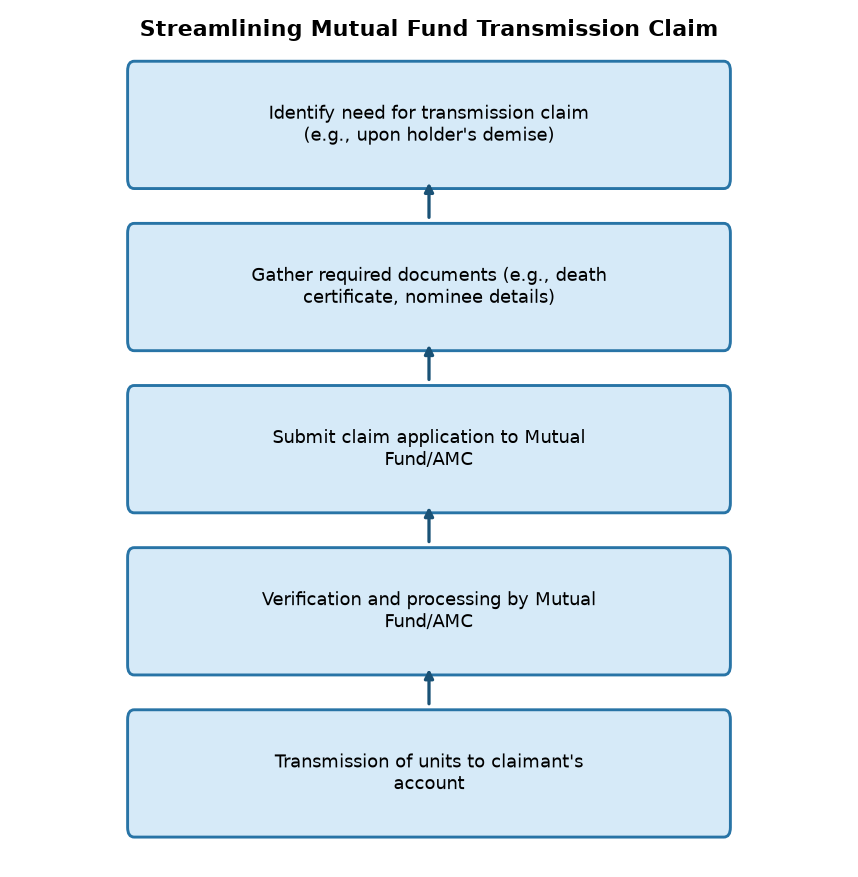
Investor invests in Mutual Funds → Investor’s demise occurs → Nominee/Legal Heir initiates Transmission Claim → Claim submitted with required documents (Death Cert, ID, Nomination/Heirship) → AMC/RTA verifies documents and processes claim → Units transferred to Nominee/Legal Heir’s account → Claim settlement completed
Prelims Practice Questions
Q1. With reference to the recent SEBI measures for streamlining mutual fund transmission claims, consider the following statements:
1. The measures primarily aim to simplify the process for redeeming mutual fund units by deceased investors.
2. Registrar and Transfer Agents (RTAs) play a crucial role in processing these transmission claims.
3. The absence of a valid nomination typically simplifies the transmission process due to reduced documentation.
Which of the statements given above is/are correct?
- A. 1 only
- B. 2 only
- C. 1 and 3 only
- D. 2 and 3 only
Answer: B. 2 only — Statement 1 is incorrect. The measures aim to simplify the ‘transmission’ of units to legal heirs/nominees, not ‘redemption’ by deceased investors. Statement 2 is correct. RTAs are central to processing mutual fund transactions, including transmission claims. Statement 3 is incorrect. The absence of a valid nomination complicates the transmission process, often requiring legal heirship certificates and potentially court orders, thus increasing documentation and complexity.
Q2. Which of the following is NOT a primary objective of SEBI’s recent initiatives to streamline mutual fund transmission claims?
- A. Enhancing investor protection and confidence.
- B. Reducing operational complexities for Asset Management Companies (AMCs).
- C. Promoting speculative trading in mutual fund units.
- D. Fostering greater financial inclusion.
Answer: C. Promoting speculative trading in mutual fund units. — Options A, B, and D are all primary objectives of SEBI’s initiatives, as they aim to make the market safer, more efficient, and accessible. Option C, ‘Promoting speculative trading in mutual fund units,’ is contrary to SEBI’s mandate of investor protection and orderly market development, which generally discourages speculation.
Mains Practice Question
✍ The recent SEBI measures to streamline mutual fund transmission claims are a significant step towards enhancing investor protection and market efficiency. Critically examine the implications of these reforms for the Indian financial market and discuss the persistent challenges that need to be addressed for their effective implementation. (250 words)
Approach: Begin by briefly introducing the context of SEBI’s role and the objective of the recent measures. Discuss the positive implications, such as increased investor confidence, improved market efficiency, and contribution to financial inclusion. Subsequently, critically examine the challenges that may hinder effective implementation, including low investor awareness, data management complexities, legal hurdles in the absence of nomination, and operational issues. Conclude with a forward-looking perspective, suggesting measures like enhanced investor education, robust digital infrastructure, and continuous regulatory oversight to overcome these challenges and fully realize the benefits of the reforms.
Source: SEBI
Generated by AanyaAi for educational purpose.

- Harivansh Leads India at 153rd IPU Assembly in Tanzania - October 3, 2026
- अमेरिका में व्यापार मिशन: भारत की बड़ी योजना, जानिए क्या है सरकार की रणनीति - October 3, 2026
- Nasha Mukt Bharat: Youth Role in Polity & Governance for UPSC & PCS - October 3, 2026

No Comments