


17 Aug SEED Scheme: Govt’s Key Initiative for DNNT Communities’ Upliftment
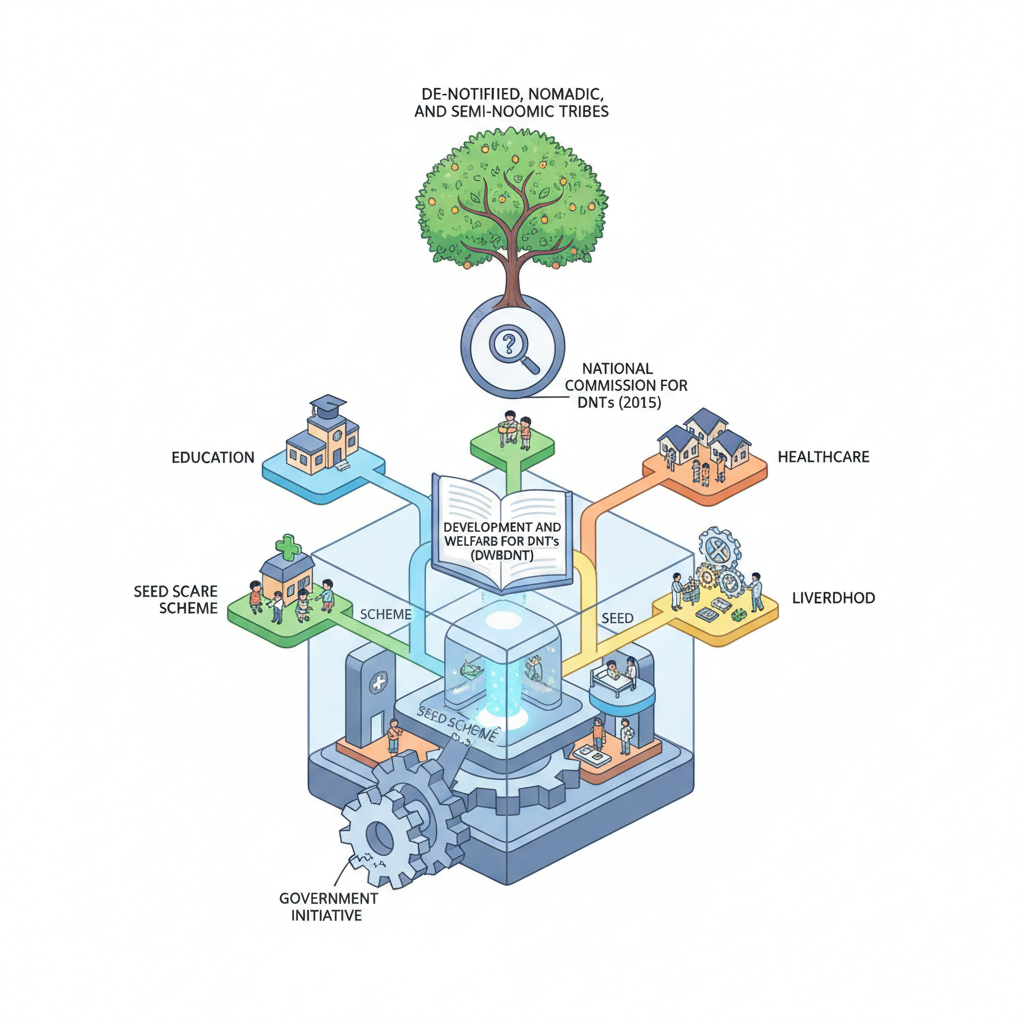
SEED SchemeDWBDNT BoardDNT CommunitiesNC-DNT Commission✎ The CEED Scheme is a governance framework under the DWBDNT, integrating education, healthcare, livelihood, and housing components to address the socio-economic exclusion of De-Notified, Nomadic, and Semi-Nomadic Tribes, aligning…
Subject Relevance — Where This Topic Fits
- GS Paper I — Social Empowerment | GS Paper II — Constitutional and Statutory Bodies | GS Paper III — Welfare Schemes for Vulnerable Sections
- Prelims: De-Notified Tribes (DNTs), Nomadic and Semi-Nomadic Tribes (NT/SNT), Development and Welfare Board for DNTs (DWBDNT), SEED Scheme (Scheme for Economic Empowerment of DNTs), Competitive Examination Coaching for DNTs, National Commission for DNTs
- Essay: The Role of Constitutional Safeguards in Addressing Historical Marginalization, Balancing Inclusion and Development: Policy Interventions for Vulnerable Communities
Quick Revision: The CEED Scheme is a governance framework under the DWBDNT, integrating education, healthcare, livelihood, and housing components to address the socio-economic exclusion of De-Notified, Nomadic, and Semi-Nomadic Tribes, aligning with constitutional mandates for affirmative action.
Why is this in the news?
The Press Information Bureau (PIB) has highlighted the implementation of the Scheme for Economic Empowerment of DNTs (CEED) through the Development and Welfare Board for De-Notified, Nomadic, and Semi-Nomadic Tribes (DWBDNT). This initiative aims to address the socio-economic disparities faced by these historically marginalized communities through targeted interventions in education, healthcare, livelihood, and housing. The scheme’s structured approach underscores the government’s commitment to inclusive development and institutionalized support mechanisms for DNTs.
Background
- The National Commission for De-Notified, Nomadic, and Semi-Nomadic Tribes (DNTs) was constituted in January 2015 to examine and recommend measures for the welfare and development of these communities.
- The Commission submitted its report in December 2017, identifying systemic exclusion, lack of access to education, healthcare, and livelihood opportunities, and historical stigmatization as key challenges.
- In February 2019, the Government of India established the Development and Welfare Board for De-Notified, Nomadic, and Semi-Nomadic Tribes (DWBDNT) to implement the recommendations of the Commission.
- DNTs include communities that were previously classified as ‘criminal tribes’ under the Criminal Tribes Act, 1871, which was repealed in 1952 but left lasting socio-economic scars.
- Nomadic and Semi-Nomadic Tribes (NT/SNT) are characterized by their migratory or semi-migratory lifestyles, often leading to exclusion from formal systems of governance and service delivery.
Key Features
| Feature | Significance |
|---|---|
| Four-component framework (Education, Health, Livelihood, Housing) | Ensures a holistic approach to address the multidimensional vulnerabilities of DNT/NT/SNT communities. |
| Competitive exam coaching for DNT candidates | Facilitates access to civil services and other high-competition examinations, enhancing socio-economic mobility. |
| Health insurance support for DNT communities | Reduces out-of-pocket expenditure and mitigates health-related financial risks. |
| Livelihood initiatives at community level | Promotes self-employment, skill development, and sustainable income-generation models. |
| Financial assistance for housing construction | Improves living conditions and reduces homelessness among marginalised nomadic groups. |
Why it Matters
Social Justice and Inclusion
- Operationalises constitutional mandate under Articles 15(4) and 46 for the welfare of historically marginalised groups.
- Acknowledges historical injustices faced by De-notified, Nomadic, and Semi-Nomadic Tribes (DNT/NT/SNT) due to colonial-era criminalisation.
- Aligns with the principles of affirmative action to bridge socio-economic disparities.
Policy Continuity and Institutional Strengthening
- Builds on the National Commission for De-notified, Nomadic and Semi-Nomadic Tribes (2015–2017) and its recommendations.
- Establishes the Development and Welfare Board for DNTs (DWBDNC) as a permanent institutional mechanism for targeted interventions.
- Demonstrates a structured, multi-sectoral governance approach to tribal welfare.
Economic Empowerment and Poverty Alleviation
- Targets structural barriers to economic participation by providing livelihood support and skill development.
- Enhances human capital through education and health interventions, enabling long-term economic independence.
- Reduces dependency on exploitative informal economic activities common among nomadic communities.
Administrative Efficiency and Targeted Delivery
- Leverages a dedicated institutional framework (DWBDNC) for focused policy implementation.
- Uses a multi-component strategy to address overlapping vulnerabilities across education, health, and housing.
- Ensures convergence with existing welfare schemes for efficiency and scalability.
Challenges
1. Historical Marginalisation and Stigma
- Deep-rooted social stigma and historical criminalisation of DNT/NT/SNT communities impede social acceptance and integration.
- Lack of reliable data on population and socio-economic status hinders accurate targeting of beneficiaries.
- Cultural and linguistic diversity within these communities complicates policy design and delivery.
UPSC Link: GS-I: Tribal communities; GS-II: Social Justice
2. Implementation Gaps and Institutional Constraints
- Limited awareness among target communities about eligibility and benefits under SEED, leading to low uptake.
- Fragmented delivery mechanisms across states due to varying administrative capacities and priorities.
- Inadequate monitoring and evaluation frameworks to assess impact and course-correct.
UPSC Link: GS-II: Governance; GS-III: Developmental challenges
3. Sustainability of Livelihood Initiatives
- Nomadic lifestyles and seasonal mobility create challenges in providing consistent access to services.
- Dependence on informal economic activities limits scalability of formal livelihood programmes.
- Climate vulnerabilities and lack of asset ownership exacerbate economic instability.
UPSC Link: GS-III: Rural Development; GS-I: Tribal livelihoods
4. Healthcare Accessibility and Quality
- Geographical remoteness and lack of fixed abodes hinder access to health facilities.
- Low health literacy and cultural barriers affect utilisation of health services.
- Inadequate healthcare infrastructure in tribal and nomadic habitations.
UPSC Link: GS-II: Health; GS-I: Tribal health
5. Housing and Land Rights Issues
- Nomadic communities often lack legal land titles, complicating housing interventions.
- High construction costs and lack of collateral limit access to housing finance.
- Policy gaps in recognising customary land rights hinder settlement schemes.
UPSC Link: GS-II: Housing; GS-III: Land reforms
Challenges — UPSC Perspective
| Issue | Concern |
|---|---|
| Data Deficiency | Absence of reliable demographic and socio-economic data on DNT/NT/SNT communities. |
| Cultural Barriers | Stigma and lack of awareness among target communities about welfare schemes. |
| Administrative Fragmentation | Variations in state-level implementation due to differing priorities. |
| Geographical Mobility | Seasonal movement patterns disrupt continuity in service delivery. |
| Healthcare Infrastructure Gaps | Inadequate primary healthcare facilities in tribal and nomadic habitations. |
| Legal Land Rights | Lack of land titles complicates housing and settlement interventions. |
Government Initiatives — Must-Memorise for Prelims
- Development and Welfare Board for De-notified, Nomadic and Semi-Nomadic Communities (DWBDNC)
Way Forward
- Strengthen data collection mechanisms to accurately identify and enumerate DNT/NT/SNT populations.
- Enhance inter-state coordination to ensure uniform implementation of SEED across regions.
- Expand awareness campaigns through community leaders and local institutions to improve scheme uptake.
- Develop mobile service delivery units to address geographical mobility and service accessibility.
- Integrate SEED with existing welfare schemes (e.g., Ayushman Bharat, PM-KISAN) for convergence and efficiency.
- Establish a robust monitoring and evaluation framework to track progress and address implementation gaps.
- Promote public-private partnerships to enhance skill development and livelihood opportunities.
- Address legal barriers to land ownership to facilitate housing and settlement schemes.
UPSC Value Addition
Keywords for Mains Answer-Writing
De-notified Tribes (DNT), Nomadic Tribes (NT), Semi-Nomadic Tribes (SNT), Development and Welfare Board for De-notified, Nomadic and Semi-Nomadic Communities (DWBDNC), Scheme for Economic Empowerment of De-notified Tribes (SEED), social justice, inclusive development, constitutional provisions for marginalised groups, National Commission for De-notified, Nomadic and Semi-Nomadic Tribes (NCDNT), welfare measures for marginalised communities, socio-economic empowerment, access to education, healthcare, livelihood and housing · De-notified Tribes · Nomadic Tribes · Semi-Nomadic Tribes · DWBDNC · SEED Scheme · social justice · inclusive development · marginalised communities · constitutional provisions · welfare measures · socio-economic empowerment
Constitutional & Policy Linkages
- Article 15(4) – Special provisions for socially and educationally backward classes.
- Article 46 – Promotion of educational and economic interests of weaker sections.
- Fifth Schedule – Administration and control of Scheduled Areas and Scheduled Tribes.
Concept Flow
Colonial-era criminalisation of nomadic tribes → Historical marginalisation and stigma → Constitutional recognition of socio-economic backwardness → Formation of National Commission (2015) → Recommendations on welfare and empowerment → Establishment of DWBDNC (2019) → Launch of SEED scheme → Multi-component interventions (Education, Health, Livelihood, Housing) → Socio-economic empowerment and improved living conditions.
Prelims Practice Questions
Q1. Consider the following statements regarding the Development and Welfare Board for De-notified, Nomadic and Semi-Nomadic Communities (DWBDNC):
1. It was constituted by the Government of India in February 2019.
2. It implements the Scheme for Economic Empowerment of De-notified Tribes (SEED).
3. It was established based on the recommendations of the National Commission for De-notified, Nomadic and Semi-Nomadic Tribes (NCDNT) submitted in December 2017.
4. Its mandate includes providing financial assistance for housing under the SEED scheme.
How many of the above statements are correct?
- Only one
- Only two
- Only three
- All four
Answer: All four — Statements 1, 2, 3, and 4 are all correct. The DWBDNC was formed in February 2019 following the NCDNT’s report of December 2017. It implements the SEED scheme, which includes housing assistance among its components.
Q2. Assertion (A): The Scheme for Economic Empowerment of De-notified Tribes (SEED) provides quality coaching for competitive examinations to eligible candidates from De-notified Tribes.
Reason (R): The SEED scheme aims to enhance access to education and livelihood opportunities for marginalised communities.
Options:
A. Both A and R are true, and R is the correct explanation of A.
B. Both A and R are true, but R is not the correct explanation of A.
C. A is true, but R is false.
D. A is false, but R is true.
Answer: ? — Both the assertion and reason are true. The SEED scheme indeed provides coaching for competitive examinations to DNT candidates, and its broader objective is to improve educational and livelihood opportunities for marginalised communities. Hence, R correctly explains A.
Q3. Match the following initiatives with their respective objectives under the Scheme for Economic Empowerment of De-notified Tribes (SEED):
Column I (Initiative)
A. Quality coaching for competitive examinations
B. Health insurance support
C. Financial assistance for housing
D. Promotion of livelihood initiatives at the community level
Column II (Objective)
1. Enhancing access to healthcare
2. Facilitating economic independence
3. Improving educational outcomes
4. Strengthening local economies
Options:
A-3, B-1, C-2, D-4
A-2, B-3, C-1, D-4
A-4, B-2, C-3, D-1
A-1, B-4, C-2, D-3
Answer: ? — A-3 (Quality coaching for competitive examinations aligns with improving educational outcomes), B-1 (Health insurance support enhances access to healthcare), C-2 (Financial assistance for housing facilitates economic independence), D-4 (Promotion of livelihood initiatives strengthens local economies).
Mains Practice Question
✍ The Government of India’s Scheme for Economic Empowerment of De-notified Tribes (SEED) represents a multi-dimensional approach to address the socio-economic marginalisation of De-notified, Nomadic and Semi-Nomadic Tribes (DNT/NT/SNT). Critically analyse the constitutional and policy foundations of SEED, and evaluate how its four-pronged strategy—education, healthcare, livelihood and housing—contributes to the broader goal of inclusive development. (15 Marks)
Approach: MODEL-ANSWER SKELETON:
1. **Constitutional and Policy Foundations (4 marks)**
– Article 15(4) and 46: State’s duty to promote educational and economic interests of socially and educationally backward classes.
– Article 21: Right to life and dignity, including access to healthcare and housing.
– National Commission for De-notified, Nomadic and Semi-Nomadic Tribes (NCDNT) Report (2017): Highlighted historical injustices and recommended targeted interventions.
– Development and Welfare Board for De-notified, Nomadic and Semi-Nomadic Communities (DWBDNC): Institutional mechanism established in 2019 to implement SEED.
2. **SEED’s Four-Pronged Strategy (6 marks)**
– **Education**: Quality coaching for competitive examinations (e.g., UPSC, State PSC) to enhance representation in governance.
– **Healthcare**: Health insurance support to reduce out-of-pocket expenses and improve health outcomes.
– **Livelihood**: Community-level initiatives to promote sustainable income-generating activities (e.g., skill development, entrepreneurship).
– **Housing**: Financial assistance for home construction to improve living conditions and reduce vulnerability.
3. **Evaluation of Contribution to Inclusive Development (5 marks)**
– **Strengths**: Addresses structural barriers (historical stigma, lack of access to services) and aligns with SDG 1 (No Poverty), SDG 3 (Good Health and Well-being), SDG 4 (Quality Education), and SDG 11 (Sustainable Cities and Communities).
– **Challenges**: Implementation gaps (e.g., coverage, awareness), need for inter-departmental coordination, and long-term sustainability.
– **Comparative Perspective**: Contrast with other welfare schemes (e.g., PM-KISAN, Ayushman Bharat) to highlight SEED’s specificity for DNT/NT/SNT communities.
– **Way Forward**: Strengthening data systems, participatory planning, and convergence with other ministries (e.g., Ministry of Tribal Affairs, Ministry of Housing and Urban Affairs).
Source: PIB (Press Information Bureau)
Generated by AanyaAi for educational purpose.

- मद्रास उच्च न्यायालय में ‘वेट्ट्री पयणम’ योजना को असंवैधानिक घोषित करने की मांग - October 4, 2026
- Gurugram’s groundwater extraction exceeds limit by 212%; HC seeks ban - October 4, 2026
- स्वतंत्रता सेनानी श्यामजी कृष्ण वर्मा की जन्म जयंती पर पीएम का श्रद्धांजलि - October 4, 2026

No Comments