


22 Jul Seoul Tops QS 2027 Student City Rankings; Mumbai Best in India
Subject Relevance — Where This Topic Fits
- GS Paper II — International Relations (Global Education Rankings, Soft Power and Educational Diplomacy) | GS Paper III — Economy (Human Capital Development, Skill Ecosystem, and Global Talent Mobility)
- Prelims: QS Best Student Cities Ranking, Seoul, Tokyo, London, Mumbai, Delhi, Bengaluru, Chennai, Employer Activity Score, Affordability Index, International Tuition Fees, Human Capital Development
- Essay: The Role of Education in National Development: Lessons from Global Student City Rankings, Bridging the Gap: India’s Higher Education System and Global Competitiveness
Quick Revision: The QS Best Student Cities 2027 ranking uses six weighted indicators—university rankings, employer activity, affordability, desirability, student mix, and student view—to evaluate 150 cities globally.
Why is this in the news?
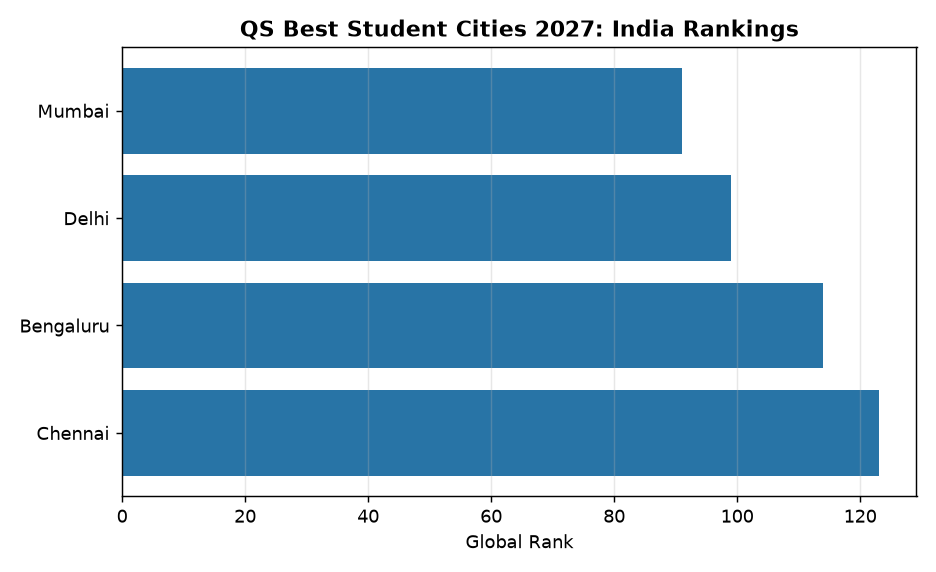
The QS Best Student Cities 2027 rankings, released in July 2026, have positioned Seoul as the world’s preeminent student destination, while highlighting India’s mixed performance with Mumbai and Delhi making significant strides and Bengaluru facing a notable decline. These rankings, based on six critical indicators, underscore the evolving dynamics of global higher education, affordability, and employability, and offer insights into India’s positioning in the global talent market.
Background
- The QS Best Student Cities ranking, published annually by QS Quacquarelli Symonds, evaluates 150 cities across six weighted indicators to assess their suitability for students.
- Seoul has retained its top position, reflecting its strong university ecosystem, affordability, and vibrant student life.
- Mumbai has emerged as India’s highest-ranked city, improving seven places to 91st globally, driven by strong employer activity and affordability scores.
- Delhi has entered the global top 100 for the first time (99th), recognised as the world’s most affordable student city with average annual international tuition fees of approximately US$2,700.
- Bengaluru’s decline by six places to joint 114th is attributed to higher international tuition fees, averaging US$5,400 annually, the highest among Indian cities in the ranking.
- Chennai improved five positions to 123rd.
What is the QS Best Student Cities Ranking?
- The QS Best Student Cities ranking is an annual assessment conducted by QS Quacquarelli Symonds, a global higher education analytics firm, to evaluate cities based on their attractiveness to students.
- The ranking assesses 150 cities across six weighted indicators: university rankings, employer activity, affordability, desirability, student mix, and student view.
- University rankings measure the concentration and performance of top universities in a city, reflecting academic excellence and research output.
- Employer activity evaluates the presence and reputation of employers, indicating job opportunities and career prospects for graduates.
- Affordability assesses the cost of living and tuition fees relative to student income, a critical factor for international students.
- Desirability captures the quality of life, safety, and cultural appeal of a city, influencing long-term student satisfaction.
- Student mix measures the diversity and internationalisation of the student population, fostering cross-cultural learning environments.
- Student view reflects feedback from current and former students, providing qualitative insights into their experiences and perceptions.
Key Features
| Feature | Significance |
|---|---|
| Affordability | Critical determinant for student mobility; lower tuition fees in Delhi (US$2,700) and Mumbai (US$5,400 in Bengaluru) directly influence global rankings and accessibility. |
| Employer Activity | High scores in Mumbai (34th) and Delhi (29th) reflect robust graduate employment prospects, aligning with India’s demographic dividend and skill ecosystem demands. |
| University Quality | Seoul’s top rank is anchored in world-leading universities; Indian cities like Mumbai (39th) and Delhi (50.3) show moderate university performance despite affordability gains. |
| Student Mix | Diversity in student population enhances cultural exposure and global competency, with Melbourne and Sydney scoring highest in this metric. |
| Desirability | Factors like safety, lifestyle, and urban environment impact long-term student retention; Vienna and Zurich excel here with near-perfect scores. |
Why it Matters
Global Higher Education Competitiveness
- The QS rankings serve as a benchmark for international student mobility, influencing policy decisions in education, immigration, and urban planning across nations.
- Seoul’s consistent top rank underscores the role of state-backed higher education investment (e.g., Korean universities like KAIST and SNU) in attracting global talent.
- Indian cities’ mixed performance highlights the need for systemic reforms in university rankings, research output, and employability metrics to compete with East Asian and European hubs.
India’s Demographic Dividend and Skill Ecosystem
- Mumbai’s rise (91st) and Delhi’s entry into the top 100 reflect India’s potential as an education hub, leveraging cost advantages and growing employer demand for skilled graduates.
- The decline of Bengaluru (114th) signals structural challenges: high tuition fees (US$5,400) and possibly over-reliance on IT services, necessitating diversification into research and innovation-driven sectors.
- Chennai’s improvement (123rd) suggests localized strategies (e.g., Tamil Nadu’s technical education reforms) can yield incremental gains in student attractiveness.
Urban Planning and Infrastructure
- Affordability in Delhi (50.3) and Mumbai (84.4) contrasts with Bengaluru’s high costs, indicating that urban governance, housing policies, and public transport systems directly impact student retention.
- The QS metrics reveal that cities with strong ‘desirability’ scores (e.g., Vienna, Zurich) prioritize livability, safety, and cultural amenities—areas where Indian metros lag despite economic growth.
Policy Implications for India
- The rankings highlight the urgency of aligning India’s higher education with global standards (e.g., NAAC/NIRF reforms, international collaborations) to improve university rankings scores.
- State-level initiatives (e.g., Maharashtra’s ‘Education Hub Policy’ or Delhi’s ‘Skill Development Mission’) must integrate affordability, employer partnerships, and research incentives to climb rankings.
Challenges
1. HIGHER EDUCATION QUALITY GAP
- Indian universities’ research output and global reputation (e.g., NIRF rankings) trail behind Seoul, Tokyo, or London, limiting their ‘University Rankings’ score in QS metrics.
- Bengaluru’s decline is partly attributed to high tuition fees, reflecting a lack of price control mechanisms or scholarship frameworks for international students.
UPSC Link: NIRF Rankings, HEERA
2. AFFORDABILITY VS. INFRASTRUCTURE TRADE-OFF
- Delhi’s affordability advantage (US$2,700 tuition) may be offset by inadequate student housing, public transport, or safety concerns, impacting ‘Desirability’ and ‘Student View’ scores.
- Mumbai’s high affordability score (84.4) coexists with urban congestion, suggesting that cost alone cannot compensate for systemic infrastructure deficits.
UPSC Link: Urban Infrastructure Challenges
3. EMPLOYER ENGAGEMENT DEFICIT
- While Mumbai and Delhi score well in ‘Employer Activity’, many Indian graduates face skill mismatches, with employers citing gaps in vocational training and industry-academia linkages.
- Bengaluru’s decline hints at sectoral over-reliance on IT, where automation and global competition reduce graduate employability in traditional roles.
UPSC Link: National Education Policy 2020, Skill India Mission
4. INTERNATIONALIZATION OF EDUCATION
- Indian cities score poorly in ‘Student Mix’ (e.g., Mumbai at 15.0), reflecting low foreign student enrollment due to visa barriers, cultural adaptation challenges, and limited English-medium programs.
- South Korea’s success (e.g., Seoul) stems from aggressive internationalization strategies, including English-taught programs and visa facilitation for foreign students.
UPSC Link: Study in India Initiative
5. DATA-DRIVEN POLICYMAKING GAP
- The QS rankings expose India’s lack of granular, city-level data on student preferences, tuition trends, and employer feedback, hindering targeted interventions.
- Mumbai’s improvement (7 places) suggests ad-hoc successes, but systemic reforms require robust data systems (e.g., linked with AISHE, UGC, and state education departments).
UPSC Link: National Institutional Ranking Framework (NIRF)
Challenges — UPSC Perspective
| Issue | Concern |
|---|---|
| Tuition Fee Inflation | Bengaluru’s US$5,400 average fees deter international students, contrasting with Delhi’s US$2,700 affordability. |
| Research Output Deficit | Indian universities lag in global rankings due to low citations, patents, and international collaborations. |
| Urban Livability | Congestion, safety, and public transport in Mumbai/Delhi reduce ‘Desirability’ despite affordability. |
| Skill-Ecosystem Mismatch | Employers report gaps between graduate skills and industry needs, particularly in non-IT sectors. |
| Visa and Cultural Barriers | Foreign students face cumbersome visa processes and limited English-medium programs in Indian cities. |
| Data Fragmentation | Lack of integrated data on student mobility, tuition trends, and employer feedback impedes policy design. |
Way Forward
- Strengthen university rankings by incentivizing research output (e.g., via UGC’s ‘Institution of Eminence’ scheme) and international collaborations to boost QS ‘University Rankings’ scores.
- Implement city-specific affordability measures: expand scholarships for international students in Bengaluru, and invest in student housing/public transport in Delhi.
- Enhance employer engagement through apprenticeship programs (e.g., aligning with National Apprenticeship Promotion Scheme) and industry-linked curriculum reforms in universities.
- Accelerate the ‘Study in India’ initiative by simplifying visa processes, expanding English-taught programs, and promoting cultural integration support for foreign students.
- Develop a national dashboard integrating NIRF, AISHE, and employer feedback to enable data-driven policymaking for higher education and urban planning.
- Promote sectoral diversification beyond IT in Bengaluru (e.g., biotech, AI research) to align with global skill demands and reduce tuition fee dependency.
- Establish ‘Student City Councils’ in metros like Mumbai and Delhi to address livability issues (safety, transport, housing) directly impacting ‘Desirability’ scores.
UPSC Value Addition
Keywords for Mains Answer-Writing
QS Best Student Cities Ranking 2027 · Global higher education rankings · Affordability in education · Employer activity score · University quality metrics · Student mobility and migration · Internationalisation of higher education · Urban education infrastructure · Economic accessibility for students · Higher education policy and rankings · Mumbai and Delhi in global rankings · Bengaluru and Chennai in QS rankings · Graduate employment prospects · Desirability of student cities · Student mix and diversity · Tuition fee trends in Indian cities
Concept Flow
Global QS Rankings → Student Mobility Trends → University Quality & Employer Activity Metrics → Urban Infrastructure & Affordability → Policy Reforms in Indian Cities → Demographic Dividend → Skill Ecosystem Demand → Employer-Engagement Scores → Graduate Employability → Rankings Improvement → Affordability Gains → International Student Influx → Student Mix Diversity → Cultural Integration Challenges → Desirability Scores → Urban Livability Deficits → Safety & Transport Issues → Student Retention Problems → Rankings Decline → Data Fragmentation → Policy Gaps → Ineffective Interventions → Rankings Stagnation → Need for Integrated Dashboards → Higher Education Reforms → Research Output Boost → University Rankings Improvement → Global Competitiveness → Sectoral Over-Reliance (e.g., IT in Bengaluru) → Skill Mismatch → Employer Activity Decline → Rankings Slippage
Prelims Practice Questions
Q1. Which of the following Indian cities was ranked as the most affordable student city globally in the QS Best Student Cities 2027 rankings?
- A. Mumbai
- B. Bengaluru
- C. Delhi
- D. Chennai
Answer: C. Delhi — Delhi was ranked as the world’s most affordable student city in the QS Best Student Cities 2027 rankings, with an affordability score of 93.9, attributed to its comparatively lower international tuition fees.
Q2. Which Indian city experienced a decline in its global ranking in the QS Best Student Cities 2027, attributed partly to higher international tuition fees?
- A. Mumbai
- B. Delhi
- C. Bengaluru
- D. Chennai
Answer: C. Bengaluru — Bengaluru slipped six places in the QS Best Student Cities 2027 rankings, with QS citing higher international tuition fees, averaging around US$5,400 annually, as a contributing factor.
Q3. Which of the following cities was ranked as the world’s best student city in the QS Best Student Cities 2027 rankings?
- A. Tokyo
- B. London
- C. Seoul
- D. Melbourne
Answer: C. Seoul — Seoul retained its position as the world’s best student city in the QS Best Student Cities 2027 rankings, achieving a perfect overall score of 100.
Mains Practice Question
✍ Evaluate the significance of the QS Best Student Cities Rankings in shaping global higher education policies and student mobility trends. How do Indian cities feature in these rankings, and what policy measures can be adopted to enhance their competitiveness in attracting international students?
Approach: The QS Best Student Cities Rankings serve as a critical benchmark for universities, policymakers, and students, influencing institutional strategies and urban planning. Indian cities like Mumbai and Delhi have shown improvement in affordability and employer activity, but challenges such as higher tuition fees in Bengaluru and limited desirability scores persist. To enhance competitiveness, India should focus on reducing tuition fee disparities, improving university rankings, and fostering urban infrastructure that supports student life. Additionally, aligning higher education policies with global standards and promoting international collaborations can further boost India’s standing in such rankings.
Source: The Indian Express
Generated by AanyaAi for educational purpose.

- UPSC Alert: 40-Day ‘Khet Bachao Abhiyan’ Launch by Union Minister - October 22, 2026
- भारत ने बताया UN रिपोर्ट में दाऊद इब्राहिम को ‘भारत-आधारित’ बताना ‘गलत’ - October 22, 2026
- GRAP Stage I activated in Delhi-NCR amid rising AQI: Key actions for aspirants - October 22, 2026

No Comments