


15 Sep SHREYAS Scheme Boosts SC/OBC Higher Education Opportunities for UPSC Aspirants
 Free coachingFinancial assistanceOverseas educationResearch fellowships
✎ SHREYAS is a multi-component scheme by the Ministry of Social Justice and Empowerment, providing free coaching, financial aid for prestigious institutions, overseas scholarships, and research fellowships to SC and OBC students to…
Subject Relevance — Where This Topic Fits
- GS Paper II — Social Justice and Governance | GS Paper II — Welfare Schemes for Vulnerable Sections | GS Paper III — Human Resource Development and Skill Enhancement
- Prelims: SHREYAS, Free Coaching Scheme, National Overseas Scholarship, Dr. Ambedkar Post-Matric Scholarship, Social Justice and Empowerment Ministry, Scheduled Castes, Other Backward Classes, Higher Education Accessibility, Competitive Examinations, Research Fellowships
- Essay: Equitable access to higher education as a cornerstone of social justice, The role of targeted scholarships in bridging socio-economic divides
Quick Revision: SHREYAS is a multi-component scheme by the Ministry of Social Justice and Empowerment, providing free coaching, financial aid for prestigious institutions, overseas scholarships, and research fellowships to SC and OBC students to enhance higher education access and equity.
Why is this in the news?
The Union Ministry of Social Justice and Empowerment has highlighted the impact of the ‘Scheme for Higher Education for Young Achievers’ (SHREYAS) in strengthening higher education opportunities for Scheduled Caste (SC) and Other Backward Class (OBC) students. Over the period from 2014-15 to 2025-26, the scheme has disbursed approximately ₹3,509.39 crore across four components, benefiting over 1.18 lakh students through initiatives such as free coaching, financial assistance for prestigious institutions, overseas education support, and research fellowships.
Background
- The Constitution of India, through Articles 15(4) and 16(4), empowers the State to make special provisions for the advancement of socially and educationally backward classes, including SCs and OBCs.
- The 12th Five-Year Plan (2012-17) and subsequent plans emphasized inclusive growth, with a focus on educational empowerment of marginalized sections.
- The Dr. Ambedkar Post-Matric Scholarship Scheme for SCs and the Centrally Sponsored Scheme for OBCs have historically addressed financial barriers in higher education.
- Global trends in higher education underscore the need for targeted interventions to ensure equitable access for underrepresented groups.
- India’s commitment to Sustainable Development Goal 4 (Quality Education) necessitates policy measures to reduce disparities in educational attainment.
What is the SHREYAS Scheme?
- SHREYAS is a centrally sponsored scheme launched by the Ministry of Social Justice and Empowerment to address educational and vocational disparities faced by SC and OBC students.
- The scheme operates through four key components: Free Coaching for Competitive Examinations, Financial Assistance for Education in Prestigious Institutions, National Overseas Scholarship (NOS) for studies abroad, and Research Fellowships for advanced studies.
- Free Coaching: Provides financial assistance to economically disadvantaged SC and OBC students for quality coaching to prepare for competitive and professional examinations, enhancing their employability in public and private sectors.
- Financial Assistance for Prestigious Institutions: Supports meritorious SC students in meeting the cost of higher education in elite institutions, ensuring they are not constrained by financial limitations.
- National Overseas Scholarship (NOS): Facilitates SC students in pursuing postgraduate and PhD studies in top-ranked foreign universities, fostering international academic exposure and research collaboration.
- Research Fellowships: Enables advanced research in designated fields by providing fellowships to SC scholars, promoting academic excellence and innovation.
- The scheme aligns with the broader policy framework of ‘Sabka Saath, Sabka Vikas’ by ensuring inclusive growth and reducing educational inequities.
- Funding for SHREYAS is routed through the Social Justice and Empowerment Ministry, with disbursements monitored to ensure transparency and accountability.
Key Features
| Feature | Significance |
|---|---|
| Free Coaching for Competitive Exams | Provides quality coaching to SC/OBC students for entrance and professional exams, reducing financial barriers to competitive success. |
| Financial Assistance for Prestigious Institutions | Supports meritorious SC students in pursuing higher education at top domestic institutions, covering academic expenses. |
| National Overseas Scholarship (NOS) | Enables SC students to access international education in reputed global universities, fostering academic excellence and global exposure. |
| Research Fellowships for Advanced Studies | Supports SC/OBC students in pursuing doctoral and post-doctoral research, promoting academic leadership and innovation. |
Why it Matters
Social Equity and Inclusion
- Advances constitutional mandate of equality (Article 14, 15) by addressing historical educational disadvantages faced by SC and OBC communities.
- Reduces socio-economic disparities in access to premier educational institutions and global academic opportunities.
- Promotes inter-generational mobility by enabling disadvantaged students to access high-quality education and career pathways.
Human Capital Development
- Enhances the skill and knowledge base of SC/OBC youth, contributing to India’s demographic dividend and economic growth.
- Fosters a more diverse and representative professional workforce across sectors, including civil services, academia, and corporate leadership.
- Supports India’s transition to a knowledge-based economy by nurturing research talent and innovation.
Governance and Public Policy
- Demonstrates the role of targeted welfare schemes in achieving inclusive development outcomes within the framework of constitutional governance.
- Highlights the importance of multi-year budgetary commitments (2014–2026) in sustaining long-term educational empowerment initiatives.
- Showcases the integration of scholarships, fellowships, and coaching as a holistic approach to educational upliftment.
Challenges
1. Implementation Gaps in Reaching Marginalised Groups
- Ensuring last-mile delivery to the most economically disadvantaged SC/OBC students, particularly in remote and tribal regions.
- Addressing administrative delays in disbursement of funds and approvals, which may deter eligible students from availing benefits.
- Monitoring and evaluating the effectiveness of coaching programs to ensure quality and relevance for competitive exams.
UPSC Link: GS-II: Welfare schemes for vulnerable sections
2. Sustainability of Funding and Scalability
- Balancing the increasing demand for scholarships with budgetary constraints, especially in the context of competing development priorities.
- Ensuring equitable distribution of funds across states and regions to prevent concentration in urban or already developed areas.
- Developing mechanisms for leveraging public-private partnerships to augment resources and expand outreach.
UPSC Link: GS-III: Resource mobilization for development
3. Quality Assurance in Educational Institutions
- Maintaining academic standards in the institutions where SC/OBC students are placed under financial assistance schemes.
- Ensuring that coaching programs align with the evolving syllabi and examination patterns of competitive exams.
- Providing mentorship and support systems to help students adapt to the academic rigor of prestigious institutions.
UPSC Link: GS-II: Education policy and governance
4. Global Competitiveness and Recognition
- Ensuring that degrees obtained through overseas scholarships are recognized and valued in the domestic job market.
- Addressing cultural and linguistic barriers faced by students in foreign universities to enhance their academic and social integration.
- Facilitating post-study opportunities for returning scholars to contribute effectively to India’s development.
UPSC Link: GS-II: International relations and education
Challenges — UPSC Perspective
| Issue | Concern |
|---|---|
| Awareness and Outreach | Limited awareness among eligible students about the scheme’s components and application processes. |
| Administrative Bottlenecks | Delays in processing applications, disbursement of funds, and approvals for overseas scholarships. |
| Quality of Coaching Institutes | Variability in the quality of coaching provided under the free coaching component. |
| Post-Scholarship Employment | Challenges in securing employment or further education opportunities post-completion of the scholarship. |
| Regional Disparities | Uneven distribution of benefits across states, with higher uptake in developed regions. |
Government Initiatives — Must-Memorise for Prelims
- National Overseas Scholarship (NOS) for Scheduled Caste students
- Free Coaching Scheme for SC and OBC students
Way Forward
- Strengthen awareness campaigns through digital platforms, local bodies, and educational institutions to reach remote and marginalised students.
- Streamline administrative processes by leveraging technology for faster approvals, disbursements, and grievance redressal.
- Establish a robust monitoring and evaluation framework to assess the impact of coaching programs and scholarships on academic and career outcomes.
- Expand public-private partnerships to augment resources for coaching and overseas education, ensuring scalability without compromising quality.
- Develop mentorship programs and alumni networks to support students in adapting to academic rigors and securing post-scholarship opportunities.
- Enhance regional equity by allocating a higher proportion of funds to states with lower participation rates in the scheme.
- Collaborate with foreign universities to ensure seamless recognition of degrees and provide pre-departure orientation for overseas scholars.
UPSC Value Addition
Keywords for Mains Answer-Writing
Scheduled Castes (SCs) · Other Backward Classes (OBCs) · Scholarships for Higher Education · Social Justice and Empowerment Ministry · Free Coaching for Competitive Examinations · Foreign Education Scholarships · Research Fellowships · Educational Empowerment · Inclusive Education · Financial Assistance for SC/OBC Students · National Overseas Scholarship (NOS) · Pradhan Mantri Anusuchit Jati Abhyuday Yojana (PM-AJAY) · UPSC Civil Services Examination · Institutional Support for Marginalised Groups
Constitutional & Policy Linkages
- Article 15(4) – Special provisions for advancement of socially and educationally backward classes
- Article 46 – Promotion of educational and economic interests of SCs, STs, and weaker sections
- Directive Principles of State Policy (Part IV) – Articles 38, 39, 41, 45, 46
Concept Flow
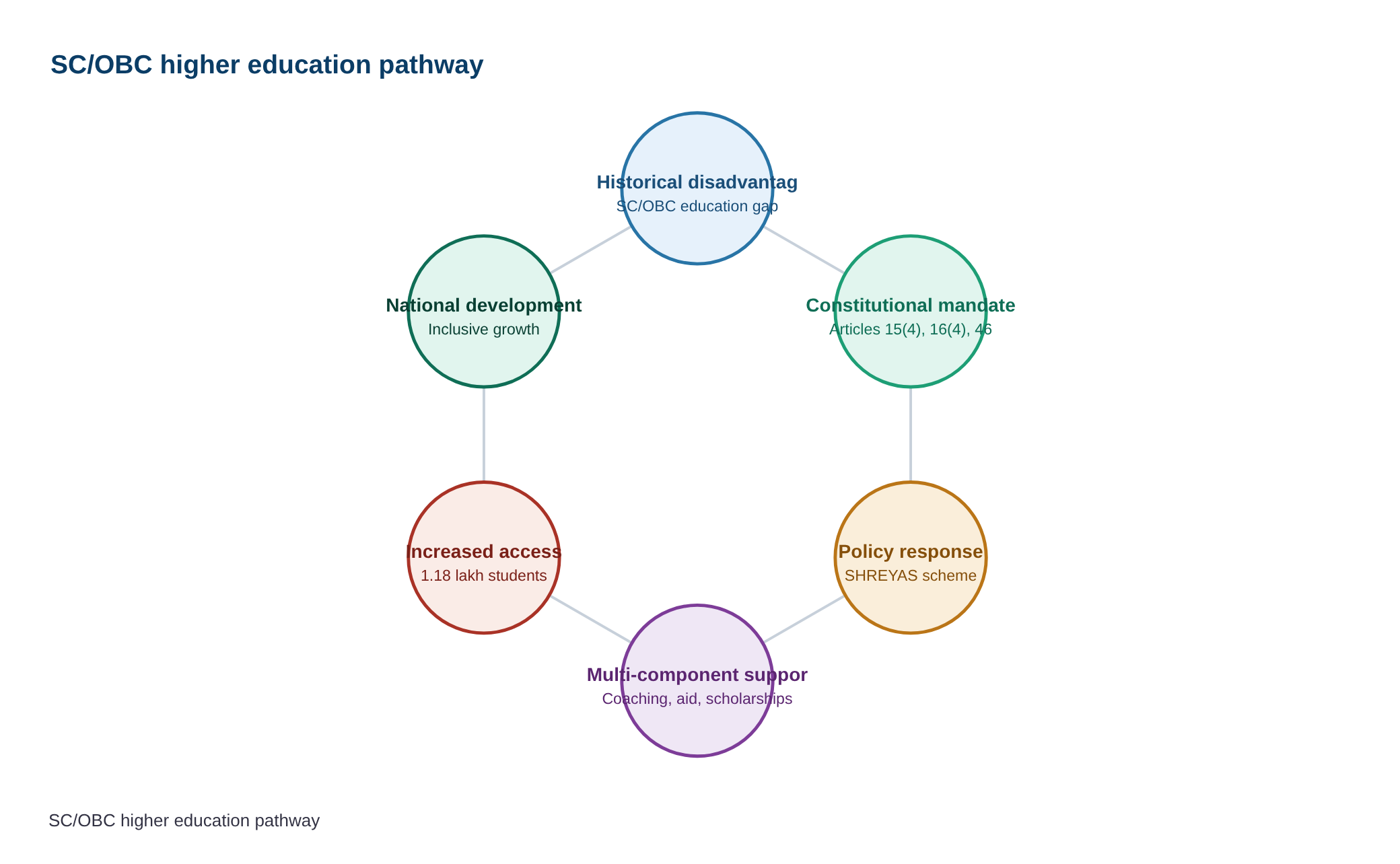
Historical educational disadvantage faced by SC/OBC communities -> Constitutional mandate for equity (Articles 15, 46) -> Policy response: Shreyas Scheme (2014–2026) -> Multi-component support (coaching, financial aid, overseas scholarships, fellowships) -> Increased access to higher education and global opportunities -> Enhanced human capital and socio-economic mobility -> Contribution to national development and inclusive growth.
Prelims Practice Questions
Q1. Consider the following statements regarding the ‘SHREYAS’ scheme:
1. It is implemented by the Ministry of Social Justice and Empowerment.
2. It provides financial assistance for free coaching to SC and OBC students for competitive examinations.
3. The scheme exclusively funds education in foreign universities for all Indian students.
4. Under the scheme, research fellowships are provided only to SC students.
How many of the above statements are correct?
- Only one
- Only two
- Only three
- All
Answer: Only three — Statements 1 and 2 are correct. Statement 3 is incorrect as the scheme funds foreign education only for SC students under the NOS component. Statement 4 is incorrect as research fellowships are provided to both SC and OBC students.
Q2. Assertion (A): The ‘SHREYAS’ scheme aims to reduce financial barriers in higher education for SC and OBC students.
Reason (R): The scheme provides financial assistance for free coaching, institutional support, foreign education, and research fellowships.
Options:
A. Both A and R are true, and R is the correct explanation of A.
B. Both A and R are true, but R is not the correct explanation of A.
C. A is true, but R is false.
D. A is false, but R is true.
Answer: ? — Both A and R are true, and R correctly explains A as the scheme’s components directly address financial barriers through targeted financial assistance.
Q3. Match the following components of the SHREYAS scheme with their respective objectives:
Component
1. Free Coaching for Competitive Examinations
2. Financial Assistance for Education in Prestigious Institutions
3. National Overseas Scholarship (NOS)
4. Research Fellowships
Objective
A. To support SC/OBC students in pursuing education in top domestic institutions
B. To provide quality coaching for competitive exams to economically disadvantaged students
C. To enable SC students to study in foreign universities
D. To promote advanced research among SC/OBC scholars
Select the correct match:
- 1-B, 2-A, 3-C, 4-D
- 1-A, 2-B, 3-C, 4-D
- 1-C, 2-A, 3-B, 4-D
- 1-D, 2-C, 3-A, 4-B
Answer: 1-B, 2-A, 3-C, 4-D — The correct matches are: 1-B (Free Coaching aims to support competitive exam preparation), 2-A (Financial Assistance supports education in prestigious institutions), 3-C (NOS enables foreign education for SC students), and 4-D (Research Fellowships promote advanced research).
Mains Practice Question
✍ The SHREYAS scheme represents a multi-pronged approach to address educational disparities faced by Scheduled Castes (SCs) and Other Backward Classes (OBCs) in India. Critically examine the scheme’s design, its components, and the extent to which it has succeeded in bridging the educational divide. Also, analyse the challenges in its implementation and suggest measures to enhance its efficacy. (15 Marks)
Approach: MODEL-ANSWER SKELETON:
1. **Introduction (2 Marks)**
– Define the SHREYAS scheme and its objectives under the Ministry of Social Justice and Empowerment.
– Contextualise the need for such interventions in the backdrop of historical educational disparities faced by SCs and OBCs.
2. **Design and Components (4 Marks)**
– **Free Coaching for Competitive Examinations**: Target group (economically disadvantaged SC/OBC students), scope (UPSC, IIT-JEE, NEET, etc.), and financial outlay (₹145.10 crore, 23,208 beneficiaries).
– **Financial Assistance for Education in Prestigious Institutions**: Support for SC students in IITs, IIMs, NITs, etc., with expenditure rising from ₹19.37 crore (2014-15) to ₹117.19 crore (2025-26) and beneficiaries from 1,568 to 4,742.
– **National Overseas Scholarship (NOS)**: Enables SC students to study in top foreign universities, with beneficiaries increasing from 20 (2014-15) to 114 (2023-24).
– **Research Fellowships**: Support for advanced research among SC/OBC scholars.
– Highlight the scheme’s alignment with constitutional provisions (Articles 15(4), 16(4), 46) and SDG 4 (Quality Education).
3. **Success and Impact (4 Marks)**
– **Quantitative Impact**: Cite data on beneficiaries (1,18,248 students) and financial outlay (₹3,509.39 crore).
– **Qualitative Impact**: Discuss how the scheme has improved access to quality education, reduced financial barriers, and enhanced employability.
– **Comparative Advantage**: Contrast with earlier schemes (e.g., PM-AJAY) and highlight its specialised focus on higher education.
4. **Challenges in Implementation (3 Marks)**
– **Awareness Gaps**: Limited reach in remote and tribal areas.
– **Administrative Bottlenecks**: Delays in disbursement, complex application processes, and lack of grievance redressal mechanisms.
– **Sustainability Concerns**: Dependence on budgetary allocations and potential underutilisation in certain components.
– **Quality of Coaching Institutions**: Ensuring standardised and effective coaching.
5. **Measures for Enhancement (2 Marks)**
– **Digital Integration**: Use of AI/ML for targeted outreach and streamlined application processes.
– **Partnerships**: Collaboration with state governments, NGOs, and private institutions to expand reach.
– **Monitoring and Evaluation**: Regular audits, beneficiary feedback mechanisms, and outcome-based funding.
– **Inclusivity Enhancements**: Extend benefits to other marginalised groups (e.g., EWS, DNTs) and integrate gender-sensitive approaches.
6. **Conclusion (1 Mark)**
– Reiterate the scheme’s significance in promoting inclusive education and social justice.
– Emphasise the need for continuous evaluation and adaptive policy measures to address evolving challenges.
Source: PIB (Press Information Bureau)
Generated by AanyaAi for educational purpose.
Related guides on our sites
- Best PSIR optional coaching for upsc
- Best sociology optional coaching for upsc
- Which is best sociology optional coaching for upsc
- Best PSIR optional teacher for upsc

- श्रेयस योजना: अनुसूचित जाति एवं ओबीसी विद्यार्थियों के लिए उच्च शिक्षा का मार्ग प्रशस्त - September 15, 2026
- SHREYAS Scheme Boosts SC/OBC Higher Education Opportunities for UPSC Aspirants - September 15, 2026
- झारखंड में बांध सुरक्षा: एनडीएसए की समीक्षा और प्रमुख सुझाव - September 15, 2026

No Comments