


22 Sep SIPCOT Pollution: 25 Tamil Nadu Villages Face Groundwater Crisis Explained
✎ Groundwater contamination in Perundurai SIPCOT stems from industrial effluents (textile, tannery) containing heavy metals and high TDS, exceeding permissible limits and rendering 37 sources in 25 villages unfit for drinking…
Subject Relevance — Where This Topic Fits
- GS Paper II — Governance, Transparency and Accountability | GS Paper III — Environmental Pollution and Degradation, Industrial Policy and Sustainability
- Prelims: Groundwater contamination, SIPCOT Industrial Growth Centre, Perundurai, Effluent Treatment Plant (ETP), Common Effluent Treatment Plant (CETP), Total Dissolved Solids (TDS), Tamil Nadu Water Supply and Drainage (TWAD) Board, tannery effluents, textile dyeing units, Cauvery river basin
- Essay: Environmental governance and industrial sustainability, Balancing economic growth with ecological integrity
Quick Revision: Groundwater contamination in Perundurai SIPCOT stems from industrial effluents (textile, tannery) containing heavy metals and high TDS, exceeding permissible limits and rendering 37 sources in 25 villages unfit for drinking, necessitating urgent remediation and regulatory compliance.
Why is this in the news?
The renewed scrutiny of groundwater contamination in 25 villages around the Perundurai SIPCOT Industrial Growth Centre in Tamil Nadu’s Erode district has highlighted systemic failures in industrial effluent management, regulatory oversight, and long-term remediation strategies. This issue exemplifies the broader challenge of reconciling industrial expansion with environmental protection, particularly in water-scarce regions, and underscores the need for robust governance frameworks to address legacy and ongoing pollution in industrial clusters.
Background
- The SIPCOT Industrial Growth Centre at Perundurai was established in 1991 over 2,700 acres in Erode district, Tamil Nadu, as part of the State Industrial Promotion Corporation of Tamil Nadu (SIPCOT) initiative to foster industrial development.
- The industrial estate hosts over 250 industries, including 52 textile dyeing and processing units, 14 tannery units (relocated from Cauvery and Kalingarayan Canal areas in 2001), and other manufacturing units, contributing to significant effluent generation.
- Historically, tannery and textile units have been major contributors to water pollution due to the use of hazardous chemicals, heavy metals, and high Total Dissolved Solids (TDS) in effluents, which often exceed permissible limits.
- Local communities and farmers have reported adverse impacts on agricultural productivity and health since the mid-2000s, with visible degradation in waterbodies such as Nallaa Odai, Odaikattur tank, and Punjai Palatholuvu tank.
- The Tamil Nadu Pollution Control Board (TNPCB) and TWAD Board have periodically monitored water quality, but enforcement of effluent discharge norms and remediation efforts have faced delays and gaps.
What is the Perundurai SIPCOT Industrial Growth Centre and its pollution challenge?
- The Perundurai SIPCOT Industrial Growth Centre is a designated industrial estate under the State Industrial Promotion Corporation of Tamil Nadu (SIPCOT), established to promote industrialization and employment in the region.
- Spread over 2,700 acres, the estate houses over 250 industries, including textile dyeing and processing units, tanneries, and chemical manufacturing units, which generate significant volumes of liquid effluents.
- Effluents from these industries contain hazardous substances such as chromium, lead, cadmium, and synthetic dyes, which pose severe risks to surface and groundwater quality if improperly treated or disposed of.
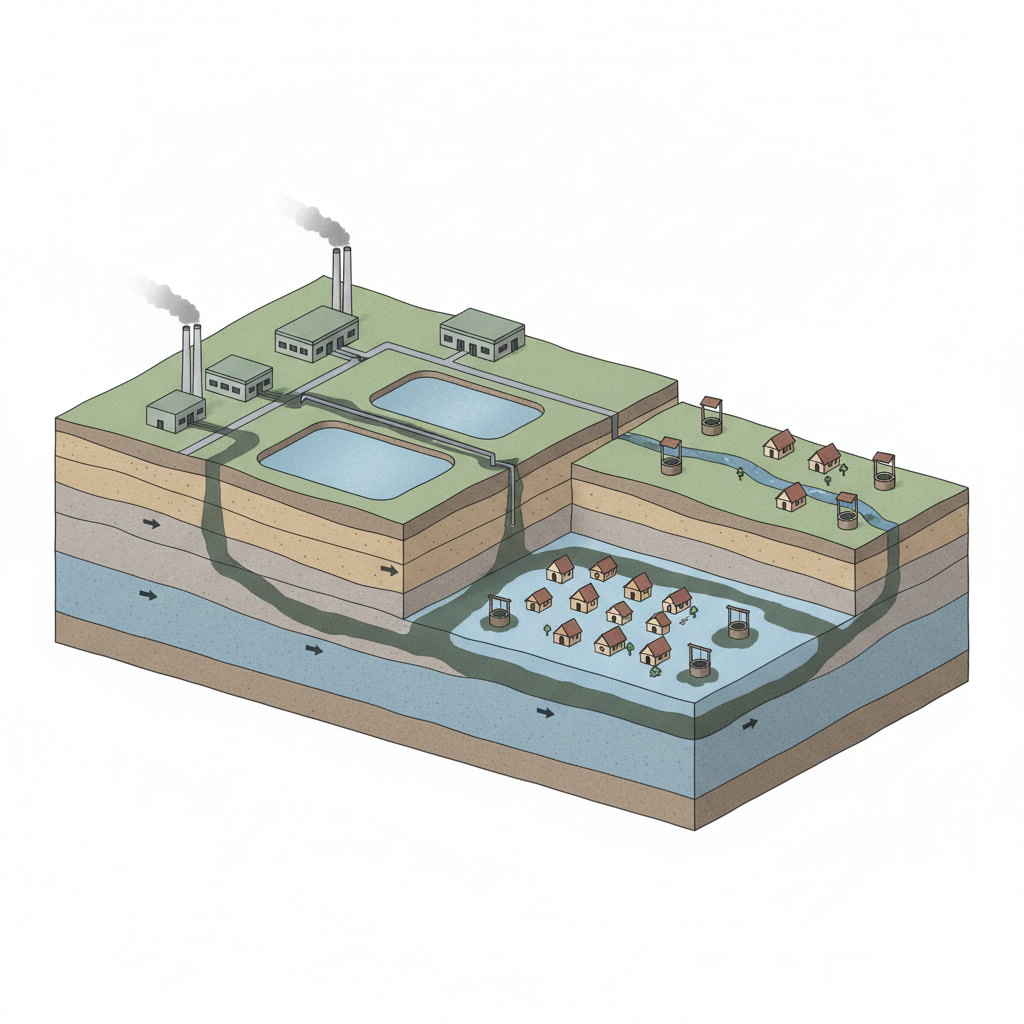
- Groundwater contamination in the region is exacerbated by the geological characteristics of the area, where shallow aquifers are vulnerable to seepage from untreated or partially treated effluents, particularly in the absence of strict regulatory compliance.
- The contamination has rendered groundwater from 37 sources in 25 villages unfit for drinking, as per the Tamil Nadu Water Supply and Drainage (TWAD) Board’s assessment.
- The issue is compounded by the historical relocation of tannery units from the Cauvery and Kalingarayan Canal areas to SIPCOT in 2001, which transferred pollution risks to a new but equally vulnerable hydrological setting.
- Long-term remediation requires a multi-pronged approach, including the completion and operationalization of the ₹136.76-crore CETP, restoration of contaminated aquifers, and strengthening of regulatory monitoring and enforcement mechanisms.
Key Features
| Feature | Significance |
|---|---|
| SIPCOT Industrial Growth Centre, Perundurai | Established in 1991 over 2,700 acres, it hosts over 250 industries, including 52 textile dyeing and processing units and former tannery operations, making it a major industrial cluster in Tamil Nadu. |
| Groundwater contamination in 25 villages | TWAD Board tests in 2025 identified 37 groundwater sources across 25 villages as unfit for drinking due to industrial effluents, posing a severe public health risk. |
| Common Effluent Treatment Plant (CETP) | A ₹136.76-crore CETP is under construction to treat contaminated seepage water and resupply treated water to industries, addressing immediate pollution but not ensuring long-term sustainability. |
| Nallaa Odai and Odaikattur/Punjai Palatholuvu tanks | Local waterbodies contaminated by seepage from textile-processing units, historically used for irrigation, now pose ecological and agricultural risks due to high Total Dissolved Solids (TDS) and foul odour. |
| Perundurai SIPCOT Affected People’s Welfare Association | A civil society group formed in 2018 to advocate for affected communities, highlighting long-term pollution impacts and demanding accountability from industries and authorities. |
Why it Matters
Environmental and Public Health
- Groundwater contamination threatens potable water security for over 25 villages, with TDS levels exceeding permissible limits (15,000 mg/l in 2018), rendering water unfit for consumption.
- Agricultural productivity is at risk due to polluted waterbodies (Nallaa Odai, Odaikattur, and Punjai Palatholuvu tanks), affecting livelihoods of local farmers dependent on irrigation.
- Ecological degradation of aquatic ecosystems, including soil and water toxicity, poses long-term risks to biodiversity and human health through bioaccumulation.
Industrial Regulation and Governance
- Demonstrates the failure of existing effluent management systems (individual ETPs and CETPs) to prevent groundwater contamination, necessitating stricter enforcement of the Water (Prevention and Control of Pollution) Act, 1974.
- Highlights the need for integrated industrial zoning policies to prevent the clustering of high-pollution industries (e.g., tanneries, textile dyeing) near water sources.
- Underscores the importance of real-time monitoring and third-party audits of effluent treatment facilities to ensure compliance with environmental standards.
Socio-Economic Impact
- Disproportionate burden on marginalised communities, including farmers and rural households, who bear the brunt of industrial pollution without adequate compensation or remediation.
- Economic losses for local agriculture and allied sectors due to reduced crop yields and soil degradation, exacerbating rural distress.
- Increased public expenditure on alternative water supply solutions (e.g., tankers, bottled water) for affected households, straining local resources.
Challenges
1. Regulatory Enforcement Gaps
- Inadequate monitoring and delayed action by state pollution control boards (e.g., TNPCB) in identifying and penalising non-compliant industries.
- Lack of stringent penalties for industries violating effluent discharge norms, leading to repeated violations.
- Insufficient coordination between multiple agencies (TWAD Board, TNPCB, local bodies) responsible for water and pollution management.
UPSC Link: Water Act 1974, Environment Protection Act 1986
2. Technological and Infrastructure Constraints
- Limited capacity of existing CETPs and ETPs to handle the volume and toxicity of effluents from high-pollution industries like tanneries and textile processing.
- Absence of a robust, decentralised water treatment infrastructure to address groundwater contamination at the source.
- High capital and operational costs of advanced treatment technologies (e.g., reverse osmosis, zero-liquid discharge) for industries and municipalities.
UPSC Link: CETP Scheme, National Green Tribunal
3. Community Mobilisation and Legal Recourse
- Challenges in organising affected communities due to socio-economic disparities, lack of awareness, and fear of retaliation from powerful industrial lobbies.
- Lengthy legal processes under the National Green Tribunal (NGT) or civil courts to seek compensation or enforcement of pollution control norms.
- Inadequate grievance redressal mechanisms for affected individuals, leading to prolonged suffering without timely relief.
UPSC Link: Public Interest Litigation, NGT Act 2010
4. Sustainable Industrial Development
- Balancing industrial growth with environmental sustainability, particularly in water-stressed regions like Tamil Nadu.
- Promoting circular economy models (e.g., effluent recycling, resource recovery) to reduce industrial water consumption and waste generation.
- Encouraging industries to adopt cleaner technologies (e.g., waterless dyeing, bio-based tanning) to minimise pollution at the source.
UPSC Link: National Clean Air Programme, Swachh Bharat Mission
5. Data Gaps and Monitoring
- Insufficient real-time data on groundwater quality and effluent discharge, hindering evidence-based policymaking and enforcement.
- Lack of standardised protocols for sampling and testing groundwater in industrial clusters, leading to inconsistent findings.
- Delayed publication of pollution data by regulatory agencies, reducing transparency and public trust.
UPSC Link: Environmental Impact Assessment, CPCB Guidelines
Challenges — UPSC Perspective
| Issue | Concern |
|---|---|
| Non-compliance with effluent norms | Industries continue to discharge untreated or partially treated effluents, exacerbating groundwater contamination. |
| Inadequate CETP infrastructure | Existing CETPs are overburdened, leading to untreated seepage and groundwater pollution. |
| Lack of real-time monitoring | Delayed detection of pollution allows contamination to spread unchecked, complicating remediation efforts. |
| Community health risks | Prolonged exposure to contaminated water increases the risk of waterborne diseases and long-term health complications. |
| Legal and bureaucratic delays | Lengthy processes for enforcement, compensation, and remediation deter timely action and justice. |
| Economic trade-offs | Industries resist adopting cleaner technologies due to high costs, prioritising short-term profits over sustainability. |
Way Forward
- Strengthen enforcement of the Water (Prevention and Control of Pollution) Act, 1974, by mandating regular third-party audits of effluent treatment facilities in industrial clusters.
- Accelerate the completion and commissioning of the ₹136.76-crore CETP in Perundurai, ensuring it meets the treatment capacity required for the industrial estate.
- Implement a phased programme for industries to adopt zero-liquid discharge (ZLD) systems, reducing effluent discharge and promoting water reuse.
- Establish a decentralised groundwater monitoring network in industrial zones, with real-time data accessible to the public and regulatory agencies.
- Conduct a comprehensive environmental impact assessment (EIA) of the SIPCOT Industrial Growth Centre to identify high-risk zones and prioritise remediation.
- Launch a public awareness campaign in collaboration with local NGOs to educate communities on water safety, pollution risks, and legal recourse.
- Develop a compensation framework for affected communities, including financial support for alternative water supply and healthcare costs.
- Promote research and development in low-cost, scalable water treatment technologies tailored to industrial effluents.
UPSC Value Addition
Keywords for Mains Answer-Writing
Groundwater contamination · Industrial pollution · SIPCOT Industrial Growth Centre · Perundurai · Erode district · Tamil Nadu Water Supply and Drainage Board · Common Effluent Treatment Plant · Textile dyeing units · Tannery effluents · Groundwater remediation · Environmental governance · Polluter Pays Principle · Precautionary Principle · National Green Tribunal · Public health · Sustainable development · Effluent Treatment Plants (ETPs) and CETPs
Constitutional & Policy Linkages
- [‘Article 21 (Right to Life)’, ‘includes right to safe drinking water’]
- [‘Article 48A (Directive Principle)’, ‘protection and improvement of environment’]
Concept Flow
Industrialisation and clustering of high-pollution units (textile, tanneries) in Perundurai SIPCOT → Inadequate effluent treatment and storage leading to seepage and leakage into groundwater → Contamination of local waterbodies (Nallaa Odai, Odaikattur tank) and agricultural land → Rise in Total Dissolved Solids (TDS) and foul odour in groundwater, rendering it unfit for drinking → Public health crisis with affected communities reporting waterborne diseases and livelihood losses → Civil society mobilisation (Perundurai SIPCOT Affected People’s Welfare Association) and regulatory intervention (TWAD Board, TNPCB) → Short-term measures (CETP construction) and long-term challenges (sustainable remediation, policy enforcement)
Prelims Practice Questions
Q1. Consider the following statements regarding the SIPCOT Industrial Growth Centre at Perundurai:
1. It was established in 1991 over 2,700 acres.
2. It houses over 250 industries, including 52 textile dyeing and processing units.
3. The Centre has a history of tannery operations, with 23 units shifted from the Cauvery and Kalingarayan Canal in Erode in 2001.
4. The CETP at the Centre was closed in 2021 following complaints of pollution of waterbodies.
How many of the above statements are correct?
- Only one
- Only two
- Only three
- All four
Answer: All four — Statements 1, 2, and 3 are correct. Statement 4 is incorrect as the CETP was closed in 2021, but the Common Effluent Treatment Plant (CETP) under construction is a new facility, not the one closed in 2021.
Q2. Assertion (A): The Tamil Nadu Water Supply and Drainage (TWAD) Board found groundwater from 37 sources in 25 villages near the Perundurai SIPCOT Industrial Growth Centre unfit for drinking in 2025.
Reason (R): The contamination was primarily due to untreated effluents from textile dyeing and tannery units seeping into the groundwater.
In the context of the above two statements, which of the following is correct?
- Both A and R are true, and R is the correct explanation of A.
- Both A and R are true, but R is not the correct explanation of A.
- A is true, but R is false.
- A is false, but R is true.
Answer: Both A and R are true, and R is the correct explanation of A. — Both A and R are true. The TWAD Board’s findings in 2025 confirmed groundwater contamination in 25 villages, and the primary source of contamination was indeed untreated effluents from textile dyeing and tannery units.
Q3. Match the following industrial units in the Perundurai SIPCOT Industrial Growth Centre with their respective treatment arrangements:
Column I (Industrial Unit Type) | Column II (Treatment Arrangement)
1. Textile dyeing units | A. Individual Effluent Treatment Plants (ETPs)
2. Tannery units | B. Common Effluent Treatment Plant (CETP)
3. New CETP under construction | C. Oxidation ponds and unused borewells
Select the correct match:
- 1-A, 2-B, 3-C
- 1-A, 2-C, 3-B
- 1-B, 2-A, 3-C
- 1-C, 2-A, 3-B
Answer: 1-A, 2-C, 3-B — Textile dyeing units primarily have individual ETPs (43 out of 52 units). Tannery units were historically linked to oxidation ponds and unused borewells, though they are now closed. The new CETP under construction is designed to treat contaminated seepage water from industries.
Mains Practice Question
✍ The contamination of groundwater in villages around the Perundurai SIPCOT Industrial Growth Centre exemplifies the failure of environmental governance in India. Critically analyse the institutional, legal, and policy gaps that have contributed to this crisis. Also, outline the measures required to ensure sustainable remediation and long-term prevention of such industrial pollution. (15 Marks)
Approach: MODEL-ANSWER SKELETON:
1. **Institutional Gaps**:
– Role of State Pollution Control Boards (SPCBs) and their enforcement failures (e.g., non-compliance monitoring of ETPs/CETPs).
– Weak coordination between TWAD Board, SPCBs, and local authorities in monitoring groundwater quality and industrial effluents.
– Lack of a robust grievance redressal mechanism for affected communities (e.g., Perundurai Affected People’s Welfare Association).
2. **Legal and Policy Frameworks**:
– **Water (Prevention and Control of Pollution) Act, 1974**: Provisions for effluent discharge standards (Schedule VI) and penalties under Section 41-43, but weak implementation.
– **Environment (Protection) Act, 1986**: Empowers the Central Government to take measures for environmental protection, yet enforcement remains ad hoc.
– **National Green Tribunal (NGT)**: Jurisdiction under the NGT Act, 2010 for environmental disputes, but delays in adjudication and limited deterrent effect.
– **Polluter Pays Principle (PPP)**: Theoretically embedded in the National Environment Policy, 2006, but rarely enforced to hold industries accountable for historical contamination.
– **Precautionary Principle**: Emphasised in the Rio Declaration, yet often overlooked in industrial siting and expansion decisions.
3. **Policy Failures**:
– Absence of a **National Groundwater Management Policy** to address cumulative industrial pollution.
– Inadequate **Environmental Impact Assessment (EIA) 2006** compliance for existing industries (e.g., textile dyeing units operating without updated EIAs).
– Lack of **real-time effluent monitoring systems** and third-party audits for CETPs/ETPs.
4. **Measures for Sustainable Remediation and Prevention**:
– **Legal**: Strengthen SPCBs with greater autonomy, mandate real-time effluent monitoring, and enforce strict penalties for non-compliance (e.g., closure of non-compliant units).
– **Institutional**: Establish a **multi-stakeholder groundwater monitoring committee** with community representation to oversee remediation efforts.
– **Technological**: Deploy **advanced oxidation processes (AOPs)** and **phytoremediation** for groundwater cleanup, coupled with decentralised water treatment plants.
– **Policy**: Enforce **mandatory zero-liquid discharge (ZLD)** for high-pollution industries (e.g., tanneries, textile dyeing) and incentivise adoption of **green chemistry** in industrial processes.
– **Community Engagement**: Formalise grievance redressal mechanisms under the **Right to Information Act, 2005** and **Environmental Protection Act, 1986**, ensuring transparency in pollution data.
5. **Case Studies and Precedents**:
– Reference the **Tanneries Pollution Control (TNPCB) case (2017)** where the Madras High Court directed closure of non-compliant tanneries in Dindigul.
– Cite the **CPCB’s guidelines on CETPs (2020)** for improving treatment efficiency.
6. **Conclusion**:
– Emphasise the need for a **holistic, rights-based approach** combining legal enforcement, technological innovation, and community participation to prevent future crises.
Source: The Hindu
Tamil Nadu PCS (TNPSC) — State PCS Practice
Prelims: Which of the following industrial clusters in Tamil Nadu is primarily responsible for the groundwater contamination in 25 villages around Perundurai due to industrial pollution?
- SIPCOT Industrial Complex, Perundurai
- Neyveli Lignite Corporation
- Manali Petrochemical Complex
- BHEL, Ranipet
Answer: SIPCOT Industrial Complex, Perundurai — The SIPCOT Industrial Complex in Perundurai is identified as the source of industrial pollution leading to groundwater contamination in 25 villages.
Mains: Examine the socio-economic and health impacts on the local communities in Perundurai due to groundwater contamination from the SIPCOT Industrial Complex. Suggest measures for remediation and long-term sustainable development in the affected villages.
Generated by AanyaAi for educational purpose.
Related guides on our sites
- Current affairs for upsc 2026
- How to prepare for GS paper 1 for UPSC CSE mains exam
- Best UPSC coaching for IFOS exam
- Best geography optional coaching

- SIPCOT Pollution: 25 Tamil Nadu Villages Face Groundwater Crisis Explained - September 22, 2026
- यूएस एफ-35 सहित वैश्विक हवाई ताकतों का जोधपुर में ‘तरंग शक्ति’ युद्धाभ्यास में प्रदर्शन - September 22, 2026
- F-35 Stealth Fighter to Feature in India’s Tarang Shakti 2026 Exercise - September 22, 2026

No Comments