


11 Aug SMILE Scheme: ₹45.59 Cr Spent, 10,446 Beneficiaries Rehabilitated by 2026
✎ The SMILE – Comprehensive Rehabilitation of Persons Engaged in Beggary operationalises the Supreme Court’s directives for humane rehabilitation of persons engaged in begging through institutional frameworks, skill development…
Subject Relevance — Where This Topic Fits
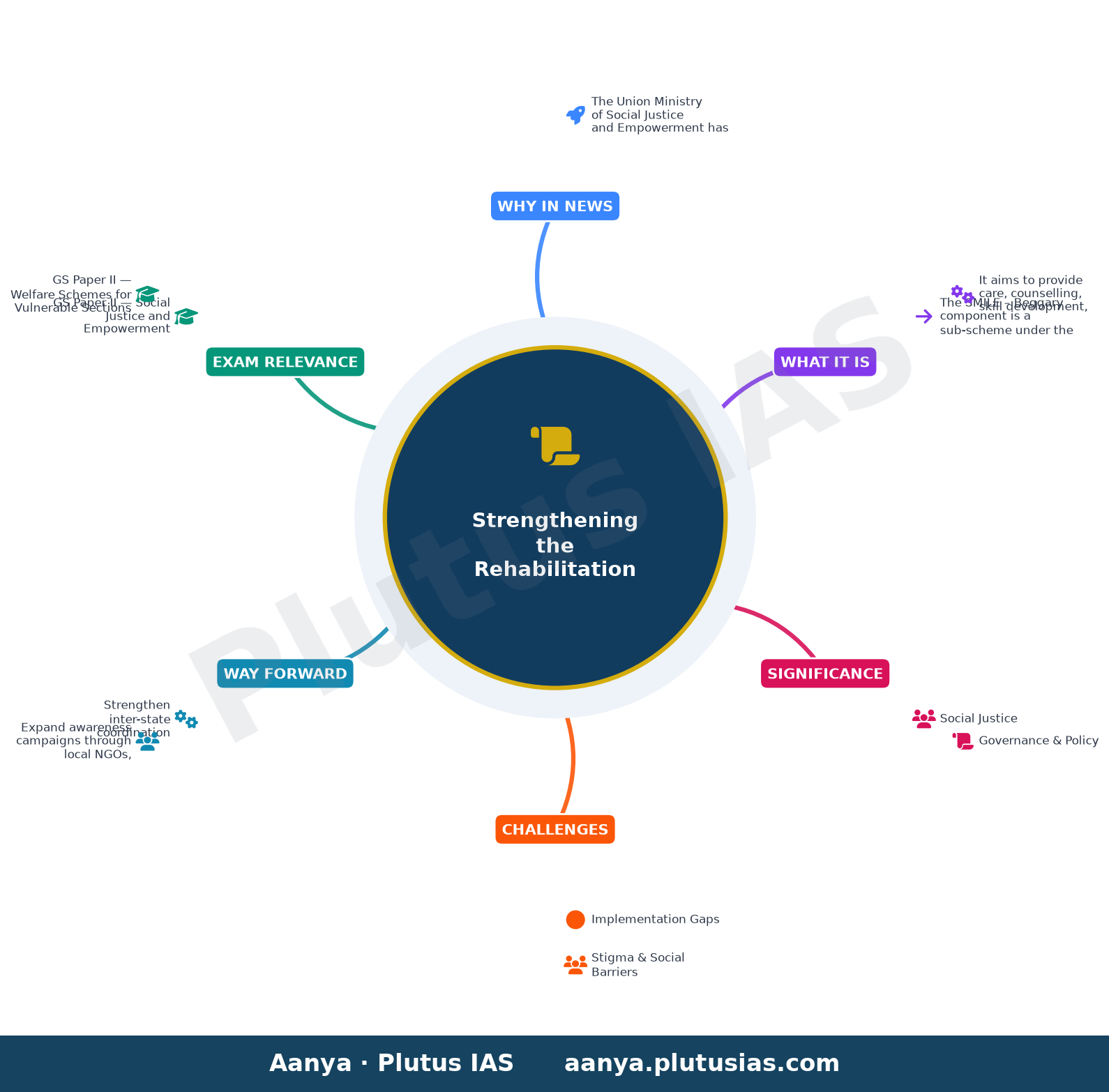
- GS Paper II — Social Justice and Empowerment | GS Paper II — Welfare Schemes for Vulnerable Sections | GS Paper III — Skill Development and Livelihood
- Prelims: SMILE Scheme, Beggary Act, 1959, Deendayal Antyodaya Yojana-National Urban Livelihoods Mission (DAY-NULM), National Consultative Committee, Model Guidelines for Rehabilitation of Beggars
- Essay: Ethical Governance and Social Inclusion: Balancing Rights and Rehabilitation, Livelihood Security and the Informal Sector: Policy Challenges and Solutions
Quick Revision: The SMILE – Comprehensive Rehabilitation of Persons Engaged in Beggary operationalises the Supreme Court’s directives for humane rehabilitation of persons engaged in begging through institutional frameworks, skill development, livelihood support, and social reintegration, with ₹45.59 crore disbursed and 10,446 individuals rehabilitated as of July 2026.
Why is this in the news?
The Union Ministry of Social Justice and Empowerment has strengthened the rehabilitation framework for persons engaged in begging under the SMILE (Support for Marginalised Individuals for Livelihood and Enterprise) – Beggary component, as reported in a written reply to the Lok Sabha on 31 July 2026. The measures include enhanced institutional arrangements, skill development, livelihood support, and adherence to the Supreme Court’s directives in *M.S. Pather v. Government of NCT of Delhi* (2025). The scheme has disbursed ₹45.59 crore since its launch on 23 October 2023, rehabilitating 10,446 individuals, including 2,824 children.
Background
- The practice of begging has historically been linked to socio-economic marginalisation, disability, mental health challenges, and lack of access to formal livelihood opportunities.
- The Constitution of India, under Articles 21 (Right to Life and Dignity) and 41 (Right to Public Assistance), mandates the state to ensure welfare measures for vulnerable populations, including those engaged in begging.
- The Bombay Prevention of Begging Act, 1959, and similar state legislations criminalised begging, leading to institutionalisation without rehabilitation; this was challenged in the Supreme Court.
- The Supreme Court’s judgment in *M.S. Pather v. Government of NCT of Delhi* (2025) directed the Union and State Governments to develop humane, rights-based rehabilitation frameworks for persons engaged in begging.
- The SMILE scheme was launched on 23 October 2023 as a centrally sponsored initiative under the Ministry of Social Justice and Empowerment to address livelihood support, skill development, and social reintegration for marginalised individuals, including those engaged in begging.
What is the SMILE – Beggary Component?
- The SMILE – Beggary component is a sub-scheme under the broader SMILE initiative, focusing on the holistic rehabilitation of persons engaged in begging, including children.
- It aims to provide care, counselling, skill development, livelihood support, and social reintegration through a multi-sectoral approach involving ministries, states, NGOs, and financial institutions.
- The scheme operates under the legal framework of the Supreme Court’s directives and model guidelines issued on 13 April 2026, ensuring humane and rights-based interventions.
- Financial outlay: ₹45.59 crore disbursed from 23 October 2023 to 31 July 2026, with ₹40.04 crore allocated to implementing authorities and the remainder for administrative and related expenses.
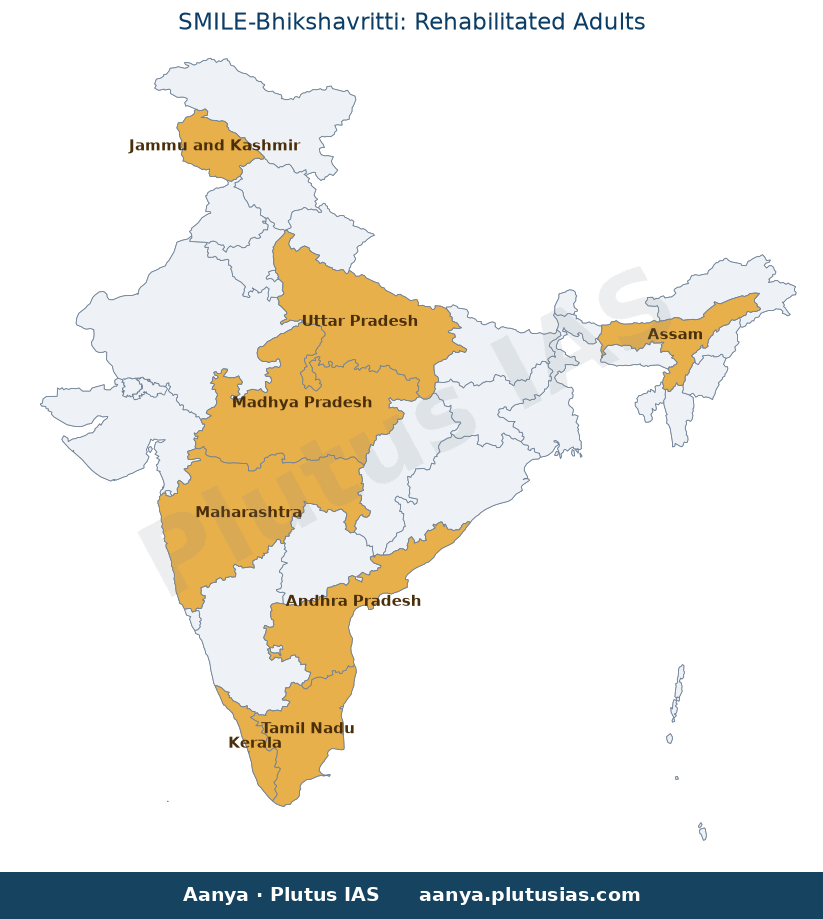
- Rehabilitation targets achieved: 10,446 individuals (7,622 adults and 2,824 children) rehabilitated as of 31 July 2026, with Tamil Nadu, Madhya Pradesh, and Uttar Pradesh leading in adult beneficiary numbers.
- Key interventions include vocational training (e.g., carpentry, tailoring, sanitation services, e-rickshaw driving), self-help group formation, and facilitation of bank linkages for micro-enterprises (e.g., tiffin stalls, food carts, spice and pickle production).
- Children rescued under the scheme receive age-appropriate care, education, counselling, and family reunification, with no vocational training imposed unless age-appropriate.
- The scheme aligns with the Deendayal Antyodaya Yojana-National Urban Livelihoods Mission (DAY-NULM) for urban livelihood support and the National Urban Livelihoods Mission (NULM) for skill development and microfinance linkages.
Key Features
| Feature | Significance |
|---|---|
| Financial Allocation | A total of ₹45.59 crore has been disbursed under the SMILE-VS scheme since its inception, with ₹40.04 crore directed to implementing authorities for direct beneficiary support and rehabilitation activities. |
| Rehabilitation Coverage | 10,446 individuals, including 2,824 children, have been rehabilitated, with structured interventions for adults and age-appropriate care for children. |
| Vocational Training | Customised vocational training is provided based on beneficiaries’ interests, age, physical/mental condition, and local livelihood opportunities, covering sectors like carpentry, tailoring, sanitation services, and food vending. |
| Self-Employment Support | Beneficiaries are linked with financial institutions for credit access, and assisted in forming self-help groups for collective enterprises such as tiffin stalls, spice production, and vegetable vending. |
| Institutional Framework | The scheme operationalises a multi-stakeholder approach involving central ministries, state governments, NGOs, and statutory bodies like the National Human Rights Commission for standardised implementation. |
Why it Matters
Social Justice
- Operationalises constitutional commitments under Articles 15(2), 21, and 41 to ensure dignity, non-discrimination, and social inclusion for marginalised sections engaged in begging.
- Aligns with the Directive Principles of State Policy (Part IV) to promote welfare measures for weaker sections through structured rehabilitation and livelihood support.
- Addresses systemic exclusion by providing not just material support but also psychological counselling, family reunification, and long-term social reintegration.
Governance & Policy
- Demonstrates a rights-based approach to governance by framing rehabilitation as a legal entitlement rather than a charitable act, consistent with judicial directives (e.g., Supreme Court’s observations in *M.S. Patter v. NCT Delhi*).
- Establishes a model for inter-ministerial and inter-departmental coordination, integrating inputs from the Ministries of Social Justice, Housing & Urban Affairs, Skill Development, and Women & Child Development.
- Sets a precedent for evidence-based policy design through data-driven monitoring of beneficiary outcomes and expenditure utilisation.
Economic & Livelihood
- Facilitates transition from informal, precarious livelihoods to formal, sustainable income sources through skill development and self-employment linkages, thereby reducing dependency on alms.
- Enhances local economic resilience by promoting community-based enterprises and micro-enterprises in sectors with high demand, such as sanitation services and food vending.
- Contributes to reducing urban poverty by addressing the root causes of begging, including lack of education, skill deficits, and social marginalisation.
Judicial & Institutional
- Responds to judicial directives for humane treatment and rehabilitation of persons engaged in begging, ensuring compliance with constitutional and human rights standards.
- Strengthens institutional capacity at the state and local levels through the formulation of model guidelines and the establishment of a National Advisory Committee for oversight and policy refinement.
Challenges
1. Implementation Gaps
- Variations in state-level execution due to differing administrative capacities, resource allocation, and political priorities, as evidenced by the disparity in rehabilitation numbers across states (e.g., Tamil Nadu vs. Jammu & Kashmir).
- Delays in fund disbursement to implementing agencies, which may hinder timely service delivery and beneficiary engagement.
- Limited awareness among target populations about the scheme’s benefits and enrolment processes, leading to underutilisation.
UPSC Link: GS-II: Welfare Schemes
2. Stigma & Social Barriers
- Deep-rooted societal stigma towards persons engaged in begging persists, affecting their willingness to seek rehabilitation and reintegrate into mainstream society.
- Family and community resistance to reintegration, particularly for children, due to economic dependencies or social prejudices.
- Mental health challenges among beneficiaries, including trauma, addiction, or developmental disorders, require specialised counselling services that may be under-resourced.
UPSC Link: GS-I: Social Issues
3. Sustainability of Livelihoods
- Risk of relapse into begging due to inadequate post-training support, market competition, or lack of access to formal credit for establishing micro-enterprises.
- Dependence on local economic conditions; sectors like sanitation services or food vending may have saturated markets in certain urban areas.
- Need for continuous upskilling to adapt to technological and market changes, which requires long-term institutional support.
UPSC Link: GS-III: Employment & Skill Development
4. Data & Monitoring
- Lack of a unified national database for tracking beneficiaries across states, leading to fragmented monitoring and difficulty in assessing scheme impact.
- Challenges in verifying the authenticity of beneficiaries and ensuring that funds reach intended recipients without leakage.
- Limited longitudinal studies on the long-term outcomes of rehabilitation, such as employment retention or social reintegration success rates.
UPSC Link: GS-II: Government Policies
5. Urban Governance Constraints
- High population density and resource constraints in urban areas may limit the availability of shelter homes, vocational training centres, and rehabilitation facilities.
- Coordination challenges between municipal authorities, NGOs, and central agencies in densely populated cities like Delhi or Mumbai.
- Policy conflicts between urban development goals (e.g., beautification drives) and the need for inclusive spaces for marginalised groups.
UPSC Link: GS-II: Urbanisation
Challenges — UPSC Perspective
| Issue | Concern |
|---|---|
| State Disparities | Uneven rehabilitation outcomes due to varying administrative and financial capacities across states. |
| Stigma & Exclusion | Societal and familial resistance hinders social reintegration and willingness to participate in rehabilitation. |
| Sustainability Risks | Lack of post-training support and market access may lead to relapse into begging. |
| Data Fragmentation | Absence of a unified beneficiary tracking system complicates impact assessment and policy refinement. |
| Urban Resource Constraints | High-density urban areas face challenges in providing adequate shelter and rehabilitation infrastructure. |
| Mental Health Gaps | Insufficient specialised counselling services for trauma, addiction, or developmental disorders among beneficiaries. |
Government Initiatives — Must-Memorise for Prelims
- SMILE – Comprehensive Rehabilitation of Persons Engaged in Begging (SMILE-VS)
- Deendayal Antyodaya Yojana – National Urban Livelihoods Mission (DAY-NULM)
- Pradhan Mantri Kaushal Vikas Yojana (PMKVY)
- National Urban Housing Mission (PMAY-U)
Way Forward
- Strengthen inter-state coordination mechanisms to reduce disparities in implementation and ensure uniform service delivery standards.
- Expand awareness campaigns through local NGOs, community leaders, and digital platforms to enhance beneficiary enrolment and participation.
- Establish a national-level monitoring dashboard to track rehabilitation progress, fund utilisation, and long-term outcomes in real time.
- Increase allocation for mental health and counselling services, including partnerships with specialised NGOs and government health programmes.
- Develop sector-specific livelihood support programmes, such as microfinance schemes for food vending or sanitation services, tailored to local market demands.
- Integrate the scheme with existing urban poverty alleviation programmes (e.g., DAY-NULM) to create synergies and avoid duplication of efforts.
- Conduct periodic impact assessments, including longitudinal studies, to evaluate the scheme’s effectiveness and inform policy refinements.
- Enhance collaboration with private sector entities for skill development, apprenticeship opportunities, and corporate social responsibility (CSR) funding.
UPSC Value Addition
Keywords for Mains Answer-Writing
SMILE-Schemes for Marginalised Individuals for Livelihood and Enterprise · Comprehensive Rehabilitation of Persons Engaged in Begging · Social Justice and Empowerment Ministry · Institutional Framework for Rehabilitation · Skill Development and Livelihood Support · National Consultative Committee · Model Guidelines for Persons Engaged in Begging · Supreme Court Directives in M.S. Patter v. Government of NCT Delhi · Social Reintegration and Inclusion · Welfare of Marginalised Communities
Constitutional & Policy Linkages
- Article 15(2): Prohibition of discrimination in accessing public places or facilities.
- Article 21: Right to life and personal liberty, including the right to dignity and humane treatment.
- Article 41: Directive Principle to secure the right to public assistance in cases of unemployment, old age, sickness, and disablement.
- Article 46: Promotion of educational and economic interests of weaker sections.
Concept Flow
Marginalisation and exclusion → Engagement in begging as a survival strategy → Government intervention through SMILE-VS scheme → Identification and registration of beneficiaries → Provision of shelter, counselling, and vocational training → Skill development and self-employment support → Social reintegration and economic independence → Sustainable livelihoods and reduced dependency on alms.
Prelims Practice Questions
Q1. Consider the following statements regarding the SMILE-Schemes for Marginalised Individuals for Livelihood and Enterprise (SMILE-Beggary):
1. The scheme aims to provide vocational training in activities such as carpentry, tailoring, and e-rickshaw driving.
2. Under the scheme, 45.59 crore rupees have been released from its inception to 31 July 2026.
3. The scheme mandates the provision of institutional care, skill development, and social reintegration for persons engaged in begging.
4. The scheme is implemented exclusively by the Ministry of Housing and Urban Affairs.
How many of the above statements are correct?
- Only one
- Only two
- Only three
- All four
Answer: Only three — Statements 1, 2, and 3 are correct. Statement 4 is incorrect as the scheme is implemented by the Ministry of Social Justice and Empowerment.
Q2. Assertion (A): The SMILE-Beggary scheme includes provisions for the rehabilitation of children rescued from begging.
Reason (R): The scheme provides age-appropriate care, education, counselling, and family reintegration for rescued children.
Options:
A. Both A and R are true, and R is the correct explanation of A.
B. Both A and R are true, but R is not the correct explanation of A.
C. A is true, but R is false.
D. A is false, but R is true.
Answer: ? — Both the Assertion and Reason are true, and the Reason correctly explains the Assertion as the scheme explicitly addresses the rehabilitation of children through education and family reintegration.
Q3. Match the following pairs related to the SMILE-Beggary scheme:
Column I (State/UT) Column II (Number of Rehabilitated Adult Beneficiaries)
a. Tamil Nadu 1. 472
b. Assam 2. 1,557
c. Uttar Pradesh 3. 884
d. Maharashtra 4. 817
Options:
A. a-2, b-1, c-3, d-4
B. a-1, b-2, c-3, d-4
C. a-2, b-3, c-1, d-4
D. a-4, b-1, c-3, d-2
Answer: ? — The correct matches are: Tamil Nadu (1,557), Assam (472), Uttar Pradesh (884), and Maharashtra (817).
Mains Practice Question
✍ The Supreme Court, in M.S. Patter v. Government of NCT Delhi, directed the formulation of comprehensive guidelines for the rehabilitation of persons engaged in begging. In this context, critically examine the institutional framework and provisions of the SMILE-Beggary scheme, highlighting its objectives, implementation mechanisms, and challenges in achieving social reintegration. Also, discuss the role of the National Consultative Committee in ensuring effective compliance with the scheme’s objectives. (15 Marks)
Approach: MODEL-ANSWER SKELETON:
1. **Introduction**: Briefly outline the context of the Supreme Court’s directive in M.S. Patter v. Government of NCT Delhi and the need for a structured rehabilitation framework for persons engaged in begging.
2. **Objectives of SMILE-Beggary Scheme**:
– Holistic rehabilitation: care, skill development, livelihood support, and social reintegration.
– Focus on institutional strengthening: establishment of shelters, vocational training centers, and financial linkages.
– Protection of children: age-appropriate care, education, and family reintegration.
3. **Institutional Framework and Implementation Mechanisms**:
– **Ministry of Social Justice and Empowerment**: Nodal agency for policy formulation and fund release (45.59 crore rupees released till 31 July 2026).
– **State/UT Implementing Authorities**: Responsible for on-ground execution, beneficiary identification, and rehabilitation activities.
– **Model Guidelines (13 April 2026)**: Framework for dignified, rights-based rehabilitation, including standards for shelters and training programs.
– **National Consultative Committee**: Multi-stakeholder body with representatives from ministries (Law, Health, Housing, Women & Child Development, Skill Development), NHRC, NGOs, and state governments. Role in policy oversight, monitoring, and ensuring compliance.
4. **Provisions for Skill Development and Livelihood Support**:
– Vocational training in sectors like carpentry, tailoring, e-rickshaw driving, sanitation services, and food vending.
– Financial linkages with banks and MFIs for self-employment ventures (e.g., tiffin stalls, vegetable carts).
– Formation of self-help groups for collective enterprise and income generation.
5. **Challenges in Achieving Social Reintegration**:
– **Stigma and Social Exclusion**: Deep-rooted societal attitudes toward begging and marginalised communities.
– **Implementation Gaps**: Variability in state-level execution and resource allocation.
– **Sustainability**: Ensuring long-term livelihood opportunities post-training.
– **Data and Monitoring**: Need for robust MIS to track progress and outcomes.
6. **Role of National Consultative Committee**:
– **Policy Coordination**: Aligning central and state efforts, and integrating inputs from diverse stakeholders.
– **Monitoring and Compliance**: Reviewing state-level progress and addressing implementation bottlenecks.
– **Advocacy and Awareness**: Promoting rights-based approaches and sensitising communities.
7. **Conclusion**:
– Acknowledge the scheme’s strengths in providing a multi-dimensional rehabilitation framework.
– Emphasise the need for sustained political will, inter-ministerial coordination, and community participation to overcome challenges and achieve the scheme’s objectives.
**Key Data Points to Include**:
– Total beneficiaries rehabilitated: 10,446 (including 2,824 children).
– Funds released: 45.59 crore rupees (40.04 crore to implementing authorities).
– State-wise distribution of rehabilitated adults (e.g., Tamil Nadu: 1,557; Uttar Pradesh: 884).
Source: PIB (Press Information Bureau)
Generated by AanyaAi for educational purpose.

- मद्रास उच्च न्यायालय में ‘वेट्ट्री पयणम’ योजना को असंवैधानिक घोषित करने की मांग - October 4, 2026
- Gurugram’s groundwater extraction exceeds limit by 212%; HC seeks ban - October 4, 2026
- स्वतंत्रता सेनानी श्यामजी कृष्ण वर्मा की जन्म जयंती पर पीएम का श्रद्धांजलि - October 4, 2026

No Comments