


17 Aug SMILE Scheme: UPSC Focus on Govt’s Comprehensive Rehabilitation for Marginalized Groups
SMILE schemeSocial Justice MinistryMarginalised individualsRehabilitation programSkill developmentLivelihood support✎ The SMILE scheme is a structured, outcome-oriented framework for social rehabilitation, combining direct welfare delivery with long-term socio-economic integration for marginalised groups, implemented through multi-stakeholder…
Subject Relevance — Where This Topic Fits
- GS Paper II — Governance, Social Justice and Welfare | GS Paper III — Employment, Skill Development and Social Sector Schemes
- Prelims: SMILE Scheme, Garima Grihas, National Transgender Portal, PM-JAY for Transgender Persons, Deendayal Antyodaya Yojana-National Urban Livelihoods Mission (DAY-NULM), Social Justice and Empowerment Ministry
- Essay: Social Inclusion as a Pillar of Sustainable Development, Role of Government in Addressing Marginalisation
Quick Revision: The SMILE scheme is a structured, outcome-oriented framework for social rehabilitation, combining direct welfare delivery with long-term socio-economic integration for marginalised groups, implemented through multi-stakeholder coordination and digital governance.
Why is this in the news?
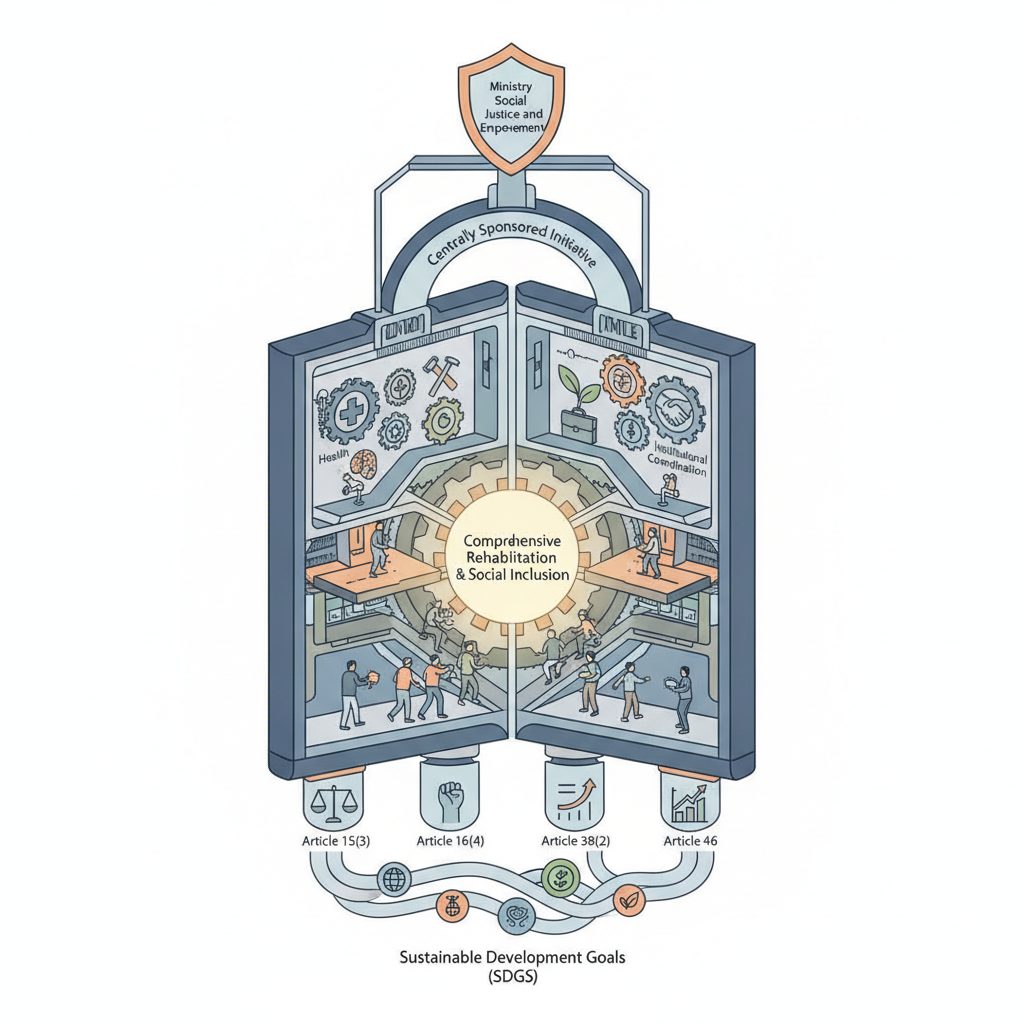
The Ministry of Social Justice and Empowerment has enhanced the implementation of the ‘Support for Marginalised Individuals for Livelihood and Enterprise’ (SMILE) scheme, a centrally sponsored initiative aimed at comprehensive rehabilitation and social inclusion of marginalised sections, including beggars and transgender persons. The scheme integrates health, skill development, livelihood support, and institutional coordination to foster long-term socio-economic integration, with measurable progress reported in identification, rehabilitation, and service delivery.
Background
- The scheme operationalises the constitutional mandate under Articles 15(3), 16(4), 38(2), and 46 to promote social justice, equality, and economic empowerment of vulnerable sections.
- The scheme aligns with the Sustainable Development Goals (SDG 1, 8, 10) by targeting poverty eradication, decent work, and reduced inequalities through targeted interventions.
- The ‘SMILE-Beggary’ portal serves as a digital platform for real-time monitoring, beneficiary identification, and service delivery coordination across states and union territories.
- The scheme builds on earlier welfare measures such as the Deendayal Antyodaya Yojana-National Urban Livelihoods Mission (DAY-NULM) and the National Portal for Transgender Persons.
- The initiative reflects a shift from ad hoc welfare to a structured, outcome-oriented rehabilitation framework with measurable indicators.
What is the SMILE Scheme?
- The scheme comprises two key sub-schemes: (i) ‘Comprehensive Rehabilitation of Persons Engaged in Begging’ and (ii) ‘Welfare of Transgender Persons’.
- The ‘Comprehensive Rehabilitation of Persons Engaged in Begging’ sub-scheme focuses on identification, mobilisation, medical assistance, counselling, education, skill development, and sustainable livelihood opportunities for beggars.
- The ‘Welfare of Transgender Persons’ sub-scheme provides shelter through ‘Garima Grihas’ (shelter homes), healthcare, skill training, entrepreneurship support, and employment facilitation for homeless and destitute transgender individuals.
- The scheme operates through multi-stakeholder collaboration, involving state governments, district administrations, urban local bodies, NGOs, and other agencies to ensure coordinated service delivery.
- Digital governance is a key pillar, with the ‘SMILE-Beggary’ portal enabling real-time tracking of beneficiary identification, rehabilitation progress, and service utilisation across the country.
- The scheme integrates with existing health and welfare programmes, such as Ayushman Bharat PM-JAY, to ensure seamless access to healthcare services for marginalised groups.
- Monitoring and evaluation mechanisms, including third-party assessments, ensure transparency, accountability, and continuous improvement in programme implementation.
Key Features
| Feature | Significance |
|---|---|
| Sub-scheme for Comprehensive Rehabilitation of Beggars (‘SMILE-Beggary’) | Targets identification, mobilization, and holistic rehabilitation of beggars through medical, counselling, education, skill development, and livelihood support, aligning with the goal of a ‘Beggary-Free India’. |
| Transgender Welfare Component under ‘SMILE’ | Provides shelter (via 23 ‘Garima Grihas’ in 17 states/UTs), health services, skill training, and employment linkages for homeless and destitute transgender individuals. |
| National Transgender Portal | Facilitates issuance of Transgender Certificates and ID cards to 33,303 individuals, streamlining access to welfare schemes and legal recognition. |
| Integration with Ayushman Bharat PM-JAY | Enables transgender individuals to avail health coverage through 147 dedicated ‘AB PM-JAY Transgender Cards’, ensuring financial protection against medical expenses. |
| Skill Development and Entrepreneurship Initiatives | Provides training to 725 transgender individuals and entrepreneurship support to 150, alongside organizing national employment fairs for mainstream integration. |
Why it Matters
Social Inclusion and Equity
- Advances the constitutional mandate of social justice (Article 46) by addressing systemic exclusion of marginalized groups, including beggars and transgender persons.
- Promotes dignity and self-reliance through structured rehabilitation frameworks, reducing dependency on ad-hoc charity.
- Ensures equitable access to welfare services by leveraging digital portals (e.g., ‘SMILE-Beggary’ and National Transgender Portal) for transparency and outreach.
Institutional Collaboration
- Demonstrates multi-stakeholder governance by integrating efforts of central ministries, state governments, district administrations, urban local bodies, and civil society organizations.
- Fosters inter-departmental synergy (e.g., Ministry of Social Justice with Ministry of Health and National Health Authority) to deliver comprehensive services.
- Strengthens decentralized implementation through local bodies, ensuring contextualized solutions for diverse regional challenges.
Economic Empowerment
- Enhances livelihood opportunities via skill development and entrepreneurship programs, aligning with the ‘Atmanirbhar Bharat’ vision of self-sufficiency.
- Reduces long-term economic burden on public health systems by preventing chronic illnesses through early intervention and counselling.
- Creates a pipeline for formal employment through job fairs and partnerships with private sector entities.
Legal and Policy Framework
- Operationalizes the Transgender Persons (Protection of Rights) Act, 2019, by providing tangible welfare measures beyond legal recognition.
- Supports the National Policy for Persons with Disabilities (2006) and Rights of Persons with Disabilities Act, 2016, for beggars with disabilities.
- Complements the National Urban Livelihoods Mission (NULM) by addressing urban homelessness and destitution.
Challenges
1. Identification and Data Disparities
- Incomplete or inaccurate identification of beggars and transgender persons due to stigma, mobility constraints, and lack of standardized survey protocols.
- Digital divide limits access to portals like ‘SMILE-Beggary’ and National Transgender Portal, particularly in rural and tribal areas.
UPSC Link: GS-II: Social Justice; Vulnerable Sections
2. Stigma and Social Barriers
- Deep-rooted societal prejudice against beggars and transgender persons hinders mainstream integration and employment opportunities.
- Family and community rejection often forces individuals back into destitution post-rehabilitation.
UPSC Link: GS-I: Social Empowerment
3. Resource Allocation and Last-Mile Delivery
- Inadequate funding for ‘Garima Grihas’ and skill development programs, leading to capacity constraints in service delivery.
- Delays in inter-departmental fund disbursement and bureaucratic bottlenecks affect timely implementation.
UPSC Link: GS-III: Government Budgeting and Financial Management
4. Healthcare and Mental Health Gaps
- Limited availability of specialized healthcare services for transgender persons, including mental health support.
- Beggars with substance abuse or mental health disorders require long-term care, which current frameworks may not fully address.
UPSC Link: GS-II: Health; Social Justice
5. Monitoring and Outcome Measurement
- Absence of a unified MIS (Management Information System) to track rehabilitation outcomes and prevent duplication of efforts.
- Lack of standardized metrics to evaluate the effectiveness of skill training and employment linkages.
UPSC Link: GS-IV: Ethics; Governance
Challenges — UPSC Perspective
| Issue | Concern |
|---|---|
| Inadequate Shelter Infrastructure | Limited capacity of ‘Garima Grihas’ (23 centers) to accommodate the estimated 5-6 lakh transgender population in India. |
| Fragmented Skill Development Programs | Lack of industry-aligned curricula and certification mechanisms for transgender individuals, reducing employability. |
| Inter-State Migration Challenges | Transgender persons and beggars relocating across states face barriers in accessing state-specific welfare schemes due to residency requirements. |
| Legal Recognition Delays | Prolonged processing times for Transgender Certificates and ID cards, delaying access to welfare benefits. |
| Private Sector Engagement Gaps | Limited corporate participation in employment fairs and skill programs, restricting job placement opportunities. |
Government Initiatives — Must-Memorise for Prelims
- SMILE (Support for Marginalized Individuals for Livelihood and Enterprise)
- Ayushman Bharat PM-JAY (Pradhan Mantri Jan Arogya Yojana)
- Transgender Persons (Protection of Rights) Act, 2019
- National Urban Livelihoods Mission (NULM)
- National Policy for Persons with Disabilities (2006)
Way Forward
- Expand ‘Garima Grihas’ network to at least one center per state/UT, with a focus on Tier-II and Tier-III cities for equitable access.
- Establish a unified MIS platform integrating ‘SMILE-Beggary’ and National Transgender Portal to enable real-time tracking of rehabilitation outcomes and resource allocation.
- Launch industry-specific skill development programs in collaboration with NSDC (National Skill Development Corporation) and private sector partners to enhance employability.
- Strengthen mental health and substance abuse treatment facilities within rehabilitation centers, with partnerships with NIMHANS and state health departments.
- Simplify legal recognition processes by decentralizing certificate issuance to district-level authorities and introducing fast-track mechanisms for marginalized groups.
- Conduct annual national-level audits of ‘SMILE’ implementation to identify bottlenecks and recommend policy reforms, with participation from civil society and academia.
- Enhance public awareness campaigns to reduce stigma, leveraging mass media, local influencers, and community leaders.
- Incentivize private sector participation through tax benefits and CSR mandates for hiring transgender individuals and ex-beggars.
UPSC Value Addition
Keywords for Mains Answer-Writing
SMILE Scheme · Comprehensive Rehabilitation · Social Inclusion · De-notified, Nomadic and Semi-Nomadic Tribes (DNTs) · Transgender Persons (Protection of Rights) Act, 2019 · Welfare of Marginalised Groups · Skill Development and Livelihood Support · Government-NGO Collaboration · Garima Grihas · National Transgender Portal
Constitutional & Policy Linkages
- Article 15(2): Prohibition of discrimination on grounds of religion, race, caste, sex, or place of birth in accessing public places and services.
- Article 16(4): Reservation in public employment for socially and educationally backward classes.
- Article 41: Directive Principle of State Policy to provide public assistance in cases of unemployment, old age, sickness, and disablement.
- Article 46: Promotion of educational and economic interests of weaker sections of society, including SCs, STs, and other marginalized groups.
Concept Flow
Marginalization → Stigma and Exclusion → Government Intervention (SMILE Scheme) → Identification and Mobilization (Portals, Surveys) → Rehabilitation Framework (Shelter, Health, Skill Development) → Social and Economic Integration (Employment, Legal Recognition) → Sustainable Livelihood and Dignity.
Prelims Practice Questions
Q1. Consider the following statements regarding the ‘SMILE’ Scheme:
1. It is a Central Sector Scheme aimed at comprehensive rehabilitation and social inclusion of marginalised groups.
2. The scheme includes a sub-scheme for the rehabilitation of beggars.
3. The ‘Garima Grihas’ under the scheme provide shelter and support exclusively to transgender persons.
4. The scheme does not cover skill development or livelihood support.
How many of the above statements are correct?
- Only one
- Only two
- Only three
- All
Answer: Only three — Statements 1, 2, and 3 are correct. Statement 4 is incorrect as the scheme explicitly includes skill development and livelihood support as key components.
Q2. Assertion (A): The ‘SMILE’ Scheme is implemented in collaboration with state governments, district administrations, and urban local bodies.
Reason (R): The scheme aims to ensure long-term social and economic integration of marginalised groups beyond immediate relief.
Options:
A. Both A and R are true, and R is the correct explanation of A.
B. Both A and R are true, but R is not the correct explanation of A.
C. A is true, but R is false.
D. A is false, but R is true.
- A
- B
- C
- D
Answer: B — Both the Assertion and Reason are true. The scheme’s implementation involves multi-stakeholder collaboration (A), and this collaboration is designed to ensure long-term integration (R), making R the correct explanation of A.
Mains Practice Question
✍ The ‘SMILE’ Scheme represents a significant policy intervention aimed at the comprehensive rehabilitation and social inclusion of marginalised groups in India. Critically examine its objectives, components, and implementation framework. Also, analyse its potential to address systemic barriers faced by such groups in accessing welfare services and livelihood opportunities. (15 Marks)
Approach: MODEL-ANSWER SKELETON:
1. **Introduction (2 Marks)**:
– Define the ‘SMILE’ Scheme and its legal/constitutional basis (e.g., Article 41 of the Directive Principles of State Policy, Social Justice and Empowerment Ministry’s mandate).
– State its primary objective: comprehensive rehabilitation and social inclusion of marginalised groups, including De-notified, Nomadic and Semi-Nomadic Tribes (DNTs), beggars, and transgender persons.
2. **Key Components and Objectives (4 Marks)**:
– **Sub-scheme for Beggars**: Identification, rehabilitation, medical facilities, counselling, education, skill development, and livelihood support (cite data: 42,589 identified, 12,710 rehabilitated).
– **Transgender Persons Welfare**: Establishment of ‘Garima Grihas’ (23 in 17 states/UTs), skill development (725 trained), entrepreneurship support (150 trained), and health services (e.g., tie-up with Ayushman Bharat).
– **Collaborative Framework**: Involvement of state governments, district administrations, urban local bodies, and NGOs (cite the ‘SMILE-Begari’ portal and National Transgender Portal).
3. **Implementation Framework (4 Marks)**:
– **Multi-Stakeholder Collaboration**: Role of central ministries (Social Justice and Empowerment, Health and Family Welfare), state agencies, and local bodies.
– **Institutional Mechanisms**: Use of digital platforms (e.g., National Transgender Portal for identity certificates; 33,303 certificates issued) and convergence with existing schemes (e.g., Ayushman Bharat).
– **Monitoring and Evaluation**: Data-driven approach (e.g., real-time tracking via portals) and periodic reviews.
4. **Potential to Address Systemic Barriers (3 Marks)**:
– **Access to Welfare Services**: Breaking barriers in accessing healthcare, education, and legal identity (e.g., transgender certificates).
– **Livelihood Opportunities**: Skill development and entrepreneurship support to reduce dependency on begging or exploitative livelihoods.
– **Social Stigma and Discrimination**: Addressing societal attitudes through awareness campaigns and community engagement.
5. **Challenges and Limitations (2 Marks)**:
– **Implementation Gaps**: Disparities in state-level execution, limited reach in remote areas.
– **Sustainability**: Ensuring long-term integration beyond immediate relief (e.g., post-rehabilitation support).
– **Data Gaps**: Need for more granular data on outcomes (e.g., employment rates post-training).
**Balanced View**: Acknowledge the scheme’s strengths in its comprehensive approach and multi-stakeholder design, while critiquing its potential limitations in scalability and sustainability.
Source: PIB (Press Information Bureau)
Generated by AanyaAi for educational purpose.

- मद्रास उच्च न्यायालय में ‘वेट्ट्री पयणम’ योजना को असंवैधानिक घोषित करने की मांग - October 4, 2026
- Gurugram’s groundwater extraction exceeds limit by 212%; HC seeks ban - October 4, 2026
- स्वतंत्रता सेनानी श्यामजी कृष्ण वर्मा की जन्म जयंती पर पीएम का श्रद्धांजलि - October 4, 2026

No Comments