


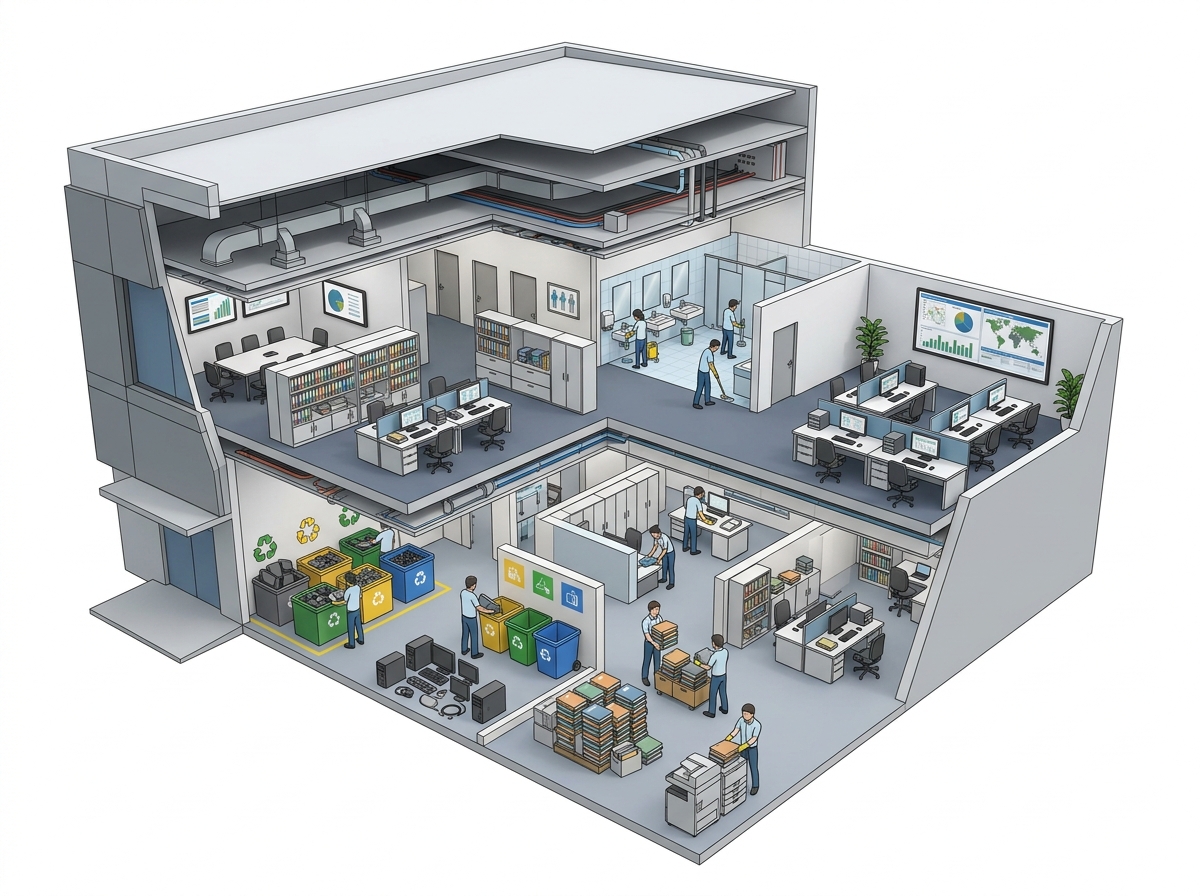
26 Sep Special Campaign 6.0: DCP&C to Focus on E-Waste, Cleanliness & Workplace Efficiency
✎ Special Campaign 6.0 (October 2026) of the Department of Chemicals and Petrochemicals prioritises e-waste disposal under the E-waste (Management) Rules, 2022, and record management reforms to institutionalise administrative…
Subject Relevance — Where This Topic Fits
- GS Paper II — Governance, Transparency and Accountability | GS Paper III — Environment and Sustainable Development | GS Paper III — Government Budgeting and Financial Management
- Prelims: E-waste (Management) Rules, 2022, General Financial Rules (GFR) 2017, Swachh Bharat Mission, Digital India, Parliamentary Assurances Monitoring
- Essay: Administrative reforms and institutional efficiency in governance, Sustainable waste management as a public good
Quick Revision: Special Campaign 6.0 (October 2026) of the Department of Chemicals and Petrochemicals prioritises e-waste disposal under the E-waste (Management) Rules, 2022, and record management reforms to institutionalise administrative efficiency and transparency.
Why is this in the news?
The Department of Chemicals and Petrochemicals (DCPC), under the Ministry of Chemicals and Fertilizers, is preparing for Special Campaign 6.0 (October 2–31, 2026) to enhance workplace efficiency, e-waste disposal, and sanitation, building on the achievements of Special Campaign 5.0 (October 2–31, 2025), which generated over ₹9.18 lakh in revenue from scrap disposal, freed 7,156 sq ft of office space, and resolved all public grievances within timelines.
Background
- The Department of Chemicals and Petrochemicals (DCPC) is a nodal agency under the Ministry of Chemicals and Fertilizers, responsible for policy formulation, implementation, and monitoring of schemes related to chemicals, petrochemicals, and fertilisers in India.
- Special Campaigns are time-bound, mission-mode initiatives launched by the Government of India to promote cleanliness, efficiency, and transparency in public offices, aligning with the broader objectives of the Swachh Bharat Mission and the Digital India programme.
- E-waste (Management) Rules, 2022, mandate the identification, segregation, storage, transportation, processing, and disposal of e-waste, with provisions for extended producer responsibility (EPR) and formalisation of the informal sector.
- Public Sector Undertakings (PSUs) and autonomous institutions under DCPC, such as CIPET, IPFT, HOCIL, and HIL, play a critical role in implementing waste management and efficiency measures across the chemicals and petrochemicals sector.
- Parliamentary assurances and public grievances form an integral part of governance accountability, with departments required to monitor and resolve them within stipulated timelines.
What is Special Campaign 6.0?
- Special Campaign 6.0 is a month-long, government-wide initiative (October 2–31, 2026) aimed at enhancing workplace efficiency, sanitation, and e-waste management in the Department of Chemicals and Petrochemicals (DCPC) and its affiliated institutions.
- The campaign builds on the success of Special Campaign 5.0 (October 2–31, 2025), which achieved measurable outcomes in scrap disposal (₹9.18 lakh revenue), space optimisation (7,156 sq ft freed), and record management (4,792 physical files reviewed, 237 declared redundant; 1,275 e-files reviewed, 170 closed).
- E-waste management is a focal area under Special Campaign 6.0, with emphasis on identification, segregation, and disposal in compliance with the E-waste (Management) Rules, 2022, including formalisation of informal sector linkages and safe disposal mechanisms.
- Space management and workplace beautification are prioritised to optimise office layouts, remove obsolete furniture, and enhance ergonomic and aesthetic standards, thereby improving administrative efficiency and employee productivity.
- Public grievances and parliamentary assurances will be reviewed and resolved within stipulated timelines, with a focus on time-bound redressal and accountability in service delivery.
- Record management reforms include the review, digitisation, and closure of redundant physical and electronic files, aligning with the Digital India initiative and reducing administrative burden.
- The campaign fosters inter-ministerial coordination, with participation from PSUs and autonomous institutions such as CIPET, IPFT, HOCIL, and HIL, ensuring sector-wide implementation of efficiency and waste management measures.
Key Features
| Feature | Significance |
|---|---|
| E-waste management under E-Waste (Management) Rules, 2022 | Ensures compliance with national regulations for hazardous electronic waste disposal, reducing environmental contamination and promoting circular economy principles. |
| Workspace optimization and scrap disposal | Enhances administrative efficiency by reclaiming underutilized office space and generating revenue through sale of scrap materials. |
| Digital record management (physical & electronic files) | Reduces storage costs, improves retrieval speed, and aligns with the Digital India initiative for paperless governance. |
| Timely disposal of pending parliamentary assurances and public grievances | Demonstrates adherence to constitutional obligations and strengthens citizen-government interface through responsive administration. |
| Participation of CPSEs and autonomous bodies (e.g., CIPET, HOCIL) | Extends campaign’s impact across the chemical sector’s ecosystem, fostering uniform governance standards in public enterprises. |
Why it Matters
Administrative Efficiency
- Systematic elimination of redundant records and scrap reduces bureaucratic overhead, accelerating decision-making processes.
- Revenue generation from scrap disposal (₹9.18 lakh in 2025) demonstrates fiscal prudence in public expenditure management.
- Optimization of 7,156 sq. ft. of office space in 2025 highlights resource efficiency, a critical component of sustainable governance.
Environmental Governance
- Mandatory e-waste segregation and disposal under E-Waste (Management) Rules, 2022 mitigates toxic waste accumulation in landfills.
- Promotes Extended Producer Responsibility (EPR) principles, aligning with India’s commitment to the Basel Convention on hazardous waste management.
- Reduces carbon footprint by curbing improper e-waste incineration and informal recycling practices.
Digital Transformation
- Transition from physical to electronic records aligns with the National e-Governance Plan (NeGP) and reduces logistical burdens on archival systems.
- Enhances transparency by enabling real-time tracking of file movements and grievance redressal status.
- Supports the ‘Paperless Office’ mandate under the Ministry of Electronics and Information Technology (MeitY).
Compliance and Accountability
- Ensures adherence to General Financial Rules (GFR) for scrap disposal and surplus asset management, preventing financial irregularities.
- Timely disposal of parliamentary assurances (9 in 2025) and public grievances (6 in 2025) reinforces constitutional governance norms.
- Institutionalizes periodic audits of records and assets, reducing the risk of data breaches or misappropriation.
Challenges
1. E-waste segregation and compliance
- Limited awareness among staff about hazardous components in e-waste (e.g., lead, mercury) may lead to improper handling.
- Dependence on third-party recyclers requires stringent monitoring to prevent illegal dumping or export of e-waste.
- High initial costs for setting up authorized e-waste collection centers within departmental premises.
UPSC Link: GS3: Environmental Pollution & Degradation
2. Digital record management bottlenecks
- Legacy systems with incompatible file formats hinder seamless migration to electronic records.
- Resistance to change among employees accustomed to physical file-based workflows.
- Cybersecurity risks associated with centralized digital repositories necessitate robust data protection protocols.
UPSC Link: GS2: Governance, Transparency & Accountability
3. Space optimization in older government buildings
- Structural constraints in heritage buildings limit flexibility in reconfiguring office layouts.
- High costs of retrofitting spaces to accommodate modern workstations and storage solutions.
- Balancing aesthetics with functional needs in workspace design for long-term sustainability.
UPSC Link: GS2: Government Policies & Interventions
4. Inter-departmental coordination for pending parliamentary matters
- Delays in responses to parliamentary assurances arise from multi-layered approval processes.
- Lack of standardized templates for tracking and reporting on assurances across ministries.
- Overlapping jurisdictions between central ministries and state governments complicate resolution timelines.
UPSC Link: GS2: Parliament & State Legislatures
5. Public grievance redressal system overload
- High volume of complaints in CPGRAMS portal may overwhelm departmental grievance cells.
- Inadequate staffing in public grievance redressal units to handle surge in complaints during campaign periods.
- Need for proactive outreach to educate citizens on simplified grievance filing mechanisms.
UPSC Link: GS2: Citizen Charter & Grievance Redressal
Challenges — UPSC Perspective
| Issue | Concern |
|---|---|
| E-waste regulatory compliance | Risk of non-adherence to E-Waste (Management) Rules, 2022 due to procedural gaps in segregation and disposal. |
| Digital record migration delays | Potential data loss or corruption during transition from physical to electronic records. |
| Parliamentary assurance backlog | Systemic delays in addressing assurances may erode public trust in governance. |
| Space reconfiguration costs | High capital expenditure for retrofitting offices in heritage buildings. |
| Third-party e-waste recycler oversight | Lack of monitoring mechanisms to prevent illegal recycling or export of e-waste. |
| Employee resistance to digital workflows | Cultural inertia in adopting paperless processes despite training initiatives. |
Way Forward
- Conduct mandatory training sessions for staff on e-waste segregation protocols under E-Waste (Management) Rules, 2022.
- Establish in-house e-waste collection centers with certified recyclers to ensure end-to-end compliance.
- Accelerate migration to electronic records by digitizing legacy files and adopting cloud-based storage solutions.
- Implement a standardized dashboard for tracking parliamentary assurances and public grievances in real time.
- Undertake structural audits of office spaces to identify underutilized areas and prioritize reconfiguration projects.
- Introduce incentive mechanisms (e.g., recognition awards) for departments achieving high efficiency in record management.
- Collaborate with MeitY to integrate CPGRAMS with departmental grievance redressal systems for seamless tracking.
- Pilot a ‘Paperless Office’ model in select branches to demonstrate cost savings and operational benefits.
UPSC Value Addition
Keywords for Mains Answer-Writing
Special Campaign 6.0 · e-waste management · E-Waste (Management) Rules, 2022 · scrap disposal · office space optimization · record management · administrative efficiency · Government of India initiatives · public sector undertakings · sustainable governance · workplace productivity · Swachh Bharat Mission · General Financial Rules (GFR) · parliamentary assurances · public grievances redressal
Concept Flow
Departmental inefficiencies (redundant records, scrap accumulation) → Launch of Special Campaign 5.0 (2025) → Measurable gains (₹9.18 lakh revenue, 7,156 sq. ft. space reclaimed) → Expansion to Special Campaign 6.0 (2026) with sharper focus on e-waste and digital records. → E-Waste (Management) Rules, 2022 → Mandate for hazardous waste disposal → Integration into departmental operations via Special Campaign 6.0 → Environmental compliance and circular economy alignment. → General Financial Rules (GFR) → Governance of scrap disposal and surplus asset management → Implementation through campaign protocols → Revenue generation and fiscal discipline. → Digital India initiative → National e-Governance Plan (NeGP) → Transition to electronic records → Enhanced transparency and reduced bureaucratic delays. → Parliamentary Assurances → Constitutional obligation under Article 80/81 → Monitoring via campaign → Improved citizen-government interface and accountability. → Public Grievances (CPGRAMS) → Right to Service Delivery → Time-bound redressal under campaign → Strengthened administrative responsiveness.
Prelims Practice Questions
Q1. Consider the following statements regarding the Special Campaign 6.0 launched by the Department of Chemicals & Petrochemicals: 1. The campaign focuses on e-waste management, workplace efficiency, and office space optimization. 2. It mandates the disposal of scrap and redundant items in accordance with the General Financial Rules (GFR). 3. The campaign is conducted under the aegis of the Ministry of Environment, Forest and Climate Change. How many of the above statements are correct?
- Only one
- Only two
- All three
- None
Answer: Only two — Statement 1 is correct as the campaign targets e-waste management, workplace efficiency, and office space optimization. Statement 2 is correct as the disposal of scrap and redundant items is governed by GFR. Statement 3 is incorrect as the campaign is under the Ministry of Chemicals and Fertilizers, not the Ministry of Environment.
Q2. Assertion (A): The E-Waste (Management) Rules, 2022, place a statutory obligation on producers, consumers, and recyclers for the environmentally sound management of e-waste. Reason (R): The Rules mandate the establishment of a Producer Responsibility Organization (PRO) to ensure compliance with e-waste collection and recycling targets.
- Both A and R are true, and R is the correct explanation of A
- Both A and R are true, but R is not the correct explanation of A
- A is true, but R is false
- A is false, but R is true
Answer: Both A and R are true, but R is not the correct explanation of A — Both the Assertion and Reason are correct. The E-Waste (Management) Rules, 2022, impose statutory obligations on stakeholders for e-waste management, and the Rules also mandate the establishment of Producer Responsibility Organizations (PROs) to facilitate compliance with collection and recycling targets.
Q3. Match the following initiatives with their respective ministries/departments: 1. Special Campaign 6.0 2. Swachh Bharat Mission 3. E-Waste (Management) Rules, 2022 4. General Financial Rules (GFR)
A. Ministry of Chemicals and Fertilizers
B. Ministry of Housing and Urban Affairs
C. Ministry of Environment, Forest and Climate Change
D. Ministry of Finance
- 1; A
- 2; B
- 3; C
- 4; D
Answer: ? — Special Campaign 6.0 is under the Ministry of Chemicals and Fertilizers. Swachh Bharat Mission is under the Ministry of Housing and Urban Affairs. E-Waste (Management) Rules, 2022, are under the Ministry of Environment, Forest and Climate Change. General Financial Rules (GFR) are issued by the Ministry of Finance.
Mains Practice Question
✍ The Government of India’s Special Campaign 6.0, launched by the Department of Chemicals & Petrochemicals, seeks to institutionalise administrative reforms through a focus on e-waste management, workplace efficiency, and record optimisation. Critically examine the significance of such campaigns in enhancing governance outcomes and administrative efficiency in India. (15 Marks)
Approach: MODEL-ANSWER SKELETON:
1. **Introduction**: Define Special Campaign 6.0 and its objectives (e-waste disposal, workplace efficiency, record management, scrap disposal). Link to broader administrative reform initiatives like Swachh Bharat Mission and the Digital India campaign.
2. **Significance of Special Campaigns in Governance**:
– **Administrative Efficiency**: Cite the outcomes of Special Campaign 5.0 (e.g., revenue generation from scrap disposal, space optimization, record reduction) as empirical evidence of tangible improvements.
– **Sustainability and Compliance**: Highlight the alignment with statutory frameworks such as the E-Waste (Management) Rules, 2022, and General Financial Rules (GFR), 2017, to ensure legal and procedural adherence.
– **Transparency and Accountability**: Discuss how digitisation of records and systematic disposal of scrap reduce corruption and improve audit trails.
– **Workplace Productivity**: Reference studies or government reports (e.g., NITI Aayog’s Good Governance Index) that correlate workplace cleanliness and space optimisation with employee productivity.
3. **Challenges and Limitations**:
– **Implementation Gaps**: Discuss potential challenges in scaling such campaigns across diverse ministries/PSUs, citing examples of uneven participation or resource constraints.
– **Sustainability of Impact**: Question whether such campaigns are episodic or can be institutionalised as continuous processes.
– **Stakeholder Engagement**: Highlight the role of public sector undertakings (PSUs) and autonomous bodies in ensuring widespread adoption.
4. **Comparative Perspective**:
– Compare with similar initiatives in other countries (e.g., Japan’s ‘Cool Biz’ campaign for workplace efficiency or Singapore’s ‘Green Mark’ certification for sustainable workplaces).
– Discuss how India’s approach differs in its multi-pronged focus (e-waste, records, space) versus single-issue campaigns elsewhere.
5. **Conclusion and Way Forward**:
– Emphasise the need for integrating such campaigns with long-term governance reforms (e.g., Mission Karmayogi for civil service capacity building).
– Suggest measures such as mandatory annual audits, incentivisation for PSUs, and public dashboards for transparency.
**Key Data/Provisions to Cite**:
– Outcomes of Special Campaign 5.0 (e.g., ₹9.18 lakh revenue from scrap, 7,156 sq. ft. space freed).
– Statutory frameworks: E-Waste (Management) Rules, 2022; GFR, 2017.
– Comparative examples: Japan’s ‘Cool Biz’, Singapore’s ‘Green Mark’.
Source: PIB (Press Information Bureau)
Generated by AanyaAi for educational purpose.
Related guides on our sites
- Best PSIR optional coaching for upsc
- Best PSIR optional teacher for upsc
- Best teacher of PSIR optional for upsc
- Best PSIR optional coaching in delhi for UPSC

- Special Campaign 6.0: DCP&C to Focus on E-Waste, Cleanliness & Workplace Efficiency - September 26, 2026
- यूपी में हाइब्रिड सोलर सिस्टम: पीएम सूर्यघर योजना में बिजली कटौती से मुक्ति का विकल्प - September 26, 2026
- UPSC Alert: Hybrid Solar Systems in PM Surya Ghar Scheme for Power Backup - September 26, 2026

No Comments