


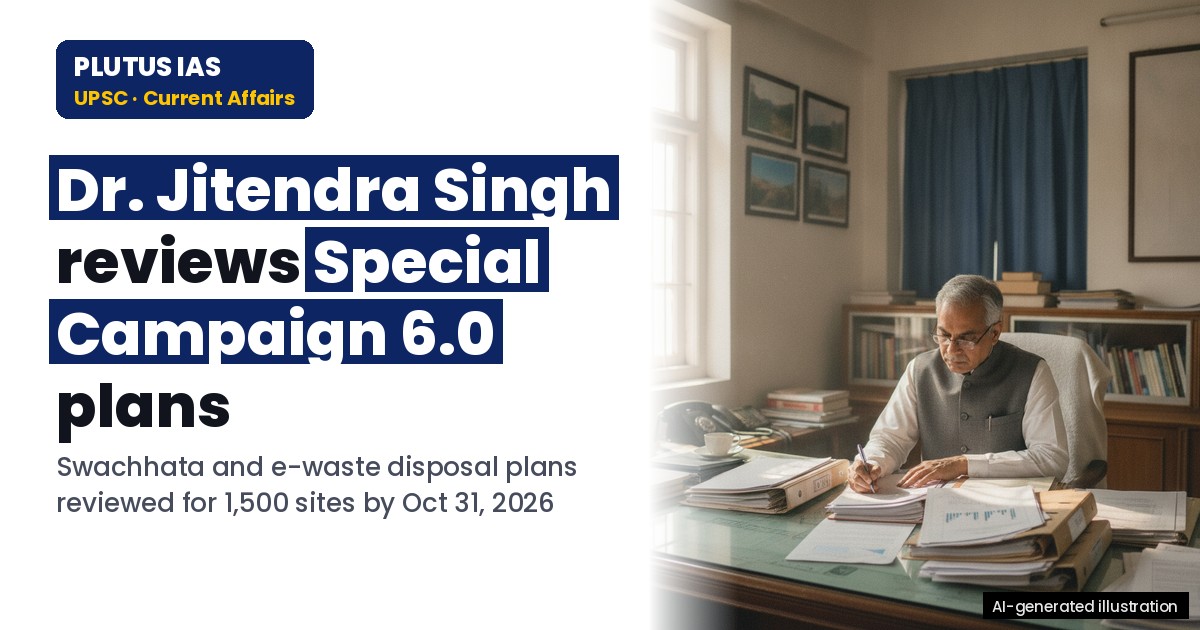
01 Oct Special Campaign 6.0: Key Preparations Reviewed by Dr. Jitendra Singh
✎ Special Campaign 6.0 is a month-long government-wide initiative (2 Oct–31 Oct 2026) focusing on cleanliness, e-waste segregation, and disposal of obsolete records, with 1,500 cleanliness sites across science ministries and…
Subject Relevance — Where This Topic Fits
- GS Paper II — Governance, Transparency and Accountability | GS Paper III — Environmental Pollution and Waste Management | GS Paper III — Science and Technology — Developments and their Applications
- Prelims: Special Campaign 6.0, E-waste Management Rules, 2022, Swachh Bharat Mission 2.0, Administrative Reforms and Public Grievances Department (DARPG), Digital monitoring platforms for government schemes
- Essay: Governance as a catalyst for sustainable development: The role of citizen-centric initiatives in nation-building, Technology and innovation in public service delivery: Balancing efficiency with environmental responsibility
Quick Revision: Special Campaign 6.0 is a month-long government-wide initiative (2 Oct–31 Oct 2026) focusing on cleanliness, e-waste segregation, and disposal of obsolete records, with 1,500 cleanliness sites across science ministries and mandatory digital monitoring by DARPG.
Why is this in the news?
The Union Minister of State (Independent Charge) for Science and Technology, Dr. Jitendra Singh, reviewed the preparations for Special Campaign 6.0, a month-long initiative (2 October–31 October 2026) aimed at enhancing cleanliness, e-waste segregation and disposal, and disposal of obsolete files across government departments. The campaign targets 1,500 cleanliness sites across science ministries, with the Ministry of Earth Sciences conducting activities at 100 sites. The review highlighted progress in budget utilisation, with the Department of Scientific and Industrial Research (DSIR) and the Ministry of Earth Sciences achieving 50% of their targets by 30 September 2026. The campaign underscores the integration of environmental sustainability with administrative efficiency in governance.
Background
- Special Campaigns are a series of time-bound, mission-mode initiatives launched by the Government of India to promote cleanliness, efficiency, and transparency in government functioning, starting with Special Campaign 1.0 in 2021.
- The campaigns align with the broader objectives of Swachh Bharat Mission 2.0, which emphasises cleanliness, waste management, and sustainable urban and rural development.
- E-waste management has emerged as a critical environmental challenge due to the rapid proliferation of electronic devices and their improper disposal, leading to soil and water contamination.
- The E-waste (Management) Rules, 2022, mandate the systematic collection, segregation, and environmentally sound disposal of e-waste, with provisions for producer responsibility and recycling.
- The Administrative Reforms and Public Grievances Department (DARPG) serves as the nodal agency for monitoring and implementing Special Campaigns, utilising digital platforms to track progress in real time.
- Government departments are increasingly adopting digital record-keeping and disposal mechanisms to enhance transparency and reduce pendency of files.
What is Special Campaign 6.0?
- A month-long, government-wide cleanliness and efficiency drive scheduled from 2 October to 31 October 2026, under the aegis of the Ministry of Science and Technology and the Ministry of Earth Sciences.
- The campaign aims to achieve tangible outcomes in cleanliness, e-waste management, and disposal of obsolete records across government departments and scientific institutions.
- Under the campaign, 1,500 cleanliness sites have been identified across various science ministries, with the Ministry of Earth Sciences conducting activities at 100 designated locations.
- The primary focus includes systematic segregation and disposal of e-waste, ensuring compliance with the E-waste (Management) Rules, 2022, and leveraging scientific and technical capabilities for value creation from obsolete equipment.
- Departments are required to conduct on-ground cleanliness drives, dispose of old files through authorised channels, and optimise office spaces for better utilisation of resources.
- The campaign mandates the preparation of item-wise reports for e-waste, involving producers, recyclers, and repairers to ensure traceability and accountability in disposal.
- Digital monitoring is facilitated through a shared platform managed by DARPG, enabling real-time tracking of targets, progress, and budget utilisation across ministries.
- The initiative is designed to enhance administrative efficiency, reduce pendency of files, and promote a culture of cleanliness and environmental responsibility within government institutions.
Key Features
| Feature | Significance |
|---|---|
| Swachhta Abhiyaan Sites | Directly targets physical cleanliness in government offices, optimizing space utilization and reducing clutter. |
| E-waste Segregation & Disposal | Ensures systematic identification, segregation, and environmentally sound disposal of electronic waste. |
| Destruction of Obsolete Files | Promotes efficient record management by eliminating redundant and outdated documentation. |
| Digital Monitoring Platform | Enables real-time tracking of campaign progress across ministries via a centralized dashboard. |
| Quarterly Expenditure Review | Facilitates fiscal discipline by assessing budgetary allocations and actual spending against targets. |
Why it Matters
Administrative Efficiency
- Enhances governance through systematic resource optimization in government offices.
- Reduces bureaucratic inefficiencies by streamlining record-keeping and space management.
- Promotes accountability via digital monitoring of campaign milestones.
Environmental Sustainability
- Addresses e-waste management, a critical component of India’s circular economy agenda.
- Prevents environmental degradation by ensuring compliant disposal of hazardous electronic materials.
- Aligns with India’s commitments under global frameworks like the Basel Convention.
Fiscal Governance
- Ensures judicious use of public funds by linking expenditure to tangible outcomes.
- Encourages ministries to achieve 50% of budgetary targets within stipulated timelines.
- Demonstrates the integration of financial auditing with operational performance.
Technological Integration
- Leverages digital tools for transparent and participatory governance.
- Facilitates data-driven decision-making through real-time progress tracking.
- Supports the ‘Digital India’ vision by embedding technology in routine administrative processes.
Challenges
1. E-waste Management Infrastructure
- Limited capacity of formal recycling facilities to handle high volumes of e-waste.
- Inadequate awareness among stakeholders regarding safe disposal protocols.
- Need for standardized certification systems for e-waste recyclers.
UPSC Link: Environmental Pollution (Prevention & Control) Act, 1986
2. Behavioral Resistance to Change
- Reluctance among officials to adopt digital record-keeping due to familiarity with manual systems.
- Cultural inertia in prioritizing cleanliness and waste segregation in routine operations.
- Training gaps in handling new protocols for e-waste segregation.
UPSC Link: Administrative Reforms (DARPG initiatives)
3. Resource Allocation Constraints
- Budgetary limitations in scaling up infrastructure for e-waste processing.
- Delays in procurement of equipment for cleanliness drives due to procedural bottlenecks.
- Need for inter-ministerial coordination to pool resources effectively.
UPSC Link: Public Financial Management System (PFMS)
4. Monitoring and Compliance Gaps
- Risk of superficial compliance without substantive behavioral change.
- Challenges in verifying the authenticity of reported e-waste disposal data.
- Ensuring uniformity in implementation across diverse government offices.
UPSC Link: Right to Information Act, 2005
Challenges — UPSC Perspective
| Issue | Concern |
|---|---|
| Infrastructure Deficit | Insufficient formal e-waste recycling facilities to meet campaign targets. |
| Stakeholder Awareness | Limited understanding of e-waste segregation protocols among government staff. |
| Procurement Delays | Bureaucratic hurdles in acquiring necessary equipment for cleanliness drives. |
| Data Verification | Difficulty in authenticating reported disposal figures for e-waste and obsolete files. |
| Behavioral Inertia | Resistance to adopting digital record-keeping and waste management practices. |
Way Forward
- Strengthen inter-ministerial coordination to ensure uniform implementation of e-waste disposal protocols.
- Conduct capacity-building workshops for officials on digital record-keeping and e-waste segregation.
- Expand partnerships with certified e-waste recyclers to augment disposal infrastructure.
- Integrate AI-based tools in the digital monitoring platform for predictive analytics on campaign progress.
- Establish a grievance redressal mechanism for reporting non-compliance or delays in implementation.
- Publish quarterly progress reports to maintain transparency and public accountability.
- Align campaign outcomes with the Swachh Bharat Mission 2.0 for synergistic impact.
- Incorporate citizen feedback mechanisms to enhance the efficacy of cleanliness drives.
UPSC Value Addition
Keywords for Mains Answer-Writing
Special Campaign 6.0 · Swachhata Abhiyan · e-waste management · Government of India cleanliness drives · Administrative Reforms and Public Grievances Department (DARPG) · scientific disposal of obsolete electronics · office space utilisation · budgetary expenditure review · DSIR · Ministry of Earth Sciences · Government record management · office cleanliness protocols · quarterly expenditure monitoring · digital monitoring platforms for governance · public sector waste management · sustainable resource utilisation in governance
Concept Flow
Government offices accumulate physical and electronic waste over time → Inefficient space utilization and environmental risks → Launch of Special Campaign 6.0 to address cleanliness and e-waste → Multi-stakeholder review by DST, DARPG, and line ministries → Digital monitoring of progress via a centralized platform → Quarterly expenditure reviews to ensure fiscal discipline → Behavioral change through training and incentives → Sustainable waste management and administrative efficiency.
Prelims Practice Questions
Q1. Consider the following statements regarding Special Campaign 6.0 in India:
1. Special Campaign 6.0 is a government initiative aimed at enhancing office cleanliness and utilising government spaces more efficiently.
2. The campaign includes systematic disposal of e-waste and obsolete electronic equipment.
3. The campaign is monitored through a shared digital platform managed by the Department of Administrative Reforms and Public Grievances (DARPG).
4. The Ministry of Earth Sciences has set a target of 1,500 cleanliness campaign sites under this initiative.
How many of the above statements are correct?
- Only one
- Only two
- Only three
- All four
Answer: Only three — Statements 1, 2, and 3 are correct. Statement 4 is incorrect as the Ministry of Earth Sciences has set a target of 100 cleanliness campaign sites, while the total target across all science ministries and departments is 1,500 sites.
Q2. Assertion (A): Special Campaign 6.0 includes the systematic identification and disposal of e-waste generated in government offices.
Reason (R): The campaign aims to leverage scientific and technical capabilities to create value from obsolete equipment and ensure proper disposal of e-waste.
In the context of the above two statements, which one of the following is correct?
- Both A and R are true, and R is the correct explanation of A
- Both A and R are true, but R is not the correct explanation of A
- A is true, but R is false
- A is false, but R is true
Answer: Both A and R are true, and R is the correct explanation of A — Both Assertion (A) and Reason (R) are true, and Reason (R) correctly explains Assertion (A). The campaign explicitly includes systematic identification, separation, and disposal of e-waste, with a focus on leveraging scientific capabilities for value creation from obsolete equipment.
Q3. Match the following columns related to Special Campaign 6.0:
Column I (Ministry/Department) | Column II (Target under Special Campaign 6.0)
a) Ministry of Earth Sciences | 1) 1,500 cleanliness campaign sites
b) Department of Scientific and Industrial Research (DSIR) | 2) 100 cleanliness campaign sites
c) Department of Biotechnology (DBT) | 3) Part of the overall 1,500 sites
Select the correct match:
- a-2, b-1, c-3
- a-1, b-2, c-3
- a-3, b-1, c-2
- a-2, b-3, c-1
Answer: a-2, b-1, c-3 — The correct match is: a) Ministry of Earth Sciences – 2) 100 cleanliness campaign sites; b) Department of Scientific and Industrial Research (DSIR) – 1) Part of the overall 1,500 sites; c) Department of Biotechnology (DBT) – 3) Part of the overall 1,500 sites.
Mains Practice Question
✍ The Government of India’s Special Campaign 6.0 represents a multi-dimensional governance initiative aimed at enhancing administrative efficiency, resource utilisation, and environmental sustainability. Critically examine the objectives, institutional mechanisms, and challenges associated with this campaign. Also, analyse how such campaigns contribute to the broader goals of ‘Minimum Government, Maximum Governance’. (15 Marks)
Approach: MODEL-ANSWER SKELETON:
1. **Introduction (2 Marks)**
– Define Special Campaign 6.0 as a cleanliness and resource optimisation drive launched by the Government of India.
– Contextualise within the broader ‘Swachh Bharat’ and ‘Minimum Government, Maximum Governance’ frameworks.
2. **Objectives of Special Campaign 6.0 (3 Marks)**
– Primary objectives: Systematic disposal of e-waste, utilisation of redundant office spaces, destruction of obsolete files, and efficient record management.
– Secondary objectives: Leveraging scientific and technical capabilities for value creation from obsolete equipment, ensuring compliance with environmental norms.
– Cite the target of 1,500 cleanliness campaign sites across science ministries and 100 sites under the Ministry of Earth Sciences.
3. **Institutional Mechanisms (4 Marks)**
– Role of the Department of Administrative Reforms and Public Grievances (DARPG) in monitoring progress via a shared digital platform.
– Involvement of key ministries: Department of Scientific and Industrial Research (DSIR), Ministry of Earth Sciences, Department of Biotechnology (DBT).
– Quarterly reviews of budgetary expenditure and progress, as highlighted in the review meeting chaired by Dr. Jitendra Singh.
– Participation of senior officials and nodal officers from respective ministries.
4. **Challenges and Criticisms (3 Marks)**
– Implementation challenges: Ensuring sustained participation across all government offices, overcoming bureaucratic inertia.
– Sustainability concerns: Long-term impact on e-waste management and office space utilisation post-campaign.
– Data management: Ensuring accurate reporting of e-waste disposal and resource utilisation.
– Resource constraints: Budgetary allocations and their efficient utilisation.
5. **Contribution to ‘Minimum Government, Maximum Governance’ (3 Marks)**
– Reduction in redundant office spaces and obsolete files, leading to cost savings and improved administrative efficiency.
– Enhanced environmental sustainability through systematic e-waste disposal and resource optimisation.
– Strengthening of digital governance via real-time monitoring platforms.
– Alignment with constitutional and statutory provisions on environmental protection and administrative efficiency (e.g., Article 48A, Directive Principles of State Policy).
6. **Conclusion (2 Marks)**
– Summarise the significance of Special Campaign 6.0 as a governance reform initiative.
– Highlight the need for continuous monitoring, stakeholder engagement, and policy integration to ensure long-term success.
Source: PIB (Press Information Bureau)
Generated by AanyaAi for educational purpose.
Related guides on our sites
- Current affairs for upsc 2026
- Best PSIR optional coaching for upsc
- Best PSIR optional teacher for upsc
- Best teacher of PSIR optional for upsc

- डीआरआई ने मुंबई एयरपोर्ट पर सोने-हीरे की तस्करी गिरोह का किया पर्दाफाश, 8 गिरफ्तार - October 3, 2026
- Chhattisgarh CM Rural Bus Scheme: 850 Villages Connected in 1 Year - October 3, 2026
- युगांडा का वन्यजीव फॉरेंसिक्स लैब: हाथीदांत तस्करी पर लगाम - October 3, 2026

No Comments