


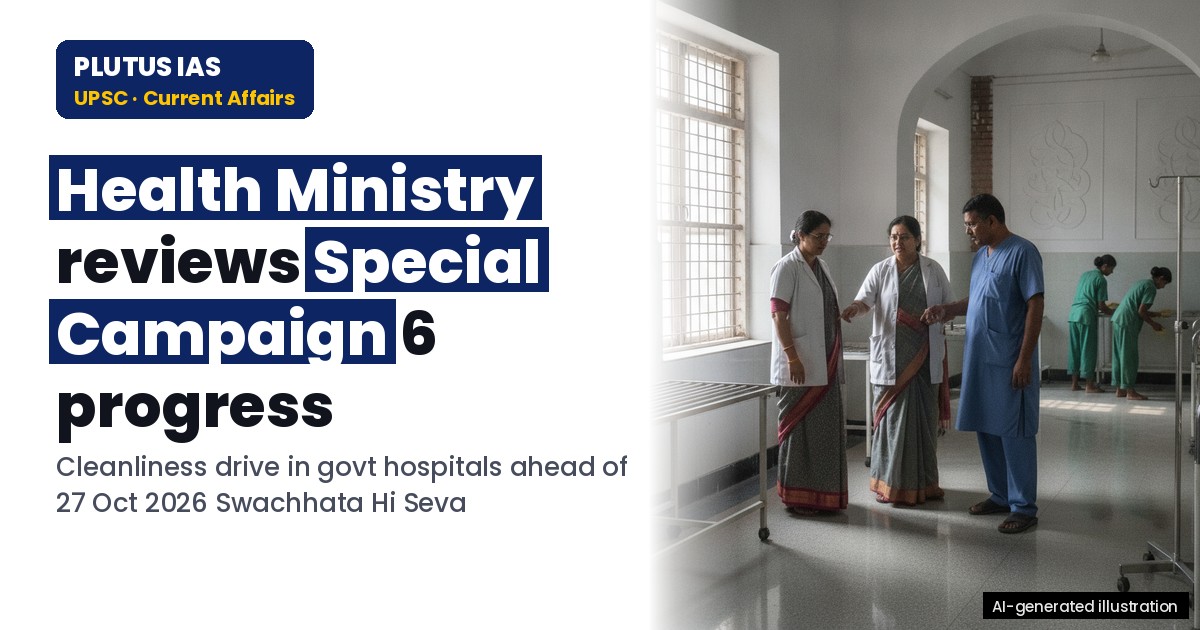
26 Oct Special Campaign 6: Health Ministry Reviews Cleanliness Drive Progress for UPSC
✎ Special Campaign 6 and Kayakalp are complementary governance initiatives aimed at institutionalising hygiene, sustainability, and efficiency in public health facilities through measurable, citizen-centric improvements.
Subject Relevance — Where This Topic Fits
- GS Paper II — Governance, Transparency and Accountability | GS Paper III — Environment and Sustainable Development
- Prelims: Kayakalp Scheme, Special Campaign 6, Swachh Bharat Mission 2.0, Biomedical Waste Management Rules 2016, E-waste (Management) Rules 2022, Public Grievances Redressal, Digital Public Grievance Redressal System (DPGRS), Reuse-Recycle-Reclaim (3R) Principle
- Essay: The Role of Institutional Hygiene in Public Health Governance, Sustainable Development Goals and Clean Public Spaces: A Governance Imperative
Quick Revision: Special Campaign 6 and Kayakalp are complementary governance initiatives aimed at institutionalising hygiene, sustainability, and efficiency in public health facilities through measurable, citizen-centric improvements.
Why is this in the news?
The Union Ministry of Health and Family Welfare conducted a review meeting on 26 October 2026 to assess the progress of Special Campaign 6 and preparatory activities for the Kayakalp initiative scheduled for 27 October 2026. The meeting, chaired by the Union Health Secretary, evaluated the implementation of sanitation measures, waste management protocols, and digital grievance redressal systems across central government health institutions. This initiative underscores the government’s commitment to institutionalising hygiene and sustainability in public health infrastructure, aligning with broader national objectives of cleanliness, efficiency, and citizen-centric governance.
Background
- The Kayakalp Scheme was launched in 2015 under the Swachh Bharat Mission to promote cleanliness, hygiene, and sustainable practices in public health facilities across India.
- Special Campaign 6, a government-wide initiative, focuses on reducing pending matters in government offices and institutionalising cleanliness, efficiency, and transparency in public service delivery.
- Public health facilities, including central government hospitals and CGHS wellness centres, serve millions of citizens daily, necessitating stringent hygiene standards to prevent infections and ensure dignified service delivery.
- The Biomedical Waste Management Rules (2016) and E-waste (Management) Rules (2022) mandate proper disposal and recycling of waste generated in healthcare settings to mitigate environmental and health risks.
- Sustainable Development Goal 6 (Clean Water and Sanitation) and Goal 11 (Sustainable Cities and Communities) emphasise the need for clean, safe, and inclusive public spaces, including healthcare facilities.
What are Special Campaign 6 and the Kayakalp Initiative?
- Special Campaign 6 is a government-wide initiative launched to reduce pending matters in government offices, institutionalise cleanliness, and enhance service delivery efficiency through a time-bound action plan.
- The campaign targets 12 identified areas for improvement, including hygiene, waste management, space utilisation, and digitalisation of records, with a focus on measurable outcomes and citizen feedback.
- The Kayakalp Scheme, operational since 2015, is a flagship programme under the Swachh Bharat Mission aimed at transforming public health facilities into models of cleanliness, hygiene, and patient-centric care.
- Kayakalp awards health facilities for excellence in cleanliness, infection control, biomedical waste management, and overall maintenance, encouraging competition and best practices among institutions.
- The scheme promotes the 3R principle (Reduce, Reuse, Recycle) to minimise waste generation and optimise resource utilisation in healthcare settings.
- Digital tools such as QR code-enabled feedback systems and online grievance redressal platforms are integrated into Kayakalp to enhance transparency and citizen engagement.
- The initiative includes capacity-building programmes for staff, awareness campaigns for patients and visitors, and regular audits to ensure sustained improvements in hygiene standards.
- Kayakalp’s evaluation framework includes direct feedback from patients, visitors, and staff, ensuring that improvements are tangible and aligned with public expectations.
Key Features
| Feature | Significance |
|---|---|
| Special Campaign 6 | A centrally coordinated governance initiative to institutionalise cleanliness, reduce pendency, and improve service delivery across government health facilities through time-bound activities. |
| Kaya Kalp Activities | One-day intensive cleanliness and rejuvenation drives on 27 October 2026 aimed at visible, measurable improvements in hygiene, waste management, and infrastructure within health institutions. |
| Digital Grievance Redressal | Deployment of digital platforms and QR-code-enabled feedback systems to accelerate complaint resolution and enhance transparency in public service delivery. |
| Revenue Generation through Auctions | Systematic disposal of scrap, obsolete records, and unutilised assets via e-auctions to create usable space and generate financial resources for maintenance. |
| Biomedical Waste Management | Implementation of standardised protocols for the segregation, treatment, and disposal of biomedical waste to mitigate public health and environmental risks. |
Why it Matters
Public Health Governance
- Demonstrates the integration of sanitation and hygiene as core governance priorities within public health infrastructure, aligning with Sustainable Development Goal 6 (Clean Water and Sanitation).
- Highlights the role of administrative leadership in driving behavioural change among health facility staff and ensuring accountability in service delivery standards.
- Emphasises the need for continuous monitoring and feedback mechanisms to sustain improvements beyond episodic campaigns.
Operational Efficiency
- Showcases the use of digital tools (e-auctions, QR feedback) to streamline administrative processes, reduce pendency, and optimise resource utilisation in government institutions.
- Illustrates the potential for revenue augmentation through asset monetisation, which can be reinvested in facility upkeep and service enhancement.
- Promotes the adoption of circular economy principles (reduce, reuse, recycle) within public sector operations, reducing waste and environmental footprint.
Institutional Capacity Building
- Strengthens institutional capacity for self-assessment, documentation, and sharing of best practices among health facilities, fostering a culture of continuous improvement.
- Encourages cross-functional collaboration between health administrators, waste management teams, and digital governance units to address multi-dimensional challenges.
- Serves as a model for replication in other sectors where cleanliness and efficiency are critical to service delivery (e.g., education, transport).
Challenges
1. Sustaining Behavioural Change
- Risk of episodic efforts reverting to pre-campaign norms without sustained institutional incentives and penalties.
- Need for regular training and awareness programmes to embed hygiene practices among staff and visitors.
- Monitoring challenges in large, decentralised health systems where compliance may vary across facilities.
UPSC Link: GS2: Governance, GS3: Infrastructure
2. Resource Constraints
- Limited financial and human resources to maintain high standards of cleanliness and waste management, particularly in resource-constrained settings.
- Dependence on external agencies for specialised services (e.g., biomedical waste treatment) may pose logistical and cost challenges.
- Balancing revenue generation from asset disposal with the need for long-term infrastructure investments.
UPSC Link: GS3: Resource Mobilisation
3. Technological and Digital Divide
- Uneven adoption of digital tools (e.g., QR feedback systems) across health facilities due to varying levels of digital literacy and infrastructure.
- Cybersecurity risks associated with digital grievance redressal platforms require robust safeguards.
- Ensuring interoperability between digital systems used by different departments and agencies.
UPSC Link: GS3: Science & Technology
4. Waste Management Infrastructure Gaps
- Inadequate segregation and treatment facilities for biomedical and electronic waste in many regions, leading to environmental and health hazards.
- Lack of standardised protocols for hazardous waste disposal in peripheral health centres.
- Need for public-private partnerships to augment waste management capacity.
UPSC Link: GS3: Environmental Pollution
5. Stakeholder Coordination
- Coordination challenges between central ministries, state governments, and local bodies in implementing uniform standards across diverse health systems.
- Engaging patients, visitors, and staff as active participants in maintaining cleanliness requires sustained awareness campaigns.
- Aligning campaign objectives with broader national missions (e.g., Swachh Bharat Mission) to avoid duplication of efforts.
UPSC Link: GS2: Centre-State Relations
Challenges — UPSC Perspective
| Issue | Concern |
|---|---|
| Compliance Variability | Inconsistent adherence to cleanliness standards across health facilities due to differing priorities and resource availability. |
| Data Management Gaps | Inadequate digital infrastructure for real-time monitoring and documentation of cleanliness activities and waste disposal. |
| Public Awareness Deficit | Limited understanding among patients and visitors regarding proper waste segregation and hygiene practices. |
| Regulatory Enforcement | Challenges in enforcing waste management regulations uniformly across states and union territories. |
| Financial Sustainability | Difficulty in sustaining improvements without dedicated budgetary allocations for maintenance and upgrades. |
| Climate Resilience | Need to integrate climate-resilient practices (e.g., rainwater harvesting, solar waste treatment) into facility management plans. |
Government Initiatives — Must-Memorise for Prelims
- Special Campaign 6
- Kaya Kalp Initiative
Way Forward
- Institutionalise a quarterly review mechanism to assess the progress of cleanliness and waste management initiatives across all health facilities.
- Develop a standardised digital dashboard for real-time tracking of cleanliness metrics, grievance redressal, and waste disposal, with public access to enhance transparency.
- Expand training programmes for health facility staff on advanced waste management techniques, digital tools, and behavioural change communication.
- Strengthen public-private partnerships to augment waste treatment infrastructure and leverage private sector expertise in facility upkeep.
- Integrate cleanliness and waste management indicators into the performance appraisal systems of health facility administrators to ensure accountability.
- Launch region-specific pilot projects to test innovative solutions (e.g., AI-based waste segregation, IoT-enabled hygiene monitoring) before scaling up.
- Establish a national helpline and mobile app for real-time reporting of cleanliness issues, with a grievance redressal timeline of 48 hours.
- Align the campaign with existing missions such as Swachh Bharat Mission 2.0 and Ayushman Bharat to ensure synergy and avoid duplication.
UPSC Value Addition
Keywords for Mains Answer-Writing
Special Campaign 6 · Swachhata Abhiyan · Kaya Kalp initiative · public health infrastructure · biomedical waste management · e-waste disposal · digital grievance redressal · institutional cleanliness · public sector undertakings (PSUs) · sustainable maintenance of health facilities · Reuse-Reduce-Recycle (3R) principles · government health schemes · public health governance · service delivery improvement · stakeholder participation in cleanliness drives
Concept Flow
Public health infrastructure → Institutional cleanliness and hygiene → Service delivery quality → Patient and visitor experience → Administrative leadership (Health Secretary) → Policy directives → Campaign design (Special Campaign 6) → Implementation (Kaya Kalp activities) → Resource mobilisation (e-auctions, digital platforms) → Operational efficiency → Revenue generation → Reinvestment in facility upkeep → Waste generation (biomedical, e-waste) → Environmental and health risks → Regulatory compliance (waste management protocols) → Sustainable disposal → Digital governance (QR feedback, grievance redressal) → Transparency → Public trust → Continuous improvement → Stakeholder engagement (staff, patients, visitors) → Behavioural change → Sustained cleanliness culture → Institutional resilience
Prelims Practice Questions
Q1. Consider the following statements regarding the Kaya Kalp initiative under the Ministry of Health and Family Welfare:
1. It is a sub-component of Special Campaign 6 aimed at enhancing cleanliness in government health facilities.
2. The initiative mandates the digitisation of medical records to free up physical space.
3. It exclusively focuses on the disposal of biomedical waste and does not address e-waste management.
4. The campaign encourages the reuse of discarded materials for functional purposes within health institutions.
How many of the above statements are correct?
- Only one
- Only two
- Only three
- All four
Answer: Only three — Statements 1, 2, and 4 are correct as they align with the objectives of Kaya Kalp under Special Campaign 6. Statement 3 is incorrect because the initiative addresses both biomedical waste and e-waste management.
Q2. Assertion (A): The Special Campaign 6 under the Ministry of Health and Family Welfare prioritises the Reuse-Reduce-Recycle (3R) principles in health institutions.
Reason (R): The campaign aims to reduce pending cases, enhance cleanliness, and generate revenue through the disposal of scrap materials.
In the context of the above two statements, which one of the following is correct?
- Both A and R are true, and R is the correct explanation of A
- Both A and R are true, but R is not the correct explanation of A
- A is true, but R is false
- A is false, but R is true
Answer: Both A and R are true, but R is not the correct explanation of A — Both Assertion (A) and Reason (R) are true. The 3R principles are explicitly mentioned as part of the campaign’s cleanliness and sustainability measures, and the campaign’s broader goals include reducing pending cases and generating revenue through scrap disposal.
Q3. Match the following initiatives with their respective objectives under the Ministry of Health and Family Welfare:
Column I (Initiative) | Column II (Objective)
——————————————-|——————————————-
A. Kaya Kalp | 1. Digitisation of medical records
B. Special Campaign 6 | 2. Institutional cleanliness and hygiene
C. Digital Grievance Redressal Platform | 3. Fast-tracking complaint resolution
D. E-auction of scrap materials | 4. Revenue generation through disposal
Select the correct match:
- A-2, B-1, C-3, D-4
- A-1, B-2, C-3, D-4
- A-2, B-4, C-3, D-1
- A-4, B-2, C-1, D-3
Answer: A-1, B-2, C-3, D-4 — Kaya Kalp focuses on institutional cleanliness (A-2). Special Campaign 6 aims at cleanliness and reducing pending cases (B-2). The Digital Grievance Redressal Platform is designed for fast-tracking complaint resolution (C-3). E-auction of scrap materials is intended for revenue generation (D-4).
Mains Practice Question
✍ The Ministry of Health and Family Welfare’s Special Campaign 6 and the Kaya Kalp initiative represent a paradigm shift in the governance of public health infrastructure in India. Critically examine the institutional, environmental, and service-delivery dimensions of these initiatives. (15 Marks)
Approach: MODEL-ANSWER SKELETON:
1. **Institutional Dimension**:
– Define Special Campaign 6 and Kaya Kalp as governance tools under the Ministry of Health and Family Welfare.
– Highlight the institutional framework: leadership by the Central Health Secretary, participation of CPSEs, CGHS, and affiliated health units.
– Discuss the role of digital platforms (e.g., digital grievance redressal, e-auctions) in streamlining administrative processes and enhancing transparency.
– Reference the 3R principles (Reduce, Reuse, Recycle) as a governance framework for sustainable institutional practices.
2. **Environmental Dimension**:
– Examine the environmental governance aspects: biomedical waste management, e-waste disposal, and pest control in health facilities.
– Discuss the integration of green initiatives such as afforestation, restoration of green spaces, and sustainable material use.
– Critically assess the impact on public health infrastructure’s carbon footprint and long-term sustainability.
3. **Service-Delivery Dimension**:
– Analyse the direct and indirect benefits of cleanliness drives on service delivery: improved patient experience, reduced infection risks, and enhanced operational efficiency.
– Discuss the role of stakeholder participation (patients, staff, and visitors) in sustaining cleanliness standards.
– Evaluate the challenges in ensuring uniform implementation across diverse health institutions (e.g., tertiary care hospitals vs. primary health centres).
4. **Critical Evaluation and Way Forward**:
– Weigh the successes (e.g., revenue generation, space optimisation, reduced pending cases) against persistent challenges (e.g., resource constraints, behavioural resistance, monitoring gaps).
– Propose measures for institutionalising these initiatives: capacity building, regular audits, and citizen feedback mechanisms.
– Conclude with the significance of such campaigns in aligning public health governance with broader national goals of sustainability and quality service delivery.
Source: PIB (Press Information Bureau)
Generated by AanyaAi for educational purpose.
Related guides on our sites
- Best PSIR optional coaching for upsc
- Best PSIR optional teacher for upsc
- Best teacher of PSIR optional for upsc
- Best PSIR optional coaching in delhi for UPSC

- NAMASTE Scheme: Enhancing Sanitation Workers’ Livelihoods & Safety - November 14, 2026
- एमएसएमई का विशेष अभियान 6.0: स्वच्छता और लंबित मामलों का निपटारा - November 14, 2026
- Sea Vigil-26: Coastal Defence Drills Off Visakhapatnam - November 14, 2026

No Comments