


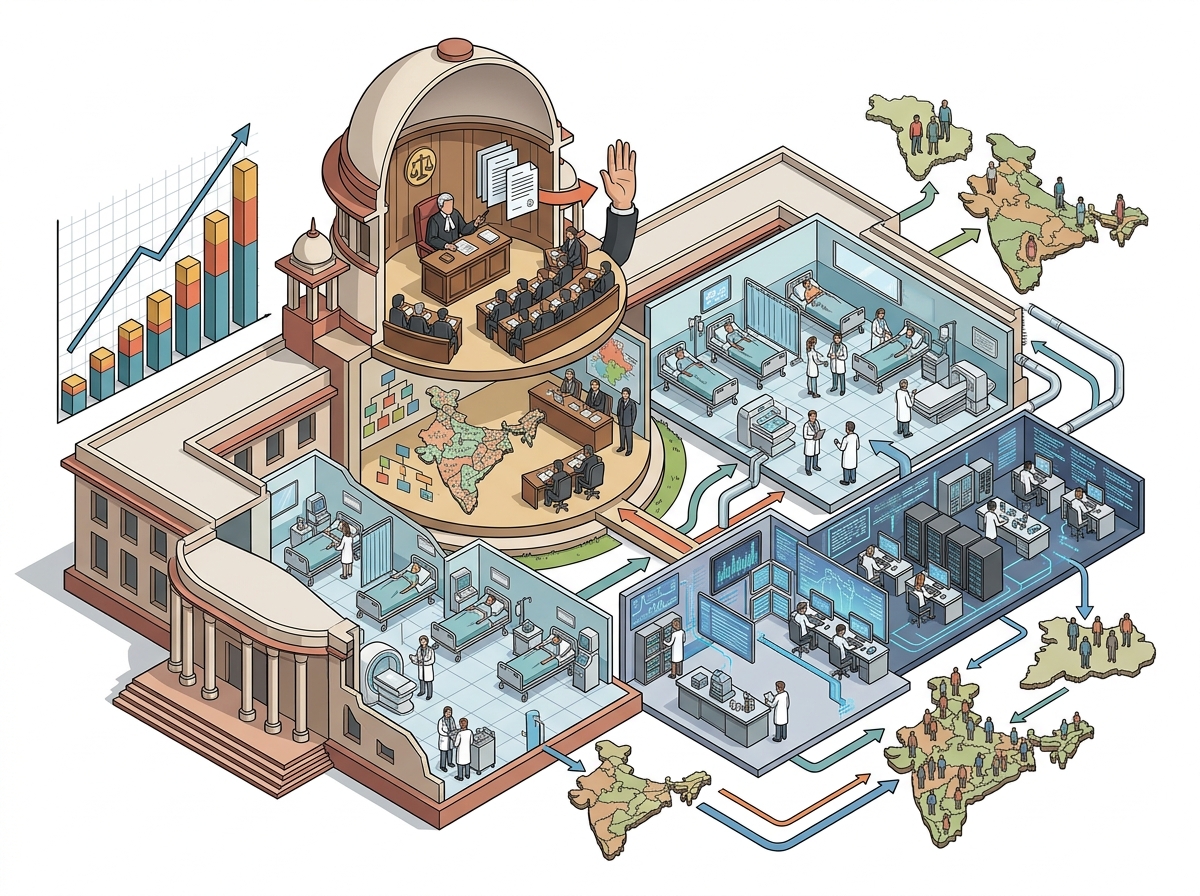
11 Aug Supreme Court Directs 19 States: Mandatory Cancer Reporting by When?
Supreme CourtPublic Interest LitigationMandatory reportingCancer registryNational Cancer Programme✎ The Supreme Court has directed states and Union Territories to implement mandatory reporting of all cancer cases as a notifiable disease to enable real-time surveillance, early detection, and evidence-based policy interventions.
Subject Relevance — Where This Topic Fits
- GS Paper II — Governance, Constitution, Polity, Social Justice | GS Paper III — Science and Technology, Health
- Prelims: Notifiable Disease, National Cancer Registry Programme, Article 21 (Right to Health), Public Health Surveillance, National Health Policy 2017, Digital Health Mission, Union-State Relations in Health, Epidemiology, NITI Aayog’s Health Index
- Essay: The Role of Judiciary in Public Health Governance, Federalism and Health Policy Implementation in India
Quick Revision: The Supreme Court has directed states and Union Territories to implement mandatory reporting of all cancer cases as a notifiable disease to enable real-time surveillance, early detection, and evidence-based policy interventions.
Why is this in the news?
The Supreme Court of India, on 11 August 2026, directed 19 states and Union Territories to implement mandatory reporting of all cancer cases as a notifiable disease, underscoring the constitutional obligation of governments to ensure timely diagnosis, treatment, and public health surveillance. The directive emanates from a Public Interest Litigation (PIL) filed by Dr. Anurag Srivastava, highlighting systemic gaps in cancer data collection and the need for a uniform national policy to combat the rising burden of cancer in India.
Background
- Cancer is the second leading cause of death in India, with over 1.3 million new cases and approximately 850,000 deaths annually, as per the Indian Council of Medical Research (ICMR) estimates.
- The National Cancer Registry Programme (NCRP) under the ICMR maintains cancer registries, but its coverage remains incomplete due to the absence of mandatory reporting in several states.
- The Union Ministry of Health and Family Welfare, in its National Health Policy 2017, emphasised the need for a robust surveillance system for non-communicable diseases, including cancer.
- The Parliamentary Standing Committee on Health, in its 2024 report, recommended the declaration of cancer as a notifiable disease across all states and Union Territories to strengthen early detection and treatment.
- As of August 2026, only 17 states and Union Territories have declared cancer as a notifiable disease, leaving a significant gap in data-driven public health interventions.
- The Supreme Court’s intervention follows a PIL seeking judicial direction for uniform implementation of cancer surveillance mechanisms, citing concerns over fragmented data and the proliferation of unscientific treatment claims.
What is a Notifiable Disease and Why is Cancer Being Considered for Mandatory Reporting?
- A notifiable disease is a medical condition that, by law, must be reported to government health authorities upon diagnosis, enabling public health surveillance and response.
- The declaration of cancer as a notifiable disease would require all healthcare providers—including hospitals, clinics, and diagnostic centres—to report every diagnosed case to designated state or district health authorities.
- Mandatory reporting facilitates the creation of a real-time, digital cancer registry, which is critical for tracking incidence, prevalence, and outcomes across regions and demographic groups.
- Such registries enable evidence-based policymaking, resource allocation, and targeted interventions for cancer prevention, early detection, and treatment.
- The absence of mandatory reporting leads to underreporting, incomplete data, and challenges in assessing the true burden of cancer, thereby impeding public health planning.
- Globally, countries like the United States, United Kingdom, and Australia have long-standing mandatory reporting systems for cancer, which have significantly improved surveillance and control measures.
- In India, the National Cancer Registry Programme (NCRP) operates on a voluntary reporting basis, leading to gaps in data coverage, particularly in rural and underserved areas.
- The Supreme Court’s directive aligns with the constitutional obligation under Article 21 (Right to Health) to ensure accessible and affordable healthcare, including timely diagnosis and treatment of cancer.
Key Features
| Feature | Significance |
|---|---|
| Mandatory reporting of cancer cases | Enables real-time epidemiological surveillance, early detection, and evidence-based policy formulation by tracking incidence, prevalence, and treatment outcomes across geographies. |
| National Cancer Registry Programme (NCRP) | Provides a structured framework for data collection, analysis, and dissemination of cancer statistics, facilitating resource allocation and research prioritisation. |
| Digital cancer registry system | Ensures interoperability, reduces data duplication, and enables dynamic monitoring of cancer trends for targeted interventions. |
| State-level notification policies | Creates a uniform legal framework for mandatory reporting, ensuring consistency in data quality and compliance across jurisdictions. |
| Supreme Court intervention | Expedites policy implementation by directing states to comply with public health mandates, reinforcing the constitutional duty of the state to protect citizens’ right to health under Article 21. |
Why it Matters
Public Health Impact
- Facilitates early diagnosis and intervention, reducing cancer-related morbidity and mortality through systematic screening and treatment protocols.
- Enables identification of high-risk populations and geographic hotspots for targeted prevention strategies.
- Supports epidemiological research by providing reliable, standardised data for studying cancer trends and risk factors.
Policy and Governance
- Strengthens the National Health Mission (NHM) by integrating cancer surveillance into primary healthcare systems.
- Aligns with the Sustainable Development Goal 3 (SDG 3.4) target of reducing premature mortality from non-communicable diseases by one-third by 2030.
- Enhances inter-state coordination and data sharing, reducing fragmentation in health governance.
Legal and Constitutional
- Upholds the fundamental right to health under Article 21 of the Constitution by ensuring timely and equitable access to cancer care.
- Reinforces the Directive Principles of State Policy (Article 47) to improve public health infrastructure and services.
- Provides a legal basis for state accountability in implementing health policies.
Economic Implications
- Reduces the economic burden of cancer treatment by enabling early detection and cost-effective interventions.
- Minimises productivity losses associated with delayed diagnosis and untreated cancer cases.
- Supports evidence-based resource allocation, optimising expenditure in the healthcare sector.
Challenges
1. Fragmented State-Level Implementation
- Only 17 of 36 states/UTs have declared cancer as a notifiable disease, leading to inconsistent data quality and coverage.
- Variations in state policies create disparities in cancer surveillance and healthcare access.
- Lack of uniform guidelines hampers inter-state data comparability and national-level planning.
UPSC Link: GS2-Polity-State vs Union responsibilities
2. Data Quality and Surveillance Gaps
- Existing cancer registries have limited coverage, particularly in rural and tribal areas, leading to underreporting.
- Inadequate digital infrastructure in some states delays real-time data transmission and analysis.
- Dependence on voluntary reporting in non-notified states undermines the reliability of cancer statistics.
UPSC Link: GS2-Governance-Data governance
3. Resource Constraints and Infrastructure Deficits
- Shortage of oncologists, pathologists, and diagnostic facilities in public health systems limits early detection and treatment.
- Inadequate funding for cancer care programmes, particularly in states with high disease burden.
- Delays in establishing and maintaining digital cancer registries due to financial and technical constraints.
UPSC Link: GS2-Governance-Health infrastructure
4. Public Awareness and Stigma
- Low awareness about cancer symptoms and risk factors delays diagnosis and treatment-seeking behaviour.
- Social stigma associated with cancer discourages reporting and reduces compliance with mandatory notification.
- Misleading claims about alternative therapies undermine trust in evidence-based medical interventions.
UPSC Link: GS2-Governance-Social determinants of health
5. Legal and Ethical Considerations
- Balancing mandatory reporting with patient confidentiality and data privacy concerns under the Digital Personal Data Protection Act, 2023.
- Ensuring equitable access to cancer care without discrimination based on socioeconomic status or geographic location.
- Addressing the ethical implications of data sharing across states and with international agencies.
UPSC Link: GS4-Ethics-Data ethics
Challenges — UPSC Perspective
| Issue | Concern |
|---|---|
| Inconsistent state policies | Creates disparities in cancer surveillance and healthcare access across regions. |
| Limited digital infrastructure | Delays real-time data transmission and analysis, reducing the efficacy of surveillance systems. |
| Underreporting in rural areas | Leads to incomplete epidemiological data, hampering policy formulation. |
| Resource shortages | Restricts the capacity for early diagnosis, treatment, and follow-up care. |
| Public stigma and misinformation | Undermines compliance with mandatory reporting and delays treatment-seeking behaviour. |
| Data privacy concerns | Raises ethical and legal challenges in balancing reporting requirements with patient confidentiality. |
Government Initiatives — Must-Memorise for Prelims
- National Cancer Registry Programme (NCRP)
- National Programme for Prevention and Control of Cancer, Diabetes, Cardiovascular Diseases and Stroke (NPCDCS)
- Ayushman Bharat Health and Wellness Centres (AB-HWCs)
- Ayushman Bharat Digital Mission (ABDM)
Way Forward
- Issue a uniform directive from the Union Ministry of Health and Family Welfare to all states/UTs, mandating the declaration of cancer as a notifiable disease within a specified timeline.
- Develop a centralised digital cancer registry portal with standardised data formats and real-time reporting mechanisms.
- Strengthen state-level cancer surveillance systems by investing in digital infrastructure and human resources, particularly in underserved regions.
- Launch targeted awareness campaigns to educate the public on cancer symptoms, risk factors, and the importance of early diagnosis and mandatory reporting.
- Establish a multi-stakeholder task force comprising health officials, epidemiologists, and civil society representatives to monitor implementation and address challenges.
- Integrate cancer surveillance into the Ayushman Bharat Digital Mission to ensure interoperability with other health records and seamless data sharing.
- Allocate dedicated funds under the National Health Mission (NHM) for strengthening cancer care infrastructure and surveillance systems.
- Conduct periodic reviews and audits of state-level compliance to ensure accountability and address implementation gaps.
UPSC Value Addition
Keywords for Mains Answer-Writing
Cancer as notifiable disease · Public Health Surveillance · Supreme Court directives on health policy · National Cancer Registry Programme · State Health Jurisdiction · Public Interest Litigation (PIL) in health governance · Real-time digital health data systems · Constitutional provisions on public health · Health data reporting mechanisms · Judicial activism in public health
Constitutional & Policy Linkages
- Article 21 (Right to Life and Personal Liberty) – Ensuring access to healthcare and public health measures.
- Article 47 (DPSP – Duty of State to raise the level of nutrition and standard of living) – Improving public health infrastructure.
- Article 246 (Distribution of Legislative Powers) – Health as a state subject, requiring Centre-state coordination.
Concept Flow
Cancer burden and underreporting → Inadequate epidemiological data → Delayed policy responses → Supreme Court intervention → Mandate for mandatory reporting → Uniform state policies → Strengthened surveillance systems → Early detection and intervention → Reduced morbidity and mortality → Improved public health outcomes.
Prelims Practice Questions
Q1. Consider the following statements regarding the legal framework for declaring a disease as ‘notifiable’ in India:
1. The power to declare a disease notifiable is vested in the central government under the Epidemic Diseases Act, 1897.
2. State governments can independently declare any disease as notifiable without consulting the central government.
3. The Supreme Court of India has no jurisdiction to direct the declaration of a disease as notifiable.
4. The National Cancer Registry Programme (NCRP) is a voluntary reporting system and not mandatory.
How many of the above statements are correct?
- Only one
- Only two
- Only three
- All
Answer: Only three — Statements 1 and 4 are correct. Statement 1 is correct as the Epidemic Diseases Act, 1897 empowers the central government to declare diseases notifiable. Statement 4 is correct because the NCRP operates on a voluntary reporting basis. Statements 2 and 3 are incorrect as state governments can declare diseases notifiable under the Act, and the Supreme Court has jurisdiction to direct such declarations as seen in the referenced case.
Q2. Assertion (A): The Supreme Court of India has directed states to declare cancer as a notifiable disease to enhance public health surveillance.
Reason (R): The National Cancer Registry Programme (NCRP) currently covers only a limited number of cancer cases, necessitating mandatory reporting for comprehensive data collection.
In the context of the above two statements, which of the following is correct?
- Both A and R are true, and R is the correct explanation of A.
- Both A and R are true, but R is not the correct explanation of A.
- A is true, but R is false.
- A is false, but R is true.
Answer: Both A and R are true, but R is not the correct explanation of A. — Both Assertion (A) and Reason (R) are true. The Supreme Court has indeed directed states to declare cancer as a notifiable disease to improve public health surveillance. The Reason (R) correctly explains why such a directive is necessary, as the NCRP’s limited coverage highlights gaps in data collection that mandatory reporting would address.
Q3. Match the following columns related to public health governance in India:
Column I (Provisions/Acts)
A. Epidemic Diseases Act, 1897
B. National Health Policy, 2017
C. Article 21 of the Constitution of India
D. National Digital Health Mission (NDHM)
Column II (Features)
1. Ensures the right to health as part of the right to life
2. Framework for digital health records and interoperability
3. Empowers governments to take measures to prevent the spread of dangerous epidemic diseases
4. Aims to achieve the highest possible level of health for all Indians by 2025
Select the correct match:
- A-3, B-4, C-1, D-2
- A-1, B-2, C-3, D-4
- A-4, B-3, C-2, D-1
- A-2, B-1, C-4, D-3
Answer: A-3, B-4, C-1, D-2 — The correct matches are: A-3 (Epidemic Diseases Act, 1897 empowers governments to prevent the spread of epidemic diseases), B-4 (National Health Policy, 2017 aims to achieve the highest possible level of health for all Indians by 2025), C-1 (Article 21 of the Constitution ensures the right to health as part of the right to life), and D-2 (National Digital Health Mission aims to create a framework for digital health records and interoperability).
Mains Practice Question
✍ The Supreme Court of India has recently directed 19 states and Union Territories to declare cancer as a notifiable disease, emphasizing the need for mandatory reporting to enhance public health surveillance and early detection. Critically examine the constitutional, legal, and policy dimensions of this directive. Also, assess the challenges in implementing such a system uniformly across India. (15 Marks)
Approach: MODEL-ANSWER SKELETON:
1. **Constitutional and Legal Basis**:
– Article 21 of the Constitution (Right to Life and Personal Liberty) and Article 47 (Duty of the State to raise the level of nutrition and standard of living) provide the constitutional foundation for health as a fundamental right.
– The Epidemic Diseases Act, 1897, empowers the central and state governments to declare diseases notifiable and take measures to prevent their spread. Cite relevant provisions (Sections 2 and 3).
– The Supreme Court’s directive is rooted in judicial activism under Article 32 (Right to Constitutional Remedies) and Article 142 (Power of the Supreme Court to pass any order necessary for doing complete justice).
2. **Policy and Governance Dimensions**:
– The National Health Policy, 2017, and the National Digital Health Mission (NDHM) emphasize the need for robust health data systems, including real-time digital registries.
– The National Cancer Registry Programme (NCRP) currently operates on a voluntary basis, covering only a fraction of cancer cases. Mandatory reporting would align with global best practices (e.g., WHO’s International Classification of Diseases for Oncology).
– The directive seeks to address gaps in cancer surveillance, early diagnosis, and treatment planning, particularly in states with limited healthcare infrastructure.
3. **Challenges in Implementation**:
– **Federalism and Jurisdictional Issues**: Health is a state subject under the Seventh Schedule (List II, Entry 6). The central government can only recommend, not mandate, uniform policies, leading to variations in implementation.
– **Data Privacy and Security**: Mandatory reporting raises concerns about patient confidentiality under the Digital Information Security in Healthcare Act (DISHA) and the Personal Data Protection Bill (PDP Bill).
– **Infrastructure and Capacity**: Many states lack the necessary healthcare infrastructure, digital systems, and trained personnel to implement mandatory reporting effectively.
– **Public Awareness and Compliance**: Low awareness among healthcare providers and patients about the benefits of reporting may hinder compliance.
– **Resource Allocation**: Uniform implementation requires significant financial and technical resources, which may not be uniformly available across states.
4. **Comparative Perspective**:
– Globally, countries like the USA (SEER Program), UK (National Cancer Registration and Analysis Service), and Australia (Australian Cancer Database) have robust mandatory cancer reporting systems. India can draw lessons from their experiences.
5. **Conclusion**:
– The Supreme Court’s directive is a significant step toward strengthening public health governance in India. However, its success depends on collaborative federalism, adequate resource allocation, and robust data protection mechanisms. The central government must play a proactive role in facilitating uniform implementation while respecting state autonomy.
Source: amarujala.com
Generated by AanyaAi for educational purpose.

- Supreme Court Panel Finds 9% Students Report Suicidal Thoughts - September 29, 2026
- सर्वोच्च न्यायालय ने चुनाव आयोग के अधिकार पर उठाया सवाल, जानिए पूरा मामला - September 29, 2026
- How AI-Driven Chip Inflation Impacts India’s Economy and Imports - September 29, 2026

No Comments