


02 Sep Supreme Court directs BCI to consult AG, Solicitor General for policy decisions
✎ The Supreme Court’s directive mandates that all policy decisions of the Bar Council of India (BCI) must be taken in consultation with the Attorney General for India and the Solicitor General, reinforcing constitutional checks and…
Subject Relevance — Where This Topic Fits
- GS Paper II — Polity and Governance (Constitutional and Statutory Bodies) | GS Paper II — Judiciary and Legal System
- Prelims: Bar Council of India (BCI), Attorney General of India, Solicitor General of India, judicial review, constitutional bodies, legal profession regulation, judicial appointments, constitutional provisions
- Essay: Judicial Primacy in Governance: Balancing Autonomy and Accountability in Legal Institutions, The Role of Constitutional Functionaries in Ensuring Institutional Integrity
Quick Revision: The Supreme Court’s directive mandates that all policy decisions of the Bar Council of India (BCI) must be taken in consultation with the Attorney General for India and the Solicitor General, reinforcing constitutional checks and balances in the governance of the legal profession.
Why is this in the news?
The Supreme Court of India, while hearing petitions challenging the prolonged tenure of the Bar Council of India (BCI) Chairman, issued a significant directive mandating that all policy decisions of the BCI must be taken in consultation with the Attorney General for India and the Solicitor General. This ruling underscores the constitutional imperative of ensuring checks and balances in the governance of legal institutions and highlights the judiciary’s role in upholding institutional accountability.
Background
- The Bar Council of India (BCI) is the statutory body established under the Advocates Act, 1961, to regulate the legal profession and legal education in India.
- The BCI functions as a regulatory authority for advocates and law colleges, with powers to frame rules, prescribe standards, and enforce discipline within the legal fraternity.
- The Supreme Court’s directive aligns with the principle of judicial oversight over statutory bodies, ensuring that their actions remain within the bounds of constitutional and statutory mandates.
- The petition challenged the prolonged tenure of the BCI Chairman, raising concerns about the lack of transparency and accountability in the BCI’s functioning.
- The judiciary’s intervention reflects its constitutional role in safeguarding the integrity of institutions that govern the legal profession.
What is the Bar Council of India (BCI)?
- The Bar Council of India (BCI) is a statutory body constituted under the Advocates Act, 1961, to regulate the legal profession and legal education in India.
- It is empowered to frame rules for legal education, prescribe standards for law colleges, and enforce professional conduct among advocates.
- The BCI is composed of members elected from state bar councils and ex-officio members, including the Attorney General for India and the Solicitor General.
- The BCI’s functions include conducting the All India Bar Examination (AIBE) to certify advocates for practice, disciplining advocates for professional misconduct, and promoting legal education.
- The BCI operates under the supervision of the Supreme Court of India, which exercises judicial review over its actions.
- The BCI’s policy decisions must align with constitutional principles, including the rule of law, due process, and the independence of the judiciary.
- The BCI’s role is distinct from the judiciary, as it focuses on the regulation of the legal profession rather than adjudication of disputes.
- The BCI’s decisions are subject to judicial review, ensuring that it functions within the framework of the Constitution and the Advocates Act, 1961.
Key Features
| Feature | Significance |
|---|---|
| Supreme Court directive on BCI policy decisions | Mandates consultation with the Attorney General and Solicitor General to ensure constitutional and legal alignment in regulatory decisions. |
| Bar Council of India (BCI) as statutory regulator | BCI is the apex body governing legal education and professional standards for advocates in India, established under the Advocates Act, 1961. |
| Role of constitutional law officers | The Attorney General and Solicitor General are constitutional authorities providing legal advice to the Government of India, ensuring policy decisions adhere to legal frameworks. |
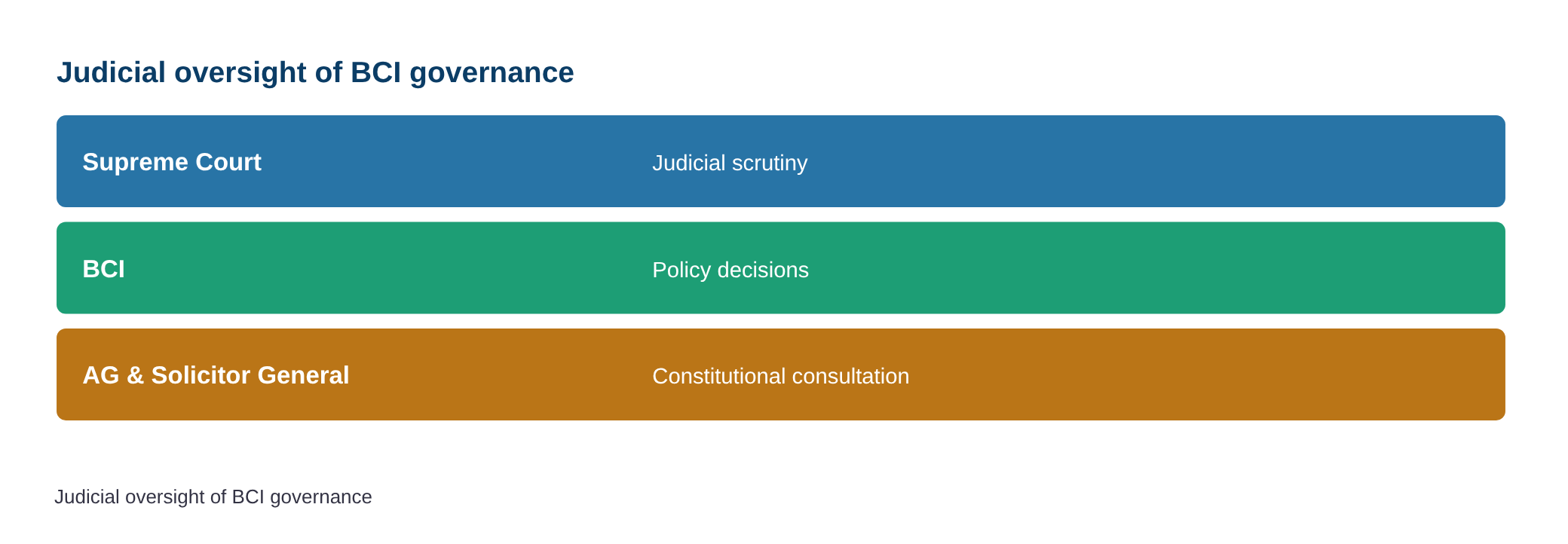
| Judicial oversight of regulatory bodies | Judicial scrutiny of prolonged tenures and governance practices of statutory bodies like BCI to uphold accountability and transparency. |
Why it Matters
Legal and Regulatory Framework
- The Supreme Court’s directive reinforces the principle of checks and balances in the governance of statutory bodies, ensuring that policy decisions are not unilateral or arbitrary.
- It underscores the importance of inter-institutional consultation between the executive’s legal advisors (AG and SG) and the regulatory body (BCI) to maintain legal coherence.
- The ruling highlights the judiciary’s role in safeguarding the integrity of regulatory institutions by preventing prolonged tenures that may compromise independence.
Governance and Accountability
- The decision emphasizes the need for transparency in the functioning of professional regulatory bodies, particularly those entrusted with upholding ethical and educational standards in the legal profession.
- It sets a precedent for judicial intervention in cases of perceived governance failures, reinforcing the expectation of periodic reviews and term limits for office-bearers.
- The directive aligns with broader principles of administrative law, including the doctrine of fairness and the requirement for reasoned decision-making in public bodies.
Professional Standards in Legal Education
- By mandating consultation with constitutional law officers, the ruling ensures that policy decisions by BCI—such as those related to legal education reforms—are grounded in constitutional and statutory provisions.
- It reinforces the BCI’s responsibility to maintain high standards in legal education and professional conduct, as envisaged under the Advocates Act, 1961.
- The decision may influence future policies on legal education, including curriculum design, accreditation of law schools, and professional ethics.
Challenges
1. Governance and Tenure of Regulatory Bodies
- Prolonged tenures of office-bearers in statutory bodies like BCI may lead to governance fatigue, reduced accountability, and potential conflicts of interest.
- Lack of clear term limits or periodic reviews can undermine the independence and dynamism of regulatory institutions.
- Ensuring compliance with judicial directives while balancing institutional autonomy remains a persistent challenge.
UPSC Link: Constitutional provisions on statutory bodies (Articles 323A, 323B)
2. Inter-Institutional Coordination
- Coordination between the judiciary, executive, and regulatory bodies requires robust mechanisms to avoid jurisdictional overlaps or delays in decision-making.
- Differences in interpretation of legal provisions or policy objectives between constitutional authorities and statutory bodies can create friction.
- The need for timely consultation may be constrained by bureaucratic or procedural delays.
UPSC Link: Doctrine of Separation of Powers (Basic Structure)
3. Judicial Activism vs. Institutional Autonomy
- Excessive judicial intervention in the functioning of statutory bodies may be perceived as encroaching upon their autonomy, raising concerns about judicial overreach.
- Balancing judicial oversight with the need for functional independence in regulatory bodies is a delicate constitutional issue.
- The ruling may set a precedent for similar interventions in other sectors governed by statutory bodies.
UPSC Link: Judicial Review (Article 13, 32, 226)
Challenges — UPSC Perspective
| Issue | Concern |
|---|---|
| Prolonged tenure of BCI chairperson | Risk of institutional stagnation and reduced accountability in policy-making. |
| Lack of explicit term limits for BCI office-bearers | Potential for governance fatigue and erosion of public trust. |
| Coordination gaps between BCI and constitutional law officers | Delays or inconsistencies in policy implementation. |
| Judicial intervention in regulatory governance | Perceived overreach and concerns about judicial activism. |
| Ensuring transparency in BCI’s decision-making | Risk of opacity in regulatory processes affecting stakeholders. |
Way Forward
- The BCI should formalize term limits and periodic reviews for its office-bearers to align with principles of good governance and constitutional morality.
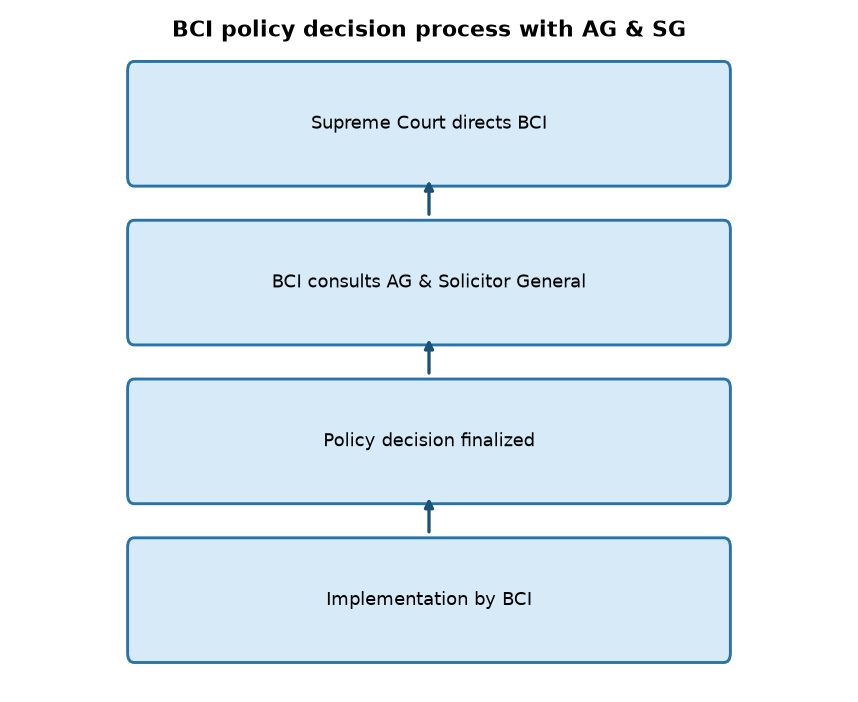
- Institutionalize a structured consultation mechanism with the Attorney General and Solicitor General for all major policy decisions to ensure legal and constitutional compliance.
- Enhance transparency in the functioning of BCI by publishing annual reports, policy rationales, and consultation records for public scrutiny.
- Strengthen internal governance mechanisms within BCI, including audit committees and grievance redressal systems, to prevent governance failures.
- Conduct capacity-building programs for BCI members on constitutional principles, administrative law, and ethical governance to improve decision-making quality.
- Encourage stakeholder consultations (lawyers, law schools, bar associations) in policy formulation to ensure inclusivity and legitimacy.
- Monitor compliance with judicial directives through periodic reporting to the Supreme Court or designated oversight bodies.
UPSC Value Addition
Keywords for Mains Answer-Writing
Bar Council of India · Attorney General of India · Solicitor General of India · Supreme Court of India · constitutional bodies · judicial review · legal profession regulation · policy-making in legal governance · judicial-constitutional interface · institutional checks and balances · Bar Council of India Rules · legal ethics · constitutional morality
Constitutional & Policy Linkages
- Article 76 – Role of Attorney General of India (Constitutional advisor to the Government)
- Article 14 – Right to Equality (ensuring fairness in regulatory governance)
- Article 226 – Writ jurisdiction of High Courts (judicial oversight of statutory bodies)
Concept Flow
Supreme Court’s observation on BCI’s governance → Judicial scrutiny of prolonged tenure → Need for consultation with constitutional law officers → Ensuring constitutional and legal alignment in policy decisions → Reinforcement of checks and balances in regulatory institutions.
Prelims Practice Questions
Q1. Consider the following statements regarding the Bar Council of India (BCI):
1. The BCI is a statutory body established under the Advocates Act, 1961.
2. The Attorney General for India is the ex-officio Chairman of the BCI.
3. The Supreme Court of India has held that any policy decision by the BCI must be taken in consultation with the Attorney General for India and the Solicitor General of India.
4. The BCI is empowered to frame rules for the legal profession under the Constitution of India.
How many of the above statements are correct?
- Only one
- Only two
- Only three
- All four
Answer: Only three — Statements 1 and 3 are correct. The BCI is indeed a statutory body under the Advocates Act, 1961, and the Supreme Court has directed consultation with the Attorney General and Solicitor General for policy decisions. Statement 2 is incorrect as the Attorney General is not the ex-officio Chairman. Statement 4 is incorrect as the BCI frames rules under the Advocates Act, not directly under the Constitution.
Q2. Assertion (A): The Supreme Court of India has the power to direct the Bar Council of India (BCI) to consult the Attorney General for India and the Solicitor General of India before taking any policy decision.
Reason (R): The Supreme Court, as the guardian of the Constitution, can issue such directions to ensure constitutional compliance and institutional checks in the legal governance framework.
Options:
A. Both A and R are true, and R is the correct explanation of A.
B. Both A and R are true, but R is not the correct explanation of A.
C. A is true, but R is false.
D. A is false, but R is true.
Answer: ? — Both the Assertion (A) and Reason (R) are true, and R correctly explains A. The Supreme Court, as the highest judicial authority, can issue directions to ensure constitutional compliance and institutional checks, as seen in the directive regarding BCI policy decisions.
Mains Practice Question
✍ The Supreme Court of India has recently held that any policy decision by the Bar Council of India (BCI) must be taken in consultation with the Attorney General for India and the Solicitor General of India. In this context, critically examine the constitutional and institutional significance of this directive. (15 Marks)
Approach: MODEL-ANSWER SKELETON:
1. **Constitutional and Statutory Framework**:
– Role of the BCI under the Advocates Act, 1961 (Sections 4-8).
– Constitutional provisions governing the legal profession and the role of constitutional authorities (Articles 76, 76A, 144).
– Distinction between statutory bodies and constitutional bodies.
2. **Institutional Checks and Balances**:
– Need for consultation with the Attorney General (AG) and Solicitor General (SG) to ensure constitutional propriety and avoid arbitrariness.
– AG and SG as constitutional authorities (Article 76: duties, functions, and independence).
– Judicial review as a mechanism to ensure adherence to constitutional morality (e.g., Supreme Court’s role in judicial activism).
3. **Judicial Precedents and Evolving Jurisprudence**:
– Reference to landmark judgments on judicial review and institutional checks (e.g., *SP Gupta v. Union of India*, *Union of India v. R. Gandhi*).
– The directive aligns with the principle of separation of powers and ensures accountability in policy-making.
4. **Balancing Autonomy and Accountability**:
– Arguments for BCI’s autonomy in framing rules for the legal profession.
– Counter-arguments: necessity of external oversight to prevent misuse of power and ensure public interest.
5. **Contemporary Relevance**:
– Recent debates on judicial-constitutional interface and the role of the judiciary in governance.
– Implications for the legal profession, including ethical standards and regulatory reforms.
6. **Conclusion**:
– Synthesis: The directive reinforces the balance between institutional autonomy and constitutional accountability, ensuring that policy decisions by the BCI are guided by constitutional principles and public interest.
Source: orissapost.com
Generated by AanyaAi for educational purpose.
Related guides on our sites
- Best PSIR optional coaching for upsc
- Best Law optional coaching for upsc
- Best PSIR optional teacher for upsc
- Best teacher of PSIR optional for upsc

- लोकायन 2026: भारतीय नौसेना का सुदर्शनी पोत स्पेन के बार्सिलोना पहुंचा - September 2, 2026
- INS Sudarshini reaches Barcelona under Lokayan 2026: Key UPSC insights - September 2, 2026
- केरल बाल अधिकार आयोग ने आंगनवाड़ी बच्चों के लिए न्यूट्रिमिक्स में चीनी का इस्तेमाल बंद करने का निर्देश दिया - September 2, 2026

No Comments