


10 Sep Supreme Court directs CBSE to exempt Class 6 from 3-language policy this year
✎ The CBSE’s three-language policy, introduced under the NEP 2020 and NCF-SE 2023, mandates Class 9 students to study three languages, including two native Indian languages, with the Supreme Court directing exemptions for Class 6…
Subject Relevance — Where This Topic Fits
- GS Paper II — Governance, Constitution and Polity (Judicial Review, Fundamental Duties, Policy Implementation) | GS Paper IV — Ethics, Integrity and Aptitude (Policy Conflicts, Stakeholder Concerns)
- Prelims: Three-language formula, National Education Policy 2020, National Curriculum Framework for School Education 2023, Article 29(2) of the Constitution, CBSE Circulars, Judicial Review, Fundamental Duties (Article 51A), NCERT
- Essay: Education as a tool for national integration vs. regional linguistic diversity, Balancing uniformity in curriculum with cultural and linguistic pluralism
Quick Revision: The CBSE’s three-language policy, introduced under the NEP 2020 and NCF-SE 2023, mandates Class 9 students to study three languages, including two native Indian languages, with the Supreme Court directing exemptions for Class 6 students in the current academic year due to implementation challenges.
Why is this in the news?
The Supreme Court of India, while hearing a batch of petitions challenging the Central Board of Secondary Education’s (CBSE) three-language policy, directed the Board to consider exempting the current Class 6 students from its mandatory implementation for the academic year. The directive underscores the judiciary’s role in mediating between policy mandates and practical implementation challenges, particularly in the context of the National Education Policy (NEP) 2020 and the National Curriculum Framework for School Education (NCF-SE) 2023.
Background
- The CBSE’s three-language policy, introduced in alignment with the NEP 2020 and NCF-SE 2023, mandates the study of three languages for Class 9 students, including at least two native Indian languages, with foreign languages permitted only as a third or fourth language.
- The policy aims to promote multilingualism, national integration, and alignment with global education standards, as envisaged in the NEP 2020.
- The Supreme Court’s intervention follows petitions challenging the policy’s implementation, citing concerns over the lack of adequate infrastructure, teacher training, and potential stress on students.
- The Court has previously highlighted the need to balance policy introduction with practical feasibility, particularly in building human resource capacity for language instruction.
- The NEP 2020 emphasizes flexibility in curriculum design while ensuring foundational literacy and numeracy, necessitating a phased and context-sensitive approach to policy implementation.
What is the CBSE Three-Language Policy?
- The policy mandates the study of three languages for Class 9 students, including at least two native Indian languages, to foster multilingual competence and national integration.
- Foreign languages may be studied only as a third or fourth language, ensuring priority to indigenous linguistic diversity.
- The policy is aligned with the National Education Policy (NEP) 2020 and the National Curriculum Framework for School Education (NCF-SE) 2023, which emphasize holistic and flexible learning.
- The CBSE’s authority to implement this policy stems from its role as a national-level examination board under the Ministry of Education, Government of India.
- The policy’s implementation is intended to be phased, with Class 9 as the initial cohort, followed by gradual expansion to lower classes.
- The Supreme Court’s directive to exempt Class 6 students for the current academic year reflects a judicious balance between policy objectives and practical constraints.
- The policy’s legal and constitutional underpinnings include the Fundamental Duties (Article 51A) and the Right to Education (Article 21A), which emphasize the importance of education and cultural preservation.
- The policy’s implementation requires collaboration between the CBSE, NCERT, state education boards, and teacher training institutions to ensure adequate infrastructure and human resource development.
Key Features
| Feature | Significance |
|---|---|
| Three-language policy for Class 9 (2026 onwards) | Aligns CBSE curriculum with NEP 2020 and NCF-SE 2023, mandating study of at least two Indian languages and one foreign language (as third or fourth option). |
| Supreme Court’s interim directive for Class 6 exemption | Temporarily suspends the policy for the current Class 6 batch to mitigate implementation challenges and student anxiety, pending further deliberation. |
| Judicial observation on policy introduction | Emphasises the need for phased implementation to avoid undue pressure on students and to ensure adequate infrastructure for language options. |
| CBSE circular dated May 15, 2026 | Formalises the three-language requirement for Class 9, specifying the hierarchy of language choices and constraints on foreign language inclusion. |
| Supreme Court’s deferral to September 17, 2026 | Allows time for CBSE, NCERT, and the Centre to address concerns raised by petitioners and to explore accommodations for affected students. |
Why it Matters
Educational Policy
- Demonstrates the Centre’s commitment to implementing the National Education Policy (NEP) 2020 through structural reforms in school curriculum, particularly in language education.
- Highlights the tension between policy ambition and ground-level implementation, as seen in the Supreme Court’s intervention to balance equity and feasibility.
- Reflects the evolving role of the judiciary in reviewing educational policies to safeguard student welfare and ensure constitutional compliance.
Judicial Review
- Showcases the Supreme Court’s role in adjudicating disputes over educational policies, ensuring that reforms do not impose undue burdens on students or institutions.
- Illustrates the judiciary’s preference for phased implementation of policies to allow for systemic adjustments, as evidenced by the interim directive for Class 6 students.
Governance and Administration
- Underscores the need for inter-institutional coordination between CBSE, NCERT, and the Ministry of Education to harmonise curriculum reforms with existing frameworks.
- Raises questions about the division of responsibilities between CBSE (for Classes 9-12) and NCERT (for Classes 1-8) in implementing language policies.
Challenges
1. Implementation Gap
- Sudden policy enforcement without adequate preparation may lead to student distress, particularly for those transitioning to Class 9.
- Insufficient teacher training and resource allocation for teaching multiple languages, especially regional and foreign languages.
- Potential inequities in access to language options across different states and socio-economic groups.
UPSC Link: GS Paper 2: Issues relating to development and management of Social Sector/Services relating to Education
2. Jurisdictional Overlap
- Disputes over the authority of CBSE to frame policies for Classes 6-8, which traditionally fall under the purview of NCERT.
- Lack of clarity on the role of state education boards in aligning with the CBSE policy, leading to fragmented implementation.
UPSC Link: GS Paper 2: Functions and responsibilities of the Union and the States
3. Student and Parent Anxiety
- Delays in policy implementation and judicial interventions exacerbate uncertainty, affecting academic planning and mental well-being.
- Parental concerns about the academic load and potential impact on student performance in core subjects.
UPSC Link: GS Paper 2: Issues relating to development and management of Social Sector/Services relating to Education
4. Infrastructure and Resource Constraints
- Inadequate availability of qualified language teachers, especially for less commonly taught languages.
- Limited access to textbooks, digital resources, and assessment tools aligned with the new policy.
UPSC Link: GS Paper 2: Government policies and interventions for development in various sectors
Challenges — UPSC Perspective
| Issue | Concern |
|---|---|
| Policy enforcement timeline | Risk of abrupt implementation causing student stress and systemic unpreparedness. |
| Jurisdictional ambiguity (CBSE vs NCERT) | Potential conflict over curriculum design and authority for Classes 6-8. |
| Teacher training and capacity | Shortage of trained educators to teach multiple languages effectively. |
| Resource allocation | Insufficient textbooks, digital tools, and assessment frameworks for new language options. |
| Equity in access | Variations in language options and quality across states and socio-economic strata. |
| Judicial intervention | Delays in policy rollout due to court proceedings, creating uncertainty for stakeholders. |
Way Forward
- CBSE, NCERT, and the Ministry of Education should collaborate to develop a phased implementation roadmap for the three-language policy, starting with pilot programmes in select schools.
- Conduct nationwide teacher training programmes to build capacity for teaching multiple languages, with a focus on regional and foreign language options.
- Ensure equitable access to language resources by providing digital platforms, textbooks, and assessment tools in all major Indian languages.
- Clarify the division of responsibilities between CBSE and NCERT to avoid jurisdictional conflicts, particularly for Classes 6-8.
- Establish a monitoring mechanism to assess the policy’s impact on student performance, mental health, and academic outcomes.
- Engage with state education boards to align their curricula with the CBSE policy, ensuring uniformity and reducing implementation gaps.
- Address concerns raised by petitioners through transparent consultations with stakeholders, including students, parents, and educators.
- Develop a grievance redressal system to address implementation challenges and provide accommodations for affected students.
UPSC Value Addition
Keywords for Mains Answer-Writing
Three-language formula · National Education Policy 2020 · National Curriculum Framework for School Education 2023 · CBSE curriculum reforms · Supreme Court intervention in education policy · multilingualism in school education · language policy in India · NCERT-CBSE jurisdiction · academic flexibility in school policies · right to education and curriculum autonomy · educational governance in India · judicial review of educational policies
Constitutional & Policy Linkages
- Article 29(1) – Cultural and educational rights of minorities
- Article 30(1) – Right of minorities to establish and administer educational institutions
- Article 350A – Facilities for instruction in mother-tongue at primary stage
Concept Flow
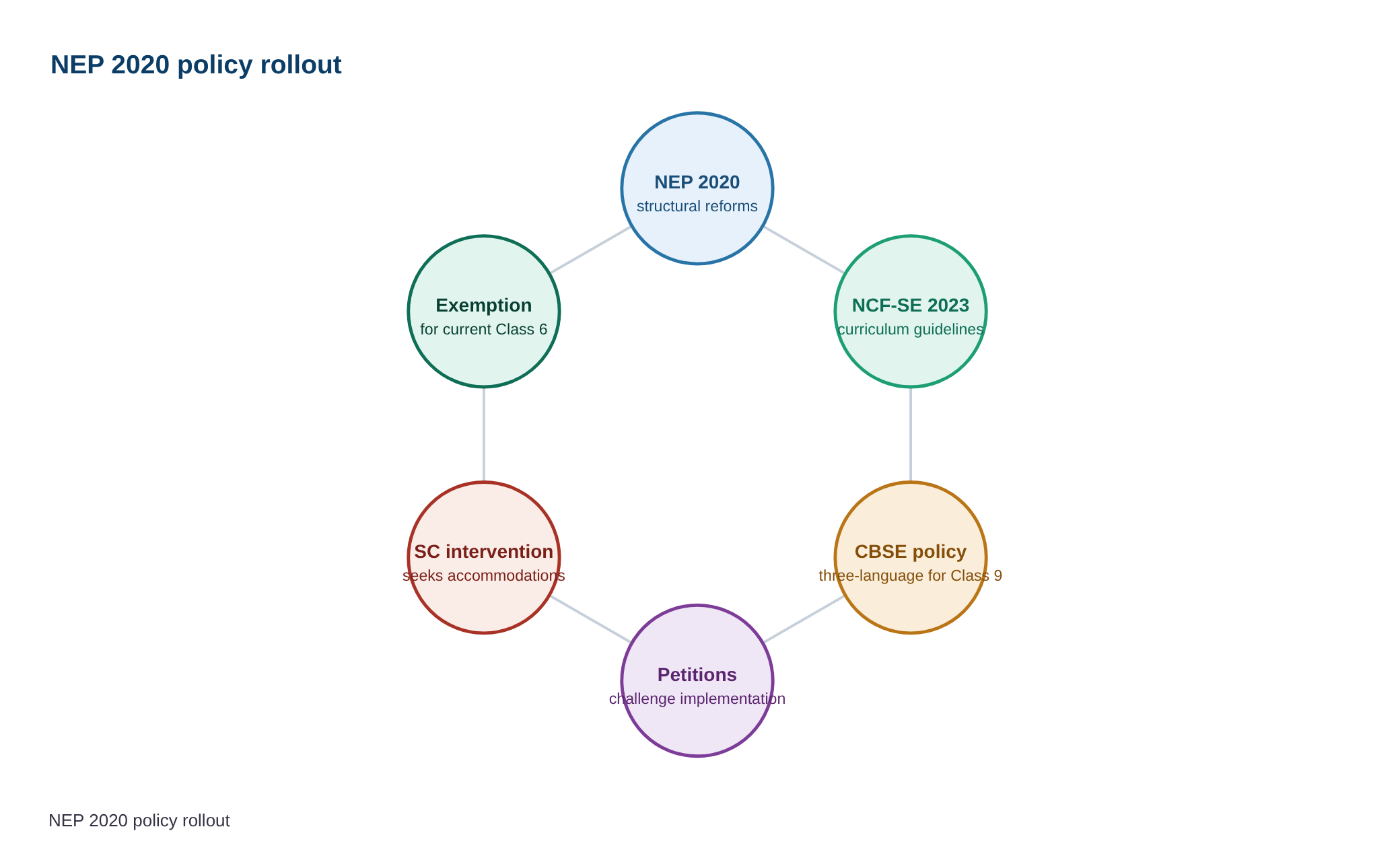
NEP 2020 mandates structural reforms in school education -> NCF-SE 2023 translates policy into curriculum guidelines -> CBSE introduces three-language policy for Class 9 (2026) -> Petitioners challenge policy citing implementation flaws -> Supreme Court intervenes, seeks accommodations -> CBSE considers exempting Class 6 for 2026-27 -> Policy implementation deferred pending further deliberation.
Prelims Practice Questions
Q1. Consider the following statements regarding the Three-Language Formula in India’s school education system:
1. The formula mandates the study of three languages, including at least two Indian languages, for students from Class 6 onwards.
2. The National Education Policy (NEP) 2020 recommends the Three-Language Formula as a means to promote multilingualism.
3. The Central Board of Secondary Education (CBSE) has the authority to frame the curriculum for Classes 6 to 8 under the Right to Education Act, 2009.
4. The Supreme Court of India has recently intervened to exempt the current batch of Class 6 students from the Three-Language Formula due to implementation challenges.
How many of the above statements are correct?
- Only one
- Only two
- Only three
- All
Answer: Only three — Statements 1, 2, and 4 are correct. Statement 3 is incorrect because the curriculum for Classes 6 to 8 is framed by the NCERT, not the CBSE, under the National Curriculum Framework for School Education (NCF-SE), 2023.
Q2. Assertion (A): The National Curriculum Framework for School Education (NCF-SE), 2023, aligns with the National Education Policy (NEP) 2020 to promote multilingualism in school education.
Reason (R): The NCF-SE, 2023, explicitly mandates the study of three languages, including two Indian languages, for all students from Class 6 onwards to ensure linguistic diversity and cultural integration.
In the context of the above two statements, which one of the following is correct?
- Both A and R are true, and R is the correct explanation of A
- Both A and R are true, but R is NOT the correct explanation of A
- A is true, but R is false
- A is false, but R is true
Answer: Both A and R are true, but R is NOT the correct explanation of A — Both Assertion (A) and Reason (R) are true. The NCF-SE, 2023, is designed to implement the NEP 2020’s vision of multilingualism, and the Three-Language Formula is a key component of this framework to promote linguistic diversity and cultural integration.
Q3. Match the following policies/frameworks with their respective implementing bodies:
Column I (Policy/Framework) | Column II (Implementing Body)
1. National Education Policy (NEP) 2020 | A. Central Board of Secondary Education (CBSE)
2. National Curriculum Framework for School Education (NCF-SE), 2023 | B. Ministry of Education, Government of India
3. Three-Language Formula for school education | C. National Council of Educational Research and Training (NCERT)
4. Curriculum for Classes 6 to 8 | D. State Education Boards
Choose the correct match:
- 1-B, 2-C, 3-D, 4-A
- 1-A, 2-B, 3-C, 4-D
- 1-B, 2-C, 3-D, 4-C
- 1-C, 2-B, 3-A, 4-D
Answer: 1-B, 2-C, 3-D, 4-A — The correct matches are: 1-B (NEP 2020 is implemented by the Ministry of Education), 2-C (NCF-SE, 2023, is framed by NCERT), 3-D (The Three-Language Formula is implemented by State Education Boards and CBSE), and 4-C (Curriculum for Classes 6 to 8 is framed by NCERT).
Mains Practice Question
✍ Critically examine the constitutional and educational governance dimensions of the Supreme Court’s recent directive to the CBSE regarding the Three-Language Formula. Also, analyse the implications of this directive for the autonomy of educational bodies like the CBSE and NCERT in curriculum formulation. (15 Marks)
Approach: MODEL-ANSWER SKELETON:
1. **Context and Directive**: Briefly explain the Supreme Court’s directive (dated September 10, 2026) to the CBSE to consider exempting the current batch of Class 6 students from the Three-Language Formula, citing the bench’s observation on avoiding undue pressure on students.
2. **Constitutional and Legal Framework**:
– Discuss the constitutional provisions related to education (Article 21A, Directive Principles of State Policy under Articles 39(f), 41, 45, and 46).
– Highlight the role of the judiciary in educational governance (e.g., Unnikrishnan JP v. State of Andhra Pradesh, 1993; T.M.A. Pai Foundation v. State of Karnataka, 2002).
– Explain the doctrine of judicial review and its application in educational policy disputes.
3. **Educational Governance and Autonomy**:
– Differentiate between the roles of CBSE (exam board) and NCERT (curriculum body) under the National Curriculum Framework for School Education (NCF-SE), 2023.
– Analyse the tension between centralised curriculum control (NCF-SE) and the CBSE’s implementation mandate, citing the Supreme Court’s observation on the CBSE’s lack of jurisdiction over Classes 6 to 8.
– Discuss the principle of cooperative federalism in education (e.g., NEP 2020’s emphasis on state participation).
4. **Implications of the Directive**:
– Short-term: Exemption for Class 6 students may reduce immediate pressure but could create inconsistencies in policy implementation.
– Long-term: The directive may set a precedent for judicial intervention in curriculum matters, potentially undermining the autonomy of educational bodies.
– Suggest a balanced approach: Recommend mechanisms for phased implementation, stakeholder consultations, and capacity-building for language teachers.
5. **Conclusion**: Summarise the need for a harmonised approach between judicial oversight, executive policy, and educational autonomy to ensure equitable and effective implementation of the Three-Language Formula.
Source: The Indian Express
Generated by AanyaAi for educational purpose.
Related guides on our sites
- Best PSIR optional coaching for upsc
- Best PSIR optional teacher for upsc
- Best teacher of PSIR optional for upsc
- Best PSIR optional coaching in delhi for UPSC

- Supreme Court directs CBSE to exempt Class 6 from 3-language policy this year - September 10, 2026
- पश्चिम बंगाल विधानसभा में ‘एक राज्य, एक शिक्षा’ नीति पर महत्वपूर्ण विधेयक पारित होगा - September 10, 2026
- West Bengal’s ‘One State, One Education’ Bill: Key Provisions & Controversies - September 10, 2026

No Comments