


04 Aug Supreme Court Directs RBI to Frame SOP for Mule Accounts in 4 Weeks
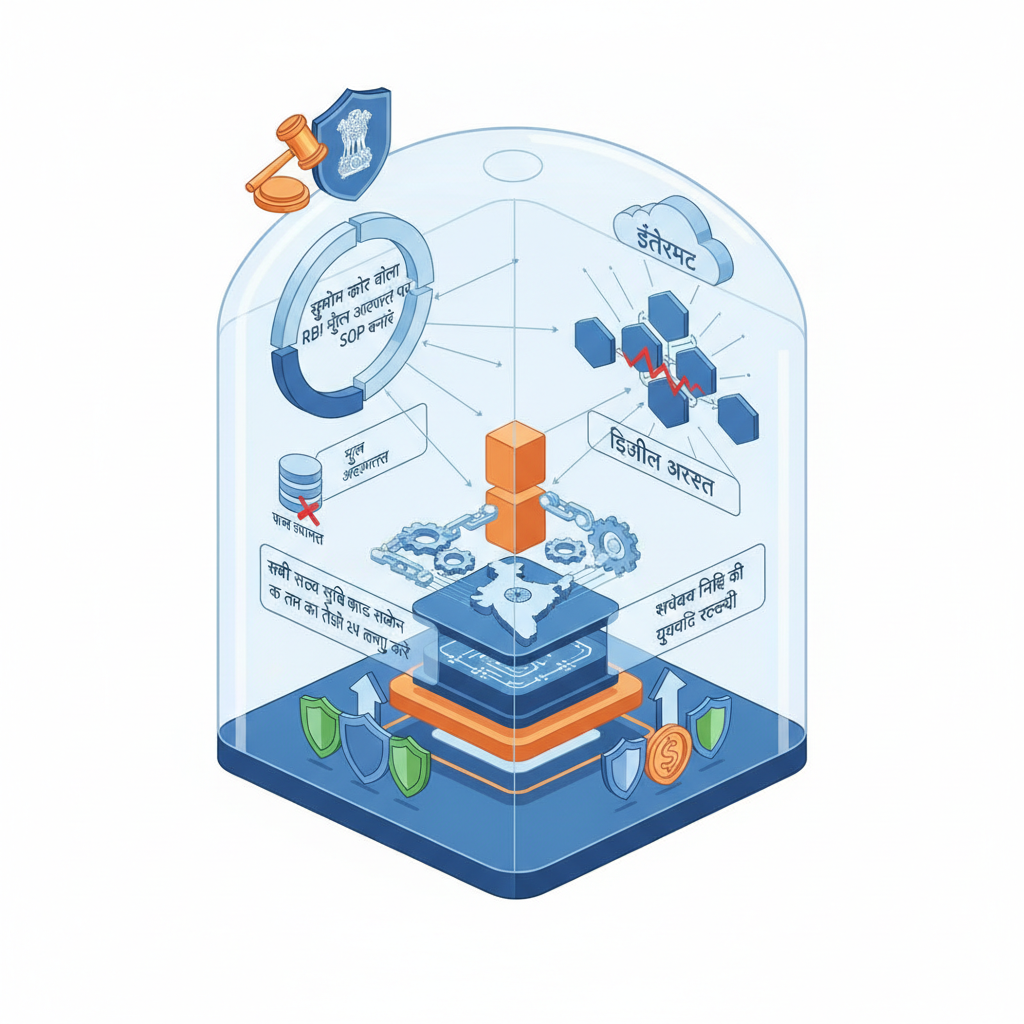
✎ The Supreme Court has mandated the RBI to formulate an SOP for mule accounts within four weeks to curb digital arrest scams, while directing states to implement the I4C’s cyber fraud prevention framework, including e-Zero FIR and…
 Digital arrest scamsMule accountsGrievance redressalCyber security
Subject Relevance — Where This Topic Fits
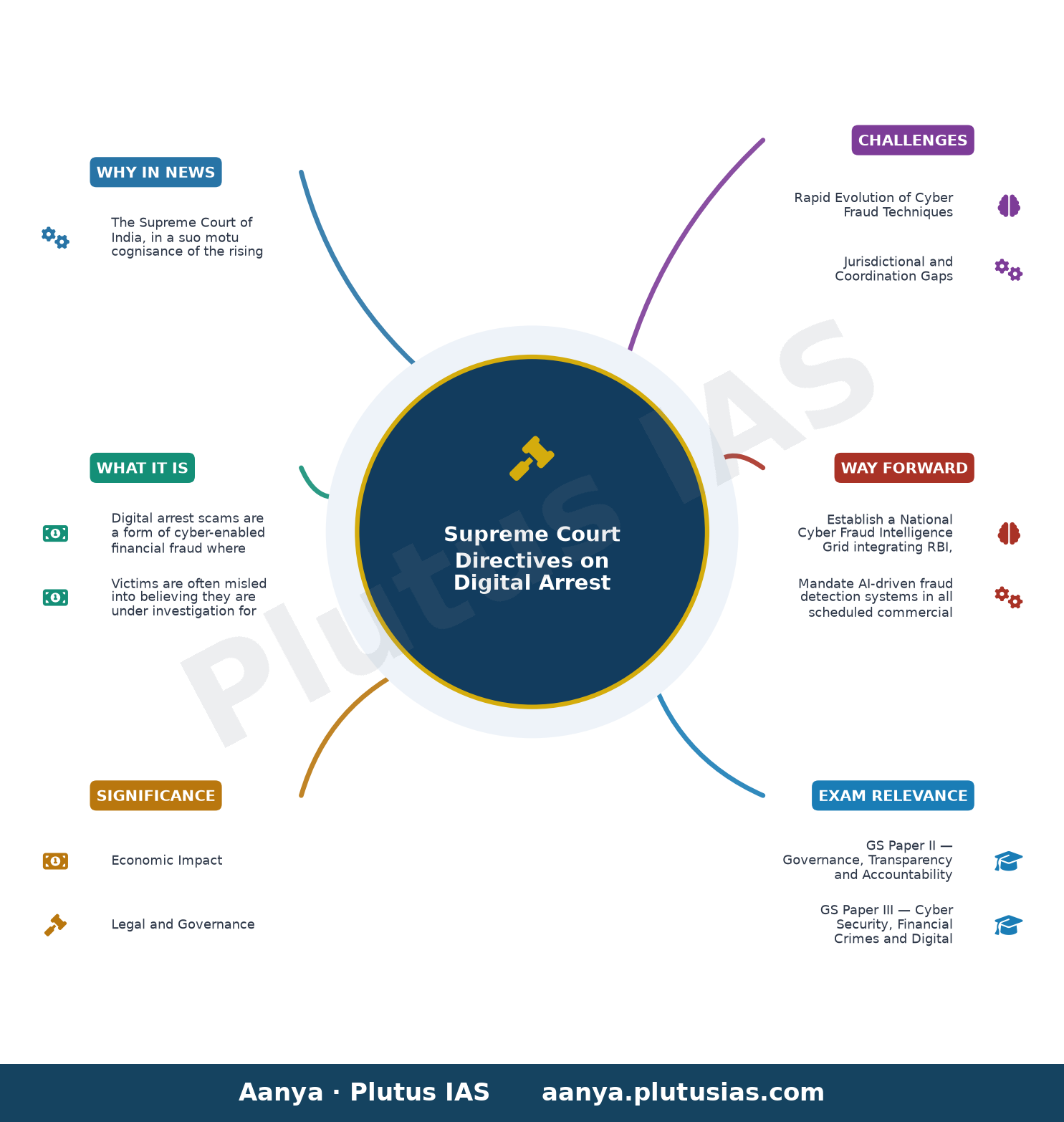
- GS Paper II — Governance, Transparency and Accountability | GS Paper III — Cyber Security, Financial Crimes and Digital Governance
- Prelims: Digital Arrest Scam, Mule Accounts, Indian Cyber Crime Coordination Centre (I4C), e-Zero FIR, Money Mule, Cyber Fraud Prevention Framework, RBI SOP for Mule Accounts, Inter-Departmental Committee on Cyber Fraud
- Essay: The Role of Judiciary in Safeguarding Digital Citizenship: A Case Study of Digital Arrest Scams, Balancing Technological Innovation with Cyber Security: Lessons from India’s Regulatory Response
Quick Revision: The Supreme Court has mandated the RBI to formulate an SOP for mule accounts within four weeks to curb digital arrest scams, while directing states to implement the I4C’s cyber fraud prevention framework, including e-Zero FIR and expeditious grievance redressal, to ensure victims can recover stolen funds promptly.
Why is this in the news?
The Supreme Court of India, in a suo motu cognisance of the rising menace of digital arrest scams, has issued comprehensive directives to the central government, Reserve Bank of India (RBI), state governments, and law enforcement agencies. These directives aim to curb cyber fraud, particularly through the misuse of mule accounts, and mandate the establishment of robust grievance redressal mechanisms for victims. The order underscores the judiciary’s proactive role in addressing gaps in cyber security governance and ensuring expeditious recovery of illicit funds.
Background
- Digital arrest scams involve fraudsters impersonating law enforcement or judicial officials to extort money from victims under false pretences of arrest or legal action.
- The scam exploits psychological manipulation, often targeting vulnerable groups such as senior citizens, and has seen a surge in incidents across India, with reported losses exceeding ₹1,000 crore annually.
- Mule accounts—bank accounts used by criminals to launder illicit funds—are a critical enabler of such scams, necessitating stringent regulatory oversight by financial institutions and law enforcement.
- The Indian Cyber Crime Coordination Centre (I4C), established under the Ministry of Home Affairs (MHA), serves as the nodal agency for coordinating cyber crime prevention and investigation efforts across states and Union Territories.
- The RBI, as the regulator of India’s banking system, is tasked with formulating Standard Operating Procedures (SOPs) to identify, freeze, and dismantle mule accounts while ensuring compliance with anti-money laundering (AML) norms.
- The Supreme Court’s intervention follows a status report submitted by the I4C, highlighting systemic deficiencies in cyber fraud prevention, delayed grievance redressal, and inadequate coordination among stakeholders.
What are Digital Arrest Scams and Mule Accounts?
- Digital arrest scams are a form of cyber-enabled financial fraud where perpetrators pose as police officers, judges, or tax officials to coerce victims into transferring money under the threat of arrest or legal consequences.
- Victims are often misled into believing they are under investigation for non-existent crimes, such as tax evasion or financial irregularities, and are instructed to transfer funds to designated accounts to avoid arrest.
- Mule accounts are bank accounts opened by individuals (often unknowingly) or criminal syndicates to facilitate the movement of illicit funds. These accounts are used to receive stolen money, launder proceeds, or transfer funds to other jurisdictions.
- Mule accounts can be classified into two types: (a) ‘witting mules’—individuals who knowingly open accounts for criminal purposes, and (b) ‘unwitting mules’—victims of identity theft or coercion who are unaware of the account’s misuse.
- The proliferation of mule accounts is exacerbated by weak Know Your Customer (KYC) norms, inadequate due diligence by banks, and the use of stolen or synthetic identities to open accounts.
- Digital arrest scams are often perpetrated through Voice over Internet Protocol (VoIP) calls, social engineering tactics, and the impersonation of government officials, leveraging the lack of public awareness and technological literacy.
- The RBI’s proposed SOP for mule accounts is expected to include measures such as real-time monitoring of suspicious transactions, mandatory reporting of unusual account activity, and collaborative mechanisms with law enforcement agencies to freeze and confiscate illicit funds.
- The Supreme Court’s directives emphasize the need for a multi-stakeholder approach, involving banks, telecom service providers, and digital platforms, to disrupt the operational infrastructure of cyber fraudsters.
Key Features
| Feature | Significance |
|---|---|
| Supreme Court’s directive on Digital Arrest Scam | Mandates urgent measures to curb cyber fraud, including SOP for mule accounts and faster redressal mechanisms. |
| RBI’s SOP for Mule Accounts | Standardises procedures to identify, freeze, and investigate accounts used for illicit transactions, reducing financial fraud. |
| Indian Cyber Crime Coordination Centre (I4C) | Centralised platform for real-time coordination among states, banks, and law enforcement to combat cybercrime. |
| e-Zero FIR Mechanism | Enables immediate registration of cyber fraud complaints without jurisdictional delays, ensuring swift action. |
| Time-based Telecom Restrictions | Proposes temporary suspension of telecom services linked to fraudulent activities to disrupt criminal networks. |
Why it Matters
Economic Impact
- Prevents financial losses to individuals and institutions from cyber fraud, preserving public trust in digital transactions.
- Reduces systemic risks to the banking sector by curbing money laundering through mule accounts.
- Enhances the efficiency of financial intermediaries by streamlining fraud detection and recovery processes.
Legal and Governance
- Strengthens the judiciary’s role in directing executive action for public welfare in cybercrime cases.
- Promotes inter-departmental collaboration between RBI, MeitY, DoT, and law enforcement agencies.
- Ensures accountability through periodic status reports and judicial oversight.
Technological and Operational
- Encourages the adoption of AI and machine learning for real-time fraud detection in banking systems.
- Facilitates the integration of telecom and financial sector data to trace and block fraudulent transactions.
- Standardises cybercrime reporting mechanisms, reducing delays in investigation and recovery.
Challenges
1. Rapid Evolution of Cyber Fraud Techniques
- Fraudsters continuously adapt to bypass detection systems, exploiting loopholes in banking and telecom regulations.
- Emergence of AI-driven deepfake calls and synthetic identities complicates identification of mule accounts.
UPSC Link: GS3: Cyber Security
2. Jurisdictional and Coordination Gaps
- Lack of unified cybercrime databases across states hinders real-time information sharing.
- Delayed implementation of I4C recommendations due to bureaucratic and administrative hurdles.
UPSC Link: GS2: Centre-State Relations
3. Technological Lag in Law Enforcement
- Limited forensic capabilities in police forces to investigate digital fraud and trace illicit transactions.
- Inadequate training of cybercrime units in handling sophisticated fraud cases.
UPSC Link: GS3: Internal Security
4. Public Awareness and Trust Deficit
- Low awareness among citizens, especially elderly populations, about cyber fraud risks and redressal mechanisms.
- Distrust in digital platforms due to high-profile fraud cases erodes confidence in financial technologies.
UPSC Link: GS4: Ethics and Governance
5. Regulatory Arbitrage in Banking Sector
- Banks may prioritise customer convenience over fraud detection, leading to lax monitoring of mule accounts.
- Regulatory gaps between RBI and other financial regulators create avenues for fraudsters to exploit.
UPSC Link: GS3: Financial Inclusion
Challenges — UPSC Perspective
| Issue | Concern |
|---|---|
| Mule Accounts | Used for money laundering and fraud; difficult to trace due to layered ownership. |
| Deepfake Technology | Enables fraudsters to impersonate authorities, increasing credibility of scams. |
| Telecom-Banking Nexus | Fraudsters exploit telecom services to execute scams; requires coordinated regulatory action. |
| Delayed Redressal | Victims face prolonged wait times for complaint registration and fund recovery. |
| State-Level Disparities | Varied implementation of cybercrime policies across states leads to inconsistent outcomes. |
| Forensic Limitations | Lack of advanced tools to analyse digital evidence delays investigation and prosecution. |
Way Forward
- Establish a National Cyber Fraud Intelligence Grid integrating RBI, MeitY, DoT, and I4C for real-time data sharing.
- Mandate AI-driven fraud detection systems in all scheduled commercial banks within 12 months.
- Launch nationwide awareness campaigns targeting elderly and rural populations on cyber fraud risks and redressal mechanisms.
- Strengthen the e-Zero FIR system by integrating it with state police databases and cybercrime units.
- Enforce time-bound telecom service suspensions for SIMs linked to verified fraud cases, with judicial oversight.
- Develop a standardised SOP for RBI to freeze mule accounts within 24 hours of detection, with quarterly audits.
- Enhance training programs for cybercrime units, focusing on digital forensics and AI-based investigation tools.
- Introduce graded penalties for banks failing to implement fraud detection measures, including monetary fines.
UPSC Value Addition
Keywords for Mains Answer-Writing
Digital Arrest Scam · Mule Accounts · RBI Standard Operating Procedure (SOP) · Indian Cyber Crime Coordination Centre (I4C) · e-Zero FIR · Cyber Fraud Prevention Mechanisms · Supreme Court Directions on Cyber Crimes · Bank Account Freezing Protocols · Telecom Regulatory Measures · Money Laundering Prevention · State Cyber Crime Coordination Centres · Inter-Departmental Committees on Cyber Security · Financial Fraud Investigation · Victim Compensation and Restitution
Concept Flow
Cyber fraudsters identify vulnerable individuals (e.g., elderly) via social engineering → Fraudsters impersonate authorities (Digital Arrest) to coerce victims → Illicit funds are transferred to mule accounts → Banks detect anomalies but lack standardised SOP → Funds are laundered through complex transactions → Victims report delays in redressal → Judicial intervention directs RBI to formulate SOP → I4C coordinates state-level action → Telecom restrictions disrupt fraud networks → Fraud detection and recovery mechanisms are streamlined
Prelims Practice Questions
Q1. Consider the following statements regarding the ‘Digital Arrest Scam’ as highlighted by the Supreme Court of India:
1. The scam involves impersonation of law enforcement officers to extort money from victims.
2. The RBI has been directed to formulate a Standard Operating Procedure (SOP) for ‘Mule Accounts’ within four weeks.
3. The Supreme Court has mandated the immediate implementation of the ‘e-Zero FIR’ mechanism across all states.
4. The Telecom Regulatory Authority of India (TRAI) has been tasked with freezing telecom services of fraudsters.
How many of the above statements are correct?
- Only one
- Only two
- Only three
- All four
Answer: Only three — Statements 1, 2, and 3 are correct as per the Supreme Court’s directives. Statement 4 is incorrect because the Supreme Court directed the Department of Telecommunications (DoT) and MeitY to examine proposals for time-based restrictions on telecom services, not TRAI.
Q2. Assertion (A): The Indian Cyber Crime Coordination Centre (I4C) is a nodal agency for coordinating cyber crime prevention and investigation in India.
Reason (R): The I4C operates under the aegis of the Ministry of Home Affairs and has been mandated by the Supreme Court to implement the ‘e-Zero FIR’ mechanism.
Options:
A. Both A and R are true, and R is the correct explanation of A.
B. Both A and R are true, but R is not the correct explanation of A.
C. A is true, but R is false.
D. A is false, but R is true.
Answer: ? — Both the Assertion (A) and Reason (R) are correct. The I4C is indeed a nodal agency under the Ministry of Home Affairs and has been directed by the Supreme Court to implement the ‘e-Zero FIR’ mechanism. R correctly explains A.
Q3. Match the following directives issued by the Supreme Court in the context of the Digital Arrest Scam with their respective implementing authorities:
Column I (Directive)
1. Formulate SOP for ‘Mule Accounts’
2. Implement ‘e-Zero FIR’ mechanism
3. Investigate time-based restrictions on telecom services
4. Establish State Cyber Crime Coordination Centres
Column II (Implementing Authority)
A. Reserve Bank of India (RBI)
B. Department of Telecommunications (DoT) and MeitY
C. Indian Cyber Crime Coordination Centre (I4C)
D. State Governments and Union Territories
Options:
1-A, 2-C, 3-B, 4-D
1-B, 2-A, 3-C, 4-D
1-C, 2-B, 3-A, 4-D
1-A, 2-D, 3-B, 4-C
Answer: ? — The correct matching is: 1-A (RBI to formulate SOP for Mule Accounts), 2-C (I4C to implement ‘e-Zero FIR’), 3-B (DoT and MeitY to investigate time-based restrictions on telecom services), and 4-D (State Governments and Union Territories to establish State Cyber Crime Coordination Centres).
Mains Practice Question
✍ The Supreme Court of India, in its recent directives concerning the Digital Arrest Scam, has underscored the necessity for a multi-stakeholder approach to combat cyber fraud. Critically examine the institutional mechanisms proposed by the Court, including the role of the RBI, the Indian Cyber Crime Coordination Centre (I4C), and the Department of Telecommunications (DoT). Also, assess the efficacy of these measures in addressing the challenges posed by ‘Mule Accounts’ and victim restitution. (15 Marks)
Approach: MODEL-ANSWER SKELETON:
1. **Institutional Mechanisms Highlighted by the Supreme Court:**
– **RBI’s SOP for Mule Accounts:** Examine the need for a standardized operating procedure to identify, freeze, and investigate mule accounts used in cyber fraud. Discuss the RBI’s existing frameworks (e.g., KYC norms, Section 12 of the Banking Regulation Act, 1949) and their limitations in addressing digital fraud.
– **I4C’s Role:** Outline the functions of the Indian Cyber Crime Coordination Centre (I4C) under the Ministry of Home Affairs, including its mandate to coordinate cyber crime prevention, investigation, and victim restitution. Reference the Cyber Crime Prevention against Women and Children (CCPWC) scheme and the National Cyber Crime Reporting Portal.
– **DoT and MeitY’s Proposals:** Discuss the Supreme Court’s directive to the Department of Telecommunications (DoT) and the Ministry of Electronics and Information Technology (MeitY) to explore time-based restrictions on telecom services for suspected fraudsters. Evaluate the legal and technical feasibility of such measures.
2. **Challenges Posed by Mule Accounts:**
– Define ‘Mule Accounts’ and their role in money laundering and cyber fraud. Cite data from the RBI’s Financial Stability Reports or reports by the Financial Intelligence Unit (FIU-IND) on fraud trends.
– Highlight the difficulties in tracing and freezing mule accounts due to the use of shell entities, nominees, and cross-border transactions.
3. **Victim Restitution and Legal Safeguards:**
– Examine the Supreme Court’s emphasis on victim compensation and restitution, including the implementation of ‘e-Zero FIR’ and the grievance redressal mechanism under the I4C.
– Discuss the legal framework for victim compensation under the Information Technology Act, 2000 (Section 43A) and the Indian Penal Code (Sections 420, 378, and 381).
– Critique the effectiveness of these mechanisms in ensuring timely restitution, citing delays or gaps in implementation.
4. **Multi-Stakeholder Coordination:**
– Assess the need for inter-departmental coordination among the RBI, I4C, DoT, MeitY, and state cyber crime units. Reference the Inter-Departmental Committee directed by the Supreme Court.
– Evaluate the role of banks and financial intermediaries in detecting and reporting suspicious transactions under the Prevention of Money-Laundering Act (PMLA), 2002.
5. **Critical Assessment and Way Forward:**
– Weigh the strengths and limitations of the proposed mechanisms. For instance, while the RBI’s SOP for mule accounts is a step forward, its success depends on real-time data sharing and technological integration.
– Suggest measures such as mandatory two-factor authentication (2FA) for high-risk transactions, public awareness campaigns, and capacity-building for law enforcement agencies.
– Conclude with a balanced view on whether the Supreme Court’s directives provide a robust framework or require further legislative and technological enhancements.
Source: bhaskar.com
Generated by AanyaAi for educational purpose.

- पेरियार टाइगर रिजर्व में 6 नई प्रजातियाँ खोजी गईं, जानिए क्या हैं विशेषताएँ - September 22, 2026
- Six New Species Discovered in Periyar Tiger Reserve: UPSC & PCS Key Biodiversity Insights - September 22, 2026
- तमिलनाडु में बस किराए में संशोधन: सरकार को चार सप्ताह और समय मिला, उच्च न्यायालय का फैसला - September 22, 2026

No Comments