


03 Aug Supreme Court Directs States to Verify Wetlands in SAC Atlas Within 2 Months
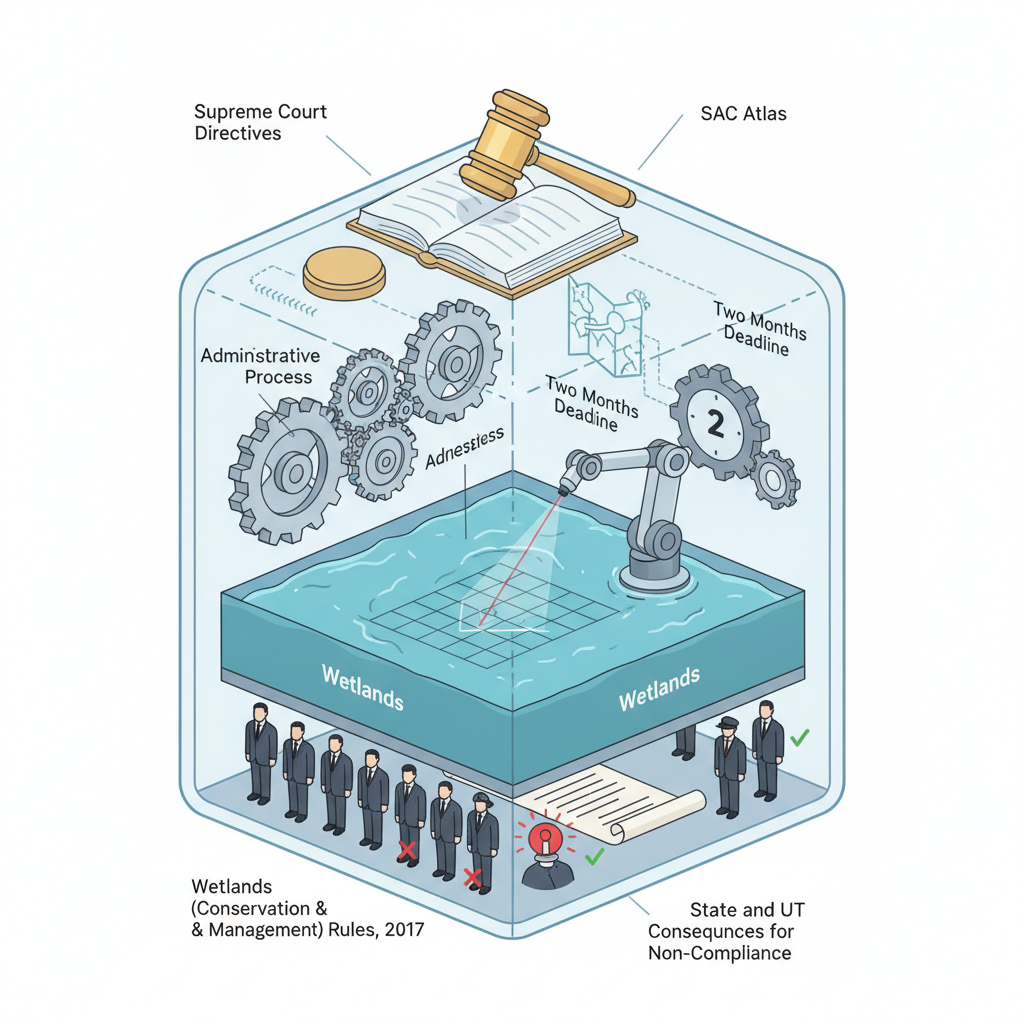
✎ The Supreme Court’s directive mandates physical verification and demarcation of wetlands listed in the SAC Atlas within two months, failing which senior officials will face personal accountability, underscoring the statutory…
 SAC AtlasWetlands RulesState officials
Subject Relevance — Where This Topic Fits
- GS Paper II — Governance, Constitution, Polity, Social Justice and International Relations (Environmental Governance) | GS Paper III — Environment, Biodiversity, Climate Change and Disaster Management
- Prelims: Wetlands (Conservation and Management) Rules, 2017, Space Applications Centre (SAC) Atlas, Ground-truthing, State Wetland Authorities, Public Interest Litigation (PIL), Anand Arya v. Union of India, Vanashakti, Wetland conservation, Environmental governance, Statutory compliance
- Essay: The Role of Judiciary in Environmental Conservation: Balancing Development and Ecological Sustainability, Wetlands: Unsung Guardians of Biodiversity and Climate Resilience
Quick Revision: The Supreme Court’s directive mandates physical verification and demarcation of wetlands listed in the SAC Atlas within two months, failing which senior officials will face personal accountability, underscoring the statutory obligation under the Wetlands (Conservation and Management) Rules, 2017.
Why is this in the news?
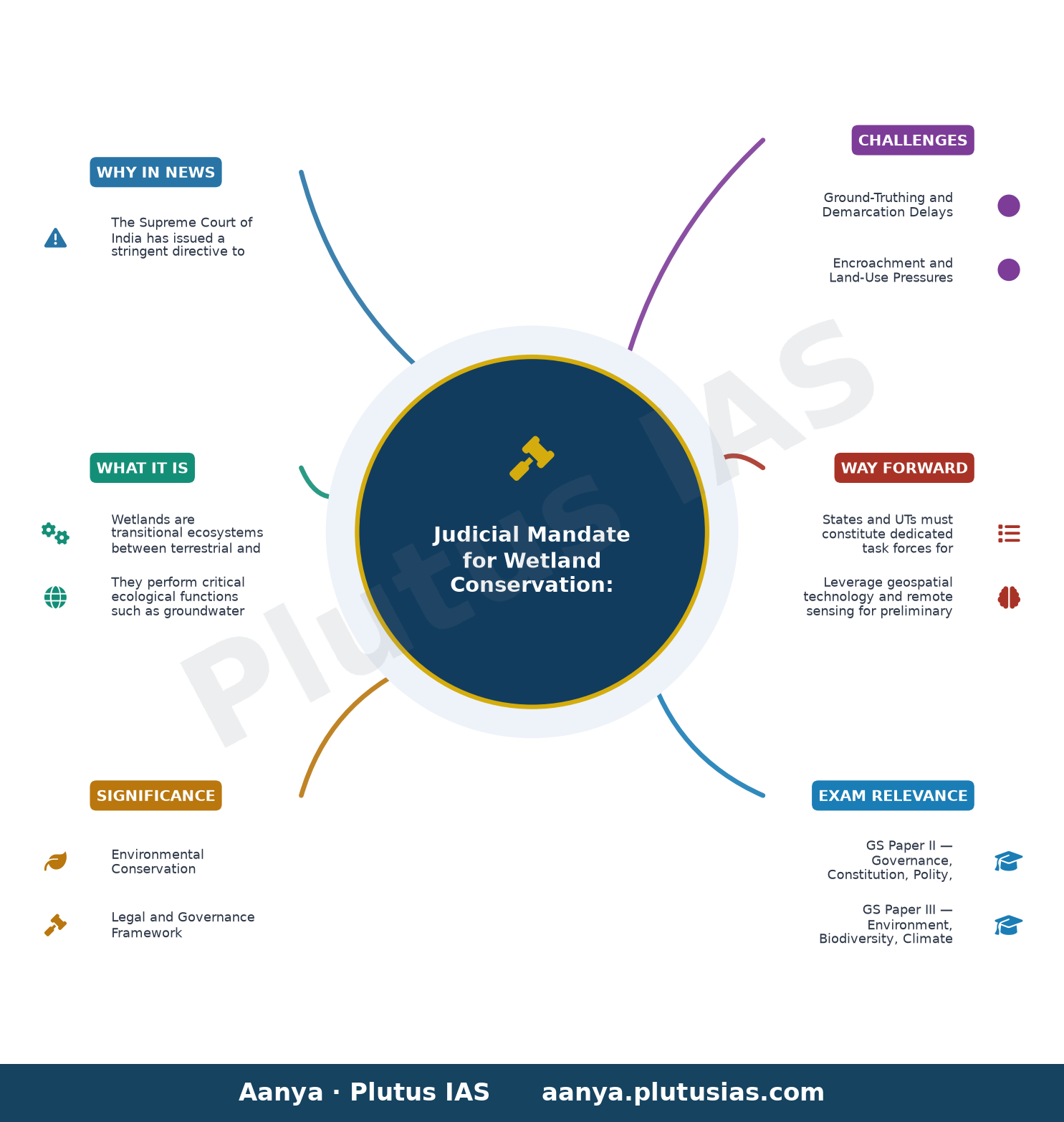
The Supreme Court of India has issued a stringent directive to the Centre, states, and Union Territories, mandating the physical verification and demarcation of all wetlands identified in the Space Applications Centre (SAC) Atlas within two months. This order, passed on July 28, 2026, underscores the judicial impatience with administrative lethargy in implementing the Wetlands (Conservation and Management) Rules, 2017, and signals a decisive shift from paper-based compliance to ground-level action. The directive, arising from ongoing PILs, reflects the apex court’s proactive stance in ensuring statutory obligations are met, with severe consequences for non-compliance, including personal appearance of senior officials.
Background
- The Wetlands (Conservation and Management) Rules, 2017, were notified under the Environment (Protection) Act, 1986, to regulate and conserve wetlands across India, following the Ramsar Convention’s principles.
- The Space Applications Centre (SAC) Atlas, prepared by ISRO, is a geospatial database identifying wetlands based on satellite imagery, serving as the primary reference for wetland identification under the Rules.
- The Supreme Court has been monitoring wetland conservation since 2018, with a series of orders directing states to identify, notify, and protect wetlands, including a December 11, 2024, directive for ground-truthing within three months.
- Public Interest Litigations (PILs) filed by environmentalists like Anand Arya and NGOs such as Vanashakti have catalysed judicial intervention, highlighting systemic failures in wetland governance.
- The Rules mandate that wetlands be notified by state governments, with boundaries demarcated and managed through State Wetland Authorities, but compliance has been inconsistent across jurisdictions.
- The SAC Atlas, while comprehensive, requires physical verification to account for local ecological nuances, anthropogenic pressures, and seasonal variations in wetland delineation.
What are Wetlands and Why are They Significant?
- Wetlands are transitional ecosystems between terrestrial and aquatic environments, characterized by waterlogged or inundated soils, including marshes, swamps, bogs, fens, peatlands, rivers, lakes, deltas, floodplains, and coastal areas.
- They perform critical ecological functions such as groundwater recharge, flood mitigation, water purification, carbon sequestration, and biodiversity conservation, hosting over 40% of the world’s species despite covering only 6% of the Earth’s surface.
- Wetlands act as natural sponges, reducing the impact of floods and storms, and serve as vital carbon sinks, mitigating climate change by storing 30% of terrestrial carbon.
- They support livelihoods through fisheries, agriculture, and tourism, and are culturally significant in many indigenous communities.
- India hosts 757,060 wetlands, covering 15.26 million hectares (4.63% of the country’s land area), as per the National Wetland Atlas (2011), though many remain unnotified or degraded.
- The Ramsar Convention, to which India is a signatory since 1982, designates Wetlands of International Importance, with 75 such sites in India as of 2026, highlighting their global significance.
- The Wetlands (Conservation and Management) Rules, 2017, were framed to implement the Convention’s guidelines domestically, requiring identification, notification, and conservation of wetlands.
- The SAC Atlas, developed by ISRO’s Space Applications Centre, uses remote sensing and GIS to map wetlands, providing a scientific basis for conservation efforts.
Key Features
| Feature | Significance |
|---|---|
| Supreme Court directive on physical verification and demarcation | Ensures statutory compliance under the Wetlands (Conservation and Management) Rules, 2017, by mandating ground-level verification of wetlands listed in the SAC Atlas. |
| Two-month deadline for states and UTs | Accelerates the pace of wetland identification and protection, preventing further degradation through delayed implementation. |
| Personal appearance of senior officials for non-compliance | Creates accountability among state and central bureaucrats, ensuring adherence to judicial directives. |
| Integration with SAC Atlas (2021) | Leverages satellite-based wetland mapping for systematic identification and prioritisation of conservation efforts. |
| Judicial monitoring since 2018 | Demonstrates sustained judicial oversight to enforce environmental governance, particularly for wetlands. |
Why it Matters
Environmental Conservation
- Wetlands are critical ecosystems providing biodiversity hotspots, carbon sequestration, and flood mitigation.
- Physical demarcation prevents encroachment, pollution, and unsustainable land-use changes.
Legal and Governance Framework
- Reinforces the statutory obligations under the Wetlands Rules, 2017, which mandate state-led conservation measures.
- Judicial intervention ensures uniformity in implementation across states, addressing inter-state disparities.
Public Interest Litigation (PIL) Impact
- Highlights the role of PILs in environmental governance, enabling citizen-led accountability in ecological protection.
- Demonstrates the judiciary’s proactive stance in addressing ecological degradation through judicial directives.
Sustainable Development Goals (SDGs)
- Supports SDG 6 (Clean Water and Sanitation) and SDG 15 (Life on Land) by ensuring wetland conservation.
- Aligns with India’s commitments under international conventions like the Ramsar Convention.
Challenges
1. Ground-Truthing and Demarcation Delays
- States may lack technical capacity or resources for physical verification of wetlands.
- Bureaucratic inertia and inter-departmental coordination gaps could hinder timely implementation.
UPSC Link: GS3: Environmental Governance
2. Encroachment and Land-Use Pressures
- Agricultural expansion, urbanisation, and industrial activities often lead to wetland degradation.
- Illegal constructions and pollution sources remain unchecked without strict enforcement.
UPSC Link: GS3: Conservation and Environmental Pollution
3. Data Discrepancies in SAC Atlas
- Satellite-based mapping may not capture small or seasonal wetlands accurately.
- Lack of updated ground data can lead to misclassification or omission of wetlands.
UPSC Link: GS3: Geospatial Technology and Governance
4. Inter-State Coordination Gaps
- Wetlands often span multiple states, requiring coordinated action for effective conservation.
- Disputes over jurisdiction or resource-sharing may delay demarcation efforts.
UPSC Link: GS2: Centre-State Relations
5. Public Awareness and Local Opposition
- Local communities may resist wetland conservation if livelihoods are affected.
- Lack of awareness about ecological importance can lead to non-compliance with regulations.
UPSC Link: GS3: People’s Participation in Governance
Challenges — UPSC Perspective
| Issue | Concern |
|---|---|
| Resource Constraints | States may lack funds, technical expertise, or personnel for ground verification. |
| Political Prioritisation | Environmental conservation may take a backseat to developmental projects in state agendas. |
| Data Gaps | Incomplete or outdated wetland inventories hinder accurate demarcation. |
| Legal Ambiguities | Overlapping jurisdictions between forest, revenue, and urban development departments. |
| Public Resistance | Local communities may oppose restrictions on land use for conservation. |
| Climate Change Impacts | Altered hydrological patterns may render existing wetland boundaries obsolete. |
Way Forward
- States and UTs must constitute dedicated task forces for ground-level verification of wetlands listed in the SAC Atlas.
- Leverage geospatial technology and remote sensing for preliminary identification before physical surveys.
- Strengthen inter-departmental coordination between forest, revenue, and urban development authorities.
- Conduct awareness campaigns to sensitise local communities on the ecological and economic benefits of wetland conservation.
- Implement strict penalties for encroachment and pollution under the Wetlands Rules, 2017, to deter violations.
- Establish a centralised monitoring mechanism to track progress and ensure accountability across states.
- Integrate wetland conservation into state-level climate action plans to address long-term sustainability.
- Encourage citizen science initiatives for community-led monitoring and reporting of wetland degradation.
UPSC Value Addition
Keywords for Mains Answer-Writing
Wetlands (Conservation and Management) Rules, 2017 · Space Applications Centre (SAC) Atlas · ground-truthing · wetland demarcation · Supreme Court directives on wetlands · State Wetland Authorities · public interest litigation (PIL) · wetland conservation · environmental governance · ecosystem services of wetlands · statutory obligations under environmental law · wetland protection mechanisms · apex court oversight of environmental policy · physical verification of wetlands
Concept Flow
Identification of wetlands via SAC Atlas (2021) → Statutory obligation under Wetlands Rules, 2017 → Judicial monitoring since 2018 → Supreme Court directive for ground-truthing → Physical verification and demarcation within two months → Accountability of senior officials for non-compliance → Sustainable conservation outcomes.
Prelims Practice Questions
Q1. Consider the following statements regarding the Wetlands (Conservation and Management) Rules, 2017 in India:
1. The Rules mandate physical verification and demarcation of wetlands identified in the SAC Atlas.
2. The Rules were notified under the Environment (Protection) Act, 1986.
3. The Rules exempt wetlands below 5 hectares from any conservation measures.
4. The State Wetland Authorities are empowered to issue directions for wetland conservation.
How many of the above statements are correct?
- Only one
- Only two
- Only three
- All four
Answer: Only three — Statements 1, 2, and 4 are correct. Statement 3 is incorrect as the Rules do not exempt wetlands below 5 hectares from conservation measures.
Q2. Assertion (A): The Supreme Court of India has directed states and Union Territories to physically verify and demarcate wetlands within two months, failing which senior officials may be summoned.
Reason (R): The Wetlands (Conservation and Management) Rules, 2017, impose a statutory obligation on states to conduct ground-truthing and boundary demarcation of wetlands identified in the SAC Atlas.
- Both A and R are true, and R is the correct explanation of A
- Both A and R are true, but R is not the correct explanation of A
- A is true, but R is false
- A is false, but R is true
Answer: Both A and R are true, and R is the correct explanation of A — Both the assertion and reason are true, and the reason correctly explains the assertion as the Supreme Court’s directive is grounded in the statutory obligations under the Wetlands Rules.
Q3. Match the following columns related to wetland governance in India:
Column I
1. Wetlands (Conservation and Management) Rules, 2017
2. Space Applications Centre (SAC) Atlas
3. State Wetland Authorities
4. Public Interest Litigation (PIL)
Column II
A. Entity responsible for issuing directions for wetland conservation
B. Framework for identifying and mapping wetlands
C. Legal instrument governing wetland conservation
D. Mechanism for judicial oversight of wetland protection
Select the correct match:
- 1-C, 2-B, 3-A, 4-D
- 1-A, 2-B, 3-C, 4-D
- 1-B, 2-C, 3-A, 4-D
- 1-D, 2-A, 3-B, 4-C
Answer: 1-C, 2-B, 3-A, 4-D — Correct matches: 1-C (Legal instrument), 2-B (Framework for mapping), 3-A (Entity issuing directions), 4-D (Mechanism for judicial oversight).
Mains Practice Question
✍ Critically examine the role of the Supreme Court in ensuring the conservation of wetlands in India through its recent directives. Also, analyse the challenges faced by State Wetland Authorities in implementing the Wetlands (Conservation and Management) Rules, 2017. (15 Marks)
Approach: MODEL-ANSWER SKELETON:
1. **Judicial Oversight and Directives**:
– Discuss the Supreme Court’s role as an institutional safeguard for environmental governance, citing the recent directive (July 2026) mandating physical verification and demarcation of wetlands within two months.
– Highlight the statutory basis: Wetlands (Conservation and Management) Rules, 2017, framed under the Environment (Protection) Act, 1986, and the SAC Atlas (2021) as the scientific framework for wetland identification.
– Reference the bench of Justices Aravind Kumar and Vipul M Pancholi, emphasizing the court’s insistence on ‘ground-truthing’ over mere paperwork.
2. **Legal and Institutional Framework**:
– Outline the structure of State Wetland Authorities (SWAs) under Rule 4 of the Wetlands Rules, 2017, and their statutory obligations.
– Explain the role of the Ministry of Environment, Forest and Climate Change (MoEFCC) in coordinating with SWAs and the SAC.
3. **Challenges in Implementation**:
– **Administrative and Resource Constraints**: Limited capacity of SWAs, lack of technical expertise, and financial resources for ground-truthing and demarcation.
– **Political Economy Pressures**: Conflicts with land-use policies, encroachments, and developmental projects (e.g., infrastructure, agriculture) that threaten wetland integrity.
– **Data and Mapping Gaps**: Inaccuracies in the SAC Atlas or delays in updating it; lack of standardized methodologies for wetland delineation.
– **Enforcement Deficits**: Weak monitoring mechanisms, delayed notifications, and non-compliance by local authorities.
4. **Comparative Perspective**:
– Contrast India’s approach with global best practices (e.g., Ramsar Convention’s guidelines on wetland management and the EU Water Framework Directive).
5. **Way Forward**:
– Strengthening SWAs through capacity-building, inter-departmental coordination, and community participation.
– Leveraging technology (remote sensing, GIS) for accurate mapping and real-time monitoring.
– Ensuring strict adherence to the ‘polluter pays’ principle and penalizing violations under the Environment (Protection) Act, 1986.
6. **Conclusion**:
– Acknowledge the Supreme Court’s proactive role in environmental governance but emphasize the need for systemic reforms to address implementation gaps. Conclude that judicial directives alone cannot substitute for robust institutional and political commitment.
Source: Hindustan Times
Generated by AanyaAi for educational purpose.

- आरबीआई 24 सितंबर 2026 को ओवरनाइट वीआरआरआर नीलामी करेगा: यूपीएससी-पीसीएस परीक्षा के लिए महत्वपूर्ण - September 23, 2026
- RBI to Conduct Overnight VRRR Auction on Sept 24, 2026: Key Details for UPSC & State PCS - September 23, 2026
- बिहार सरकार का बड़ा फैसला: कारोबार शुरू करने में होगी आसानी, जानिए कैसे मिलेगा फायदा - September 23, 2026

No Comments