


28 Jul Supreme Court flags flaws in anti-defection law enforcement: Key UPSC insights
Subject Relevance — Where This Topic Fits
- GS Paper II — Polity and Governance — Constitutional Provisions, Parliament and State Legislatures
- Prelims: Tenth Schedule, Anti-defection law, Disqualification of members, Parliamentary procedures, Speaker’s discretion, Constitutional morality, Floor crossing, Political party mergers
- Essay: The efficacy of constitutional provisions in preserving democratic integrity, Role of judicial intervention in safeguarding electoral mandates
Quick Revision: The Tenth Schedule’s merger exception (Paragraph 4) allows legislators to evade disqualification if their party merges with another, provided two-thirds of its members approve, but this provision has been exploited to engineer defections, undermining democratic mandates and necessitating judicial and legislative reforms.
Why is this in the news?
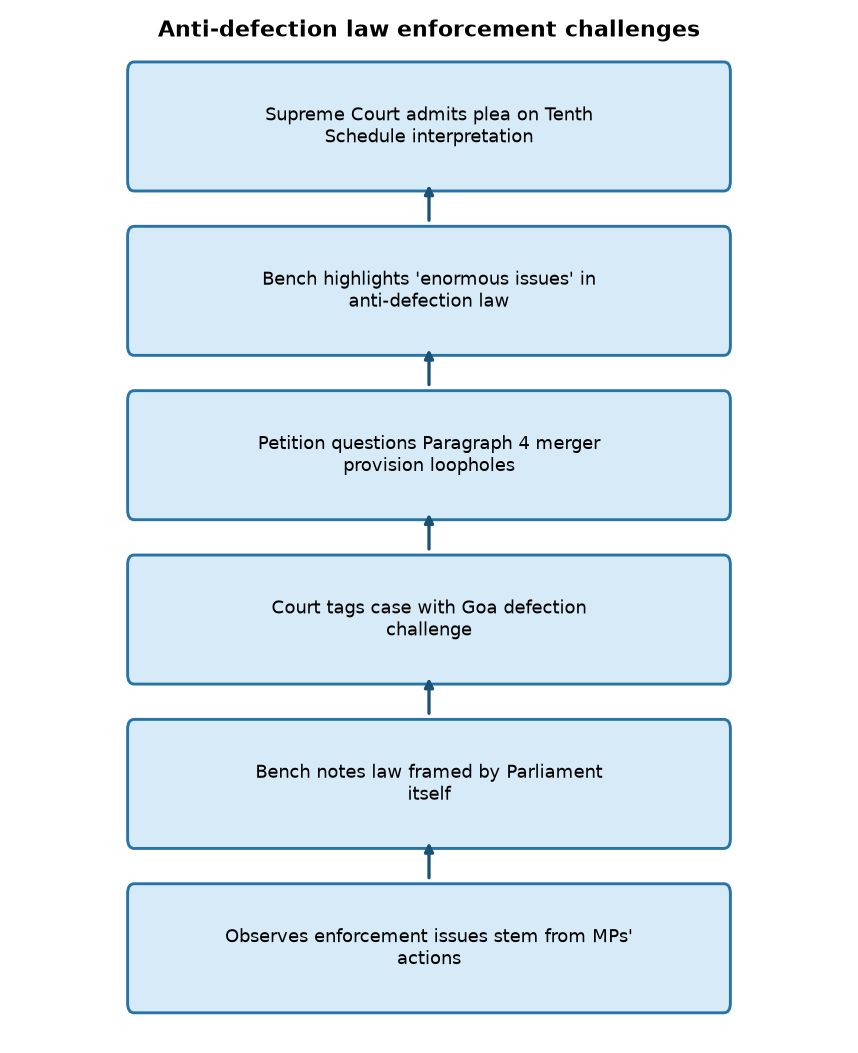
The Supreme Court, on 28 July 2026, agreed to examine a petition filed by senior advocate and Rajya Sabha MP Kapil Sibal, challenging the interpretation of Paragraph 4 of the Tenth Schedule to the Constitution, which permits legislators to evade disqualification by invoking the merger provision. The bench, comprising Justices PS Narasimha and Alok Aradhe, issued notice and tagged the matter with a pending case on Goa political defections, highlighting systemic issues in the enforcement of anti-defection laws that undermine democratic principles.
Background
- The Tenth Schedule to the Constitution, inserted by the 52nd Amendment Act, 1985, was introduced to curb the menace of political defections, which had destabilised governments in the past.
- Paragraph 4 of the Tenth Schedule provides an exception to disqualification for legislators if their original political party merges with another party, subject to a two-thirds threshold of party members approving the merger.
- The provision has been criticised for enabling engineered defections, where legislators switch allegiance to topple governments or manipulate electoral outcomes, thereby subverting the voters’ mandate.
- The Supreme Court has previously upheld the constitutional validity of the Tenth Schedule in *Kihoto Hollohan v. Zachillhu* (1992), but concerns persist regarding its implementation and the role of Speakers in adjudicating disqualification petitions.
- Recent political developments, such as the Goa case and other instances of mass defections, have reignited debates on the efficacy of the anti-defection law in preserving democratic stability.
- The judiciary has historically intervened in matters concerning the Tenth Schedule, but the Court has also emphasised the need for legislative and political solutions to systemic flaws.
What is the Tenth Schedule and the Anti-Defection Law?
- The Tenth Schedule, also known as the Anti-Defection Law, was inserted into the Constitution via the 52nd Amendment Act, 1985, to prevent political defections that had led to frequent government collapses in the 1960s and 1970s.
- It applies to members of Parliament and State Legislatures and imposes disqualification for defection, defined as voluntarily giving up membership of a political party or voting against the party whip, except in specific circumstances like a merger.
- Paragraph 2 of the Tenth Schedule outlines the grounds for disqualification, including voting against the party whip or resigning from the party.
- Paragraph 4 provides an exception: if a political party merges with another party, and at least two-thirds of its legislators approve the merger, no disqualification occurs for those who join the new party or leave politics.
- The law was enacted to ensure stability in governance, but its enforcement has been criticised for being prone to misuse, particularly through engineered defections where legislators switch sides to secure political gains.
- The Speaker’s role in deciding disqualification petitions has been a subject of controversy, with allegations of bias and delays in adjudication undermining the law’s effectiveness.
- The Supreme Court, in *Kihoto Hollohan v. Zachillhu* (1992), upheld the constitutional validity of the Tenth Schedule but emphasised that judicial review is limited to procedural aspects, not the merits of the Speaker’s decision.
- The law’s effectiveness is further complicated by the lack of a time-bound framework for the Speaker to decide on disqualification petitions, leading to prolonged uncertainty for legislators and political parties.
Key Features
| Feature | Significance |
|---|---|
| Tenth Schedule to the Constitution | Primary legal framework governing anti-defection provisions in Parliament and State Legislatures, aimed at maintaining stability in elected bodies. |
| Paragraph 4 of the Tenth Schedule | Permits legislators to avoid disqualification by claiming protection under the ‘merger provision’, requiring a two-thirds threshold for party mergers. |
| Supreme Court’s judicial scrutiny | Highlights systemic flaws in the enforcement of anti-defection laws, underscoring judicial intervention in legislative processes. |
| Political party merger exception | Allows legislators to either join a new political group or leave without disqualification, often exploited to legitimise engineered defections. |
| Article 32 of the Constitution | Empowers the Supreme Court to issue writs for the enforcement of fundamental rights, invoked by the petitioner to challenge anti-defection law interpretations. |
Why it Matters
Constitutional Integrity
- The Tenth Schedule is a constitutional mechanism designed to curb unethical political defections, ensuring stability in elected bodies.
- Judicial scrutiny of its enforcement underscores the balance between legislative autonomy and constitutional safeguards.
- The merger provision’s interpretation has far-reaching implications for the sanctity of electoral mandates and democratic representation.
Democratic Governance
- Engineered defections undermine the will of the electorate, altering majority-minority dynamics without genuine public mandate.
- The Supreme Court’s observations highlight the erosion of public trust in democratic institutions due to exploitative political practices.
- A minority government can be artificially transformed into a majority, distorting the principles of representative democracy.
Judicial-Legislative Interface
- The bench’s remarks indicate a reluctance to intervene in purely political matters, deferring to Parliament’s role in framing laws.
- However, the court’s willingness to examine constitutional interpretations reflects its role as the guardian of fundamental rights.
- This duality underscores the tension between judicial activism and legislative sovereignty in governance.
Challenges
1. Ambiguity in Merger Provision
- The two-thirds threshold for party mergers is often misinterpreted or manipulated to legitimise defections.
- Lack of clarity in defining ‘merger’ and ‘split’ creates loopholes exploited by political actors.
- No clear mechanism to verify the authenticity of merger claims, leading to arbitrary disqualifications or protections.
UPSC Link: Polity: Anti-Defection Law (Tenth Schedule)
2. Judicial Deference to Legislature
- The Supreme Court’s reluctance to intervene in political matters limits its ability to enforce anti-defection laws effectively.
- Parliament’s role in framing the Tenth Schedule creates a conflict of interest, as legislators are both lawmakers and potential beneficiaries of loopholes.
- Judicial activism is constrained by the doctrine of separation of powers, even when laws are exploited for unethical purposes.
UPSC Link: Polity: Separation of Powers
3. Erosion of Electoral Mandates
- Engineered defections distort the electoral process, allowing minority governments to gain majority status without public support.
- The merger exception enables political parties to bypass anti-defection laws, undermining the sanctity of elections.
- This practice erodes public confidence in democratic institutions and representative governance.
UPSC Link: Polity: Electoral Reforms
4. Lack of Independent Oversight
- Speakers of Legislatures, often from ruling parties, are entrusted with deciding disqualification matters, creating conflicts of interest.
- No independent body exists to investigate or verify claims of mergers or splits, leading to partisan decisions.
- The absence of a neutral authority exacerbates the misuse of anti-defection provisions.
UPSC Link: Polity: Role of Speaker
5. Political Exploitation of Loopholes
- The merger provision is frequently used to justify large-scale defections, particularly in coalition governments.
- Political parties manipulate the two-thirds threshold to engineer defections without consequences.
- This practice incentivises unethical political behaviour, prioritising power over democratic principles.
UPSC Link: Polity: Political Ethics
Challenges — UPSC Perspective
| Issue | Concern |
|---|---|
| Two-thirds threshold ambiguity | Misinterpretation or manipulation of merger provisions to legitimise defections. |
| Speaker’s conflict of interest | Speakers from ruling parties deciding disqualification cases, leading to biased outcomes. |
| Lack of independent oversight | No neutral authority to verify merger claims or investigate defections. |
| Judicial deference to legislature | Supreme Court’s reluctance to intervene in political matters, limiting enforcement. |
| Erosion of electoral mandates | Engineered defections distort the will of the electorate, altering majority-minority dynamics. |
| Political exploitation of loopholes | Parties manipulate anti-defection laws to gain power, undermining democratic principles. |
Way Forward
- Strengthen the merger provision by defining ‘merger’ and ‘split’ with clear, unambiguous criteria to prevent exploitation.
- Establish an independent authority, such as an Election Commission-like body, to investigate and verify claims of mergers or splits.
- Amend the Tenth Schedule to remove the merger exception or replace it with a stricter threshold, such as a three-fourths majority.
- Empower the Supreme Court to directly intervene in anti-defection disputes, bypassing Speakers in cases of conflict of interest.
- Introduce mandatory transparency in merger processes, including public disclosure of merger agreements and voting records.
- Enhance judicial scrutiny of Speakers’ decisions in disqualification matters to ensure impartiality and fairness.
- Conduct regular reviews of the Tenth Schedule by a parliamentary committee to identify and rectify loopholes.
- Promote ethical political practices through awareness campaigns and stricter party discipline rules.
UPSC Value Addition
Keywords for Mains Answer-Writing
Anti-Defection Law · Tenth Schedule of the Constitution · Parliamentary Democracy · Constitutional Provisions on Defections · Role of the Supreme Court in Upholding Constitutional Morality · Political Party Mergers and Defections · Constitutional Interpretation of Disqualification Provisions · Separation of Powers and Judicial Review · Constitutional Morality vs. Political Expediency · Electoral Mandates and Democratic Stability
Constitutional & Policy Linkages
- {‘Article 102(2) of the Constitution of India: Provisions for disqualification of members of Parliament on grounds of defection.’: ‘Grounds for disqualification under anti-defection law.’}
- {‘Tenth Schedule to the Constitution: Anti-Defection Law’: ‘Primary legal framework governing anti-defection provisions.’}
Concept Flow
Electoral mandate → Engineered defections → Exploitation of merger provision → Ambiguity in Tenth Schedule → Speakers’ biased decisions → Judicial reluctance to intervene → Erosion of democratic principles → Need for constitutional reforms.
Prelims Practice Questions
Q1. Which of the following provisions of the Indian Constitution deals with the disqualification of members of Parliament on grounds of defection?
- A. Article 75
- B. Article 102
- C. Tenth Schedule
- D. Article 324
Answer: C. Tenth Schedule — The Tenth Schedule of the Indian Constitution, also known as the Anti-Defection Law, outlines the provisions for disqualification of members of Parliament and State Legislatures on the grounds of defection.
Q2. Under the Tenth Schedule, a member of a political party can avoid disqualification for defection if:
- A. The member resigns from the party and joins another party within 15 days
- B. The member claims protection under the merger provision requiring a two-thirds threshold of the party’s legislators
- C. The member votes against the party whip but justifies it in writing to the Speaker
- D. The member abstains from voting on a crucial issue
Answer: B. The member claims protection under the merger provision requiring a two-thirds threshold of the party’s legislators — The merger provision under Paragraph 4 of the Tenth Schedule allows members to avoid disqualification if two-thirds of the party’s legislators merge with another party, enabling members to either join the new group or leave without facing disqualification.
Mains Practice Question
✍ Critically examine the efficacy of the Anti-Defection Law in India. How has its enforcement, or the lack thereof, impacted the stability of parliamentary democracy and electoral mandates? Suggest reforms to strengthen the law while balancing the need for political accountability and democratic representation.
Approach: Begin by outlining the constitutional and legal framework of the Anti-Defection Law under the Tenth Schedule, including its objectives and key provisions such as the merger clause and the role of the Speaker. Analyze the challenges in enforcement, such as the misuse of the merger provision, political interference in the role of the Speaker, and the lack of judicial oversight. Discuss the impact on parliamentary democracy, including the erosion of electoral mandates and the undermining of party discipline. Conclude by suggesting reforms, such as reducing the discretionary powers of the Speaker, introducing judicial review of disqualification decisions, and tightening the merger provisions to prevent engineered defections.
Source: Hindustan Times
Generated by AanyaAi for educational purpose.

- संसद सदस्यों के कारण उप-उत्पत्ति: सर्वोच्च न्यायालय ने दलबदल कानून के क्रियान्वयन में बड़ी चुनौतियाँ बताईं - July 28, 2026
- Supreme Court flags flaws in anti-defection law enforcement: Key UPSC insights - July 28, 2026
- लोकसभा में आज कठोर पेपर लीक विरोधी बिल पर होगी चर्चा, विपक्ष के विरोध के बाद - July 28, 2026

No Comments