


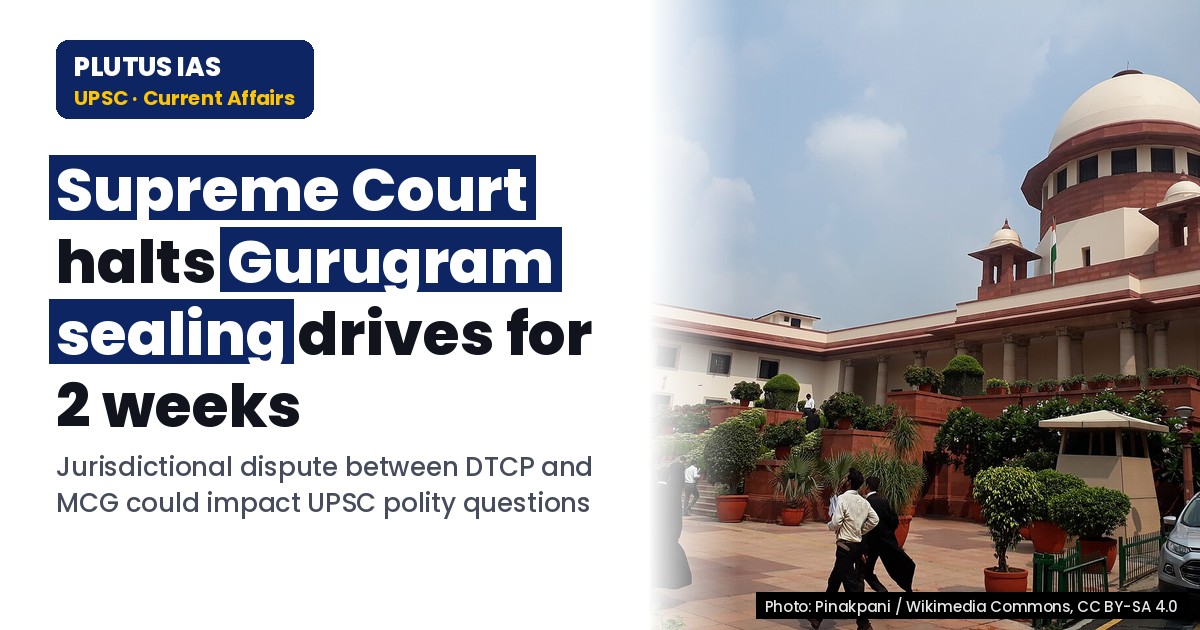
14 Oct Supreme Court Halts Sealing Drive in Gurugram Licensed Colonies: Key Polity Issue
✎ The Supreme Court’s interim stay on sealing drives in Gurugram’s licensed plotted colonies hinges on the jurisdictional balance between the DTCP and the MCG under the doctrine of legislative intent and constitutional protection…
Subject Relevance — Where This Topic Fits
- GS Paper II — Functions and Responsibilities of the Union and the States, Issues and Challenges Pertaining to the Federal Structure | GS Paper III — Land Reforms in India | GS Paper III — Urban Development, Housing and Urban Poverty Alleviation
- Prelims: Town and Country Planning Act, Municipal Corporation Act, Haryana Development and Regulation of Urban Areas Act, 1975, Section 3(4) and Section 3B, Fundamental Right to Shelter under Article 21, Doctrine of Pith and Substance, Municipalization, Licensed Plotted Colonies
- Essay: Federalism and Urban Governance: Balancing State and Municipal Authority, The Role of Judicial Interventions in Resolving Land Use and Property Rights Disputes
Quick Revision: The Supreme Court’s interim stay on sealing drives in Gurugram’s licensed plotted colonies hinges on the jurisdictional balance between the DTCP and the MCG under the doctrine of legislative intent and constitutional protection of property rights.
Why is this in the news?
The Supreme Court’s interim stay on sealing drives in Gurugram’s licensed plotted colonies for two weeks, pending examination of a jurisdictional dispute between the Directorate of Town and Country Planning (DTCP) and the Municipal Corporation of Gurugram (MCG), underscores critical constitutional and statutory questions regarding the exercise of urban planning powers within municipal limits. The case highlights the interplay between state-level town planning legislation and municipal governance, raising issues of legislative intent, statutory interpretation, and the protection of property rights under the Constitution.
Background
- The Haryana Development and Regulation of Urban Areas Act, 1975, empowers the DTCP to regulate and control urban development, including the issuance of licences for plotted colonies and enforcement of building regulations.
- In 2008, the boundaries of the Municipal Corporation of Gurugram (MCG) were expanded to include areas previously governed by the DTCP, leading to overlapping jurisdictions and disputes over regulatory authority.
- Licensed plotted colonies, such as DLF Phases I, II, III, and Sushant Lok I, were developed under the DTCP’s regulatory framework and obtained licences prior to municipalization.
- The Punjab and Haryana High Court, in a September 7, 2026 interim order, rejected preliminary objections raised by residents against the DTCP’s jurisdiction, holding that municipalization does not extinguish the DTCP’s powers under the 1975 Act.
- Residents of these colonies approached the Supreme Court, arguing that the MCG’s jurisdiction under the Haryana Municipal Corporation Act, 1994, supersedes the DTCP’s authority in areas brought within municipal limits.
- The dispute also centres on the interpretation of Section 3B, which restricts certain building activities.
What is the Jurisdictional Dispute in Urban Planning?
- The conflict arises from the expansion of municipal limits in Gurugram in 2008, which brought areas previously regulated by the DTCP under the jurisdiction of the MCG. This created a legal ambiguity regarding which authority—state-level town planning department or municipal corporation—holds regulatory power over licensed plotted colonies.
- The Haryana Development and Regulation of Urban Areas Act, 1975, is a state legislation designed to regulate urban development, including the issuance of licences for plotted colonies, enforcement of building norms, and prevention of unauthorized construction. The Act applies to both municipal and non-municipal areas unless explicitly excluded.
- The Haryana Municipal Corporation Act, 1994, governs the functioning of municipal corporations, including their powers to regulate land use, issue building permits, and enforce municipal by-laws. The Act does not explicitly exclude the application of the 1975 Act in areas brought within municipal limits.
- Section 3B of the 1975 Act imposes restrictions on building construction in licensed colonies, particularly concerning the development of multiple buildings or structures. Residents argue that this section does not apply to individual plot allottees who are not constructing multiple buildings, further complicating the jurisdictional issue.
- The High Court’s interpretation that “municipalization neither creates nor extinguishes the DTCP’s jurisdiction” is grounded in the principle that the source of jurisdiction lies in the licence granted under the 1975 Act, which subsists even after municipalization. This implies that the DTCP retains regulatory powers unless the legislature explicitly transfers them to municipal authorities.
- The residents’ contention that the Act does not apply to individuals whose land measures less than 4,000 sq m and falls within a municipal area introduces a threshold argument, which the courts may need to evaluate in the context of statutory intent and legislative design.
- The case also implicates the fundamental right to shelter under Article 21 of the Constitution, as residents argue that sealing or demolition of properties by a department lacking jurisdiction would result in grave and irreparable loss.
Key Features
| Feature | Significance |
|---|---|
| Supreme Court interim stay on sealing drives | Provides temporary relief to property owners in licensed plotted colonies of Gurugram, halting demolition/sealing actions for two weeks to allow judicial examination of jurisdictional disputes. |
| Jurisdictional dispute between DTCP and MCG | Highlights the conflict over enforcement authority in areas brought under municipal limits, testing the application of the Haryana Development and Regulation of Urban Areas Act, 1975, vis-à-vis the Haryana Municipal Corporation Act, 1994. |
| Section 3(4) of the 1975 Act | Clarifies that municipal rules and by-laws apply unless explicitly excluded, forming a critical legal argument in the residents’ petition against DTCP’s jurisdiction. |
| Punjab and Haryana High Court’s interim order (September 7, 2026) | Rejected preliminary objections to DTCP’s jurisdiction, asserting that municipalization does not extinguish the department’s powers under the 1975 Act. |
| Arguments on Section 3B of the 1975 Act | Residents contend that restrictions on building construction under this section apply only to developers, not individual plot allottees, challenging the scope of DTCP’s enforcement powers. |
Why it Matters
Legal and Governance
- The case underscores the complexities of urban governance where overlapping jurisdictions between state town planning authorities and municipal corporations create legal ambiguities.
- It tests the principle of ‘municipalization’—whether bringing areas under municipal limits automatically transfers all regulatory powers to the municipal body or preserves certain statutory functions of state agencies.
- The Supreme Court’s intervention highlights the judiciary’s role in resolving inter-institutional disputes to prevent arbitrary enforcement actions that may violate property rights.
Urban Planning and Regulation
- The dispute reflects broader challenges in harmonising state-level town planning laws with municipal governance, particularly in rapidly urbanising regions like Gurugram.
- It raises questions about the effectiveness of licensing systems for plotted colonies and the enforcement of building regulations post-municipalisation.
- The case may influence future policy on delineating the scope of state and municipal authorities in urban development and regulation.
Property Rights and Economic Impact
- Temporary relief for property owners mitigates immediate economic losses from sealing or demolition actions, preserving investment confidence in licensed plotted colonies.
- The outcome could set a precedent for property rights protection in areas where municipal boundaries are expanded, ensuring legal certainty for landowners.
- Prolonged legal uncertainty may deter real estate development and investment in such colonies, affecting local economies.
Challenges
1. Jurisdictional Ambiguity in Urban Governance
- Overlapping and conflicting legal provisions between state town planning laws and municipal acts create confusion in enforcement, leading to disputes and litigation.
- The absence of explicit statutory clarity on the transfer of powers post-municipalisation exacerbates inter-institutional conflicts.
- Such ambiguities undermine the predictability of urban planning and regulatory frameworks, deterring private investment.
- Resolving these disputes requires legislative or judicial clarification to delineate the roles of state and municipal authorities.
UPSC Link: GS-II: Functions and responsibilities of the Union and the States
2. Enforcement of Urban Regulations in Licensed Colonies
- Licensed plotted colonies often face enforcement challenges due to unclear demarcation of regulatory responsibilities between state and municipal bodies.
- The case highlights the need for streamlined coordination mechanisms to ensure consistent application of building and land-use regulations.
- Arbitrary or inconsistent enforcement actions can lead to legal challenges, undermining public trust in regulatory institutions.
UPSC Link: GS-II: Government policies and interventions for development
3. Protection of Property Rights in Urban Areas
- The dispute raises concerns about the vulnerability of property rights in areas undergoing municipal expansion, particularly where state agencies retain enforcement powers.
- Property owners face risks of sealing or demolition due to jurisdictional disputes, necessitating safeguards to prevent arbitrary actions.
- Balancing regulatory enforcement with the protection of vested property rights remains a critical governance challenge.
UPSC Link: GS-II: Fundamental Rights (Article 19(1)(f) read with Article 300A)
4. Judicial Role in Resolving Institutional Disputes
- The judiciary’s intervention in this case underscores its role in resolving inter-institutional conflicts to prevent administrative paralysis.
- However, prolonged judicial scrutiny may delay resolution, creating uncertainty for stakeholders.
- The case exemplifies the need for proactive judicial mechanisms to address governance disputes efficiently.
UPSC Link: GS-II: Judiciary and its role in governance
Challenges — UPSC Perspective
| Issue | Concern |
|---|---|
| Conflict between state and municipal jurisdictions | Creates legal uncertainty and hampers effective urban governance. |
| Ambiguity in the application of the 1975 Act post-municipalisation | Leads to inconsistent enforcement and disputes over regulatory authority. |
| Risk of arbitrary sealing/demolition actions | Undermines property rights and investor confidence in licensed plotted colonies. |
| Prolonged legal disputes | Delays resolution and exacerbates economic losses for property owners. |
| Lack of clear legislative guidance on power transfer | Hinders the harmonisation of state and municipal roles in urban planning. |
Way Forward
- The Supreme Court should deliver a reasoned judgment clarifying the jurisdiction of DTCP and MCG in licensed plotted colonies to prevent future disputes.
- The Haryana government should consider amending the Haryana Development and Regulation of Urban Areas Act, 1975, and the Haryana Municipal Corporation Act, 1994, to explicitly delineate the powers of state and municipal authorities post-municipalisation.
- State town planning departments and municipal corporations should establish formal coordination mechanisms to resolve jurisdictional conflicts and ensure consistent enforcement of urban regulations.
- Property owners in licensed plotted colonies should be provided with legal safeguards, including prior notice and opportunities for redressal, before enforcement actions are initiated.
- Urban local bodies should conduct audits of licensed plotted colonies to identify and regularise unauthorised constructions, reducing the scope for future disputes.
- The judiciary should prioritise cases involving inter-institutional disputes to minimise delays and ensure timely resolution.
- Stakeholders, including resident welfare associations and real estate developers, should be consulted in the formulation of policies to harmonise state and municipal roles in urban planning.
UPSC Value Addition
Keywords for Mains Answer-Writing
Town and Country Planning Act, 1975 · Haryana Development and Regulation of Urban Areas Act, 1975 · Municipal Corporation of Gurugram · Directorate of Town and Country Planning (DTCP) · jurisdictional disputes in urban governance · sealing drives and property rights · municipalization of licensed colonies · urban planning and regulation · fundamental right to shelter · constitutional governance of urban areas
Constitutional & Policy Linkages
- [‘Article 246 (Distribution of Legislative Powers)’, ‘Division of powers between Union and States.’]
- [‘Article 243W (Powers, Authority and Responsibilities of Municipalities)’, ‘Municipal functions and governance.’]
- [‘Article 300A (Right to Property)’, ‘Protection of property rights.’]
Concept Flow
Licensed plotted colonies in Gurugram brought under MCG limits via 2008 notification → → MCG asserts jurisdiction; DTCP issues sealing notices → → Residents challenge DTCP’s authority in High Court → → High Court rejects objections, upholds DTCP’s powers under 1975 Act → → Residents approach Supreme Court, citing Section 3(4) of 1975 Act → → Supreme Court grants interim stay on sealing drives → → Judicial examination of jurisdictional dispute to determine final authority
Prelims Practice Questions
Q1. Consider the following statements regarding the Haryana Development and Regulation of Urban Areas Act, 1975:
1. The Act empowers the Directorate of Town and Country Planning (DTCP) to regulate urban areas even within municipal limits.
2. Section 3(4) of the Act states that municipal rules and by-laws apply unless specifically excluded.
3. The Act applies exclusively to licensed colonies and not to individual plot allottees.
4. The Act was designed to operate outside municipal limits from its inception.
How many of the above statements are correct?
- Only one
- Only two
- Only three
- All
Answer: Only two — Only statements 1 and 2 are correct. Statement 3 is incorrect as the Act applies to licensed colonies and individual plot allottees within municipal areas. Statement 4 is incorrect as the Act was designed to operate within municipal limits from its inception.
Q2. Assertion (A): The Punjab and Haryana High Court held that municipalization of a licensed colony does not extinguish the powers of the Directorate of Town and Country Planning (DTCP) under the Haryana Development and Regulation of Urban Areas Act, 1975.
Reason (R): The license granted under the Act subsists even after the area is brought within municipal limits, and the Act was designed to operate inside municipal limits from its commencement.
Code:
(A) Both A and R are true, and R is the correct explanation of A.
(B) Both A and R are true, but R is not the correct explanation of A.
(C) A is true but R is false.
(D) A is false but R is true.
- A
- B
- C
- D
Answer: A — Both the Assertion (A) and Reason (R) are true, and R correctly explains A as per the High Court’s interpretation of the Act.
Q3. Match the following columns regarding urban governance in Haryana:
Column I
A. Haryana Development and Regulation of Urban Areas Act, 1975
B. Haryana Municipal Corporation Act, 1994
C. Directorate of Town and Country Planning (DTCP)
D. Municipal Corporation of Gurugram (MCG)
Column II
1. Regulates urban planning and development in Haryana
2. Governs municipal administration and services in Gurugram
3. Empowered to issue show-cause notices and seal properties under the 1975 Act
4. Governs municipal areas and excludes jurisdiction under other enactments unless specified
Options:
A-1, B-4, C-3, D-2
A-3, B-2, C-1, D-4
A-2, B-1, C-4, D-3
A-4, B-3, C-2, D-1
- A-1, B-4, C-3, D-2
- A-3, B-2, C-1, D-4
- A-2, B-1, C-4, D-3
- A-4, B-3, C-2, D-1
Answer: A-1, B-4, C-3, D-2 — A-1: The 1975 Act regulates urban planning and development in Haryana. B-4: The 1994 Act governs municipal areas and excludes jurisdiction under other enactments unless specified. C-3: The DTCP is empowered to issue show-cause notices and seal properties under the 1975 Act. D-2: The MCG governs municipal administration and services in Gurugram.
Mains Practice Question
✍ The Supreme Court’s interim order halting sealing drives in Gurugram’s licensed plotted colonies underscores the jurisdictional complexities between the Directorate of Town and Country Planning (DTCP) and the Municipal Corporation of Gurugram (MCG). Critically examine the constitutional and statutory framework governing urban planning and regulation in India, with particular reference to the interplay between municipal authorities and state town planning departments. Also, analyse the implications of such disputes for property rights and urban governance. (15 Marks)
Approach: MODEL-ANSWER SKELETON:
1. **Constitutional Framework**:
– Article 243W (74th Amendment Act, 1992) empowers municipalities to prepare plans for economic development and social justice, including urban planning.
– Article 243Q defines the functional domain of municipalities, including town planning.
– State legislatures enact laws to delegate powers to municipalities (e.g., Haryana Municipal Corporation Act, 1994).
2. **Statutory Framework**:
– **Haryana Development and Regulation of Urban Areas Act, 1975**: Establishes the DTCP to regulate urban development, including licensed colonies. Section 3(4) clarifies that municipal rules apply unless specifically excluded.
– **Town Planning Acts**: State-specific laws (e.g., in Haryana) vest town planning departments with regulatory powers, including the issuance of show-cause notices and sealing of properties.
3. **Jurisdictional Disputes**:
– **Municipalization vs. Town Planning**: The conflict arises when areas are brought within municipal limits. The Supreme Court and High Courts have held that municipalization does not extinguish the powers of the town planning department if the source of jurisdiction (e.g., a license) subsists.
– **Judicial Precedents**: Cite the Supreme Court’s observations in *State of Haryana v. Bhagwan Dass* (2008) and the Punjab and Haryana High Court’s ruling in the present case, emphasizing that the 1975 Act was designed to operate within municipal limits.
4. **Property Rights and Urban Governance**:
– **Fundamental Right to Shelter (Article 21)**: The Supreme Court has recognized the right to shelter as part of the right to life. Disputes like the one in Gurugram can lead to arbitrary sealing and demolition, violating this right.
– **Urban Governance Challenges**: Highlight the need for clear demarcation of powers between municipal authorities and town planning departments to avoid conflicts. Discuss the role of the **National Urban Policy Framework (2018)** and **Atal Mission for Rejuvenation and Urban Transformation (AMRUT)** in addressing such issues.
5. **Balancing Views**:
– **Pro-Municipalization Argument**: Municipal authorities are democratically elected and better suited to address local needs.
– **Pro-Town Planning Argument**: Town planning departments have technical expertise and historical jurisdiction over licensed colonies, ensuring planned development.
6. **Way Forward**:
– **Legislative Clarity**: Amendments to state town planning acts to explicitly define the scope of municipal and town planning jurisdictions.
– **Inter-Institutional Coordination**: Establish mechanisms for coordination between DTCP and MCG to avoid conflicts.
– **Judicial Guidance**: The Supreme Court’s final decision in the Gurugram case should provide clarity on the interpretation of Section 3(4) of the 1975 Act.
Source: The Indian Express
Haryana PCS (HPSC / HCS) — State PCS Practice
Prelims: Recently, the Supreme Court of India granted a two-week stay on the sealing drive in Gurugram’s licensed plotted colonies. Which of the following is the PRIMARY reason behind this judicial intervention?
- To allow the Haryana government to regularize unauthorized constructions in these colonies under the ‘Haryana Development and Regulation of Urban Areas Act, 1975’
- To enable the Municipal Corporation of Gurugram (MCG) to complete its pending encroachment removal drives in a phased manner
- To provide time for the Gurugram Metropolitan Development Authority (GMDA) to submit a revised master plan for these colonies
- To facilitate the Haryana State Pollution Control Board (HSPCB) in conducting environmental impact assessments of the colonies
Answer: To allow the Haryana government to regularize unauthorized constructions in these colonies under the ‘Haryana Development and Regulation of Urban Areas Act, 1975’ — The Supreme Court intervened to allow the Haryana government to regularize unauthorized constructions under the Haryana Development and Regulation of Urban Areas Act, 1975, addressing the plight of residents in licensed plotted colonies.
Mains: Analyze the socio-economic and legal implications of the Supreme Court’s recent order halting the sealing drive in Gurugram’s licensed plotted colonies. How can the Haryana government balance urban development imperatives with the rights of residents in such cases? Suggest a structured approach with reference to existing state policies.
Generated by AanyaAi for educational purpose.
Related guides on our sites
- Current affairs for upsc 2026
- Best PSIR optional coaching for upsc
- Best PSIR optional teacher for upsc
- Best teacher of PSIR optional for upsc

- Kerala HC Orders SBI to Refund ₹3.73 Lakh in Cyberfraud Case: Key Judgment for UPSC - October 21, 2026
- मुंबई फ्लेमिंगो अभयारण्य बफर जोन में सड़क निर्माण: 680 मैनग्रोव होंगे प्रभावित - October 21, 2026
- RBI Hikes Repo Rate by 25 bps: MPC Minutes Reveal Inflation Concerns - October 21, 2026

No Comments