


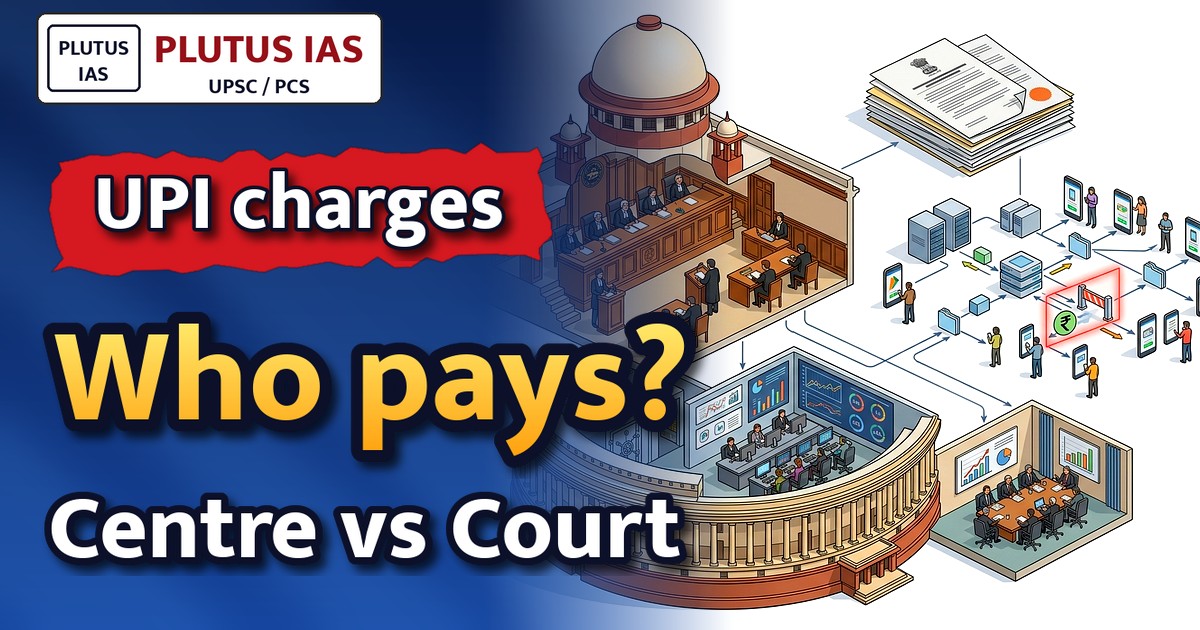
28 Sep Supreme Court Issues Notice to Centre, RBI on UPI Transaction Charges
✎ The Supreme Court’s notice to the Union Government and RBI in the UPI transaction fee case underscores the constitutional principle that executive actions in the digital economy must be justified by empirical evidence, procedural…
Subject Relevance — Where This Topic Fits
- GS Paper III — Indian Economy: Issues relating to Planning, Mobilization of Resources, Growth, Development and Employment | GS Paper III — Money and Banking: Role of Central Bank, Monetary Policy and Regulation of Financial Institutions
- Prelims: Unified Payments Interface (UPI), Reserve Bank of India (RBI), Digital Payment Systems, Payment Aggregators, Financial Sector Regulatory Framework, Supreme Court of India, Judicial Review of Executive Actions
- Essay: The Interface of Technology and Governance: Balancing Innovation with Public Interest, Regulatory Challenges in the Digital Economy: Sovereignty, Security and Service Delivery
Quick Revision: The Supreme Court’s notice to the Union Government and RBI in the UPI transaction fee case underscores the constitutional principle that executive actions in the digital economy must be justified by empirical evidence, procedural fairness, and alignment with regulatory mandates.
Why is this in the news?
The Supreme Court of India has issued notices to the Union Government and the Reserve Bank of India (RBI) in response to a public interest litigation challenging the legality of a gazette notification imposing transaction fees on Unified Payments Interface (UPI) transactions exceeding ₹2,000. The petition contends that the notification lacks empirical justification and may disproportionately impact digital financial inclusion, prompting judicial scrutiny of executive policymaking in the digital payments ecosystem.
Background
- The Reserve Bank of India (RBI), as the central bank and regulator of India’s financial system, is mandated under the Reserve Bank of India Act, 1934, to regulate payment systems to ensure stability, efficiency, and consumer protection.
- The Unified Payments Interface (UPI), launched in 2016 by the National Payments Corporation of India (NPCI), is a real-time interbank payment system regulated by the RBI under the Payment and Settlement Systems Act, 2007, and the Payment and Settlement Systems Regulations, 2008.
- The notification was challenged in the Supreme Court on grounds of procedural irregularity, lack of consultation with stakeholders, and potential violation of the fundamental right to financial inclusion under Article 21 of the Constitution.
- This case exemplifies the evolving judicial role in reviewing executive actions in the digital economy, particularly where policy intersects with constitutional rights and regulatory mandates.
What is the UPI Transaction Fee Notification Issue?
- The Supreme Court’s intervention underscores the principle of judicial review of executive actions, particularly where policy decisions may have far-reaching implications for constitutional rights and regulatory frameworks.
- The case also highlights the constitutional dimension of financial inclusion, as UPI is a critical enabler of access to formal financial services for millions of Indians, especially in rural and semi-urban areas.
Key Features
| Feature | Significance |
|---|---|
| Supreme Court’s refusal to stay UPI transaction charges | Preserves the status quo pending judicial review, ensuring regulatory continuity in digital payments. |
| Issuance of notice to Centre, RBI, and NPCI | Institutionalizes judicial oversight over executive and regulatory decisions impacting digital payment ecosystems. |
| Challenge to the Gazette Notification imposing charges on UPI transactions above ₹2,000 | Triggers judicial scrutiny of the legal basis and proportionality of the levy under the Payment and Settlement Systems Act, 2007. |
| Requirement for a sworn affidavit from the Centre | Mandates transparency in the executive’s rationale for the levy, aligning with principles of administrative accountability. |
| Bench comprising CJI Suryakant, Justice Joymalya Bagchi, and Justice V. Mohana | Ensures constitutional bench strength for matters of economic significance and potential policy implications. |
Why it Matters
Economic
- The levy on UPI transactions above ₹2,000 may alter consumer behavior, potentially reducing digital payment adoption among price-sensitive users.
- Revenue implications for the exchequer, as UPI transactions constitute a significant share of digital payments in India.
- Impact on fintech innovation and competition, given UPI’s role as a low-cost, interoperable payment system.
- Potential inflationary pressures if the levy is passed on to consumers, affecting retail price levels.
Regulatory
- Demonstrates the judiciary’s role in reviewing executive and regulatory actions affecting digital public infrastructure.
- Highlights the need for inter-institutional coordination between the Centre, RBI, and NPCI in policy formulation.
- Reinforces the principle that economic regulations must be proportionate, transparent, and grounded in statutory authority.
Technological
- UPI’s architecture as a real-time payment system may face operational adjustments to accommodate the levy without disrupting user experience.
- Potential delays in transaction processing if the levy introduces additional compliance layers for payment aggregators and banks.
Challenges
1. Legal and Regulatory Uncertainty
- The Supreme Court’s notice indicates potential judicial intervention, creating uncertainty for stakeholders in the digital payments ecosystem.
- The challenge to the Gazette Notification questions the executive’s authority to impose charges without parliamentary oversight or prior public consultation.
UPSC Link: Constitutional validity of delegated legislation
2. Economic Distortion
- The levy may disproportionately affect small merchants and consumers, undermining the inclusivity of digital payment systems.
- Risk of revenue leakage if the levy discourages formalization of transactions, particularly in cash-intensive sectors.
UPSC Link: Impact of taxation on digital transactions
3. Operational Complexity
- Implementing the levy requires seamless integration with UPI’s existing infrastructure, posing technical challenges for NPCI and banks.
- Potential for increased dispute resolution cases if the levy leads to confusion or errors in transaction processing.
UPSC Link: Digital public infrastructure governance
Challenges — UPSC Perspective
| Issue | Concern |
|---|---|
| Proportionality of the levy | Whether the charge is justified given UPI’s role in promoting financial inclusion and reducing cash usage. |
| Administrative burden on NPCI and banks | Additional compliance requirements may strain operational capacities. |
| Impact on small merchants | Higher costs may deter small businesses from adopting digital payment systems. |
| Judicial review of executive action | Scope for the judiciary to strike down the notification if found ultra vires or arbitrary. |
| Consumer backlash | Risk of reduced trust in digital payment systems if the levy is perceived as regressive. |
Way Forward
- The Centre must file a detailed affidavit within the stipulated timeframe, justifying the levy with empirical data on its economic and social impact.
- RBI and NPCI should conduct a cost-benefit analysis of the levy, assessing its impact on UPI’s growth trajectory and financial inclusion metrics.
- Parliamentary Standing Committee on Finance may examine the levy’s alignment with the broader objectives of the Payment and Settlement Systems Act, 2007.
- Stakeholders, including fintech firms, banks, and consumer advocacy groups, should submit representations to the judiciary to inform its deliberations.
- A phased implementation approach may be considered to mitigate operational disruptions and allow stakeholders to adapt.
- Public awareness campaigns should be launched to educate users and merchants about the levy’s implications and alternatives.
- The judiciary may direct the formation of an expert committee to evaluate the levy’s necessity and suggest modifications if required.
UPSC Value Addition
Keywords for Mains Answer-Writing
Digital Payments Ecosystem in India · Unified Payments Interface (UPI) · UPI Transaction Charges · Supreme Court of India · Reserve Bank of India (RBI) · National Payments Corporation of India (NPCI) · Gazette Notification · Payment Aggregators and Payment Gateways · Financial Inclusion · Digital Public Infrastructure · Regulatory Governance in Fintech · Judicial Review of Executive Actions · Public Interest Litigation (PIL) · Gross Merchandise Value (GMV) · Interchange Fee
Constitutional & Policy Linkages
- Article 14 (Equality before law) – Potential violation if the levy is deemed arbitrary or discriminatory.
- Article 19(1)(g) (Freedom to practice any profession) – May be invoked if the levy restricts digital payment adoption as a business practice.
- Article 266 (Consolidated Fund of India) – Ensures revenue from the levy is accounted for transparently.
Concept Flow
Introduction of UPI as a low-cost, interoperable payment system → Rapid adoption and financial inclusion → Government’s decision to impose transaction charges on high-value UPI payments → Challenge to the Gazette Notification on grounds of proportionality and legality → Supreme Court issues notice to Centre, RBI, and NPCI → Judicial scrutiny of executive action → Potential modification or withdrawal of the levy based on judicial findings.
Prelims Practice Questions
Q1. Consider the following statements regarding the Unified Payments Interface (UPI) in India:
1. UPI is a real-time payment system developed by the National Payments Corporation of India (NPCI).
2. UPI transactions are processed by the Reserve Bank of India (RBI) directly.
3. UPI allows users to make inter-bank peer-to-peer (P2P) and person-to-merchant (P2M) transactions.
4. UPI transactions are currently free of charge for all users in India.
How many of the above statements are correct?
- Only one
- Only two
- Only three
- All four
Answer: Only three — Statements 1 and 3 are correct. Statement 2 is incorrect because UPI transactions are processed by NPCI, not RBI. Statement 4 is incorrect as the government has recently introduced charges for UPI transactions exceeding ₹2,000.
Q2. Assertion (A): The Supreme Court of India has the power to issue notices to the central government and regulatory bodies to seek explanations on policy decisions.
Reason (R): The Supreme Court can review executive actions under its power of judicial review as envisaged in Article 32 of the Constitution of India.
Options:
A. Both A and R are true, and R is the correct explanation of A.
B. Both A and R are true, but R is not the correct explanation of A.
C. A is true, but R is false.
D. A is false, but R is true.
Answer: ? — Both Assertion (A) and Reason (R) are true. The Supreme Court can issue notices to the central government and regulatory bodies under its judicial review jurisdiction. However, the issuance of notices is a procedural step and not solely dependent on Article 32; it may also arise from other constitutional or statutory provisions.
Q3. Match the following regulatory bodies with their respective functions in the context of digital payments in India:
Column I (Regulatory Body)
1. Reserve Bank of India (RBI)
2. National Payments Corporation of India (NPCI)
3. Ministry of Electronics and Information Technology (MeitY)
4. Telecom Regulatory Authority of India (TRAI)
Column II (Function)
A. Oversees the operational framework of UPI and other payment systems
B. Formulates policies for digital payments and issues guidelines
C. Regulates telecom services and ensures network availability for digital transactions
D. Acts as the umbrella organisation for operating retail payment systems in India
Options:
A. 1-A, 2-D, 3-B, 4-C
B. 1-B, 2-A, 3-D, 4-C
C. 1-D, 2-B, 3-A, 4-C
D. 1-B, 2-D, 3-A, 4-C
Answer: ? — 1-B (RBI formulates policies for digital payments), 2-D (NPCI operates retail payment systems like UPI), 3-A (MeitY oversees digital payments framework), 4-C (TRAI regulates telecom services).
Mains Practice Question
✍ Critically examine the constitutional and regulatory framework governing the imposition of charges on UPI transactions in India. How does this framework balance the imperatives of financial inclusion, innovation in digital payments, and the fiscal sustainability of the digital payments ecosystem? Also, analyse the implications of the Supreme Court’s recent intervention in this matter. (15 Marks)
Approach: MODEL-ANSWER SKELETON:
1. **Constitutional and Statutory Framework**:
– Role of RBI under the Payment and Settlement Systems Act, 2007 (PSS Act) and the Reserve Bank of India Act, 1934.
– Powers of the central government under the PSS Act to regulate payment systems and impose charges.
– Judicial review jurisdiction of the Supreme Court under Article 32 and Article 226 of the Constitution.
2. **Regulatory Governance in Digital Payments**:
– NPCI as the umbrella organisation for UPI and its regulatory oversight.
– The concept of interchange fees and its impact on merchants and consumers.
– Recent gazette notification imposing charges on UPI transactions above ₹2,000 and the rationale behind it.
3. **Balance of Imperatives**:
– Financial inclusion: UPI as a tool for inclusive growth and the potential regressive impact of charges.
– Innovation: Encouraging fintech startups and the need for a level playing field.
– Fiscal sustainability: Ensuring the viability of the digital payments ecosystem without burdening users.
4. **Supreme Court’s Intervention**:
– The Supreme Court’s power to issue notices and seek explanations under judicial review.
– The significance of the Court’s scrutiny of executive actions in the context of digital public infrastructure.
– Potential outcomes: Stay on the notification, upholding the decision, or directing further consultations.
5. **Conclusion**:
– The need for a balanced approach that aligns with the objectives of the Digital India mission.
– Recommendations: Transparent consultation processes, phased implementation, and safeguards for low-income users.
Source: amarujala.com
Generated by AanyaAi for educational purpose.
Related guides on our sites
- Current affairs for upsc 2026
- Best PSIR optional coaching for upsc
- Best PSIR optional teacher for upsc
- Best teacher of PSIR optional for upsc

- Supreme Court Issues Notice to Centre, RBI on UPI Transaction Charges - September 28, 2026
- यूपी की मातृभूमि योजना: प्रवासी भारतीयों को अपने गांव का विकास करने का सुनहरा अवसर - September 28, 2026
- UN’s Climate Change Strategy: Wars as Major Obstacles - September 28, 2026

No Comments