


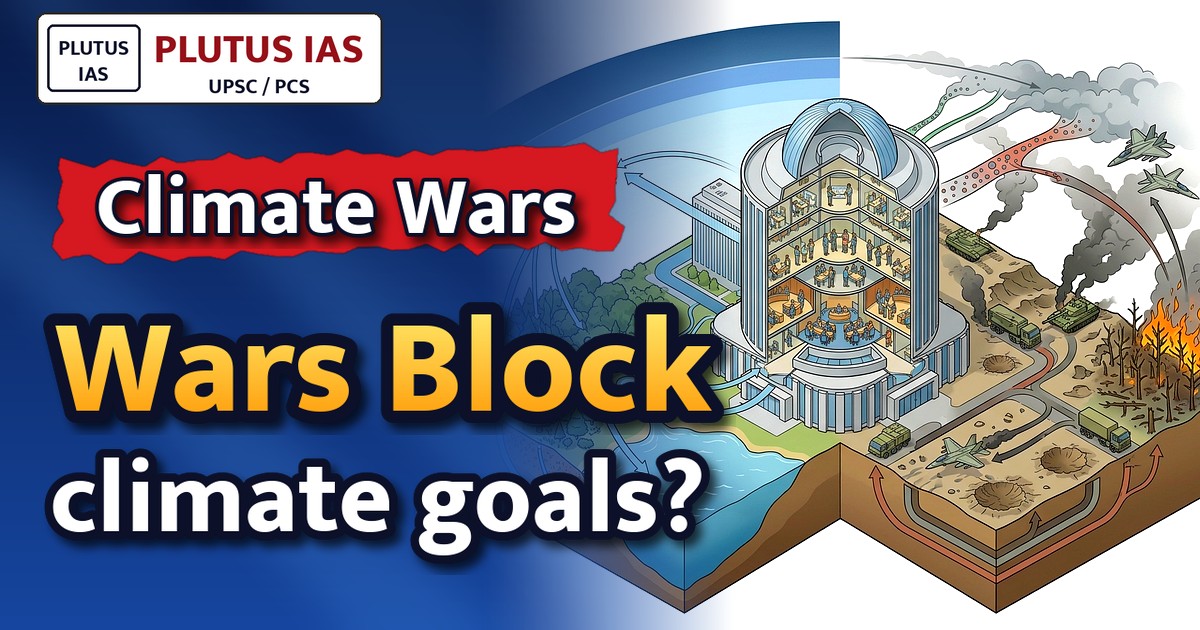
28 Sep UN’s Climate Change Strategy: Wars as Major Obstacles
✎ Military activities contribute to climate change through direct emissions, destruction of carbon sinks, and disruption of environmental governance, yet remain largely unaccounted for in global climate mitigation strategies.
Subject Relevance — Where This Topic Fits
- GS Paper II — International Relations (Role of International Organisations) | GS Paper III — Environment (Climate Change and its Impacts)
- Prelims: Carbon sinks, Greenhouse Gas Emissions Inventory, UNFCCC, Kyoto Protocol, Paris Agreement, Military Carbon Footprint, Conflict-Induced Environmental Degradation, Sustainable Development Goals (SDG 13, SDG 16)
- Essay: The interplay between peace and environmental sustainability: A global imperative, Can climate justice be achieved in a world marred by perpetual conflict?
Quick Revision: Military activities contribute to climate change through direct emissions, destruction of carbon sinks, and disruption of environmental governance, yet remain largely unaccounted for in global climate mitigation strategies.
Why is this in the news?
The 2026 United Nations General Assembly session has underscored the persistent failure of the international community to prevent armed conflicts, which are increasingly recognised as significant contributors to climate change. Wartime activities—including the operation of military machinery, destruction of carbon-rich ecosystems, and logistical operations for arms transport—emit substantial greenhouse gases, thereby exacerbating global warming. This revelation necessitates a re-evaluation of the UN’s conflict resolution mechanisms and their integration with climate mitigation strategies.
Background
- The United Nations was established in 1945 with the primary mandate of maintaining international peace and security, as enshrined in its Charter (Article 1(1)).
- Climate change, recognised as a defining challenge of the 21st century, is governed by the United Nations Framework Convention on Climate Change (UNFCCC, 1992) and the Paris Agreement (2015), which aim to limit global temperature rise to well below 2°C above pre-industrial levels.
- Armed conflicts, particularly those of prolonged duration, result in the destruction of critical carbon sinks such as forests, wetlands, and agricultural lands, thereby reducing the planet’s capacity to sequester carbon dioxide.
- Military activities are exempt from reporting under the Kyoto Protocol’s greenhouse gas emission inventories, a provision that has drawn criticism for underestimating the carbon footprint of warfare.
- The Russia-Ukraine conflict (since 2022) has highlighted the environmental toll of modern warfare, including the burning of fossil fuels for military operations, the destruction of energy infrastructure, and the release of stored carbon from damaged ecosystems.
- The UN Security Council has, on occasion, addressed environmental degradation in conflict zones (e.g., Resolution 2375 on the Democratic People’s Republic of Korea, 2017), but systematic integration of climate and conflict agendas remains limited.
What is the relationship between armed conflict and climate change?
- Armed conflicts are a significant, yet often unaccounted, source of greenhouse gas (GHG) emissions. Military operations—including the deployment of vehicles, aircraft, and naval vessels—consume vast quantities of fossil fuels, emitting CO₂, methane, and nitrous oxides.
- The destruction of infrastructure during warfare, such as power plants, refineries, and industrial facilities, can release stored carbon and other pollutants, further contributing to atmospheric warming.
- Conflict-induced deforestation and land degradation weaken terrestrial carbon sinks. For example, the Amazon rainforest, a critical carbon sink, has faced accelerated deforestation due to illegal logging and land clearing in conflict-affected regions.
- The transport and production of weapons and ammunition involve energy-intensive processes, including mining, manufacturing, and logistics, which generate substantial GHG emissions.
- Fires set during military operations or as a result of conflict (e.g., oil well fires, urban bombardment) release black carbon and other short-lived climate forcers, which have a disproportionate warming effect in the short term.
- Prolonged conflicts disrupt agricultural systems, leading to food insecurity and increased reliance on carbon-intensive food production methods, such as synthetic fertilisers, which further elevate emissions.
- The displacement of populations due to conflict exacerbates environmental pressures in host regions, including increased demand for energy, water, and land resources, often leading to further deforestation and habitat loss.
- International legal frameworks, such as the UNFCCC and the Paris Agreement, do not explicitly address the carbon footprint of military activities, creating a governance gap in climate mitigation efforts.
Key Features
| Feature | Significance |
|---|---|
| Wartime greenhouse-gas emissions | Military operations release substantial CO₂ through fuel consumption, explosions, and infrastructure destruction, exacerbating climate change. |
| Destruction of carbon sinks | Forests, wetlands, and other ecosystems that sequester carbon are degraded or eliminated during conflicts, reducing global carbon absorption capacity. |
| Arms production and transport | The lifecycle of weapons—manufacturing, deployment, and logistics—contributes significantly to emissions, often overlooked in climate accounting. |
| Infrastructure carbon release | Destruction of built environments releases embedded carbon from materials like concrete and steel, amplifying emissions beyond immediate wartime activities. |
| Post-conflict environmental degradation | Ongoing instability prevents restoration of ecosystems, leading to prolonged carbon sink loss and climate vulnerability. |
Why it Matters
Environmental Governance
- Climate change mitigation strategies must integrate conflict prevention as a core component, given the disproportionate emissions from warfare.
- The UN’s inefficacy in conflict resolution directly undermines global climate goals, highlighting a governance gap in international institutions.
- Wartime emissions data is often excluded from national carbon inventories, distorting global climate accountability and policy design.
Strategic Security
- Persistent conflicts divert resources from climate adaptation and mitigation, creating a feedback loop of insecurity and environmental degradation.
- Military carbon footprints challenge the feasibility of achieving net-zero targets, particularly in regions with active or latent conflicts.
- Climate-induced resource scarcity (e.g., water, arable land) may escalate tensions, necessitating preventive diplomacy to avoid climate-security crises.
Economic Implications
- Post-conflict reconstruction imposes economic burdens, diverting funds from sustainable development and climate resilience initiatives.
- Carbon-intensive military-industrial complexes face growing scrutiny, potentially accelerating green transitions in defense sectors.
- Insurance and financial markets are increasingly factoring in climate risks associated with conflict zones, influencing investment decisions.
International Law
- Existing international humanitarian law (e.g., Geneva Conventions) lacks explicit provisions addressing environmental harm during armed conflict, creating legal ambiguities.
- The principle of ‘ecocide’ as a war crime is gaining traction, but lacks universal ratification or enforcement mechanisms.
- Climate reparations from conflict parties remain contentious, with no established framework for accountability or compensation.
Challenges
1. Gaps in Emissions Accounting
- Wartime emissions are excluded from most national greenhouse-gas inventories, leading to underreporting of global carbon outputs.
- Military exemptions in international climate agreements (e.g., Kyoto Protocol) obscure the true scale of conflict-related emissions.
- Data on emissions from arms production, transport, and infrastructure destruction is fragmented and often classified, hindering accurate assessment.
UPSC Link: Environmental Governance/Climate Change
2. Institutional Weakness of the UN
- The UN Security Council’s permanent members’ veto powers paralyze decisive action on conflict prevention, despite climate-security linkages.
- The UN’s inability to enforce ceasefires or disarmament agreements undermines its credibility as a mediator in climate-vulnerable regions.
- Fragmentation between UN bodies (e.g., UNEP, UNDP, UNSC) hampers integrated responses to climate-conflict nexus.
UPSC Link: International Organisations/UN Reforms
3. Legal and Ethical Dilemmas
- The absence of a universally accepted definition of ‘ecocide’ complicates prosecution of environmental crimes during conflicts.
- Balancing state sovereignty with environmental protection in conflict zones remains a contentious issue in international law.
- Ethical questions arise over prioritizing climate action in war-torn regions where humanitarian crises demand immediate attention.
UPSC Link: International Law/Humanitarian Law
4. Resource Allocation Constraints
- Funds earmarked for climate adaptation are often redirected to military expenditures in conflict-prone states, exacerbating environmental vulnerabilities.
- Post-conflict reconstruction prioritizes infrastructure over ecological restoration, leading to long-term environmental degradation.
- Climate finance mechanisms (e.g., Green Climate Fund) face challenges in accessing conflict zones due to security and governance issues.
UPSC Link: Climate Finance/Resource Management
5. Technological and Data Limitations
- Satellite monitoring of conflict zones is often restricted, limiting real-time assessment of environmental damage (e.g., deforestation, oil spills).
- Lack of standardized methodologies for quantifying wartime emissions hinders policy formulation and international cooperation.
- Emerging technologies (e.g., AI, blockchain) for tracking emissions in conflict zones are underutilized due to geopolitical sensitivities.
UPSC Link: Science & Technology/Climate Monitoring
Challenges — UPSC Perspective
| Issue | Concern |
|---|---|
| Exclusion of military emissions from climate agreements | Distorts global carbon accounting and undermines mitigation efforts. |
| UN Security Council veto paralysis | Prevents timely intervention in climate-vulnerable conflict zones. |
| Fragmented UN institutional responses | Leads to overlapping mandates and inefficiencies in addressing climate-security linkages. |
| Lack of ecocide legal framework | Creates impunity for environmental destruction during conflicts. |
| Post-conflict resource misallocation | Prioritizes reconstruction over ecological restoration, deepening environmental crises. |
| Data gaps in wartime emissions tracking | Hinders accurate assessment and policy design for conflict-related climate impacts. |
Way Forward
- Strengthen international climate agreements to include mandatory reporting of military and conflict-related emissions.
- Advocate for the adoption of ‘ecocide’ as a recognized war crime under international law to deter environmental destruction.
- Enhance UN Security Council reforms to reduce veto abuse and enable proactive conflict prevention in climate-vulnerable regions.
- Develop standardized methodologies for quantifying wartime emissions and environmental damage to improve global accountability.
- Integrate climate resilience into post-conflict reconstruction plans, ensuring ecological restoration is prioritized alongside infrastructure.
- Expand satellite and AI-based monitoring of conflict zones to track environmental degradation in real time.
- Establish a dedicated UN fund for climate adaptation in conflict zones, ensuring financial access despite security constraints.
- Promote bilateral and multilateral dialogues to address climate-security linkages, fostering preventive diplomacy.
UPSC Value Addition
Keywords for Mains Answer-Writing
United Nations Security Council reform · climate change and conflict · military emissions · carbon sinks degradation · UNGA 2026 agenda · sustainable peace and climate action · environmental impact of warfare · UN institutional effectiveness · climate security nexus · Paris Agreement and conflict · UN Charter Chapter VII · greenhouse gas emissions from military activities · ecological consequences of war · UN mechanisms for conflict prevention · environmental governance under UN
Concept Flow
Armed conflict → Military operations and infrastructure destruction → Release of CO₂ and destruction of carbon sinks → Accelerated climate change → Conflict-induced environmental degradation → Loss of ecosystem services (e.g., water purification, carbon sequestration) → Increased vulnerability to climate disasters → Post-conflict instability → Delayed ecological restoration → Prolonged carbon sink loss and climate feedback loops → International law gaps → Lack of accountability for ecocide → Persistent environmental harm in conflict zones → UN institutional weaknesses → Inability to prevent conflicts → Escalation of climate-security crises → Resource diversion → Military expenditures over climate adaptation → Deepened environmental and humanitarian crises → Data fragmentation → Underreporting of wartime emissions → Distorted global climate policy
Prelims Practice Questions
Q1. Consider the following statements regarding the environmental impact of military activities:
1. Military operations generate significant greenhouse gas emissions through the use of vehicles, weapons production, and infrastructure destruction.
2. The destruction of carbon sinks such as forests and wetlands during conflicts exacerbates climate change.
3. The United Nations Framework Convention on Climate Change (UNFCCC) explicitly mandates the reporting of military emissions under its reporting guidelines.
How many of the above statements are correct?
- Only one
- Only two
- All three
- None
Answer: Only two — Statement 1 is correct as military activities contribute to emissions through vehicles, weapons, and infrastructure. Statement 2 is correct as destruction of carbon sinks worsens climate change. Statement 3 is incorrect because UNFCCC does not mandate reporting of military emissions under its standard guidelines.
Q2. Assertion (A): The United Nations Security Council has the primary responsibility for maintaining international peace and security under the UN Charter.
Reason (R): The UN Charter grants the Security Council the authority to take enforcement action, including the use of military force, to restore peace and security.
In the context of the above two statements, which of the following is correct?
- Both A and R are true, and R is the correct explanation of A
- Both A and R are true, but R is not the correct explanation of A
- A is true, but R is false
- A is false, but R is true
Answer: Both A and R are true, and R is the correct explanation of A — Assertion (A) is correct as per Article 24 of the UN Charter. Reason (R) is also correct as per Articles 39-42, which empower the Security Council to take enforcement action. R correctly explains A.
Q3. Match the following environmental consequences of warfare with their corresponding mechanisms:
Column I (Consequence)
A. Increased greenhouse gas emissions
B. Degradation of carbon sinks
C. Disruption of ecological services
D. Release of embedded carbon
Column II (Mechanism)
1. Destruction of forests and wetlands
2. Use of military vehicles and weapons production
3. Burning of fossil fuel reserves
4. Collapse of pollination and water regulation services
Select the correct match:
- A-2, B-1, C-4, D-3
- A-1, B-2, C-3, D-4
- A-3, B-4, C-1, D-2
- A-4, B-3, C-2, D-1
Answer: A-2, B-1, C-4, D-3 — A matches with 2 (military vehicles and weapons production), B with 1 (destruction of forests and wetlands), C with 4 (collapse of ecological services), and D with 3 (release of embedded carbon from fossil fuel reserves).
Mains Practice Question
✍ The nexus between armed conflict and climate change represents a critical governance challenge for the international community. Critically examine the mechanisms through which warfare exacerbates climate change and evaluate the adequacy of existing United Nations mechanisms to address this challenge. (15 Marks)
Approach: MODEL-ANSWER SKELETON:
1. **Mechanisms linking warfare and climate change:**
– Direct emissions: Military vehicles, weapons production, transport of arms (reference IPCC reports on military emissions).
– Destruction of carbon sinks: Forests, wetlands, and other ecosystems damaged or destroyed during conflicts (cite examples from Ukraine, Syria).
– Release of embedded carbon: Burning of fossil fuel reserves, infrastructure destruction (e.g., oil fields, pipelines).
– Disruption of ecological services: Loss of pollination, water regulation, and soil fertility.
2. **Existing UN mechanisms and their limitations:**
– UN Charter Chapter VII: Empowers Security Council to take enforcement action but lacks explicit climate mandate.
– UNFCCC: Does not mandate reporting of military emissions; weak enforcement.
– UNGA resolutions on climate security: Non-binding; limited implementation.
– UNEP Post-Conflict Environmental Assessment: Reactive, not preventive.
3. **Gaps in governance:**
– Lack of binding international agreements on military emissions.
– Inadequate integration of climate security into UN peacekeeping mandates.
– Limited data on military emissions due to confidentiality concerns.
4. **Proposals for reform:**
– Expand UNFCCC reporting to include military emissions (reference 2022 Glasgow Climate Pact).
– Strengthen UNEP’s role in conflict prevention and environmental protection.
– Integrate climate risk assessments into UN peacekeeping operations.
5. **Conclusion:**
– Warfare is a significant yet under-addressed driver of climate change.
– UN mechanisms require reform to incorporate climate security as a core objective, balancing sovereignty concerns with global environmental governance.
Source: Hindustan Times
Generated by AanyaAi for educational purpose.
Related guides on our sites
- Current affairs for upsc 2026
- Best PSIR optional coaching for upsc
- Best PSIR optional teacher for upsc
- Best teacher of PSIR optional for upsc

- UN’s Climate Change Strategy: Wars as Major Obstacles - September 28, 2026
- भारत में उच्च शिक्षा संकाय भर्ती एवं प्रशिक्षण: एआई युग की चुनौती - September 28, 2026
- Piyush’s Mumbai Slum Inspired Tech Wins UN Recognition for UPSC Aspirants - September 28, 2026

No Comments