


27 Jul Supreme Court Orders Independent Auditor in Ram Temple Donation Probe
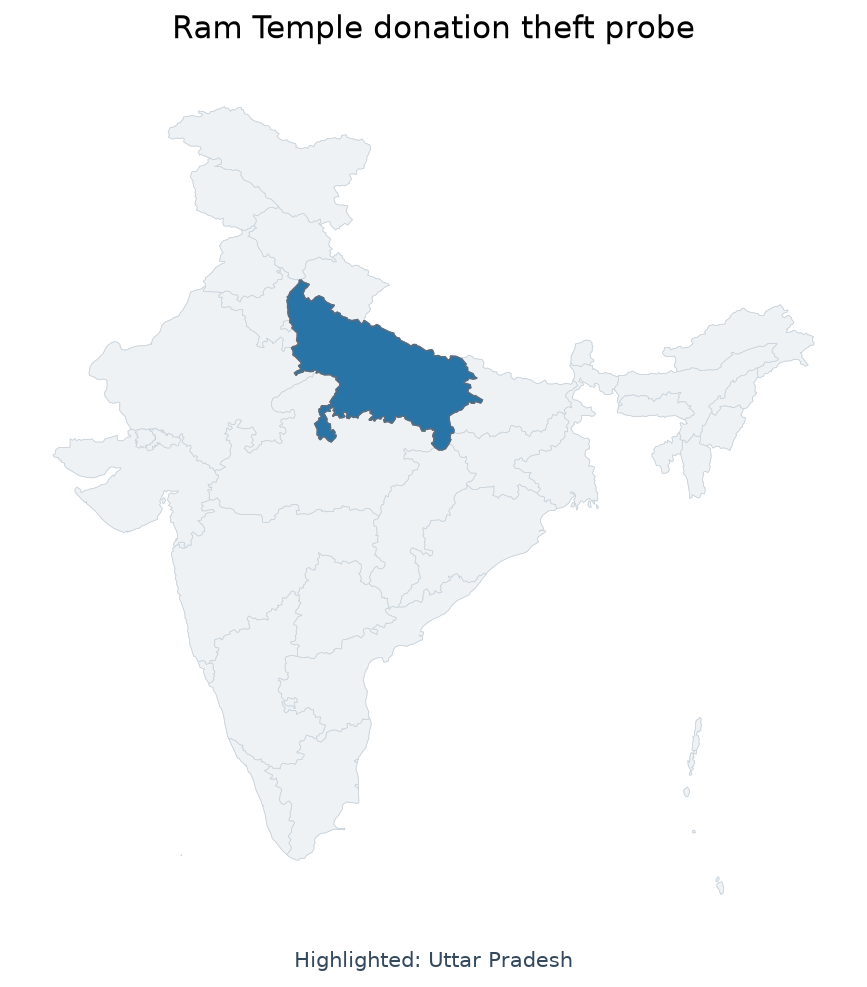
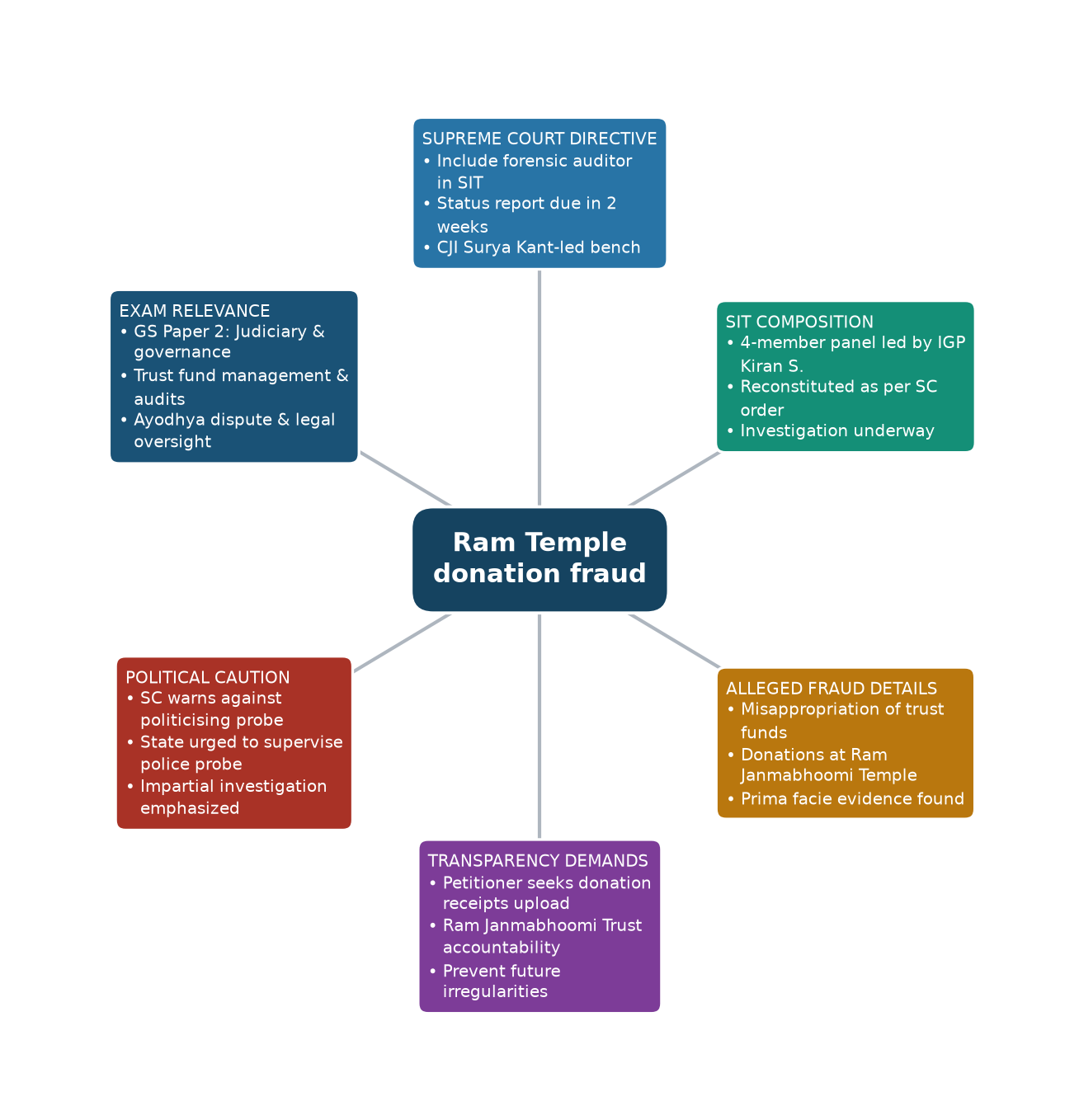
Map & concept mind-map: Ram Temple donation theft probe
Subject Relevance — Where This Topic Fits
- GS Paper II — Governance, Transparency and Accountability | GS Paper III — Economic Offences and Fraud Detection
- Prelims: Special Investigation Team (SIT), forensic audit, Shri Ram Janmabhoomi Teerth Kshetra Trust, Ayodhya dispute, financial embezzlement, trust funds, Uttar Pradesh Police, CJI-led Bench, status report, prima facie evidence
- Essay: Ethical Governance and the Role of Independent Oversight in Public Institutions, Balancing Religious Sentiment and Financial Accountability in Trust Management
Quick Revision: The Supreme Court’s directive to include an independent forensic auditor in the SIT probing financial irregularities in the Shri Ram Janmabhoomi Temple donations exemplifies the judiciary’s commitment to ensuring transparency and accountability in the management of trust funds, particularly in institutions of public and religious significance.
Why is this in the news?
The Supreme Court of India, on 27 July 2026, directed the Uttar Pradesh government to include an independent forensic auditor in the reconstituted Special Investigation Team (SIT) probing alleged financial irregularities involving donations to the Shri Ram Janmabhoomi Temple in Ayodhya. The Bench, led by Chief Justice of India Surya Kant, emphasised the need for a ‘qualitative and impartial’ investigation and directed the SIT to submit a status report within two weeks. The directive follows petitions seeking transparency in the management of temple funds and underscores the judiciary’s role in ensuring accountability in religious and public institutions.
Background
- The Shri Ram Janmabhoomi Teerth Kshetra Trust was established in 2019 to manage the financial and administrative affairs of the Ram Janmabhoomi Temple in Ayodhya, following the Supreme Court’s 2019 verdict in the Ayodhya dispute case.
- Allegations of financial misappropriation and embezzlement of temple donations emerged in early 2026, prompting public and legal scrutiny over the trust’s financial transparency.
- The Uttar Pradesh government constituted a four-member SIT in May 2026, headed by Inspector General of Police (IGP) Kiran S., to investigate the alleged fraud, following initial prima facie evidence of irregularities.
- The Supreme Court had earlier cautioned against politicising the investigation and suggested that the original SIT, which had uncovered evidence, could supervise the probe to maintain continuity.
- The petitioner in the case argued for the mandatory publication of donation receipts by the trust to ensure transparency and public accountability in the management of temple funds.
What is the Shri Ram Janmabhoomi Teerth Kshetra Trust and the Alleged Financial Irregularities?
- The Shri Ram Janmabhoomi Teerth Kshetra Trust was established to manage the financial and administrative affairs of the Ram Janmabhoomi Temple in Ayodhya.
- The trust is responsible for the receipt, utilisation, and audit of donations received for the construction and maintenance of the temple, as well as other associated activities.
- Allegations of financial irregularities surfaced in early 2026, with reports suggesting misappropriation of temple donations, including discrepancies in receipts, unauthorised withdrawals, and lack of transparency in fund utilisation.
- The Uttar Pradesh Police, acting on a complaint, initiated an investigation and later constituted an SIT to probe the matter, following the Supreme Court’s directions for an impartial probe.
- The Supreme Court’s directive for the inclusion of an independent forensic auditor in the SIT underscores the need for specialised expertise in detecting financial fraud and ensuring the integrity of the investigation.
- Forensic auditing involves the application of accounting and investigative techniques to detect financial irregularities, fraud, and misappropriation, often used in cases involving trust funds, corporate fraud, or public sector embezzlement.
- The case highlights broader issues of governance in religious institutions, where public funds and donations are managed, and the role of judicial oversight in ensuring accountability.
Key Features
| Feature | Significance |
|---|---|
| Constitution of SIT with forensic auditor | Ensures impartial forensic examination of alleged financial irregularities, addressing concerns of trust and credibility in the investigation. |
| Inclusion of independent chartered accountant | Provides specialised expertise in forensic auditing to detect misappropriation, embezzlement, or financial fraud in trust funds. |
| Status report directive within two weeks | Accelerates judicial oversight, ensuring timely progress and accountability in the investigation. |
| Supervision by experienced officials | Leverages prior prima facie evidence and institutional knowledge to guide the probe effectively. |
| Transparency in donation receipts | Mandates public disclosure of receipts to prevent opacity and restore public confidence in trust management. |
Why it Matters
Judicial Oversight and Accountability
- The Supreme Court’s intervention underscores the judiciary’s role in ensuring impartiality and adherence to constitutional principles in financial investigations involving religious trusts.
- The directive to include a forensic auditor reflects judicial recognition of the complexity of financial fraud in large-scale public donations.
- The emphasis on avoiding politicisation aligns with the principle of fair investigation, as enshrined in Article 21 (Right to Fair Trial) and Article 14 (Right to Equality).
Trust Governance and Transparency
- The case highlights the need for robust governance frameworks in religious trusts to prevent mismanagement of public funds, particularly in institutions of significant socio-religious importance.
- Transparency in donation receipts addresses concerns of public trust and accountability, reinforcing the fiduciary duty of trustees.
- The involvement of an independent auditor sets a precedent for third-party scrutiny in managing large-scale donations.
Legal and Institutional Safeguards
- The reconstitution of the SIT with forensic expertise demonstrates the state’s commitment to addressing financial irregularities through institutional mechanisms.
- The directive to submit a status report within two weeks ensures dynamic judicial monitoring, reducing delays in justice delivery.
- The inclusion of senior police officials with prior experience in the matter enhances the efficiency of the investigation.
Challenges
1. Ensuring Impartiality in Investigations
- Risk of external pressures influencing the probe, given the socio-political sensitivity of the Ram Janmabhoomi Trust.
- Need to balance speed with thoroughness to avoid premature conclusions or prolonged delays.
- Maintaining public trust while ensuring confidentiality to protect ongoing investigations.
UPSC Link: GS2: Judiciary, GS4: Probity in Governance
2. Complexity of Forensic Auditing
- Detecting sophisticated financial fraud in large-scale donation systems requires specialised expertise.
- Ensuring the independence of the forensic auditor from institutional biases or conflicts of interest.
- Coordinating between legal, financial, and investigative teams to gather and analyse evidence effectively.
UPSC Link: GS3: Economic Offences, GS4: Ethics in Governance
3. Transparency vs. Privacy in Trust Management
- Balancing the public’s right to information with the need to protect sensitive financial data.
- Ensuring that transparency measures do not undermine the operational efficiency of the trust.
- Addressing concerns of donors who may prefer anonymity while demanding accountability.
UPSC Link: GS2: Fundamental Rights, GS4: Transparency
Challenges — UPSC Perspective
| Issue | Concern |
|---|---|
| Politicisation of probe | Risk of interference by political entities, undermining the impartiality of the investigation. |
| Forensic auditing delays | Specialised audits may extend timelines, delaying justice and public disclosure. |
| Public trust erosion | Lack of transparency or perceived mishandling of funds could erode confidence in religious institutions. |
| Data privacy conflicts | Balancing transparency with donor privacy and trust confidentiality requirements. |
| Institutional resistance | Potential reluctance of trust officials to cooperate with external audits or investigations. |
Way Forward
- Constitute the SIT with the independent forensic auditor without further delay to expedite the probe.
- Ensure the SIT submits the status report within the stipulated two-week period to maintain judicial oversight.
- Mandate the Shri Ram Janmabhoomi Teerth Kshetra Trust to upload donation receipts on a public portal within a defined timeframe.
- Institute periodic third-party audits of the trust’s financial transactions to prevent future irregularities.
- Strengthen legal frameworks governing the management of religious trusts to include mandatory forensic audits for large-scale donations.
- Conduct awareness campaigns to educate donors about their rights to transparency and accountability in trust management.
- Establish a grievance redressal mechanism for donors to report irregularities or seek information about their contributions.
UPSC Value Addition
Keywords for Mains Answer-Writing
Special Investigation Team (SIT) · Ram Janmabhoomi Temple Trust · forensic audit · financial irregularities in religious trusts · Ayodhya dispute · transparency in temple administration · Uttar Pradesh government · Supreme Court directives on probe · trust fund misappropriation · constitutional governance of religious institutions · judicial oversight of executive actions · public trust and accountability
Constitutional & Policy Linkages
- Article 25: Freedom of Religion (management of religious institutions)
- Article 26: Freedom to manage religious affairs (fiduciary duties of trustees)
- Article 14: Right to Equality (ensuring fair investigation)
- Article 21: Right to Fair Trial (judicial oversight of investigations)
Concept Flow
Allegations of financial irregularities in donations to Shri Ram Janmabhoomi Temple → Petitions seeking independent probe into mismanagement of trust funds → Supreme Court directs reconstitution of SIT with forensic auditor → SIT initiates forensic auditing and investigation into alleged embezzlement → Judicial monitoring via status reports to ensure timely progress → Mandate for transparency in donation receipts to restore public trust → Potential legal and institutional reforms in trust governance
Prelims Practice Questions
Q1. Which of the following is NOT a power of the Supreme Court of India as per the Constitution?
- A. To issue writs for the enforcement of Fundamental Rights
- B. To transfer judges of High Courts
- C. To constitute Special Investigation Teams (SITs) suo motu
- D. To appoint the Chief Election Commissioner
Answer: D. To appoint the Chief Election Commissioner — The Supreme Court can issue writs (A), transfer High Court judges (B), and direct the constitution of SITs (as seen in the Ayodhya case), but it does not appoint the Chief Election Commissioner; this is done by the President of India.
Q2. Under which constitutional provision can the Supreme Court direct the inclusion of an independent auditor in a state-constituted SIT?
- A. Article 142
- B. Article 32
- C. Article 136
- D. Article 226
Answer: A. Article 142 — Article 142 empowers the Supreme Court to pass any order necessary for doing complete justice in any cause or matter pending before it, including directing the inclusion of an independent auditor in an SIT.
Q3. The Shri Ram Janmabhoomi Teerth Kshetra Trust is governed under which of the following legal frameworks?
- A. The Religious Institutions (Management) Act, 1988
- B. The Trusts Act, 1882
- C. The Charitable and Religious Trusts Act, 1920
- D. The Hindu Religious and Charitable Endowments Act, 1951
Answer: B. The Trusts Act, 1882 — The Shri Ram Janmabhoomi Teerth Kshetra Trust is governed by the Indian Trusts Act, 1882, as it is a public trust established for religious purposes.
Mains Practice Question
✍ Examine the constitutional and administrative significance of the Supreme Court’s directive to include an independent forensic auditor in the Special Investigation Team (SIT) probing alleged financial irregularities in the Shri Ram Janmabhoomi Teerth Kshetra Trust. How does this directive reinforce the principles of transparency, accountability, and judicial oversight in the governance of religious institutions in India?
Approach: The answer must analyse the constitutional basis for the Supreme Court’s intervention (Article 142 and judicial review), the role of forensic audits in ensuring financial probity, and the broader implications for transparency in religious trusts. Discuss the balance between religious autonomy and state oversight, citing relevant case laws such as *Common Cause v. Union of India* (2018) on judicial activism in trust governance. Highlight the need for preventive mechanisms to curb mismanagement in public trusts, linking it to the *Comptroller and Auditor General of India’s* role in auditing public funds.
Source: The Hindu
Generated by AanyaAi for educational purpose.

- AI एजेंटों की स्वतंत्रता: कंपनियां कैसे रखती हैं नियंत्रण? जानिए पूरी प्रक्रिया - October 3, 2026
- Harivansh Leads India at 153rd IPU Assembly in Tanzania - October 3, 2026
- अमेरिका में व्यापार मिशन: भारत की बड़ी योजना, जानिए क्या है सरकार की रणनीति - October 3, 2026

No Comments