


11 Aug Supreme Court Questions EC on Delayed Voter List Appeals in Bengal
✎ Special Intensive Revision (SIR) is a statutory process under the Representation of the People Act, 1950, for updating electoral rolls; appellate tribunals must ensure timely disposal of appeals to prevent disenfranchisement.
Subject Relevance — Where This Topic Fits
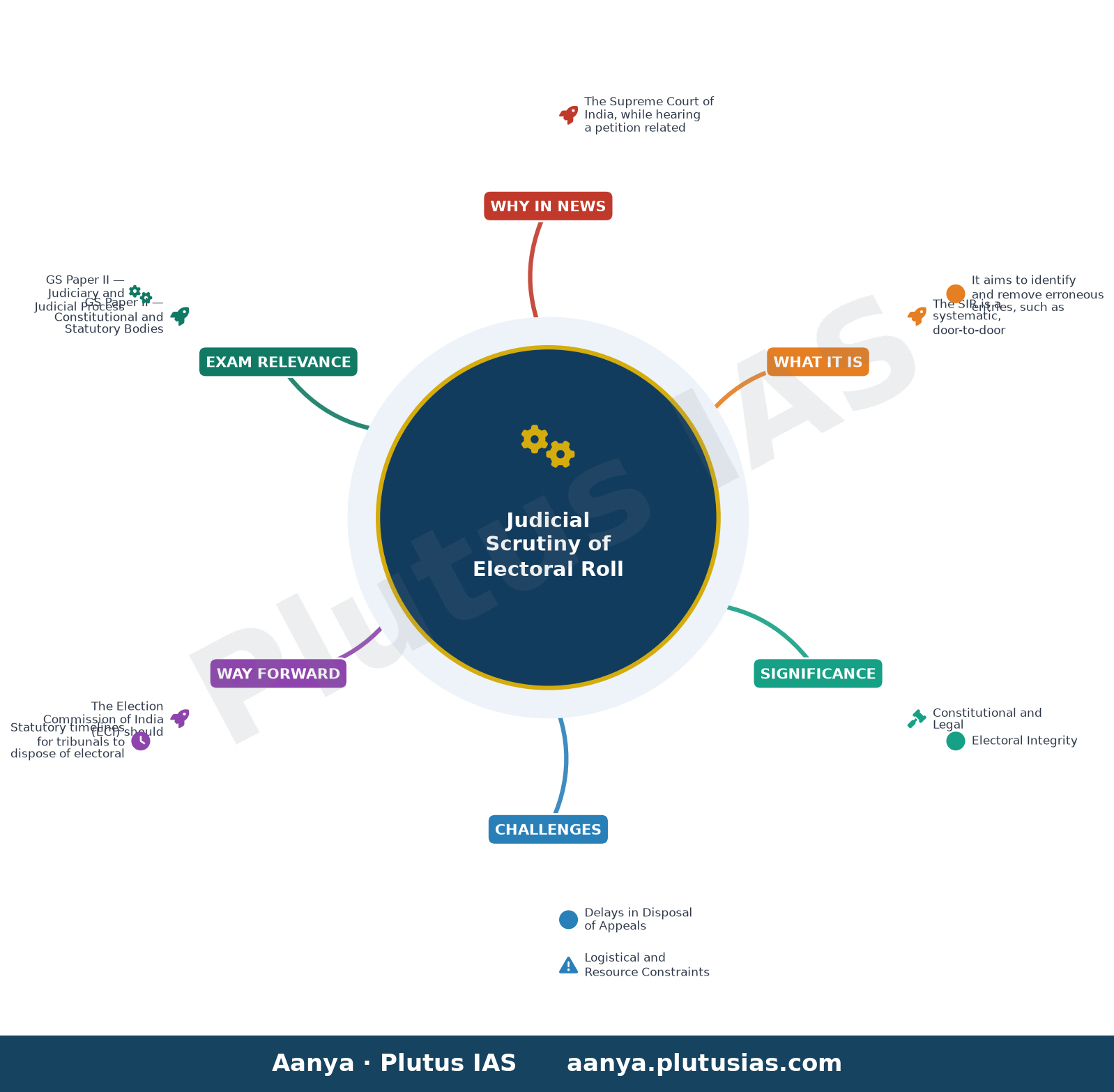
- GS Paper II — Constitutional and Statutory Bodies (Election Commission of India) | GS Paper II — Judiciary and Judicial Process | GS Paper III — Electoral Reforms and Governance
- Prelims: Special Intensive Revision (SIR), Electoral Roll, Appealate Electoral Tribunal, Election Commission of India (ECI), Voter Verification, Draft Electoral Roll, Disposal Rate of Appeals
- Essay: Electoral Integrity and Democratic Accountability, Role of Judiciary in Safeguarding Constitutional Rights
Quick Revision: Special Intensive Revision (SIR) is a statutory process under the Representation of the People Act, 1950, for updating electoral rolls; appellate tribunals must ensure timely disposal of appeals to prevent disenfranchisement.
Why is this in the news?
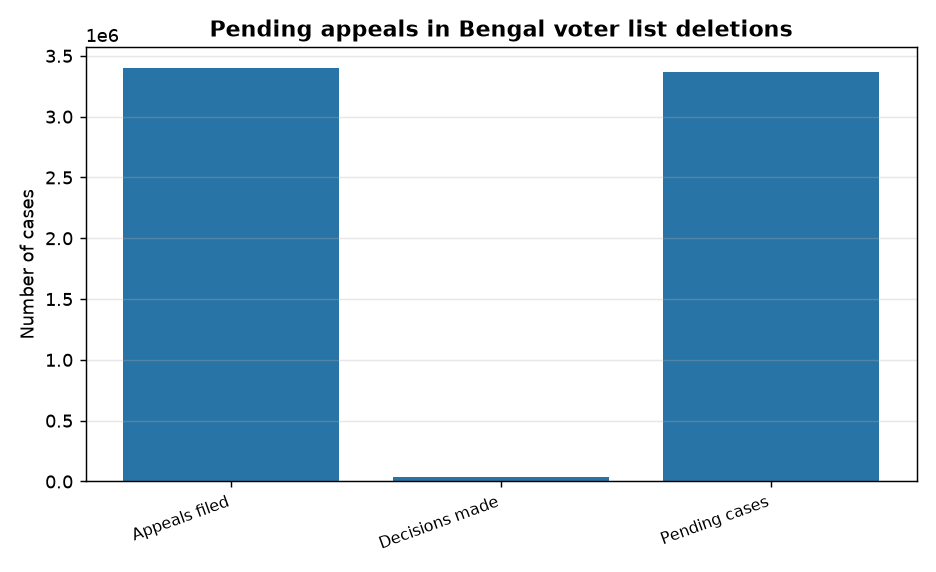
The Supreme Court of India, while hearing a petition related to the deletion of voter names during the Special Intensive Revision (SIR) process in West Bengal, sought detailed information from the Election Commission of India (ECI) regarding the pendency and disposal rate of appeals filed against such deletions. The Court expressed concern over the slow pace of adjudication by appellate tribunals, noting that delays could undermine electoral fairness and access to civic rights, including welfare benefits.
Background
- The Election Commission of India (ECI) conducts periodic revisions of electoral rolls to ensure accuracy, including the Special Intensive Revision (SIR) process, which involves intensive door-to-door verification of voters.
- In West Bengal, the SIR process led to the deletion of over 58.20 lakh names from the draft electoral roll, representing approximately 7.6% of the total electorate.
- Of the deleted names, 24.17 lakh were attributed to deceased individuals, 1.38 lakh to duplicate or fake entries, and 32.65 lakh to shifts, absences, or other administrative reasons.
- The SIR process is conducted in phases across states, with West Bengal being part of the second phase alongside Uttar Pradesh, Gujarat, Madhya Pradesh, Rajasthan, and others.
- Appeals against deletions are heard by designated appellate tribunals, which are quasi-judicial bodies tasked with resolving disputes related to electoral rolls.
What is the Special Intensive Revision (SIR) of Electoral Rolls?
- The SIR is a systematic, door-to-door verification process conducted by the Election Commission of India (ECI) to update and purify electoral rolls before elections.
- It aims to identify and remove erroneous entries, such as deceased individuals, duplicates, or fake registrations, while ensuring genuine electors are not disenfranchised.
- The process involves multiple phases: preliminary scrutiny, public display of draft rolls, and disposal of objections and claims.
- SIR is conducted under the provisions of the Representation of the People Act, 1950, which mandate the ECI to maintain accurate and updated electoral rolls.
- The ECI has implemented SIR in phases across states and Union Territories to ensure comprehensive coverage and systematic correction of electoral rolls.
- Appeals against deletions or objections in the SIR process are adjudicated by designated appellate tribunals, which function as quasi-judicial bodies.
- The tribunals are expected to adhere to principles of natural justice, ensuring fair hearings and timely disposal of cases to prevent disenfranchisement.
- The Supreme Court’s recent directions highlight the need for transparency and efficiency in the functioning of these tribunals to safeguard democratic rights.
Key Features
| Feature | Significance |
|---|---|
| Special Intensive Revision (SIR) | Systematic updation of electoral rolls to ensure accuracy by removing duplicates, deceased voters, and ineligible entries. |
| Appeal Tribunals | Quasi-judicial bodies constituted under the Representation of the People Act, 1951, to adjudicate disputes over voter list deletions. |
| Draft Electoral Roll | Preliminary voter list published during SIR to invite objections and corrections before finalization. |
| Disposal Rate of Appeals | Proportion of pending appeals resolved by tribunals, critical for timely redressal of electoral grievances. |
| Electoral Roll Integrity | Maintaining an accurate and updated voter list to uphold the principle of ‘one person, one vote’ in democratic elections. |
Why it Matters
Constitutional and Legal
- The Representation of the People Act, 1951, mandates the Election Commission of India (ECI) to prepare and periodically revise electoral rolls to ensure inclusivity and accuracy.
- Article 324 of the Constitution vests the ECI with the superintendence, direction, and control of elections, including the preparation of electoral rolls.
- Appeal Tribunals function as a check against arbitrary deletions, ensuring due process and judicial oversight in electoral matters.
Electoral Integrity
- SIR processes are essential for eliminating errors, duplicates, and ineligible entries, thereby preventing electoral fraud and ensuring fair representation.
- Timely disposal of appeals by tribunals safeguards the voting rights of citizens whose names are erroneously deleted from the voter list.
- A transparent and efficient electoral roll revision process strengthens public trust in the electoral system.
Administrative Efficiency
- The ECI’s phased implementation of SIR across states ensures systematic and resource-efficient updation of electoral rolls.
- Data-driven decision-making, including the identification of deceased voters and duplicates, enhances the accuracy of electoral rolls.
- Monitoring the disposal rate of appeals helps identify bottlenecks in the judicial process and enables targeted interventions.
Challenges
1. Delays in Disposal of Appeals
- Large backlog of pending appeals (e.g., ~34 lakh in West Bengal) leads to prolonged disenfranchisement of voters.
- Prolonged litigation affects citizens’ access to welfare schemes and other entitlements tied to voter identity.
- Judicial delays undermine the efficacy of appeal tribunals as quasi-judicial bodies.
UPSC Link: GS-II: Electoral Reforms
2. Logistical and Resource Constraints
- Inadequate infrastructure or manpower in tribunals may hinder timely disposal of appeals.
- Geographical disparities in tribunal coverage can exacerbate delays in remote or densely populated regions.
- Limited digital integration in tribunals may slow down case management and monitoring.
UPSC Link: GS-II: Governance Challenges
3. Accuracy of Draft Electoral Rolls
- Erroneous deletions (e.g., 32.65 lakh cases in West Bengal attributed to ‘shifted, missing, or other’ reasons) raise concerns about procedural fairness.
- Inadequate public awareness or outreach during SIR may lead to unintended disenfranchisement.
- Lack of standardized criteria for categorizing deletions (e.g., ‘shifted’ vs. ‘missing’) can create ambiguity.
UPSC Link: GS-II: Electoral Reforms
4. Judicial Oversight and Accountability
- Absence of statutory timelines for tribunals to dispose of appeals complicates judicial accountability.
- Inconsistent disposal rates across states highlight the need for uniform standards and monitoring mechanisms.
- Overburdened tribunals may prioritize quantity over quality, risking miscarriage of justice.
UPSC Link: GS-II: Judiciary and Governance
5. Public Trust and Participation
- Perceived or actual delays in redressal erode public confidence in the electoral process.
- Citizens may hesitate to participate in future electoral rolls revision processes due to negative experiences.
- Media scrutiny and judicial interventions (e.g., Supreme Court’s suo motu cognizance) can amplify trust deficits.
UPSC Link: GS-II: Electoral Participation
Challenges — UPSC Perspective
| Issue | Concern |
|---|---|
| Pending Appeals Backlog | Prolonged disenfranchisement of voters due to unresolved disputes over deletions. |
| Inconsistent Disposal Rates | Variations in tribunal efficiency across states lead to unequal access to justice. |
| Procedural Ambiguities | Lack of clear guidelines for categorizing deletions (e.g., ‘shifted’ vs. ‘missing’) may result in errors. |
| Resource Constraints | Inadequate infrastructure or manpower in tribunals hampers timely disposal of appeals. |
| Public Awareness Gaps | Insufficient outreach during SIR may lead to unintended disenfranchisement. |
| Judicial Accountability | Absence of statutory timelines for tribunals complicates oversight and performance evaluation. |
Way Forward
- The Election Commission of India (ECI) should collaborate with state governments to augment tribunal infrastructure and manpower, particularly in states with high pendency.
- Statutory timelines for tribunals to dispose of electoral appeal cases should be prescribed, ensuring uniformity and accountability.
- Standardized criteria for categorizing deletions in SIR (e.g., ‘shifted,’ ‘missing,’ or ‘other’) should be formulated to minimize procedural ambiguities.
- Digital integration of tribunals, including case management systems and real-time monitoring dashboards, should be prioritized to streamline processes.
- Public awareness campaigns should be intensified during SIR phases to educate citizens about the revision process and their rights to appeal.
- Periodic audits of tribunal performance, including disposal rates and pendency, should be conducted to identify and address bottlenecks.
- The ECI should explore alternative dispute resolution mechanisms, such as mediation or conciliation, for low-complexity cases to expedite redressal.
- Judicial capacity-building programs should be organized for tribunal members to enhance efficiency and consistency in decision-making.
UPSC Value Addition
Keywords for Mains Answer-Writing
Special Intensive Revision (SIR) · Election Commission of India · Electoral Rolls · Voter List Corrections · Appellate Tribunal for Disputes · Disposal Rate of Appeals · Constitutional Provisions on Elections · Supreme Court of India · Voter Deletion Mechanism · Electoral Justice Delivery System · Article 324 of the Constitution · Model Code of Conduct · Electoral Reforms · Voter Verification Process
Constitutional & Policy Linkages
- Article 324: Superintendence, direction, and control of elections by the Election Commission of India.
- Article 325: Prohibition of discrimination in electoral rolls on grounds of religion, race, caste, or sex.
- Article 326: Adult suffrage as the basis for elections to the House of the People and State Legislative Assemblies.
Concept Flow
Special Intensive Revision (SIR) → Publication of Draft Electoral Roll → Public Objections and Corrections → Finalization of Electoral Roll → Deletions of Ineligible/Erroneous Entries → Appeals to Tribunals → Disposal of Appeals → Redressal of Grievances → Restoration of Voting Rights.
Prelims Practice Questions
Q1. Consider the following statements regarding the Special Intensive Revision (SIR) of electoral rolls in India:
1. SIR is conducted in three phases across different states and Union Territories.
2. The process involves deletion of names of deceased, duplicate, or shifted voters.
3. Appeals against deletions are heard by the Appellate Tribunal for Disputes.
4. The Election Commission of India (ECI) has the power to directly order deletions without any appeal mechanism.
How many of the above statements are correct?
- Only one
- Only two
- Only three
- All four
Answer: Only three — Statements 1, 2, and 3 are correct. Statement 4 is incorrect as deletions under SIR are subject to appeal before the Appellate Tribunal for Disputes, as mandated by the Election Commission of India.
Q2. Assertion (A): The Appellate Tribunal for Disputes under the Election Commission of India is empowered to adjudicate appeals against deletions in the electoral rolls.
Reason (R): The Election Commission of India derives its powers from Article 324 of the Constitution of India, which vests it with the authority to superintend, direct, and control the preparation of electoral rolls and the conduct of elections.
Options:
A. Both A and R are true, and R is the correct explanation of A.
B. Both A and R are true, but R is NOT the correct explanation of A.
C. A is true, but R is false.
D. A is false, but R is true.
Answer: ? — Both Assertion (A) and Reason (R) are true. The Appellate Tribunal for Disputes is indeed empowered to hear appeals against deletions in electoral rolls, and the Election Commission of India derives its authority from Article 324 of the Constitution, which grants it supervisory powers over electoral processes.
Mains Practice Question
✍ The Special Intensive Revision (SIR) of electoral rolls is a critical process in maintaining the integrity of the electoral rolls in India. However, recent judicial observations highlight delays in the disposal of appeals by Appellate Tribunals, raising concerns about electoral justice delivery. Critically examine the constitutional and institutional framework governing the SIR process, the role of Appellate Tribunals, and the implications of delayed disposal of appeals. Also, suggest measures to enhance the efficiency of the electoral justice system. (15 Marks)
Approach: MODEL-ANSWER SKELETON:
1. **Constitutional and Legal Framework**:
– Article 324 of the Constitution: Role of the Election Commission of India (ECI) in superintending, directing, and controlling elections.
– Representation of the People Act, 1950 and 1951: Provisions governing electoral rolls and corrections.
– Conduct of Election Rules, 1961: Rules governing the preparation and revision of electoral rolls.
– Model Code of Conduct (MCC): Ensures fairness during the revision process.
2. **Special Intensive Revision (SIR) Process**:
– Definition and purpose: Systematic revision of electoral rolls to remove errors, duplicates, deceased voters, and shifted voters.
– Phases of SIR: Three phases implemented across states/UTs (e.g., West Bengal in Phase II).
– Data on deletions: Example of West Bengal (58.20 lakh deletions, including 24.17 lakh deceased voters).
3. **Appellate Tribunals for Disputes**:
– Role: Adjudicate appeals against deletions in electoral rolls.
– Constitutional basis: Implied under Article 324 and statutory framework.
– Challenges: Delayed disposal of appeals (e.g., 34 lakh pending appeals in West Bengal).
– Impact: Denial of rights (e.g., access to rations due to unresolved voter status).
4. **Judicial Observations and Concerns**:
– Supreme Court’s directive: Seek details on disposal rates, pending appeals, and institutional bottlenecks.
– Observation: ‘If this pace continues, the next election will arrive before appeals are resolved.’
– Concerns: Violation of electoral justice, disenfranchisement, and erosion of public trust.
5. **Measures to Enhance Efficiency**:
– **Institutional Reforms**:
– Increase the number of Appellate Tribunals and benches.
– Set time-bound disposal targets for appeals (e.g., 90 days).
– Digitalization of records and online filing of appeals.
– **Process Reforms**:
– Simplify the appeal process and reduce bureaucratic hurdles.
– Conduct awareness campaigns to educate voters about the appeal mechanism.
– **Judicial Reforms**:
– Fast-track courts for electoral disputes.
– Strengthen the monitoring role of the ECI and High Courts.
6. **Conclusion**:
– Balance between efficiency and fairness in electoral justice.
– Upholding the democratic principle of ‘universal adult franchise’ by ensuring timely resolution of disputes.
Source: bhaskar.com
Generated by AanyaAi for educational purpose.

- Rajasthan Panchayati Raj Elections: New Rules, Fines & Disqualification - September 28, 2026
- सेना प्रमुख का बड़ा बयान: जीत जमीन से ही तय होती है, तकनीक नहीं बदल सकती युद्ध की प्रकृति - September 28, 2026
- UPSC Alert: Government Cracks Down on Patwaris for SVAMITVA Scheme Refusals - September 28, 2026

No Comments