


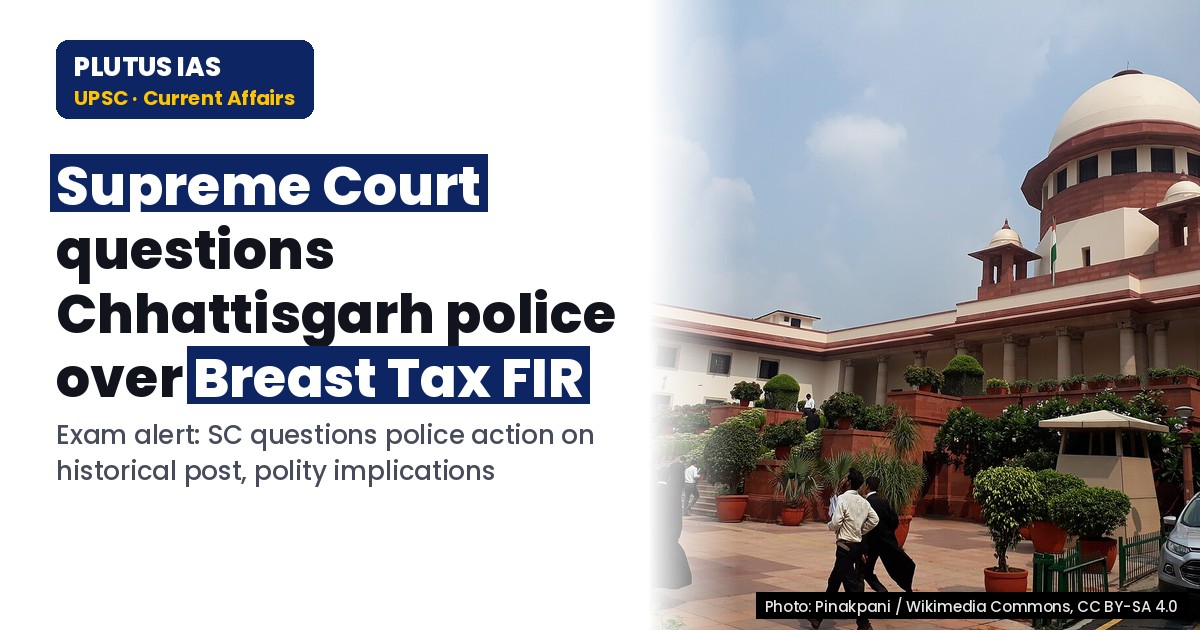
26 Oct Supreme Court Questions FIR on Breast Tax Facebook Post: Polity Analysis
✎ The Supreme Court’s questioning of an FIR over a historical social media post reaffirms that freedom of expression under Article 19(1)(a) is not absolute but must be balanced against reasonable restrictions under Article 19(2)…
Subject Relevance — Where This Topic Fits
- GS Paper II — Fundamental Rights and DPSP | GS Paper III — Role of Police and Law and Order
- Prelims: Freedom of Speech and Expression (Article 19(1)(a)), Reasonable Restrictions (Article 19(2)), Indian Penal Code (IPC) Sections 295A, 153A, 505, Indian Justice Code (IJC) Sections 299, 353(2), Supreme Court’s role in judicial review of police actions
- Essay: Balancing freedom of expression with social harmony, Judicial activism and its limits in curbing misuse of legal provisions
Quick Revision: The Supreme Court’s questioning of an FIR over a historical social media post reaffirms that freedom of expression under Article 19(1)(a) is not absolute but must be balanced against reasonable restrictions under Article 19(2), and police actions must align with constitutional principles.
Why is this in the news?
The Supreme Court of India, while hearing an anticipatory bail plea by social activist Rupanarayan Ekka in a case registered under the Bharatiya Nyaya Sanhita (BNS) for a Facebook post referencing the historical ‘Breast Tax’, raised critical questions about the necessity of registering FIRs in cases involving historical or academic discourse. The bench comprising Justices B.V. Nagarathna and R. Mahadevan observed that police resources should prioritise investigation of grave offences rather than trivial or contentious social media posts, highlighting the tension between free speech and potential misuse of penal provisions.
Background
- The ‘Breast Tax’ refers to a historical levy imposed during the medieval period in certain regions of India, particularly in parts of present-day Chhattisgarh, on women for covering their breasts, symbolising patriarchal and regressive social norms.
- The term gained renewed attention in April 2025 when a Facebook post by Rupanarayan Ekka claimed that the tax was imposed by a Brahmin official rather than Mughal emperor Aurangzeb, sparking a debate on historical accuracy and social sensitivity.
- The post led to a complaint by the president of a Brahmin association, alleging that the statement hurt religious sentiments and incited communal disharmony, prompting the registration of an FIR under Bharatiya Nyaya Sanhita (BNS) Sections 299 (malicious acts intended to outrage religious feelings) and 353(2) (spreading false information to promote enmity between groups).
- The Chhattisgarh High Court denied anticipatory bail to Ekka, leading to his appeal in the Supreme Court, which questioned the necessity of the FIR and the appropriateness of police action in such cases.
- The case underscores the broader challenge of balancing freedom of expression with the protection of social harmony, particularly in the context of historical narratives and digital communication.
What are the legal and constitutional dimensions of this case?
- **Freedom of Speech and Expression (Article 19(1)(a))**: The Supreme Court’s intervention highlights the constitutional protection accorded to speech, including historical or academic discourse, subject to reasonable restrictions under Article 19(2).
- **Reasonable Restrictions**: The state may impose restrictions on speech to maintain public order, morality, or to prevent defamation or incitement to an offence, but such restrictions must be narrowly tailored and proportionate.
- **Police Discretion and FIR Registration**: The case raises questions about the police’s power to register FIRs for contentious social media posts, especially when the alleged offence involves historical debate rather than immediate harm.
- **Judicial Review of Police Actions**: The Supreme Court’s scrutiny of the FIR reflects its role in ensuring that executive actions, including police registrations, do not infringe upon constitutional rights or lead to arbitrary prosecutions.
- **Historical Narratives and Social Sensitivity**: The case exemplifies the intersection of historical research, public memory, and legal consequences, where differing interpretations of history can lead to legal disputes.
- **Role of Social Media in Public Discourse**: The proliferation of digital platforms has amplified the reach of historical narratives, necessitating a balance between free expression and the prevention of communal disharmony.
- **Supreme Court’s Observations on Resource Allocation**: The bench’s remarks on prioritising grave offences over trivial cases underscore the need for judicial oversight of police priorities in a resource-constrained system.
Key Features
| Feature | Significance |
|---|---|
| Supreme Court’s intervention in FIR registration | Highlights judicial oversight on police discretion in registering cases, ensuring proportionality in criminal law application. |
| Section 299 of Bharatiya Nyaya Sanhita (BNS) | Prohibits acts intended to outrage religious feelings, demonstrating the legal framework for protecting religious sentiments. |
| Section 353(2) of BNS | Criminalises dissemination of false information with intent to promote enmity between groups, reflecting statutory safeguards against communal discord. |
| Social media as a medium of historical discourse | Illustrates the role of digital platforms in shaping public narratives on historical and cultural issues. |
| Police prioritisation of serious offences | Emphasises the need for law enforcement to focus on heinous crimes rather than contentious historical debates. |
Why it Matters
Legal and Constitutional
- Demonstrates the balance between freedom of expression (Article 19(1)(a)) and reasonable restrictions under Article 19(2) in the context of historical discourse.
- Reinforces the principle that criminal law must not be invoked for trivial or contentious historical claims, preserving judicial economy.
- Highlights the judiciary’s role in curbing arbitrary police action, ensuring adherence to the rule of law.
Societal and Cultural
- Exposes the sensitivity surrounding historical narratives and their potential to trigger communal tensions.
- Underscores the need for informed public discourse on historical subjects to avoid misinterpretations and conflicts.
- Raises awareness about the misuse of social media in amplifying divisive narratives.
Institutional
- Showcases the hierarchical judicial system, where the Supreme Court can question lower court decisions and police actions.
- Illustrates the role of the judiciary in safeguarding civil liberties while maintaining public order.
Challenges
1. Balancing Freedom of Expression and Public Order
- Determining the threshold for criminalising historical or cultural assertions without stifling legitimate debate.
- Preventing the misuse of religious sentiment laws to suppress dissenting historical narratives.
- Ensuring police discretion does not lead to arbitrary or politically motivated FIR registrations.
UPSC Link: GS-II: Fundamental Rights
2. Judicial Overreach vs. Police Autonomy
- Maintaining a balance between judicial intervention in police matters and preserving institutional autonomy.
- Avoiding micro-management of police investigations by higher judiciary in non-serious cases.
- Ensuring that judicial scrutiny does not undermine the efficiency of law enforcement agencies.
UPSC Link: GS-II: Judiciary
3. Social Media Regulation and Misinformation
- Developing mechanisms to curb the spread of divisive or false historical narratives on digital platforms.
- Balancing free speech with the need to prevent communal polarisation through misinformation.
- Strengthening self-regulation and fact-checking mechanisms among social media platforms.
UPSC Link: GS-II: Social Media and Governance
4. Historical Narratives and Communal Harmony
- Promoting evidence-based historical education to counter misinterpretations and myths.
- Encouraging interfaith and intercultural dialogues to foster mutual understanding.
- Addressing historical grievances without resorting to legal coercion in non-criminal contexts.
UPSC Link: GS-II: Communal Harmony
Challenges — UPSC Perspective
| Issue | Concern |
|---|---|
| Freedom of Expression vs. Restrictions | Risk of over-criminalisation of historical or cultural discourse. |
| Police Discretion in FIR Registration | Potential for arbitrary or politically influenced case registration. |
| Judicial Intervention in Police Matters | Possible erosion of institutional autonomy and efficiency. |
| Social Media Regulation | Challenge of balancing free speech with misinformation control. |
| Communal Harmony | Threat of historical narratives fueling inter-group tensions. |
Way Forward
- Clarify guidelines for police on registering FIRs in cases involving historical or cultural assertions to prevent misuse.
- Strengthen judicial oversight mechanisms to review arbitrary FIR registrations without undermining police autonomy.
- Promote digital literacy and critical thinking to reduce susceptibility to misinformation on social media.
- Encourage interfaith and intercultural dialogues to address historical grievances through dialogue rather than litigation.
- Enhance fact-checking mechanisms for historical narratives shared on digital platforms to curb divisive content.
- Develop training modules for law enforcement on handling sensitive historical and cultural issues.
- Establish a multi-stakeholder body to monitor and address communal tensions arising from historical narratives.
UPSC Value Addition
Keywords for Mains Answer-Writing
Freedom of Speech and Expression under Article 19(1)(a) · Reasonable Restrictions under Article 19(2) · Supreme Court on Social Media Posts · Criminalisation of Historical Debate · Police Discretion in FIR Registration · Balancing Free Speech and Public Order · Judicial Review of Police Action · Social Media and Law · Constitutional Limits on Speech · Public Order vs. Free Expression
Constitutional & Policy Linkages
- Article 19(1)(a): Freedom of speech and expression.
- Article 19(2): Reasonable restrictions on free speech.
- Article 25: Freedom of conscience and free profession, practice, and propagation of religion.
Concept Flow
Historical assertion on social media → Potential outrage and complaint → Police registration of FIR under BNS Sections 299 & 353(2) → Judicial scrutiny of FIR validity → Supreme Court questioning police action → Debate on freedom of expression vs. public order → Need for balanced legal and institutional responses.
Prelims Practice Questions
Q1. Consider the following statements regarding the constitutional provisions related to freedom of speech and expression in India:
1. Article 19(1)(a) guarantees the right to freedom of speech and expression to all citizens.
2. Reasonable restrictions on this right can be imposed under Article 19(2) on grounds including public order, decency, morality, and defamation.
3. The Supreme Court has consistently held that historical debates and academic discussions fall outside the ambit of free speech protections.
4. The registration of an FIR under Indian Penal Code sections does not automatically imply guilt but is a preliminary step in criminal proceedings.
How many of the above statements are correct?
- Only one
- Only two
- Only three
- All
Answer: All — Statements 1, 2, and 4 are correct. Statement 3 is incorrect as the Supreme Court has not categorically excluded historical debates from free speech protections; rather, it has emphasized the need to balance free speech with reasonable restrictions.
Q2. Assertion (A): The Supreme Court of India has the power to quash an FIR if it finds that the registration of the FIR is an abuse of the process of law.
Reason (R): Article 226 of the Constitution empowers the High Courts, and by extension the Supreme Court under Article 32, to issue writs for the enforcement of fundamental rights, including the right to liberty and free speech.
- Both A and R are true, and R is the correct explanation of A
- Both A and R are true, but R is not the correct explanation of A
- A is true, but R is false
- A is false, but R is true
Answer: Both A and R are true, but R is not the correct explanation of A — Both Assertion (A) and Reason (R) are true, and Reason (R) correctly explains Assertion (A). The Supreme Court can quash an FIR if it is found to be frivolous or an abuse of process, and this power stems from its writ jurisdiction under Articles 32 and 226.
Mains Practice Question
✍ The registration of an FIR in response to a social media post that merely presents a historical claim, albeit contentious, raises critical questions about the balance between freedom of speech and the state’s duty to maintain public order. Critically examine this proposition with reference to constitutional provisions, judicial precedents, and the role of police discretion. (15 Marks)
Approach: MODEL-ANSWER SKELETON:
1. **Constitutional Framework**:
– Article 19(1)(a) guarantees freedom of speech and expression.
– Reasonable restrictions under Article 19(2) include public order, decency, morality, and defamation.
– Highlight the need to balance free speech with societal harmony.
2. **Judicial Precedents**:
– Reference key Supreme Court judgments such as *Shreya Singhal v. Union of India* (2015) on online speech and *Romesh Thappar v. State of Madras* (1950) on public order.
– Discuss the principle that speech must be examined in its entirety and not in isolation.
3. **Police Discretion and FIR Registration**:
– Police discretion under Section 154 of the Code of Criminal Procedure (CrPC) to register an FIR.
– The Supreme Court’s stance in *Lalita Kumari v. Government of Uttar Pradesh* (2014) on mandatory FIR registration vs. suo motu judicial review.
– Critique the tendency to register FIRs for contentious historical or social media posts without prima facie evidence of a cognizable offense.
4. **Public Order vs. Free Expression**:
– Distinguish between speech that incites violence or disrupts public order and speech that merely presents a historical or academic viewpoint.
– Discuss the chilling effect of arbitrary FIRs on free speech and public discourse.
5. **Way Forward**:
– Propose measures such as sensitization of police forces, adherence to Supreme Court guidelines, and the role of the Press Council of India in mediating such disputes.
– Emphasize the need for a nuanced approach that does not stifle legitimate debate while addressing genuine threats to public order.
Source: amarujala.com
Generated by AanyaAi for educational purpose.
Related guides on our sites
- Best PSIR optional coaching for upsc
- Best sociology optional coaching for upsc
- Which is best sociology optional coaching for upsc
- Best PSIR optional teacher for upsc

- भारत-हंगरी संबंध: व्यापार, निवेश और प्रौद्योगिकी में सहयोग - November 7, 2026
- MP High Court Summons NHAI Director Over Indore-Dewas Bypass - November 7, 2026
- दिल्ली में प्रदूषण नियंत्रण हेतु निर्माण गतिविधियों पर प्रतिबंध: एक विश्लेषण - November 7, 2026

No Comments