


25 Sep Supreme Court reserves orders on Centre’s plea for OBC creamy layer policy: Key UPSC insights
✎ The Supreme Court’s power under Article 142 to grant prospective effect to its judgments is a critical tool to balance judicial activism with administrative stability, particularly in matters of reservation policies where…
Subject Relevance — Where This Topic Fits
- GS Paper II — Polity and Governance (Constitutional Provisions, Judicial Review, Reservation Policies) | GS Paper III — Social Justice and Welfare (Reservation Policies, Administrative Reforms)
- Prelims: OBC Creamy Layer, Article 142 of the Constitution, Judicial Review, Constitutional Morality, Reservation Policy, Administrative Chaos, Prospective vs Retrospective Judgments, Cadre Allocation, Seniority, Office Memorandum 1993
- Essay: Judicial Activism vs Constitutional Governance: Balancing Rights and Administrative Stability, Reservation Policies in India: Equity, Efficiency, and Judicial Intervention
Quick Revision: The Supreme Court’s power under Article 142 to grant prospective effect to its judgments is a critical tool to balance judicial activism with administrative stability, particularly in matters of reservation policies where retrospective implementation could disrupt lakhs of public sector appointments and admissions.
Why is this in the news?
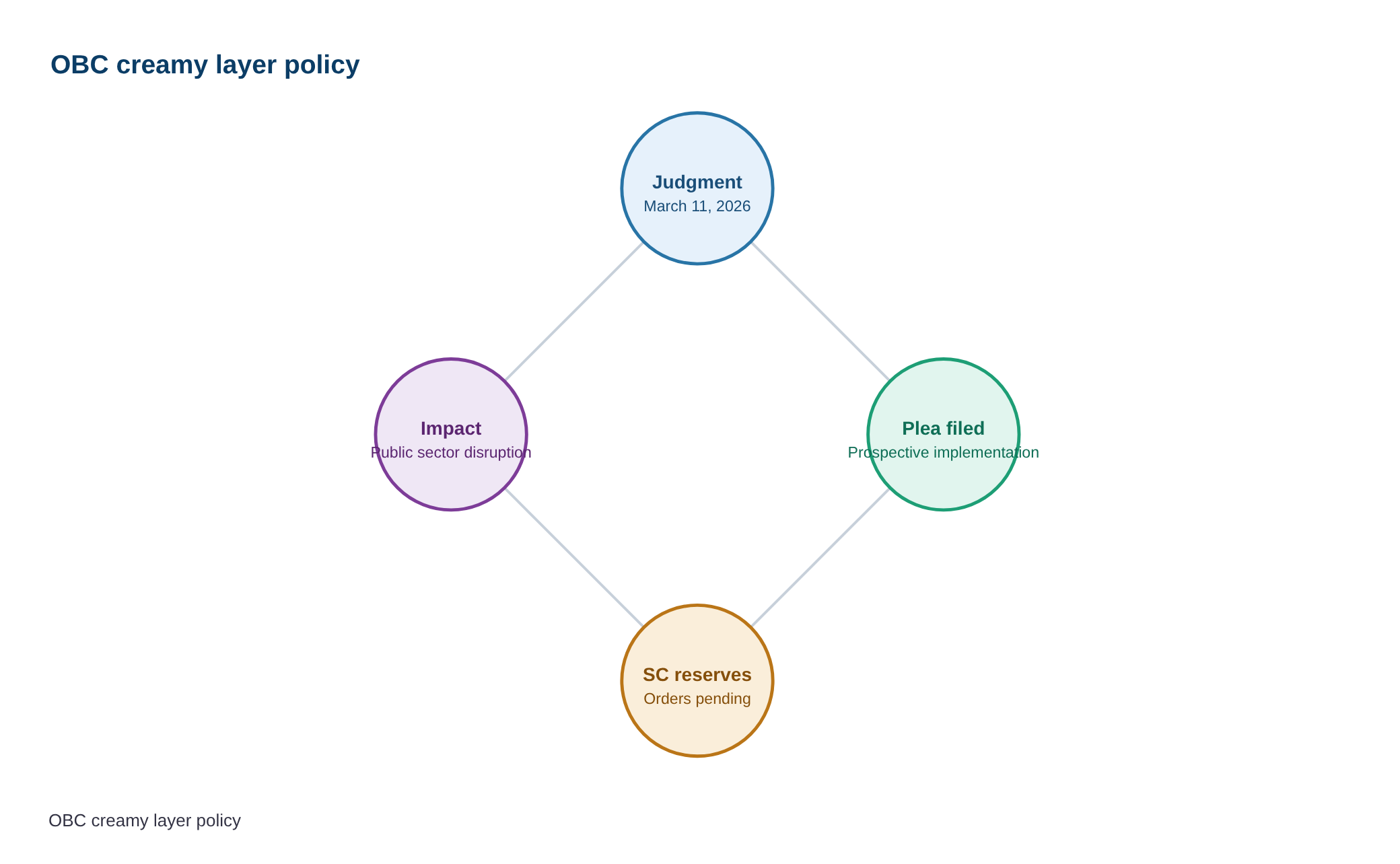
The Supreme Court of India, on September 24, 2026, reserved orders on the Union government’s plea seeking prospective implementation of its March 11, 2026 judgment re-assessing the OBC creamy layer policy. The Centre has argued that retrospective application of the verdict would disrupt ongoing recruitment processes, cadre allocations, seniority, and admissions across public sector entities, necessitating a two-year window for policy formulation. This case underscores the tension between judicial directives and administrative continuity in governance.
Background
- The concept of the ‘creamy layer’ within the Other Backward Classes (OBC) reservation framework was introduced by the Supreme Court in the Indra Sawhney case (1992), which capped reservation benefits for the ‘creamy layer’—those earning above a specified income threshold—to ensure equity within the reservation policy.
- The Union government, in its plea, has contended that retrospective application of the judgment would have ‘significant consequences’ for lakhs of employees, candidates, and administrative processes, including railways, banks, paramilitary services, and higher educational institutions.
- The Centre has invoked Article 142 of the Constitution, which empowers the Supreme Court to pass orders necessary for ‘complete justice,’ to seek prospective implementation of the judgment, arguing that administrative chaos would ensue otherwise.
- The case highlights the broader debate on the balance between judicial activism in social justice matters and the need for administrative stability, particularly in matters of reservation and public employment.
What is the OBC Creamy Layer Policy?
- The ‘creamy layer’ refers to a subset of the Other Backward Classes (OBC) who are excluded from the benefits of reservation due to their higher socio-economic status, ensuring that reservation benefits reach the most disadvantaged within the OBC category.
- The policy was introduced following the Supreme Court’s landmark judgment in *Indra Sawhney v. Union of India* (1992), which upheld the 27% reservation for OBCs but mandated exclusion of the creamy layer to prevent elite capture of reservation benefits.
- The creamy layer policy is distinct from the reservation policy for Scheduled Castes (SCs) and Scheduled Tribes (STs), as it is designed to address intra-group equity within the OBC category rather than historical discrimination.
- The creamy layer policy applies to all government services, public sector undertakings, and educational institutions, but its implementation varies based on the nature of the post or service.
- The policy is a tool for social justice, aimed at ensuring that reservation benefits are targeted at the most marginalized within the OBC category, while preventing the perpetuation of socio-economic hierarchies within the group.
Key Features
| Feature | Significance |
|---|---|
| Supreme Court judgment (March 11, 2026) | Reassessed OBC non-creamy layer status by excluding parental salary and agricultural income from the income/wealth test, altering the criteria for determining creamy layer eligibility. |
| Centre’s plea for prospective implementation | Requests a two-year window to implement the judgment to avoid administrative chaos and unintended consequences on ongoing recruitment, admissions, and service allocations. |
| Article 142 of the Constitution | Empowers the Supreme Court to declare its judgments prospective, allowing flexibility in implementation to mitigate adverse effects on stakeholders. |
| Impact on public sector recruitments | Retrospective implementation could disrupt cadre allocation, seniority, and gradation in major employers like railways, banks, and paramilitary services since 2012. |
| Stakeholder consultations | The Centre seeks time to consult with stakeholders and formulate a uniform policy for determining OBC creamy layer status post-judgment. |
Why it Matters
Constitutional and Legal
- The judgment and the Centre’s plea highlight the balance between judicial directives and administrative feasibility in reservation policies.
- Prospective implementation under Article 142 underscores the judiciary’s role in ensuring equitable governance while avoiding systemic disruptions.
- The case reinforces the principle that reservation policies must balance social justice with administrative stability.
Administrative and Governance
- The plea underscores the challenges in retroactively altering recruitment and service allocation processes, which could affect lakhs of employees.
- The Centre’s emphasis on avoiding administrative chaos reflects the need for phased policy implementation in governance.
- The case exemplifies the tension between judicial activism and bureaucratic pragmatism in policy execution.
Social Justice and Equity
- The reassessment of OBC creamy layer criteria aims to refine the reservation system to better target beneficiaries, aligning with the constitutional mandate of social justice.
- The exclusion of parental salary and agricultural income seeks to address historical inequities in the determination of creamy layer status.
- The case underscores the ongoing evolution of reservation policies to ensure they remain relevant and effective.
Challenges
1. Administrative Disruption
- Retrospective implementation could lead to administrative chaos, affecting recruitment, service allocation, and seniority in public sector entities.
- Major employers like railways, banks, and paramilitary services may face significant operational challenges.
- Existing employees and candidates could face unintended consequences despite not being parties to the litigation.
UPSC Link: GS-II: Reservation Policies and Administrative Challenges
2. Policy Formulation Lag
- The Centre requires time to consult stakeholders and formulate a uniform policy for determining OBC creamy layer status post-judgment.
- The absence of a clear timeline for policy implementation risks prolonging uncertainty for stakeholders.
- Balancing judicial directives with practical governance constraints remains a persistent challenge.
UPSC Link: GS-II: Policy Implementation and Governance
3. Legal and Judicial Coordination
- The case highlights the need for coordination between the judiciary and executive to ensure that judicial orders are implementable without systemic disruptions.
- The Centre’s plea for prospective implementation reflects the judiciary’s role in mitigating unintended consequences of its rulings.
- Ensuring that judicial directives align with administrative realities is a critical governance challenge.
UPSC Link: GS-II: Judiciary and Executive Relations
4. Equity in Reservation Policies
- The reassessment of OBC creamy layer criteria aims to address historical inequities but risks creating new disparities if not implemented carefully.
- Ensuring that the revised criteria accurately target beneficiaries without excluding deserving groups remains a challenge.
- The case underscores the need for periodic reviews of reservation policies to maintain their relevance and effectiveness.
UPSC Link: GS-II: Social Justice and Reservation Policies
Challenges — UPSC Perspective
| Issue | Concern |
|---|---|
| Retrospective implementation | Risk of administrative chaos and unintended consequences for lakhs of employees and candidates. |
| Policy formulation lag | Need for time to consult stakeholders and formulate a uniform policy post-judgment. |
| Administrative feasibility | Challenges in retroactively altering recruitment and service allocation processes. |
| Judicial-executive coordination | Ensuring that judicial directives align with administrative realities without systemic disruptions. |
| Equity in reservation criteria | Balancing the refinement of OBC creamy layer criteria with the risk of excluding deserving groups. |
Way Forward
- The Centre should expedite consultations with stakeholders to formulate a clear, uniform policy for determining OBC creamy layer status post-judgment.
- The Supreme Court may consider granting a two-year window for prospective implementation to mitigate administrative disruption.
- Public sector entities should conduct internal reviews to assess the impact of the judgment on ongoing recruitments and service allocations.
- The government should communicate transparently with affected stakeholders, including employees and candidates, to ensure clarity and reduce uncertainty.
- A dedicated task force may be constituted to oversee the implementation process and address grievances arising from the policy change.
- The judiciary and executive should explore mechanisms for better coordination to ensure that judicial directives are implementable without systemic disruptions.
- Periodic reviews of reservation policies should be institutionalized to ensure they remain relevant and effective in achieving social justice.
UPSC Value Addition
Keywords for Mains Answer-Writing
OBC creamy layer policy · Supreme Court judgment on OBC reservations · Article 142 of the Constitution · Prospective vs retrospective operation of judicial verdicts · Constitutional morality and reservation policy · Administrative implications of judicial orders · OBC non-creamy layer income criteria · 1993 Office Memorandum on OBC reservations · Government’s plea for time to implement judicial directions · Impact on recruitment, seniority, and admissions
Constitutional & Policy Linkages
- Article 16: Equality of opportunity in public employment.
- Article 46: Promotion of educational and economic interests of weaker sections.
- Article 340: Appointment of a Commission to investigate backward classes.
Concept Flow
Supreme Court judgment redefines OBC creamy layer criteria (March 11, 2026) → → Centre files plea for prospective implementation to avoid administrative chaos → → Supreme Court reserves orders on the plea, considering Article 142 → → Potential impact on public sector recruitments, admissions, and service allocations → → Need for stakeholder consultations and uniform policy formulation → → Balancing judicial directives with administrative feasibility → → Ensuring social justice and equity in reservation policies.
Prelims Practice Questions
Q1. Consider the following statements regarding the OBC creamy layer policy in India:
1. The creamy layer criterion was introduced by the Mandal Commission Report (1980).
2. The Supreme Court in the Indra Sawhney case (1992) upheld the concept of creamy layer for OBCs.
3. The income limit for determining the OBC creamy layer is fixed at ₹8 lakhs per annum as of 2026.
4. The 1993 Office Memorandum excluded parental income and agricultural income from the creamy layer test.
How many of the above statements are correct?
- Only one
- Only two
- Only three
- All four
Answer: Only three — Statement 1 is correct: The Mandal Commission recommended the creamy layer concept. Statement 2 is correct: The Indra Sawhney case (1992) upheld the creamy layer for OBCs. Statement 3 is incorrect: The income limit is not fixed at ₹8 lakhs; it is periodically revised. Statement 4 is incorrect: The 1993 Office Memorandum did not exclude parental income and agricultural income; the Supreme Court in its March 11, 2026 judgment directed this exclusion.
Q2. Assertion (A): The Supreme Court, under Article 142 of the Constitution, can declare its judgments prospective to mitigate unintended administrative consequences.
Reason (R): Prospective operation of judicial verdicts ensures that past actions remain unaffected, thereby preventing administrative chaos.
Options:
A. Both A and R are true, and R is the correct explanation of A.
B. Both A and R are true, but R is not the correct explanation of A.
C. A is true, but R is false.
D. A is false, but R is true.
- A
- B
- C
- D
Answer: A — Assertion (A) is true: Article 142 empowers the Supreme Court to pass any order necessary for doing complete justice. Reason (R) is also true and correctly explains (A): Prospective operation of judgments is used to avoid disruption to past administrative actions.
Q3. Match the following provisions/concepts with their respective contexts:
Column I
A. Article 142 of the Constitution
B. Indra Sawhney v. Union of India (1992)
C. 1993 Office Memorandum on OBC reservations
D. Article 16(4) of the Constitution
Column II
1. Introduced the concept of creamy layer for OBCs
2. Empowers the Supreme Court to pass orders for complete justice
3. Provides for reservation in favour of backward classes
4. Established the criteria for OBC reservations in government services
Options:
A-2, B-1, C-4, D-3
A-1, B-2, C-3, D-4
A-4, B-3, C-2, D-1
A-3, B-4, C-1, D-2
- A-2, B-1, C-4, D-3
- A-1, B-2, C-3, D-4
- A-4, B-3, C-2, D-1
- A-3, B-4, C-1, D-2
Answer: A-2, B-1, C-4, D-3 — A-2: Article 142 empowers the Supreme Court to pass orders for complete justice. B-1: Indra Sawhney (1992) upheld the creamy layer concept. C-4: The 1993 Office Memorandum established OBC reservation criteria. D-3: Article 16(4) provides for reservation in favour of backward classes.
Mains Practice Question
✍ The Supreme Court, in its judgment of March 11, 2026, re-assessed the OBC creamy layer policy by excluding parental salary income and agricultural income from the income/wealth test. Critically examine the constitutional and administrative implications of granting a two-year window to the government for prospective implementation of this verdict. (15 Marks)
Approach: MODEL-ANSWER SKELETON:
1. **Constitutional Framework of OBC Reservations**:
– Article 16(4) and the Indra Sawhney judgment (1992) on creamy layer.
– Role of the 1993 Office Memorandum in defining OBC reservations.
2. **Supreme Court’s March 11, 2026 Judgment**:
– Key findings: exclusion of parental income and agricultural income from creamy layer test.
– Legal reasoning: ensuring substantive equality and addressing hostile discrimination.
3. **Government’s Plea for Prospective Implementation**:
– Article 142 and the power of the Supreme Court to declare judgments prospective.
– Administrative concerns: impact on recruitment, seniority, cadre allocation, and admissions since 2012.
– Stakeholder consultations and formulation of a uniform policy.
4. **Constitutional and Administrative Implications**:
– **Constitutional Morality**: Balancing judicial activism with separation of powers.
– **Administrative Chaos**: Retrospective implementation could disrupt existing services (railways, banks, paramilitary).
– **Legal Precedents**: Cases like Union of India v. R. Gandhi (2010) on prospective judgments.
5. **Balancing Competing Interests**:
– Judicial duty to uphold constitutional values vs. government’s responsibility to maintain administrative stability.
– The role of the legislature in framing precise criteria for creamy layer.
6. **Conclusion**:
– The two-year window is a pragmatic compromise to avoid unintended consequences.
– Emphasise the need for a time-bound, consultative process to align judicial directions with administrative feasibility.
Source: The Hindu
Generated by AanyaAi for educational purpose.
Related guides on our sites
- Best PSIR optional coaching for upsc
- Best PSIR optional teacher for upsc
- Best teacher of PSIR optional for upsc
- Best PSIR optional coaching in delhi for UPSC

- Supreme Court reserves orders on Centre’s plea for OBC creamy layer policy: Key UPSC insights - September 25, 2026
- आरबीआई के 10 निर्देश: एआई को नियंत्रित करें, जोखिमों से बचें - September 24, 2026
- RBI’s 10-Point AI Governance Framework for Banks: Key for UPSC Aspirants - September 24, 2026

No Comments