


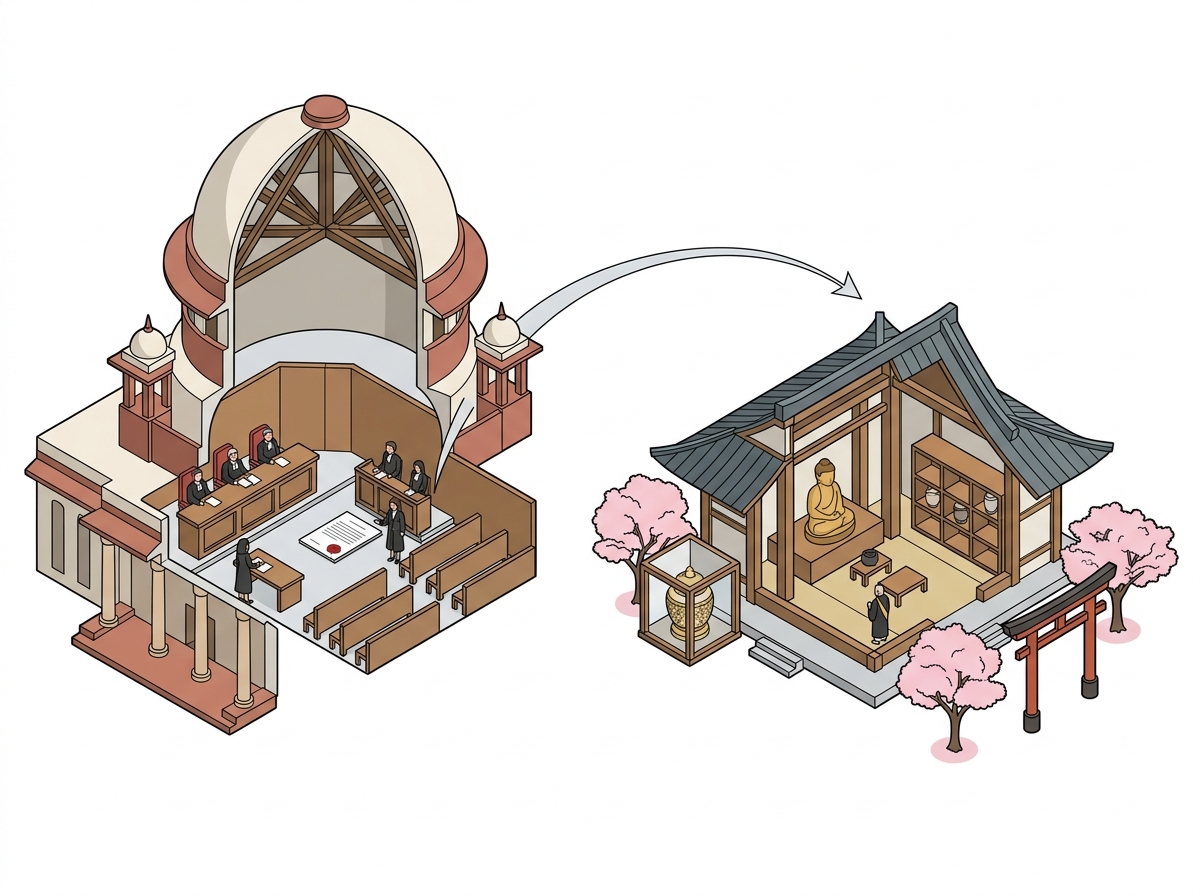
11 Aug Supreme Court Seeks Centre’s Reply on Netaji’s Ashes Repatriation Plea
Supreme Courtpetitioner's daughtermortal remainsRenkō-ji Temple✎ The repatriation of Netaji Subhas Chandra Bose’s ashes from Renkō-ji Temple in Tokyo hinges on the Union government’s diplomatic negotiations with Japan, the legal framework governing the handling of mortal remains abroad, and…
Subject Relevance — Where This Topic Fits
- GS Paper II — International Relations | GS Paper IV — Ethics, Integrity and Aptitude (Emotional Intelligence, Compassion)
- Prelims: Subhas Chandra Bose, Indian National Army (INA), Renkō-ji Temple, Taihoku (Taipei), Supreme Court of India, Union Ministries of External Affairs and Home Affairs, Freedom Fighter’s Ashes, Posthumous Recognition
- Essay: The Role of the Judiciary in Addressing Historical and Emotional Claims, Balancing National Sentiment with Diplomatic and Legal Constraints
Quick Revision: The repatriation of Netaji Subhas Chandra Bose’s ashes from Renkō-ji Temple in Tokyo hinges on the Union government’s diplomatic negotiations with Japan, the legal framework governing the handling of mortal remains abroad, and the Supreme Court’s interpretation of the right to dignity and closure under Article 21 of the Constitution.
Why is this in the news?
On August 11, 2026, the Supreme Court of India issued a notice to the Union Ministries of External Affairs and Home Affairs on a petition filed by Anita Bose Pfaff, daughter of Netaji Subhas Chandra Bose, seeking the repatriation of his mortal remains from Renkō-ji Temple in Tokyo. The petition underscores the prolonged delay in the Union government’s decision-making process and raises questions about the legal, diplomatic, and moral obligations of the state in addressing such historical and familial claims.
Background
- Netaji Subhas Chandra Bose, a prominent leader of the Indian independence movement and founder of the Indian National Army (INA), is believed to have died in an air crash at Taihoku (Taipei) on August 18, 1945, shortly after Japan’s surrender to the Allied Powers.
- His mortal remains were transported to Tokyo in early September 1945 and subsequently interred at Renkō-ji Temple, where they have been preserved for over 80 years.
- The preservation of his ashes at Renkō-ji Temple has been maintained by successive head priests, creating a state of posthumous exile and non-closure for the Bose family.
- The Union government has historically maintained a stance of non-interference in the matter, citing the absence of conclusive evidence regarding Netaji’s death and the legal complexities of repatriating remains from a foreign jurisdiction.
- The current petition by Anita Bose Pfaff, represented by senior advocate A.M. Singhvi, highlights the Union government’s failure to take a final, reasoned, and time-bound decision on the matter.
What is the Legal and Diplomatic Framework Governing the Repatriation of Human Remains?
- Repatriation of human remains is governed by international conventions such as the **Vienna Convention on Consular Relations, 1963**, which allows consular officials to assist in the repatriation of the remains of deceased nationals, subject to the laws of the host country.
- In India, the **Registration of Births and Deaths Act, 1969**, and the **Foreigners Act, 1946**, provide the legal framework for handling the remains of Indian nationals abroad, though these do not explicitly address repatriation requests.
- The **Union Ministry of External Affairs (MEA)** is the nodal agency responsible for coordinating with foreign governments on matters pertaining to Indian citizens, including the repatriation of mortal remains.
- The **Supreme Court of India**, under Article 32 of the Constitution, has the jurisdiction to entertain petitions for the enforcement of fundamental rights, including the right to dignity and closure for families of deceased individuals.
- Diplomatic negotiations for repatriation are often protracted due to considerations such as bilateral relations, legal constraints in the host country, and the absence of a formal treaty or agreement on the matter.
- The preservation of Netaji’s ashes at Renkō-ji Temple has been maintained under Japanese law, which permits the interment of foreign nationals in religious institutions, subject to local customs and regulations.
- The Union government’s stance on the matter has historically been influenced by the lack of definitive evidence regarding Netaji’s death, as well as the sensitivity of the issue in the context of India’s historical and political narrative.
- The petition raises broader ethical questions about the state’s responsibility to facilitate closure for families of historical figures whose remains are held abroad, particularly in cases involving national heroes.
Key Features
| Feature | Significance |
|---|---|
| Petition by legal heir | Establishes the locus standi of the daughter as the rightful heir for the repatriation of Netaji’s mortal remains, addressing the legal heirship question raised in earlier petitions. |
| Supreme Court intervention | Demonstrates the judiciary’s role in resolving disputes involving historical and national heritage, ensuring due process and constitutional remedies. |
| Preservation at Renkō-Ji Temple | Highlights the long-standing cultural and religious practice of honoring Netaji’s remains in Japan, forming a unique transnational heritage narrative. |
| Government’s delayed response | Underscores the administrative and diplomatic challenges in repatriating human remains, particularly when tied to historical figures of national significance. |
| Public and familial sentiment | Reflects the emotional and cultural dimensions of national memory, closure, and the dignity of final rites for a revered freedom fighter. |
Why it Matters
Historical and Cultural
- Netaji Subhash Chandra Bose’s legacy remains a pivotal narrative in India’s freedom struggle, symbolizing alternative pathways to independence beyond non-violent resistance.
- The preservation of his remains in Tokyo for over 80 years embeds a transnational dimension to his memory, bridging Indian and Japanese historical narratives.
- The repatriation issue intersects with the broader discourse on the preservation and honoring of freedom fighters’ legacies in post-colonial nation-building.
Legal and Constitutional
- The petition invokes the right to perform last rites with dignity, a facet of the right to life and personal liberty under Article 21 of the Constitution.
- The Supreme Court’s intervention highlights the judiciary’s role in adjudicating disputes involving national heritage and historical figures, ensuring constitutional governance.
- The case raises questions about the state’s obligation to facilitate closure for families of national icons, particularly when their remains are held abroad.
Diplomatic and Bilateral
- The repatriation process involves sensitive diplomatic negotiations with Japan, governed by bilateral agreements and international protocols on human remains.
- India’s diplomatic engagement must balance cultural sensitivity with national sentiment, ensuring that the repatriation is conducted with mutual respect.
- The case may set a precedent for future repatriation requests of historical figures’ remains, influencing bilateral relations and cultural diplomacy.
Administrative and Governance
- The Union government’s delayed response underscores the need for streamlined inter-ministerial coordination between the Ministries of External Affairs and Home Affairs.
- The case highlights the importance of proactive policy frameworks for addressing historical and cultural grievances, ensuring timely resolution of such matters.
- It also reflects the challenges of reconciling administrative delays with public expectations in matters of national importance.
Challenges
1. Diplomatic Sensitivity
- Repatriation of human remains requires delicate diplomatic handling to avoid straining bilateral relations with Japan.
- Cultural and religious practices in Japan, such as the preservation of remains at Renkō-Ji Temple, must be respected to ensure a smooth process.
- India must navigate these sensitivities while addressing domestic sentiment and the family’s wishes.
UPSC Link: GS-II: India’s Foreign Policy
2. Legal and Jurisdictional Ambiguity
- The case raises questions about the legal framework governing the repatriation of historical figures’ remains, particularly when held abroad.
- The Supreme Court’s intervention highlights the need for clarity on the jurisdiction and authority of the Indian state in such matters.
- The petitioner’s locus standi as the legal heir must be balanced with broader public interest and national sentiment.
UPSC Link: GS-II: Judiciary and Constitutional Governance
3. Administrative Delays and Coordination
- The Union government’s prolonged failure to take a final decision underscores systemic inefficiencies in inter-ministerial coordination.
- The case highlights the need for a dedicated policy framework to address historical and cultural grievances in a time-bound manner.
- Streamlining processes between the Ministries of External Affairs and Home Affairs is critical to avoid similar delays in the future.
UPSC Link: GS-II: Government Policies and Interventions
4. Cultural and Emotional Dimensions
- The preservation of Netaji’s remains in Tokyo for over 80 years has created a unique cultural and emotional attachment, both in India and Japan.
- Repatriation must balance the family’s desire for closure with the cultural and religious significance of the remains in Japan.
- Public sentiment in India, particularly among those who revere Netaji, adds pressure on the government to act decisively.
UPSC Link: GS-I: Indian Culture and Heritage
5. Precedent for Future Cases
- The outcome of this case may set a precedent for future repatriation requests involving historical figures’ remains held abroad.
- India must ensure that the process is transparent and equitable to avoid setting unfavorable precedents in bilateral relations.
- The case underscores the need for a standardized protocol for repatriation requests, balancing legal, cultural, and diplomatic considerations.
UPSC Link: GS-II: International Relations
Challenges — UPSC Perspective
| Issue | Concern |
|---|---|
| Diplomatic negotiations | Balancing India’s national sentiment with Japan’s cultural and religious practices to ensure a smooth repatriation process. |
| Legal jurisdiction | Determining the authority of the Indian state in repatriating remains held abroad, particularly when tied to historical figures. |
| Administrative delays | Addressing systemic inefficiencies in inter-ministerial coordination to avoid prolonged inaction on such matters. |
| Cultural and emotional attachment | Reconciling the family’s desire for closure with the cultural significance of the remains in Japan and public sentiment in India. |
| Precedent setting | Ensuring the outcome of this case does not create unfavorable precedents for future repatriation requests involving historical figures. |
Way Forward
- The Union government should constitute a high-level inter-ministerial committee, including representatives from the Ministries of External Affairs, Home Affairs, and Culture, to expedite the repatriation process with diplomatic precision.
- Engage in sustained diplomatic dialogue with Japan to explore all possible avenues for repatriation, including cultural and religious considerations, while ensuring mutual respect.
- Formulate a standardized protocol for repatriation requests involving historical figures’ remains, ensuring transparency, equity, and adherence to international norms.
- Conduct a comprehensive review of administrative processes to identify and address systemic inefficiencies that delay such critical decisions.
- Incorporate public consultations and stakeholder engagement to ensure that the repatriation process aligns with national sentiment and cultural sensitivities.
- Collaborate with the Renkō-Ji Temple authorities to facilitate the repatriation in a manner that respects both Japanese cultural practices and Indian national sentiment.
- Ensure that the repatriation process is conducted with dignity and finality, allowing Netaji’s family to perform the last rites in accordance with their traditions.
- Document the entire process transparently to build public trust and set a precedent for future cases involving historical and cultural heritage.
UPSC Value Addition
Keywords for Mains Answer-Writing
Repatriation of mortal remains · Subhash Chandra Bose · Renkō-Ji Temple, Tokyo · Supreme Court of India · Article 21 (Right to Life and Dignity) · Foreign Relations and Diplomacy · Cultural Diplomacy · Historical Memory and Closure · Executive-Judiciary Interface · Repatriation of Human Remains · Indian National Army (INA) · Freedom Struggle Legacy · Constitutional Morality · Legal Heirship and Succession · Posthumous Exile
Constitutional & Policy Linkages
- [‘Article 21: Right to Life and Personal Liberty’, ‘Ensures the dignity of performing last rites and closure for the family.’]
- [‘Article 51A: Fundamental Duties’, ‘Highlights the duty of citizens to preserve the rich heritage of the composite culture of India.’]
Concept Flow
Netaji Subhash Chandra Bose’s death in 1945 and transportation of remains to Tokyo → Preservation of remains at Renkō-Ji Temple for over 80 years, forming a transnational heritage narrative → Petition by legal heir (Anita Bose Pfaff) seeking repatriation to India for dignified last rites → Supreme Court’s intervention, seeking responses from Union Ministries of External Affairs and Home Affairs → Judicial scrutiny of administrative delays and legal heirship, ensuring due process and constitutional remedies → Diplomatic negotiations with Japan to facilitate repatriation while respecting cultural and religious practices → Potential repatriation of remains, marking closure for the family and addressing national sentiment
Prelims Practice Questions
Q1. Consider the following statements regarding the repatriation of mortal remains:
1. The Supreme Court of India has the jurisdiction to direct the repatriation of human remains preserved abroad.
2. The Union Ministry of External Affairs is the nodal agency responsible for facilitating the repatriation of mortal remains of Indian citizens.
3. The repatriation of mortal remains is governed exclusively by the Indian Succession Act, 1925.
How many of the above statements are correct?
- Only one
- Only two
- All three
- None
Answer: Only two — Statement 1 is correct as the Supreme Court can issue directions under Article 32 for repatriation. Statement 2 is correct as the Ministry of External Affairs handles such diplomatic matters. Statement 3 is incorrect as repatriation involves constitutional, diplomatic, and civil law considerations beyond the Indian Succession Act.
Q2. Assertion (A): The repatriation of Subhash Chandra Bose’s mortal remains from Tokyo is a matter of constitutional morality and dignity.
Reason (R): The Constitution of India, under Article 21, guarantees the right to life and personal liberty, which includes the right to perform final rites with dignity.
Options:
A. Both A and R are true, and R is the correct explanation of A.
B. Both A and R are true, but R is NOT the correct explanation of A.
C. A is true, but R is false.
D. A is false, but R is true.
Answer: ? — Both A and R are true. Article 21 encompasses dignity in death, and repatriation aligns with this constitutional principle. R correctly explains A as the right to dignity extends to posthumous matters.
Q3. Match the following pairs related to the repatriation of mortal remains:
Column I (Legal/Constitutional Provision) Column II (Relevance)
1. Article 21 of the Constitution of India A. Empowers the Supreme Court to issue directions for repatriation
2. Article 32 of the Constitution of India B. Governs diplomatic relations and treaties
3. The Indian Foreign Service (Cadre) Rules, 1961 C. Protects the right to life and personal dignity
4. The Citizenship Act, 1955 D. Defines the eligibility and procedures for Indian citizenship
Options:
A. 1-C, 2-A, 3-B, 4-D
B. 1-A, 2-B, 3-C, 4-D
C. 1-D, 2-C, 3-B, 4-A
D. 1-B, 2-A, 3-D, 4-C
Answer: ? — 1-C (Article 21 protects dignity), 2-A (Article 32 empowers the Supreme Court), 3-B (IFS Rules govern diplomatic functions), 4-D (Citizenship Act defines eligibility).
Mains Practice Question
✍ The preservation of Subhash Chandra Bose’s mortal remains in a foreign temple for over eight decades has been described as a state of ‘posthumous exile’ and a denial of closure to his family. In this context, critically examine the constitutional, diplomatic, and ethical dimensions of repatriating human remains from abroad to India. (15 Marks)
Approach: MODEL-ANSWER SKELETON:
1. Constitutional Dimensions:
– Article 21 (Right to Life and Dignity): Extend the scope of dignity to posthumous matters, including the right to perform final rites.
– Article 14 (Equality): Ensure equal treatment of all citizens, including respect for their cultural and religious practices.
– Legal heirship and succession: Discuss the role of Anita Bose Pfaff as the rightful heir and the legal framework governing succession.
2. Diplomatic and Governance Dimensions:
– Role of the Ministry of External Affairs: Outline the process of repatriation, including diplomatic negotiations, treaties, and bilateral agreements.
– Cultural diplomacy: Highlight India’s soft power and the symbolic significance of repatriating the remains of a national icon.
– Executive-Judiciary interface: Discuss the Supreme Court’s intervention under Article 32 and the balance between judicial activism and executive prerogative.
3. Ethical and Historical Dimensions:
– Closure for the family: Examine the psychological and emotional significance of repatriation for the family and the nation.
– Historical memory: Discuss the legacy of Subhash Chandra Bose and the Indian National Army (INA) in India’s freedom struggle.
– Posthumous exile: Critically assess the ethical implications of preserving remains abroad without the consent or closure of the family.
4. Challenges and Constraints:
– Diplomatic sensitivities: Address potential challenges in negotiating repatriation with Japan, including cultural and religious considerations.
– Legal hurdles: Discuss any procedural or legal barriers, such as the lack of a formal request from the Japanese side or the absence of a bilateral treaty.
– Public opinion and political considerations: Highlight the role of public sentiment and political narratives in shaping the repatriation debate.
5. Balanced View:
– Present arguments for and against repatriation, weighing constitutional morality, diplomatic pragmatism, and ethical considerations.
– Conclude with a reasoned position on whether repatriation is justified and feasible, and outline the steps required to achieve it.
Source: The Hindu
Generated by AanyaAi for educational purpose.

- KWML’s Feasibility Reports for Water Metro in 18 Cities: UPSC & PCS Insights - October 3, 2026
- ओडिशा में वन्यजीव अनुसंधान अनुदान कार्यक्रम शुरू, सिमिलिपाल में 300 कैमरे और बढ़ेंगे - October 3, 2026
- India Summons Pakistan High Commission Official Over Violation - October 3, 2026

No Comments