


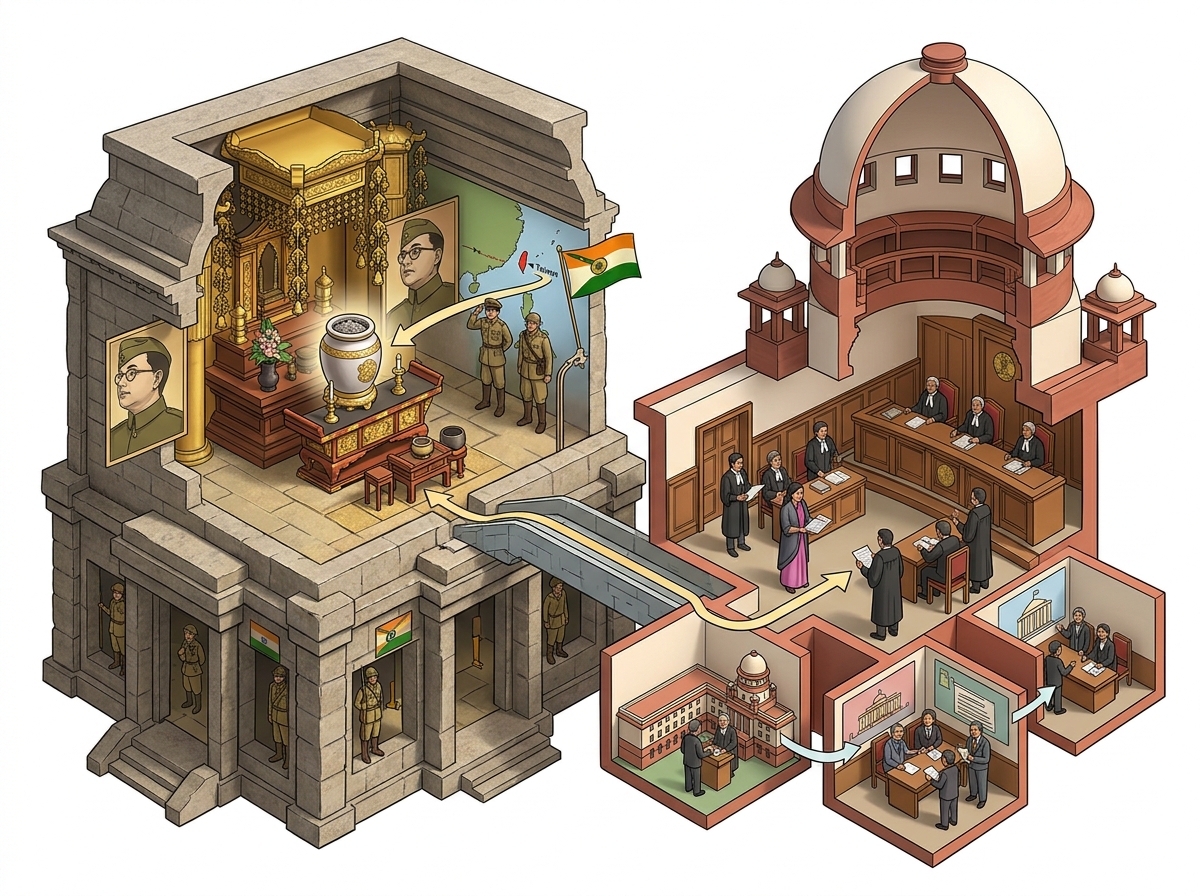
11 Aug Supreme Court Seeks Centre’s Response on Netaji’s Ashes Repatriation Plea
Supreme CourtPetitioner's daughterMortal remainsRenkō-Ji Temple✎ The repatriation of Netaji Subhas Chandra Bose’s ashes from Tokyo involves a complex interplay of constitutional rights, diplomatic considerations, and ethical obligations, with the Supreme Court’s intervention highlighting the…
Subject Relevance — Where This Topic Fits
- GS Paper II — International Relations: Bilateral relations with Japan; cultural and historical ties | GS Paper II — Polity and Governance: Fundamental Rights, Directive Principles of State Policy, and judicial review | GS Paper IV — Ethics and Integrity: Ethical obligations towards historical figures and their descendants
- Prelims: Fundamental Rights (Article 25-28), Directive Principles of State Policy (Article 51), judicial review, bilateral treaties, repatriation of mortal remains, Renkō-Ji Temple, Subhas Chandra Bose, Indian National Army
- Essay: The interplay of historical memory and national identity in post-colonial societies, Ethical dimensions of preserving and repatriating the remains of national heroes
Quick Revision: The repatriation of Netaji Subhas Chandra Bose’s ashes from Tokyo involves a complex interplay of constitutional rights, diplomatic considerations, and ethical obligations, with the Supreme Court’s intervention highlighting the need for a reasoned and time-bound decision by the Union Government.
Why is this in the news?
The Supreme Court of India, on August 11, 2026, sought responses from the Union Ministries of External Affairs and Home Affairs regarding a petition filed by Anita Bose Pfaff, daughter of Netaji Subhas Chandra Bose, for the repatriation of his mortal remains from Renkō-Ji Temple in Tokyo. The court’s intervention underscores the intersection of legal rights, historical justice, and diplomatic considerations in matters of national heritage and familial dignity.
Background
- Netaji Subhas Chandra Bose, a prominent leader of the Indian independence movement and founder of the Indian National Army (INA), is believed to have died in an air crash at Taihoku (Taipei) in August 1945, shortly after the Japanese surrender to the Allied Powers.
- His mortal remains were transported to Tokyo in early September 1945 and subsequently interred at Renkō-Ji Temple, where they have been preserved for over eight decades under the custody of successive head priests.
- The preservation of Netaji’s ashes in Japan has been a subject of historical and emotional significance for generations of Indians, with debates persisting over the authenticity of his death and the ethical implications of his remains remaining abroad.
- The Supreme Court’s refusal to entertain an earlier petition filed by Netaji’s grandnephew in April 2026, coupled with its insistence on Anita Bose Pfaff’s direct representation, highlights the legal complexities surrounding the issue of repatriation and familial rights.
- The petition raises questions about the role of the state in facilitating the repatriation of historical figures’ remains, particularly when such repatriation is sought by legal heirs for the performance of final rites in accordance with cultural and religious practices.
Legal and Constitutional Framework Governing Repatriation of Mortal Remains
- In India, the right to perform final rites and dispose of the remains of a deceased person is recognised as part of the cultural and religious freedoms guaranteed under Article 25 of the Constitution of India, subject to public order, morality, and health.
- The Union Government’s role in facilitating repatriation is discretionary but may be guided by diplomatic considerations, historical significance, and the principles of justice and fairness, as outlined in the Directive Principles of State Policy (Article 51).
- The Supreme Court, under its writ jurisdiction (Article 32), may intervene in matters involving fundamental rights or where a legal heir seeks redressal for a violation of their rights, including the right to dignity and closure.
- The preservation of Netaji’s ashes in Tokyo for over eight decades raises ethical questions about the state’s obligation to facilitate closure for the family and the nation, particularly in the absence of conclusive historical evidence regarding his death.
- The petition underscores the tension between historical memory, national identity, and the legal rights of descendants, particularly in cases where the remains of a historical figure are held abroad.
- The Union Government’s response to the petition will likely consider diplomatic sensitivities, bilateral relations with Japan, and the potential precedents it may set for future repatriation requests involving other historical figures.
Key Features
| Feature | Significance |
|---|---|
| Petition by Legal Heir | Establishes the claim of Anita Bose Pfaff as the rightful heir to Netaji’s mortal remains under civil law, triggering judicial scrutiny of state inaction. |
| Supreme Court Notice | Mandates responses from Union Ministries of External Affairs and Home, signalling constitutional oversight of executive decisions on repatriation. |
| Temporal Proximity to 80th Anniversary | The 80-year preservation of remains at Renkō-Ji Temple underscores the urgency of closure for the family and national sentiment. |
| Judicial Precedent on Ancestral Remains | The court’s insistence on direct heir representation reflects precedent on the repatriation of historical figures’ remains, balancing sovereignty and cultural sentiment. |
| Diplomatic Protocol for Repatriation | The case tests India’s bilateral agreements with Japan on the transfer of human remains, governed by the Vienna Convention on Diplomatic Relations (1961). |
Why it Matters
Diplomatic and Bilateral Relations
- The repatriation of Netaji’s remains would serve as a symbolic gesture of goodwill between India and Japan, reinforcing historical ties rooted in World War II and post-war reconciliation.
- Japan’s custodianship of the remains since 1945 reflects its adherence to the Geneva Conventions and respect for the deceased, necessitating India’s diplomatic engagement to formalise repatriation.
- A precedent set by this case could influence future requests for the return of other historical figures’ remains preserved abroad, such as those of Indian soldiers in foreign territories.
Constitutional and Legal Dimensions
- The Supreme Court’s intervention underscores the judiciary’s role in ensuring the state fulfils its duty of care toward the cultural and emotional rights of citizens, particularly in matters of national memory.
- The case raises questions about the executive’s obligation to act on petitions seeking repatriation of historical figures’ remains, invoking Article 21 (Right to Life and Dignity) for the family’s closure.
- The legal heir’s petition tests the limits of state sovereignty in matters of cultural heritage and familial rights, balancing public interest with individual claims.
Historical and Societal Impact
- Netaji’s remains at Renkō-Ji Temple have become a site of pilgrimage and national memory, symbolising his enduring legacy in India’s freedom struggle and the unresolved nature of his death.
- The repatriation, if granted, would provide closure to Netaji’s family and millions of admirers, potentially resolving decades of speculation and emotional uncertainty.
- The case highlights the role of historical figures in shaping national identity, with potential implications for public discourse on India’s independence movement and the contributions of the Indian National Army.
Institutional and Governance Challenges
- The Union government’s delay in reaching a decision reflects the complexities of balancing diplomatic sensitivities, legal claims, and national sentiment in repatriation matters.
- The case tests the efficacy of inter-ministerial coordination between the Ministries of External Affairs and Home in addressing requests with historical and cultural dimensions.
- The judiciary’s proactive stance may prompt the executive to formulate a clear policy framework for repatriation of historical figures’ remains, ensuring consistency in future cases.
Challenges
1. Diplomatic Constraints
- Japan’s custodianship of the remains since 1945 may require formal diplomatic negotiations to secure consent for repatriation, governed by bilateral agreements and international law.
- Any repatriation must align with Japan’s domestic laws on the transfer of human remains, including cremation and burial protocols, to avoid legal complications.
- The symbolic nature of the request demands careful handling to prevent misinterpretation as a political gesture, which could strain bilateral relations.
UPSC Link: Foreign Policy & Diplomacy
2. Legal and Procedural Hurdles
- The Union government must reconcile the claims of multiple stakeholders, including legal heirs and national sentiment, while ensuring compliance with civil and international law.
- The case may require the government to establish a precedent for repatriation requests, which could set expectations for future cases involving historical figures.
- The judiciary’s involvement necessitates a clear delineation of executive and judicial roles in matters of national memory and cultural heritage.
UPSC Link: Judicial Review & Executive Discretion
3. Cultural and Emotional Sensitivities
- The repatriation must be handled with sensitivity to avoid politicisation or exploitation by vested interests, which could polarise public opinion.
- The emotional significance of Netaji’s remains for the family and the nation requires a dignified and respectful approach to ensure closure without undermining historical narratives.
- The case may reignite debates on Netaji’s role in India’s freedom struggle, necessitating a balanced portrayal of his contributions to avoid historical revisionism.
UPSC Link: Cultural Heritage & National Identity
4. Administrative and Logistical Challenges
- The repatriation process involves logistical coordination for the transportation, cremation, and final rites of the remains, requiring inter-ministerial and state-level collaboration.
- The government must address concerns related to the preservation and display of the remains during transit, ensuring compliance with sanitary and religious norms.
- The case may prompt the establishment of a dedicated mechanism for handling repatriation requests, streamlining future processes.
UPSC Link: Governance & Public Administration
5. Public Perception and National Sentiment
- The government must manage public expectations and avoid creating a perception of favouritism or neglect in handling the repatriation request.
- The case may amplify calls for a comprehensive inquiry into Netaji’s death, necessitating a measured response to balance historical curiosity with national unity.
- The emotional resonance of the issue requires the government to communicate its decisions transparently to maintain public trust.
UPSC Link: Public Policy & Governance
Challenges — UPSC Perspective
| Issue | Concern |
|---|---|
| Diplomatic Consent | Securing Japan’s agreement for repatriation while adhering to bilateral and international legal frameworks. |
| Legal Heirship Disputes | Reconciling claims of multiple stakeholders, including the petitioner and other family members, under civil law. |
| Executive-Judicial Balance | Defining the roles of the judiciary and executive in addressing requests with historical and cultural dimensions. |
| Logistical Coordination | Ensuring dignified transportation, cremation, and final rites of the remains in compliance with religious and sanitary norms. |
| Public Sentiment Management | Balancing national expectations with diplomatic and legal constraints to avoid polarisation or politicisation. |
| Policy Precedent | Establishing a clear framework for future repatriation requests of historical figures’ remains to ensure consistency and fairness. |
Way Forward
- The Union government should expedite consultations with the Japanese government to formalise the repatriation process, ensuring compliance with bilateral agreements and international law.
- A high-level inter-ministerial committee should be constituted to assess the legal, diplomatic, and logistical aspects of the repatriation, including the claims of all stakeholders.
- The government must engage with Netaji’s family to understand their preferences for the final rites, ensuring the process aligns with their cultural and religious beliefs.
- A transparent communication strategy should be adopted to inform the public about the government’s decision-making process, addressing concerns and maintaining national unity.
- The judiciary’s observations in this case should be studied to formulate a policy framework for repatriation requests, ensuring consistency in future cases.
- Diplomatic channels should be utilised to explore the possibility of a joint Indo-Japanese memorial or museum in Tokyo or India to honour Netaji’s legacy, if repatriation is not feasible.
- The government should consider establishing a dedicated cell within the Ministry of External Affairs to handle repatriation requests of historical figures’ remains, streamlining future processes.
- A national dialogue should be initiated to address the unresolved aspects of Netaji’s death, balancing historical curiosity with national sentiment and avoiding politicisation.
UPSC Value Addition
Keywords for Mains Answer-Writing
Subhas Chandra Bose · Repatriation of mortal remains · Article 29 of the Indian Constitution · Cultural diplomacy · Diplomatic negotiations · Right to dignity under Article 21 · Historical memory · Constitutional morality · Executive-judiciary interface · Repatriation treaties
Constitutional & Policy Linkages
- [‘Article 21 (Right to Life and Dignity)’, ‘Ensures the family’s right to closure and dignified final rites for Netaji’s remains.’]
- [‘Article 51A (Fundamental Duties)’, ‘Obliges citizens to value and preserve the rich heritage of the composite culture of India, including historical figures like Netaji.’]
- [‘Judicial Review (Article 32 & 226)’, ‘Empowers the Supreme Court to intervene in matters of public interest, including the repatriation of historical figures’ remains.’]
Concept Flow
Netaji’s death in 1945 → Transport of remains to Tokyo → 80-year preservation at Renkō-Ji Temple → Family’s emotional distress and lack of closure → Petition by legal heir to Supreme Court → Judicial notice to Union government → Executive’s delay in decision → Supreme Court’s insistence on direct heir representation → Current judicial scrutiny of state inaction.
Prelims Practice Questions
Q1. Consider the following statements regarding the repatriation of mortal remains of national leaders:
1. The Union Government has an absolute discretion in matters of repatriation of mortal remains from foreign countries.
2. The Supreme Court of India can direct the Union Government to repatriate mortal remains under Article 32 of the Constitution.
3. The right to perform last rites with dignity is protected under the right to life and personal liberty guaranteed by Article 21 of the Constitution.
How many of the above statements are correct?
- Only one
- Only two
- All
- None
Answer: All — Statements 2 and 3 are correct. The Supreme Court can issue directions under Article 32 for repatriation if it involves enforcement of fundamental rights. Statement 1 is incorrect as the executive’s discretion is subject to judicial review if it violates constitutional rights.
Q2. Assertion (A): The repatriation of mortal remains from foreign countries is a matter of executive discretion under the Ministry of External Affairs.
Reason (R): The Union Government is bound by international treaties and conventions that may require consultation with the families of the deceased before repatriation decisions.
Options:
A. Both A and R are true, and R is the correct explanation of A.
B. Both A and R are true, but R is NOT the correct explanation of A.
C. A is true, but R is false.
D. A is false, but R is true.
Answer: ? — Assertion (A) is true as repatriation is primarily an executive function. Reason (R) is also true and explains the constraint on executive discretion through international obligations and moral considerations, though it does not fully explain the assertion itself.
Q3. Match the following provisions with their correct descriptions:
Column I (Provisions)
1. Article 21 of the Indian Constitution
2. Article 32 of the Indian Constitution
3. Article 51A of the Indian Constitution
4. Article 29 of the Indian Constitution
Column II (Descriptions)
A. Fundamental right to freedom of religion and cultural practices
B. Right to life and personal liberty including right to dignity
C. Fundamental right to constitutional remedies
D. Fundamental duty to preserve the rich heritage of our composite culture
- 1-B, 2-C, 3-D, 4-A
- 1-A, 2-B, 3-C, 4-D
- 1-D, 2-C, 3-B, 4-A
- 1-C, 2-B, 3-D, 4-A
Answer: 1-B, 2-C, 3-D, 4-A — Correct matches are: 1-B (Article 21), 2-C (Article 32), 3-D (Article 51A), 4-A (Article 29).
Mains Practice Question
✍ The repatriation of mortal remains of national leaders from foreign countries involves complex intersections of constitutional rights, diplomatic considerations, and historical memory. Critically examine the legal, ethical, and diplomatic dimensions of such repatriation requests with reference to the recent Supreme Court petition seeking the return of Netaji Subhas Chandra Bose’s ashes from Tokyo. (15 Marks)
Approach: MODEL-ANSWER SKELETON:
1. Constitutional Rights Framework (4 Marks):
– Right to dignity (Article 21) and cultural rights (Article 29) as grounds for repatriation.
– Judicial review of executive discretion under Article 32 (e.g., Vishaka Guidelines, PILs).
– Role of family rights and cultural practices in constitutional morality.
2. Diplomatic and International Law Dimensions (5 Marks):
– Sovereign immunity and bilateral agreements with Japan.
– Cultural diplomacy and soft power considerations.
– Precedents of repatriation (e.g., remains of Mahatma Gandhi’s associates, Raja Rammohan Roy).
3. Historical Memory and National Identity (3 Marks):
– Netaji’s legacy and its symbolic value in Indian nationalism.
– Balancing historical narratives with diplomatic sensitivities.
– Role of state in preserving or repatriating historical artifacts/remains.
4. Executive-Judiciary Interface (3 Marks):
– Tension between executive discretion and judicial intervention.
– Court’s role in ensuring constitutional compliance without overreach.
– Need for a time-bound policy framework for such requests.
Balance: Present arguments for both repatriation (dignity, closure) and against (diplomatic constraints, historical preservation). Conclude with a reasoned position on the need for a standardized policy.
Source: The Hindu
Generated by AanyaAi for educational purpose.

- KWML’s Feasibility Reports for Water Metro in 18 Cities: UPSC & PCS Insights - October 3, 2026
- ओडिशा में वन्यजीव अनुसंधान अनुदान कार्यक्रम शुरू, सिमिलिपाल में 300 कैमरे और बढ़ेंगे - October 3, 2026
- India Summons Pakistan High Commission Official Over Violation - October 3, 2026

No Comments