


11 Aug Supreme Court Seeks Centre’s Response on Netaji’s Ashes Repatriation
✎ The repatriation of Netaji Subhas Chandra Bose’s ashes from Tokyo involves a confluence of diplomatic protocols under the Vienna Convention on Consular Relations, constitutional rights under Article 21, and the Supreme Court’s…
Subject Relevance — Where This Topic Fits
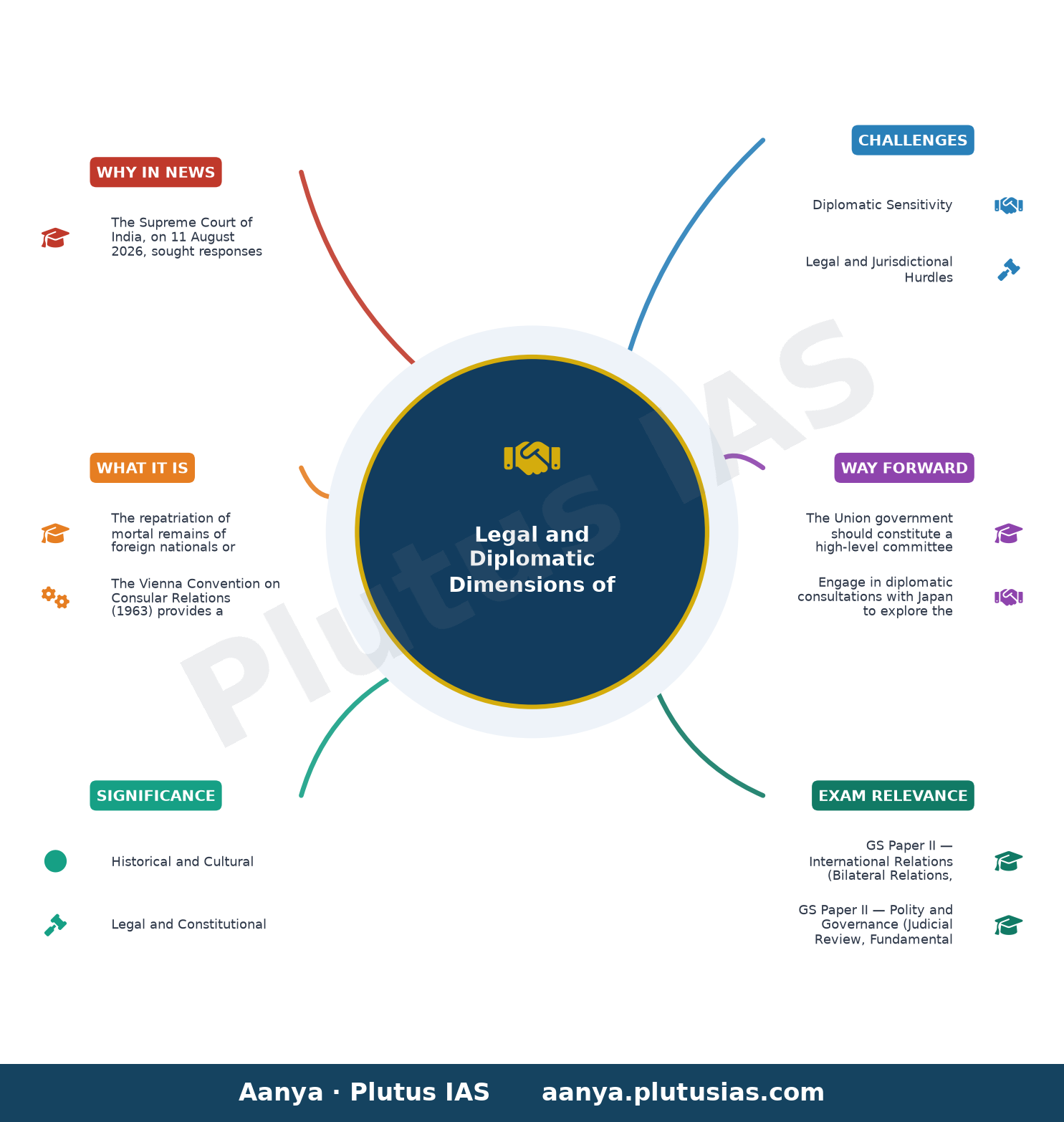
- GS Paper II — International Relations (Bilateral Relations, Cultural Diplomacy, Consular Access) | GS Paper II — Polity and Governance (Judicial Review, Fundamental Duties, Right to Dignified Last Rites) | GS Paper IV — Ethics, Integrity and Aptitude (Moral Responsibilities of the State, Family and Community Sentiments)
- Prelims: Fundamental Rights (Article 21 — Right to Dignified Life and Death), Judicial Review (Article 136 — Special Leave Petition), Cultural and Historical Diplomacy, Consular Relations and Repatriation of Remains, Netaji Subhas Chandra Bose, Renkō-Ji Temple, Taipei (Taihoku), Indian National Army (INA), Subsidiary Alliance and Allied Powers (World War II)
- Essay: The Role of Historical Memory in National Identity, Ethics of State Responsibility towards the Families of Freedom Fighters
Quick Revision: The repatriation of Netaji Subhas Chandra Bose’s ashes from Tokyo involves a confluence of diplomatic protocols under the Vienna Convention on Consular Relations, constitutional rights under Article 21, and the Supreme Court’s jurisdiction under Article 136 for matters of public importance.
Why is this in the news?
The Supreme Court of India, on 11 August 2026, sought responses from the Union Ministries of External Affairs and Home Affairs on a petition filed by Anita Bose Pfaff, daughter of Netaji Subhas Chandra Bose, seeking the repatriation of his mortal remains from the Renkō-Ji Temple in Tokyo. The petition underscores the prolonged inaction of the Government of India in facilitating the repatriation of Netaji’s ashes, thereby raising critical questions about diplomatic protocol, cultural sensitivity, and the state’s moral obligations toward the families of historical figures.
Background
- Netaji Subhas Chandra Bose, a prominent leader of the Indian independence movement and founder of the Indian National Army (INA), is believed to have died in an air crash at Taihoku (Taipei) in 1945, shortly after the surrender of Japan to the Allied Powers in World War II.
- Following his death, his mortal remains were transported to Tokyo in early September 1945 and interred at the Renkō-Ji Temple, where they have been preserved for over 80 years.
- The Government of India has, to date, not formally repatriated Netaji’s ashes, despite multiple representations from family members and public figures over the decades.
- The issue has resurfaced periodically, with legal petitions filed in the Supreme Court, including one by Netaji’s grandnephew Ashish Ray, which was previously dismissed on the grounds that the petitioner lacked locus standi.
- The current petition by Anita Bose Pfaff, represented by senior advocate A.M. Singhvi, argues that the prolonged delay in repatriation constitutes a violation of the family’s right to perform final rites with dignity and closure.
- The Union government’s stance on the matter remains unarticulated in public records, though the matter involves diplomatic negotiations with Japan, consular access protocols, and cultural considerations.
What is the Legal and Diplomatic Framework Governing the Repatriation of Remains?
- The repatriation of mortal remains of foreign nationals or historical figures is governed by bilateral treaties, consular conventions, and domestic laws of the countries involved.
- The Vienna Convention on Consular Relations (1963) provides a framework for the handling of human remains, including the right of the family to request repatriation and the obligation of the host state to facilitate the process in a dignified manner.
- The Indian Succession Act, 1925, and personal laws may also be invoked to determine the rights of the family members to perform last rites, though these are secondary to diplomatic and consular considerations in cases of international significance.
- The Supreme Court of India, under Article 136 of the Constitution, can entertain Special Leave Petitions (SLPs) on matters of public importance, including those involving historical figures or constitutional rights, even if the petitioner lacks direct legal standing in traditional terms.
- Cultural and historical diplomacy plays a pivotal role in such repatriation requests, as the remains of Netaji Bose are not merely personal property but a symbol of India’s freedom struggle, thereby invoking national sentiment and historical memory.
- The Government of Japan, as the host state, has maintained the remains at the Renkō-Ji Temple in accordance with local customs and Buddhist traditions, which adds a layer of complexity to the repatriation process.
- The principle of ‘closure’ for the family, as articulated in the petition, intersects with the state’s duty to uphold the dignity of the individual and the cultural heritage associated with the figure, as enshrined in Article 21 of the Constitution (Right to Life and Personal Liberty).
- The matter also raises questions about the state’s moral responsibility toward the families of freedom fighters, whose contributions to the nation’s history are often unacknowledged in tangible terms beyond symbolic gestures.
Key Features
| Feature | Significance |
|---|---|
| Petition by Legal Heir | The Supreme Court has entertained a petition filed by Anita Bose Pfaff, daughter of Netaji Subhash Chandra Bose, as his legal heir, seeking repatriation of his mortal remains from Renkō-Ji Temple, Tokyo. |
| Judicial Notice | The Supreme Court has issued notice to the Union Ministries of External Affairs and Home Affairs, indicating the matter’s legal and constitutional gravity. |
| Historical Preservation | Netaji’s remains have been preserved at Renkō-Ji Temple for over 80 years, reflecting a long-standing cultural and religious practice in Japan. |
| Government Inaction | The petition highlights the Union government’s prolonged failure to take a final, reasoned, and time-bound decision on repatriation, despite multiple representations. |
| Cultural and Emotional Aspect | The request for repatriation stems from the desire of Netaji’s family to perform final rites in India, addressing a long-standing emotional and cultural need. |
Why it Matters
Historical and Cultural
- The case underscores the enduring legacy of Netaji Subhash Chandra Bose, a pivotal figure in India’s freedom struggle, and the emotional resonance of his final rites in the national consciousness.
- The preservation of his remains in a foreign temple for decades symbolizes a historical anomaly that intersects with India’s post-colonial identity.
- The issue raises questions about the state’s role in addressing the cultural and emotional aspirations of citizens regarding national heroes.
Legal and Constitutional
- The petition tests the Union government’s constitutional obligation to facilitate the repatriation of the remains of a national leader, balancing diplomatic, legal, and cultural considerations.
- The Supreme Court’s intervention highlights the judiciary’s role in resolving disputes involving historical and cultural heritage, even in matters of foreign jurisdiction.
- The case may set a precedent for the repatriation of remains of other historical figures preserved abroad, raising questions of state responsibility.
Diplomatic and International
- The repatriation request involves negotiations with Japan, a strategic partner, requiring diplomatic sensitivity and adherence to international protocols.
- The case tests India’s ability to navigate bilateral relations while addressing domestic public sentiment and cultural expectations.
- The preservation of remains in a foreign temple reflects historical ties between India and Japan during the freedom struggle, adding a layer of diplomatic nuance.
Social and Emotional
- The request for repatriation addresses a long-standing emotional and cultural need of Netaji’s family and the nation, providing closure to a historical narrative.
- The case highlights the role of family rights and cultural practices in shaping national memory and heritage.
- The public discourse surrounding the petition reflects the deep emotional connection of Indians to their freedom fighters and national icons.
Challenges
1. Diplomatic Sensitivity
- Repatriation requires delicate negotiations with Japan, balancing domestic expectations with international diplomacy.
- Japan’s cultural and religious practices regarding the preservation of remains may pose legal and ethical challenges.
- The Union government must ensure that the process respects both Indian and Japanese legal frameworks.
UPSC Link: Constitutional provisions on foreign relations (Part XXI)
2. Legal and Jurisdictional Hurdles
- The Union government’s inaction may stem from legal ambiguities regarding jurisdiction over remains preserved in a foreign temple.
- The Supreme Court’s intervention raises questions about the limits of judicial authority in matters involving foreign jurisdictions.
- The case may require a legal framework to address the repatriation of remains of national figures preserved abroad.
UPSC Link: Judicial review and separation of powers
3. Cultural and Emotional Sensitivities
- The repatriation request must balance the emotional needs of Netaji’s family with broader national sentiments.
- The case may evoke debates about the appropriate way to honor national heroes, including whether repatriation is necessary or symbolic.
- The Union government must navigate public expectations while ensuring a dignified and respectful process.
UPSC Link: Cultural and historical heritage (Constitution, Directive Principles)
4. Government Inaction and Policy Gaps
- The prolonged failure to take a decision highlights gaps in the Union government’s policy framework for handling such heritage and cultural issues.
- The case underscores the need for a structured, time-bound approach to address similar requests in the future.
- The Union government must develop a clear policy on the repatriation of remains of national figures preserved abroad.
UPSC Link: Role of the executive in governance
5. Public Perception and National Sentiment
- The case has the potential to polarize public opinion, with differing views on whether repatriation is necessary or practical.
- The Union government must manage public expectations while ensuring a transparent and inclusive process.
- The case may influence how future generations perceive the legacy of Netaji and other freedom fighters.
UPSC Link: Role of media and public opinion in governance
Challenges — UPSC Perspective
| Issue | Concern |
|---|---|
| Diplomatic Relations | Balancing India’s domestic expectations with Japan’s cultural and legal practices. |
| Legal Jurisdiction | Determining the Union government’s authority over remains preserved in a foreign temple. |
| Cultural Sensitivities | Addressing the emotional and cultural needs of Netaji’s family and the nation. |
| Government Inaction | The prolonged failure to take a final, reasoned decision on repatriation. |
| Public Sentiment | Managing differing views on the necessity and practicality of repatriation. |
Way Forward
- The Union government should constitute a high-level committee comprising representatives from the Ministries of External Affairs, Home Affairs, Culture, and Law to examine the legal, diplomatic, and cultural aspects of the repatriation request.
- Engage in diplomatic consultations with Japan to explore the feasibility of repatriation while respecting its cultural and religious practices.
- Develop a clear, time-bound policy framework for the repatriation of remains of national figures preserved abroad, ensuring transparency and accountability.
- Consult with Netaji’s family to understand their preferences and ensure their emotional and cultural needs are addressed.
- Involve legal experts to assess the jurisdiction and legal implications of repatriation, including potential challenges in foreign courts.
- Conduct a public consultation or awareness campaign to explain the process, challenges, and potential outcomes of repatriation.
- Ensure that any repatriation process is dignified, respectful, and aligned with both Indian and Japanese cultural norms.
UPSC Value Addition
Keywords for Mains Answer-Writing
Subhash Chandra Bose · Repatriation of mortal remains · Renkō-Ji Temple, Tokyo · Supreme Court of India · Article 21 (Right to dignity) · Constitutional remedies · Ministry of External Affairs · Historical memory and closure · Freedom struggle legacy · Legal heir and succession · Diplomatic negotiations · Cultural diplomacy
Constitutional & Policy Linkages
- Article 253: Power of Parliament to provide for the implementation of international agreements (for diplomatic negotiations).
- Article 51: Promotion of international peace and security (relevant to diplomatic relations).
Concept Flow
Netaji’s death in 1945 and preservation of remains in Tokyo → Long-standing preservation at Renkō-Ji Temple → Family’s request for repatriation → Supreme Court petition by legal heir → Union government’s inaction → Judicial intervention and notice to ministries → Diplomatic and legal challenges in repatriation → Need for policy framework and public consultation.
Prelims Practice Questions
Q1. Consider the following statements regarding the repatriation of Netaji Subhash Chandra Bose’s mortal remains:
1. The mortal remains of Netaji are preserved at Renkō-Ji Temple in Tokyo.
2. The Supreme Court of India has recently issued notice to the Union Ministries of External Affairs and Home on a petition seeking repatriation.
3. Netaji is believed to have died in an air crash at Taihoku (Taipei) in 1945.
4. The Union government has already taken a final decision to repatriate the remains to India.
How many of the above statements are correct?
- Only one
- Only two
- Only three
- All four
Answer: Only three — Statements 1, 2, and 3 are correct. Statement 4 is incorrect as the Union government has not taken a final decision on repatriation.
Q2. Assertion (A): The Supreme Court of India can issue directions for the repatriation of mortal remains preserved abroad under Article 32 of the Constitution.
Reason (R): Article 32 provides for the enforcement of fundamental rights, including the right to dignity under Article 21.
Options:
A. Both A and R are true, and R is the correct explanation of A.
B. Both A and R are true, but R is not the correct explanation of A.
C. A is true, but R is false.
D. A is false, but R is true.
- A
- B
- C
- D
Answer: A — Both Assertion (A) and Reason (R) are true. The Supreme Court can issue directions under Article 32 for the enforcement of fundamental rights, including the right to dignity (Article 21), which may encompass the repatriation of mortal remains for closure.
Mains Practice Question
✍ The preservation of Netaji Subhash Chandra Bose’s mortal remains at Renkō-Ji Temple in Tokyo for over eight decades has been described as a state of ‘posthumous exile’ and a denial of closure to his family. In this context, critically examine the constitutional and legal dimensions of the right to dignity and closure for families in matters of repatriation of mortal remains preserved abroad. Also, discuss the role of the judiciary in ensuring such rights. (15 Marks)
Approach: MODEL-ANSWER SKELETON:
1. **Introduction (2 marks)**: Define the right to dignity (Article 21) and its judicial expansion to include closure and emotional well-being. Mention the case of *Common Cause (A Registered Society) v. Union of India* (2018) where the Supreme Court recognized the right to die with dignity.
2. **Constitutional and Legal Framework (4 marks)**:
– Article 21: Right to life and personal liberty, including dignity and emotional closure.
– Article 32: Jurisdiction of the Supreme Court to enforce fundamental rights.
– International law: Vienna Convention on Consular Relations (1963) and bilateral agreements for repatriation of mortal remains.
– Domestic laws: The Registration of Births and Deaths Act, 1969, and the Foreigners Act, 1946 (for diplomatic clearance).
3. **Judicial Precedents (4 marks)**:
– *Parmanand Katara v. Union of India* (1995): Right to dignity extends to the treatment of the dead.
– *Ashray Adhikar Abhiyan v. Union of India* (2002): Right to dignity includes the right to a dignified funeral.
– Recent Supreme Court orders in the Netaji case: Issuance of notice to the Union government and insistence on direct representation by the legal heir.
4. **Role of the Judiciary (3 marks)**:
– Judicial activism in enforcing fundamental rights and ensuring accountability of the executive.
– Balancing diplomatic sensitivities with constitutional rights.
– Ensuring time-bound decisions by the executive in matters of repatriation.
5. **Conclusion (2 marks)**: Reiterate the need for a balanced approach that respects constitutional rights while maintaining diplomatic decorum. Highlight the importance of closure for families and the preservation of historical memory.
Source: The Hindu
Generated by AanyaAi for educational purpose.

- KWML’s Feasibility Reports for Water Metro in 18 Cities: UPSC & PCS Insights - October 3, 2026
- ओडिशा में वन्यजीव अनुसंधान अनुदान कार्यक्रम शुरू, सिमिलिपाल में 300 कैमरे और बढ़ेंगे - October 3, 2026
- India Summons Pakistan High Commission Official Over Violation - October 3, 2026

No Comments