


11 Aug Supreme Court seeks response on Netaji’s ashes repatriation plea
✎ The repatriation of Netaji Subhas Chandra Bose’s ashes from Tokyo is not merely a diplomatic or familial issue but a constitutional obligation under Article 21, requiring the Union Government to act within a reasonable timeframe…
Subject Relevance — Where This Topic Fits
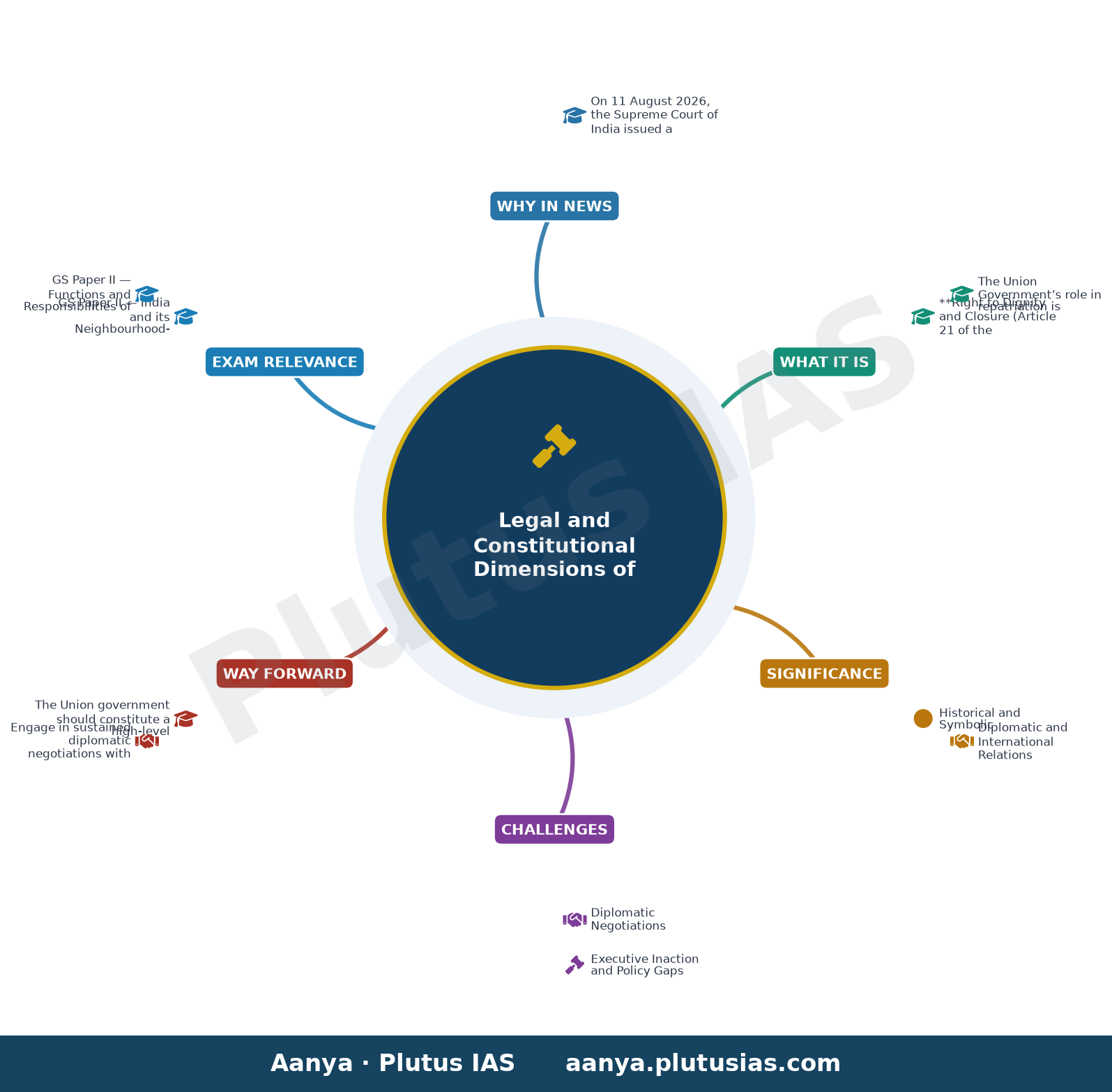
- GS Paper II — India and its Neighbourhood- Relations with Japan | GS Paper II — Functions and Responsibilities of the Union and the States, Issues and Challenges Pertaining to the Federal Structure | GS Paper II — Judiciary and its Role in Governance | GS Paper IV — Ethical Governance and Transparency in Public Administration
- Prelims: Subhas Chandra Bose, Indian National Army (INA), Renkō-Ji Temple, Tokyo, Right to Perform Last Rites, Union Ministry of External Affairs, Supreme Court of India, Article 21 (Right to Dignity), Diplomatic Immunity and Cultural Property
- Essay: The ethical obligations of the state towards the preservation of historical memory and the dignity of national heroes, The interplay between judicial intervention and executive discretion in matters of foreign policy and heritage conservation
Quick Revision: The repatriation of Netaji Subhas Chandra Bose’s ashes from Tokyo is not merely a diplomatic or familial issue but a constitutional obligation under Article 21, requiring the Union Government to act within a reasonable timeframe to facilitate closure for the family and the nation.
Why is this in the news?
On 11 August 2026, the Supreme Court of India issued a notice to the Union Ministries of External Affairs and Home Affairs on a petition filed by Anita Bose Pfaff, daughter of Netaji Subhas Chandra Bose, seeking the repatriation of her father’s mortal remains from the Renkō-Ji Temple in Tokyo. The petition underscores the prolonged inaction of the Indian government in facilitating the repatriation of Netaji’s ashes, which have been preserved in Japan for over eight decades, thereby raising significant questions about the state’s duty to address the emotional and cultural aspirations of the nation.
Background
- Netaji Subhas Chandra Bose, a prominent leader of the Indian independence movement and founder of the Indian National Army (INA), is believed to have died in an air crash in 1945, following the Japanese surrender to the Allied Powers in World War II.
- His mortal remains were transported to Tokyo in early September 1945 and subsequently interred at the Renkō-Ji Temple, where they have been preserved by successive head priests for over 80 years.
- The preservation of Netaji’s ashes in Japan has become a matter of historical and cultural significance, with successive generations of Indians expressing a desire for their repatriation to enable the performance of final rites in India.
- The Union Government has, to date, not taken a final decision on the repatriation of Netaji’s ashes, despite multiple representations from the family and the public.
- The Supreme Court, in its order dated 11 August 2026, has sought responses from the Union Ministries of External Affairs and Home Affairs.
- This petition follows a prior attempt by Netaji’s grandnephew, Ashish Ray, which the Supreme Court refused to entertain, prompting the current legal recourse by Anita Bose Pfaff as the legal heir.
What is the legal and constitutional framework governing the repatriation of mortal remains from foreign jurisdictions?
- **Right to Dignity and Closure (Article 21 of the Constitution)**: The Supreme Court has, in several judgments, recognised the right to live with dignity as an integral part of the right to life under Article 21. This includes the right to perform final rites with dignity, which may extend to the repatriation of mortal remains from foreign jurisdictions if such repatriation is essential for the closure of the family’s emotional and cultural obligations.
- The Union Government’s role in repatriation is guided by the **Constitution of India (Article 73)** and the **Government of India (Allocation of Business) Rules, 1961**, which vest the Ministry of External Affairs with the responsibility for matters relating to foreign relations, including the repatriation of mortal remains.
- The **Vienna Convention on Consular Relations, 1963**, to which India and Japan are parties, provides a legal framework for the repatriation of mortal remains. Article 37 of the Convention obligates the receiving state to facilitate the return of the remains of a deceased foreign national to their country of origin, subject to local laws and regulations.
- The **Embassy of India in Tokyo** and the **Ministry of External Affairs** are the primary nodal agencies for facilitating the repatriation process, which involves coordination with Japanese authorities, issuance of necessary documents, and logistical arrangements for transportation.
- The **Supreme Court’s jurisdiction** under Article 32 of the Constitution empowers it to issue directions, orders, or writs for the enforcement of fundamental rights, including the right to dignity and closure. The court’s intervention in this matter reflects its role as the guardian of constitutional rights and its willingness to address lacunae in executive action.
- The preservation of Netaji’s ashes in Japan for over eight decades raises **questions of cultural heritage and historical memory**, as the site has become a symbol of both reverence and unresolved national sentiment.
- The Union Government’s inaction may also be examined through the lens of **administrative law principles**, including the doctrine of legitimate expectation and the duty to act fairly, particularly where prolonged delay has created a sense of injustice among stakeholders.
Key Features
| Feature | Significance |
|---|---|
| Petition by legal heir | Establishes the locus standi of Anita Bose Pfaff as Netaji’s daughter and legal heir to seek repatriation of mortal remains, addressing the family’s long-standing demand for closure. |
| Supreme Court intervention | The judiciary’s role in directing the Union government to respond underscores the constitutional remedy available for citizens to seek redressal of grievances against executive inaction. |
| Preservation of remains | The 80-year-old state of remains at Renkō-Ji Temple reflects Japan’s cultural and religious practices, necessitating diplomatic and legal negotiations for repatriation. |
| Executive inaction | The Union government’s delay in taking a reasoned, time-bound decision highlights the procedural and policy lacunae in handling historical and sentimental matters of national significance. |
| Judicial precedent | The court’s insistence on the legal heir filing the petition directly sets a procedural precedent for similar cases involving repatriation of historical figures’ remains. |
Why it Matters
Historical and Symbolic
- Netaji Subhash Chandra Bose’s legacy remains a pivotal symbol of India’s freedom struggle, and his remains’ repatriation would provide symbolic closure to a chapter of national history that has been debated for decades.
- The issue intersects with the broader narrative of India’s struggle for independence, particularly the contributions of the Indian National Army (INA) and the complex geopolitical context of 1945.
- The preservation of remains in a foreign temple for over eight decades raises questions about the ethical and cultural dimensions of posthumous remembrance and diasporic identity.
Diplomatic and International Relations
- The repatriation of Netaji’s remains would require delicate diplomatic negotiations with Japan, given the cultural and religious significance of the Renkō-Ji Temple and the historical ties between the two nations.
- This case could set a precedent for future requests for repatriation of historical figures’ remains, influencing India’s diplomatic engagements with other countries.
- The Union government’s response will reflect its approach to handling sensitive historical and cultural matters in foreign policy, balancing national sentiment with international relations.
Constitutional and Legal
- The petition invokes the right of the legal heir to perform final rites, which intersects with the constitutional guarantee of cultural and religious freedom under Article 25.
- The Supreme Court’s intervention highlights the judiciary’s role in ensuring that executive inaction does not infringe upon citizens’ rights or perpetuate unresolved grievances.
- The case underscores the need for a structured legal and policy framework to address historical and sentimental matters of national importance.
Societal and Cultural
- The issue resonates deeply with sections of society that view Netaji as a national hero, and his repatriation could serve as a unifying symbol of national pride and historical justice.
- The prolonged preservation of remains abroad may evoke sentiments of neglect or indifference, necessitating a sensitive and inclusive approach to resolution.
- The case also raises questions about the preservation of historical memory and the role of institutions in ensuring that such legacies are accorded due respect and closure.
Challenges
1. Diplomatic Negotiations
- Japan’s cultural and religious attachment to the Renkō-Ji Temple may pose challenges in securing consent for repatriation, requiring high-level diplomatic engagement.
- The Union government must balance national sentiment with international relations, ensuring that negotiations do not strain bilateral ties.
UPSC Link: GS-II: India and its neighbourhood- relations.
2. Executive Inaction and Policy Gaps
- The Union government’s delay in taking a reasoned decision highlights the absence of a structured policy framework for handling such historical and sentimental matters.
- A time-bound and transparent process is required to address similar requests in the future, ensuring that executive inaction does not perpetuate grievances.
UPSC Link: GS-II: Functions and responsibilities of the Union and the States.
3. Legal and Procedural Hurdles
- The Supreme Court’s insistence on the legal heir filing the petition directly may set a procedural precedent, but it also underscores the need for clarity in locus standi for such cases.
- The case may face challenges in establishing the authenticity of claims or navigating competing legal heirships, requiring thorough legal scrutiny.
UPSC Link: GS-II: Judiciary- structure, organization and functioning.
4. Cultural and Ethical Sensitivities
- The repatriation of remains must be handled with cultural sensitivity, respecting both Indian and Japanese traditions to avoid unintended offense.
- The Union government must also address the ethical dimensions of posthumous remembrance, ensuring that the process is inclusive and respectful of all stakeholders.
UPSC Link: GS-II: Effect of policies and politics of developed and developing countries.
5. Public Sentiment and National Unity
- The issue has the potential to evoke strong public sentiments, necessitating careful handling to ensure that the resolution process fosters national unity rather than division.
- The Union government must engage with diverse stakeholders, including historians, legal experts, and cultural organizations, to build a consensus on the way forward.
UPSC Link: GS-II: Government policies and interventions for development in various sectors.
Challenges — UPSC Perspective
| Issue | Concern |
|---|---|
| Diplomatic consent from Japan | Japan’s cultural and religious attachment to the Renkō-Ji Temple may hinder repatriation negotiations. |
| Lack of structured policy framework | The Union government’s delay highlights the absence of a clear process for handling historical remains repatriation. |
| Legal heirship disputes | Competing claims to Netaji’s legacy may complicate the repatriation process. |
| Public sentiment and national unity | Strong emotions tied to Netaji’s legacy require sensitive handling to avoid division. |
| Cultural and ethical sensitivities | Respecting both Indian and Japanese traditions is essential to avoid unintended offense. |
Way Forward
- The Union government should constitute a high-level inter-ministerial committee, including representatives from the Ministries of External Affairs, Home, Culture, and Law, to examine the petition and formulate a reasoned response.
- Engage in sustained diplomatic negotiations with Japan, emphasizing the cultural and historical significance of the repatriation while respecting local sensitivities.
- Develop a structured policy framework for handling future requests for repatriation of historical figures’ remains, ensuring transparency and time-bound decision-making.
- Conduct consultations with historians, legal experts, and cultural organizations to build a consensus on the repatriation process and address potential concerns.
- Ensure that the repatriation process, if approved, is handled with cultural sensitivity, involving both Indian and Japanese stakeholders to foster mutual respect.
- The Supreme Court may consider appointing an amicus curiae to assist in examining the legal and procedural aspects of the petition, ensuring a balanced and informed decision.
- Address the symbolic and emotional dimensions of the issue by engaging with the public through awareness campaigns, highlighting the historical and cultural significance of Netaji’s legacy.
UPSC Value Addition
Keywords for Mains Answer-Writing
Subhash Chandra Bose · Repatriation of mortal remains · Supreme Court of India · Renkō-Ji Temple · Constitutional right to dignity · Indian National Army · Freedom struggle legacy · Cultural diplomacy · Memorialisation of freedom fighters · Diplomatic negotiations · Posthumous justice · Family rights and rituals · International relations · Historical memory and commemoration
Constitutional & Policy Linkages
- Article 25: Freedom of conscience and free profession, practice, and propagation of religion (right to perform final rites).
- Article 26: Freedom to manage religious affairs (respect for cultural and religious practices in repatriation).
Concept Flow
Netaji’s death in 1945 and preservation of remains in Tokyo → 80-year state of affairs with no closure for family → Daughter files petition in Supreme Court → Court seeks response from Union government → Legal and diplomatic challenges arise → Need for structured policy framework → Way forward involves inter-ministerial committee, diplomatic negotiations, and public engagement.
Prelims Practice Questions
Q1. Consider the following statements regarding the repatriation of Subhash Chandra Bose’s mortal remains:
1. The mortal remains of Netaji Subhash Chandra Bose are currently preserved at Renkō-Ji Temple in Tokyo.
2. The Supreme Court of India has issued notice to the Union Ministries of External Affairs and Home on a petition seeking repatriation of the remains.
3. The petition was filed by Netaji’s grandnephew Ashish Ray, and the Supreme Court had previously refused to entertain an identical petition filed by Netaji’s daughter.
How many of the above statements are correct?
- Only one
- Only two
- All three
- None
Answer: All three — Statements 1 and 2 are correct. Statement 3 is incorrect as the Supreme Court had refused to entertain an identical petition filed by Netaji’s grandnephew Ashish Ray but allowed Anita Bose Pfaff, Netaji’s daughter, to approach the court directly.
Q2. Assertion (A): The Supreme Court of India has the jurisdiction to direct the repatriation of mortal remains preserved in a foreign country.
Reason (R): The Supreme Court can issue directions under Article 32 of the Constitution of India to enforce fundamental rights, including the right to dignity.
Options:
A. Both A and R are true, and R is the correct explanation of A.
B. Both A and R are true, but R is not the correct explanation of A.
C. A is true, but R is false.
D. A is false, but R is true.
- A
- B
- C
- D
Answer: A — Both Assertion (A) and Reason (R) are true. The Supreme Court can issue directions under Article 32 to enforce fundamental rights, including the right to dignity, which may extend to the repatriation of mortal remains for the purpose of performing final rites with dignity.
Q3. Match the following pairs related to Subhash Chandra Bose and his legacy:
Column I
1. Indian National Army (INA)
2. Renkō-Ji Temple
3. Taihoku (Taipei)
4. Anita Bose Pfaff
Column II
A. Location where Netaji’s mortal remains are preserved
B. Daughter of Subhash Chandra Bose who filed the petition for repatriation
C. Place of Netaji’s alleged death in an air crash
D. Military wing founded by Netaji during the freedom struggle
Select the correct match from the options below:
- 1-D, 2-A, 3-C, 4-B
- 1-A, 2-B, 3-C, 4-D
- 1-B, 2-C, 3-D, 4-A
- 1-C, 2-D, 3-A, 4-B
Answer: 1-D, 2-A, 3-C, 4-B — The correct matches are: 1-D (INA founded by Netaji), 2-A (Renkō-Ji Temple in Tokyo), 3-C (Taihoku where Netaji allegedly died), 4-B (Anita Bose Pfaff, Netaji’s daughter).
Mains Practice Question
✍ The preservation of Subhash Chandra Bose’s mortal remains in a foreign temple for over eight decades has been described as a state of ‘posthumous exile’ and a denial of closure to his family and the nation. In this context, critically examine the legal, constitutional, and diplomatic dimensions of the repatriation of historical remains of national leaders. Also, analyse the implications of such repatriation for the commemoration of freedom struggle heroes in contemporary India. (15 Marks)
Approach: MODEL-ANSWER SKELETON:
1. **Legal and Constitutional Dimensions** (5 Marks):
– Right to dignity (Article 21) and cultural rights of the family under Article 25(1).
– Jurisdiction of the Supreme Court under Article 32 to enforce fundamental rights in transnational contexts.
– Precedents of repatriation of mortal remains (e.g., Sher Singh Rana case, 2015).
– Role of the Union Government’s executive authority in diplomatic negotiations.
2. **Diplomatic and International Relations** (4 Marks):
– Bilateral agreements and cultural diplomacy with Japan.
– Sovereignty and territorial integrity considerations in repatriation requests.
– Historical sensitivities and the role of the Renkō-Ji Temple as a site of honour.
3. **Commemoration and National Memory** (4 Marks):
– Importance of memorialisation in preserving historical memory (e.g., Netaji Bhavan, INA Memorial).
– Public sentiment and the role of the media in shaping narratives.
– Balancing personal grief with national symbolism.
4. **Counterarguments and Challenges** (2 Marks):
– Potential diplomatic friction or cultural insensitivity.
– Logistical and financial implications of repatriation.
– Alternative forms of honouring Netaji’s legacy without repatriation (e.g., virtual memorials).
Source: The Hindu
Generated by AanyaAi for educational purpose.

- KWML’s Feasibility Reports for Water Metro in 18 Cities: UPSC & PCS Insights - October 3, 2026
- ओडिशा में वन्यजीव अनुसंधान अनुदान कार्यक्रम शुरू, सिमिलिपाल में 300 कैमरे और बढ़ेंगे - October 3, 2026
- India Summons Pakistan High Commission Official Over Violation - October 3, 2026

No Comments