


23 Sep Supreme Court Slams Odisha-Centre Collusion in DGP Appointment Case
✎ The Prakash Singh case (2006) mandates that the UPSC prepare a panel of three senior-most officers for DGP appointments, ensuring transparency and insulating the police from executive interference; any deviation from this process…
Subject Relevance — Where This Topic Fits
- GS Paper II — Functions and Responsibilities of the Union and the States, Issues and Challenges Pertaining to the Federal Structure | GS Paper IV — Ethics and Integrity in Governance
- Prelims: Prakash Singh Case (2006), Director General of Police (DGP) appointment, Integrity certificate in civil services, UPSC role in police appointments, Ex-cadre posts in state police, CBI’s investigative powers
- Essay: The Role of Judicial Oversight in Upholding Constitutional Governance, Balancing Executive Autonomy and Institutional Integrity in Public Institutions
Quick Revision: The Prakash Singh case (2006) mandates that the UPSC prepare a panel of three senior-most officers for DGP appointments, ensuring transparency and insulating the police from executive interference; any deviation from this process undermines constitutional safeguards and judicial directives.
Why is this in the news?
The Supreme Court is examining allegations of premeditated collusion between the Odisha government and the Centre in the withdrawal of the integrity certificate of senior IPS officer Sushant Kumar Nath, which allegedly circumvented the constitutional safeguards laid down in the landmark Prakash Singh case (2006) for the appointment of the Director General of Police (DGP). The case underscores the tension between executive discretion and judicial directives in ensuring transparency and fairness in police appointments.
Background
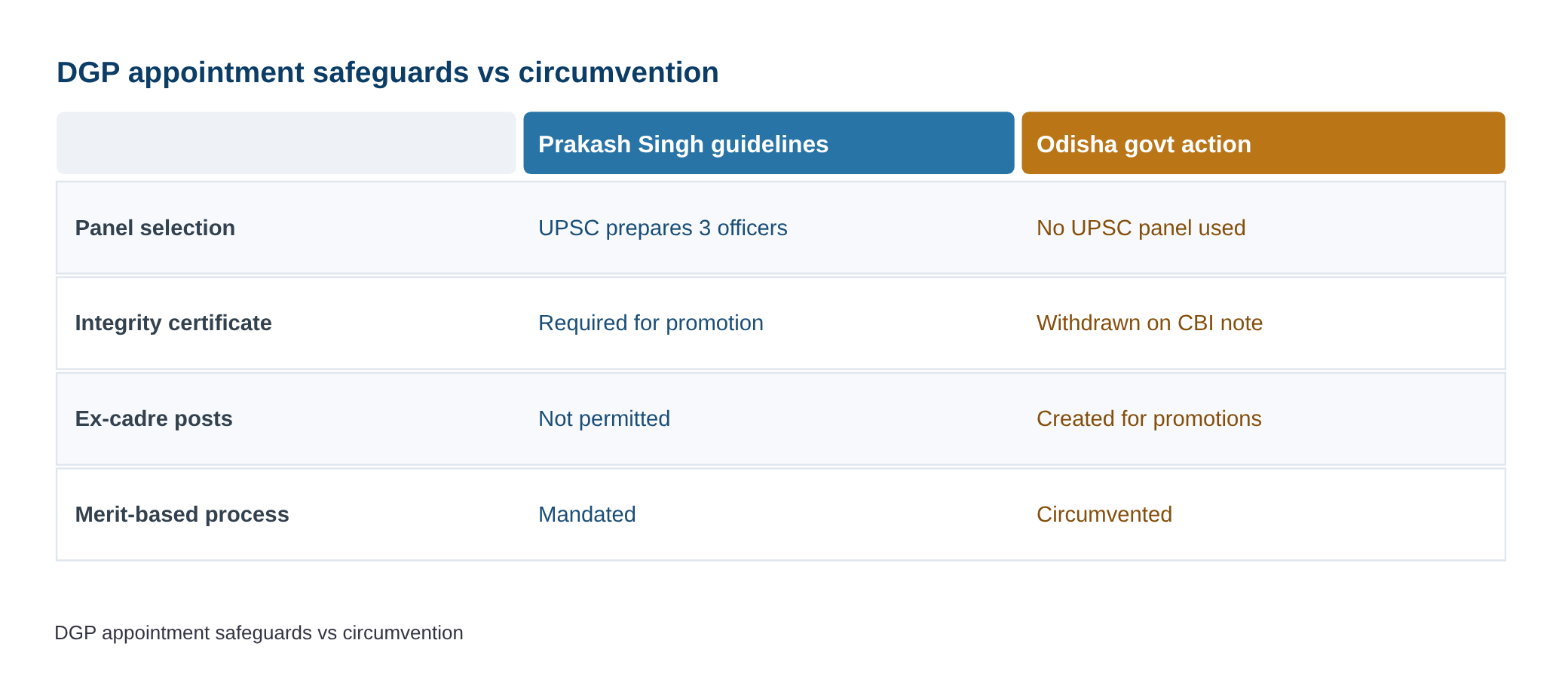
- The Supreme Court, in the landmark judgment *Prakash Singh & Ors. v. Union of India* (2006), laid down comprehensive guidelines to insulate the police from excessive executive control, particularly in the appointment of the DGP. The judgment mandated that the Union Public Service Commission (UPSC) prepare a panel of three senior-most officers (Grade 16) and send it to the state government for selection, ensuring a merit-based and transparent process.
- The Prakash Singh case was a response to widespread concerns about political interference in police appointments, which compromised institutional autonomy and professional integrity.
- The integrity certificate is a critical document certifying an officer’s suitability for promotion, based on their service record, conduct, and absence of disciplinary or criminal proceedings.
- The CBI’s communication stating that an officer ‘may be required to be examined’ does not constitute a formal chargesheet or disciplinary action, yet the Odisha government withdrew the integrity certificate of Sushant Kumar Nath solely on this basis, raising questions about procedural propriety.
- The creation of two temporary ex-cadre posts by the Odisha government to facilitate the promotion of other officers has been cited as evidence of circumvention of the established selection process.
- The case highlights the broader issue of executive overreach in sensitive appointments, where procedural safeguards are bypassed under the guise of administrative discretion.
What is the Prakash Singh Case (2006) and its relevance to DGP appointments?
- The *Prakash Singh v. Union of India* (2006) case was a landmark judgment by the Supreme Court aimed at insulating the police from political interference and ensuring professional autonomy.
- The Court directed that the UPSC prepare a panel of three senior-most officers (Grade 16) for the DGP post, and the state government select one from this panel, ensuring transparency and meritocracy.
- The judgment emphasized that the DGP should have a minimum tenure of two years, barring exceptional circumstances, to ensure functional independence and continuity.
- The Court also mandated that the selection process be based on seniority, merit, and integrity, with no scope for arbitrary exclusion of officers from the panel.
- The integrity certificate is a key component of this process, certifying that the officer has no pending disciplinary or criminal proceedings that could impair their suitability for promotion.
- The case underscored the principle that police appointments must be insulated from political pressures to ensure impartial law enforcement and institutional credibility.
- The judgment is a cornerstone of judicial oversight in governance, reinforcing the separation of powers and the primacy of constitutional mandates over executive discretion.
Key Features
| Feature | Significance |
|---|---|
| Supreme Court’s Prakash Singh judgment (2006) | Established a transparent, merit-based process for DGP appointments to insulate police from executive interference, mandating UPSC-led selection from a panel of senior-most officers. |
| Integrity certificate mechanism | A formal certification by the state government to the UPSC to validate an officer’s suitability for promotion, ensuring adherence to ethical and professional standards. |
| CBI’s preliminary inquiry communication | A non-conclusive investigative step that does not establish guilt but may trigger administrative scrutiny, particularly in cases involving alleged misconduct. |
| Temporary ex-cadre posts | Non-permanent positions created to circumvent merit-based promotions, raising concerns about arbitrary executive decisions in cadre management. |
| Judicial review of executive actions | The Supreme Court’s oversight role in ensuring compliance with constitutional principles and its own directives in matters of public interest. |
Why it Matters
Governance and Institutional Integrity
- The case underscores the critical need for adherence to the Prakash Singh judgment’s framework to prevent executive overreach in police appointments, which is essential for maintaining institutional autonomy and public trust in law enforcement.
- The integrity certificate mechanism serves as a safeguard against arbitrary disqualification of officers, ensuring that promotions are based on merit and not influenced by extraneous considerations.
- The creation of temporary ex-cadre posts highlights the risks of administrative manipulation to bypass established norms, potentially eroding the credibility of the selection process.
Rule of Law and Due Process
- The Supreme Court’s intervention reaffirms the principle that executive actions must align with legal and constitutional mandates, particularly in matters affecting the independence of statutory bodies like the police.
- The case illustrates the importance of due process in administrative decisions, where allegations or preliminary inquiries alone should not suffice to disqualify an officer without concrete evidence or chargesheet.
Judicial-Executive Interface
- The judgment exemplifies the judiciary’s role in curbing executive discretion that may undermine institutional integrity, ensuring that governance remains within the bounds of the Constitution.
- It reinforces the need for coordination between the Centre and state governments in matters of cadre management, particularly in sensitive roles like the DGP, to avoid conflicts of interest or collusion.
Challenges
1. Executive Overreach in Cadre Management
- Risk of arbitrary creation of temporary posts to manipulate promotions, bypassing merit-based selection processes.
- Potential for misuse of integrity certificates to disqualify officers based on preliminary inquiries rather than conclusive evidence.
- Erosion of institutional autonomy of police forces due to excessive executive control.
UPSC Link: GS2: Constitutional and Statutory Bodies
2. Judicial Enforcement of Constitutional Directives
- Challenge in ensuring timely compliance with Supreme Court judgments like Prakash Singh (2006) across states.
- Difficulty in balancing judicial oversight with executive autonomy in governance matters.
- Need for mechanisms to monitor and penalize non-compliance with constitutional directives.
UPSC Link: GS2: Judiciary and Constitutional Framework
3. Maintaining Transparency in Police Appointments
- Ensuring that the UPSC-led selection process remains free from external pressures or manipulations.
- Preventing the influence of political or bureaucratic considerations in the appointment of key police officers.
- Addressing concerns of public perception regarding the integrity of the selection process.
UPSC Link: GS2: Role of Constitutional Bodies
4. Balancing Due Process and Administrative Efficiency
- Risk of delays in administrative decisions due to judicial scrutiny, affecting operational efficiency.
- Need for clear guidelines on the weightage of preliminary inquiries in administrative decisions.
- Ensuring that officers are not unfairly penalized for allegations that lack substantive evidence.
UPSC Link: GS2: Government Policies and Interventions
Challenges — UPSC Perspective
| Issue | Concern |
|---|---|
| Arbitrary creation of temporary posts | Undermines merit-based promotions and creates avenues for executive manipulation. |
| Misuse of integrity certificates | Potential to disqualify officers based on non-conclusive investigations, violating due process. |
| Lack of coordination between Centre and state | May lead to conflicts in cadre management, affecting police independence. |
| Judicial delays in enforcement | Can erode public trust in the judiciary and delay critical administrative reforms. |
| Influence of extraneous factors in appointments | Risks compromising the professionalism and autonomy of the police force. |
| Public perception of bias in selections | May undermine confidence in the integrity of the police and governance institutions. |
Way Forward
- Strengthen the implementation of the Prakash Singh judgment by mandating periodic audits of state compliance with Supreme Court directives on DGP appointments.
- Establish clear guidelines for the issuance and withdrawal of integrity certificates, ensuring they are based on conclusive evidence rather than preliminary inquiries.
- Enhance transparency in the creation of temporary posts by requiring legislative approval or judicial oversight for non-permanent cadre positions.
- Develop a standardized protocol for the Centre-state coordination in police cadre management to prevent conflicts of interest or collusion.
- Promote capacity-building programs for state officials on constitutional governance and the importance of judicial directives in administrative decisions.
- Encourage the use of technology (e.g., blockchain for records) to ensure tamper-proof documentation of performance assessments and integrity certificates.
- Foster public awareness campaigns to educate citizens on the constitutional safeguards in police appointments and the role of the judiciary.
- Institute a dedicated mechanism within the UPSC to monitor and report on compliance with court directives in police appointments across states.
UPSC Value Addition
Keywords for Mains Answer-Writing
Supreme Court of India · Prakash Singh case (2006) · Director General of Police (DGP) appointment · Police Act, 1861 · Constitutional provisions for police independence · UPSC panel for DGP selection · Integrity certificate in civil services · CBI investigation and civil service integrity · Judicial review of executive actions · Federalism and Centre-State relations · Police reforms in India · Article 324 of the Constitution
Constitutional & Policy Linkages
- Article 32: Writ Jurisdiction of the Supreme Court to enforce fundamental rights and ensure compliance with constitutional directives.
- Article 14: Right to Equality and non-arbitrariness in administrative actions, ensuring fairness in police appointments.
- Article 21: Right to Life and Personal Liberty, interpreted to include the right to a fair and transparent process in public appointments.
Concept Flow
Supreme Court’s Prakash Singh judgment (2006) → Establishes transparent, UPSC-led DGP appointment process → State governments must comply with directives → Integrity certificates become a key tool in the process → CBI preliminary inquiry triggers withdrawal of certificate → State creates temporary ex-cadre posts to bypass merit-based promotion → Petitioner challenges the action in Supreme Court → Court examines compliance with its own directives → Focus on executive-judicial interface and due process → Judgment reaffirms constitutional principles and institutional autonomy → Sets precedent for future appointments and governance reforms.
Prelims Practice Questions
Q1. Consider the following statements regarding the appointment of the Director General of Police (DGP) in India:
1. The Supreme Court in the Prakash Singh case (2006) directed that the UPSC shall prepare a panel of three senior-most officers for the DGP post.
2. The state government is bound to select the DGP from the panel prepared by the UPSC.
3. The integrity certificate for an officer can be withheld solely on the basis of a CBI communication stating that the officer ‘may be required to be examined’.
How many of the above statements are correct?
- Only one
- Only two
- All three
- None
Answer: All three — Statements 1 and 2 are correct as per the Prakash Singh case (2006) directives. Statement 3 is incorrect because the integrity certificate cannot be withheld solely on the basis of a preliminary CBI communication without further evidence or chargesheet.
Q2. Assertion (A): The Supreme Court has held that the integrity certificate of a civil servant cannot be withheld arbitrarily by the executive.
Reason (R): The integrity certificate is a prerequisite for promotion and must be based on verifiable evidence of misconduct.
Options:
A. Both A and R are true, and R is the correct explanation of A.
B. Both A and R are true, but R is not the correct explanation of A.
C. A is true, but R is false.
D. A is false, but R is true.
Answer: ? — Both A and R are true. The Supreme Court has consistently held that the integrity certificate must be based on verifiable evidence and not on mere suspicion or preliminary investigations, making R the correct explanation of A.
Q3. Match the following provisions with their respective constitutional or statutory contexts:
Column I (Provision) | Column II (Context)
1. Article 324 | A. Appointment of DGP
2. Prakash Singh case (2006) | B. Independence of the Election Commission
3. Police Act, 1861 | C. Police reforms and institutional autonomy
4. Article 53(1) | D. Executive power of the Union
Options:
A. 1-B, 2-C, 3-A, 4-D
B. 1-B, 2-A, 3-C, 4-D
C. 1-D, 2-C, 3-B, 4-A
D. 1-A, 2-B, 3-D, 4-C
- A
- B
- C
- D
Answer: B — The correct match is: 1-B (Article 324 relates to the Election Commission), 2-C (Prakash Singh case pertains to police reforms), 3-A (Police Act, 1861 governs police administration), 4-D (Article 53(1) vests executive power in the President).
Mains Practice Question
✍ The Supreme Court has repeatedly emphasised the need to insulate the police from excessive executive control to ensure functional autonomy. In light of the recent observations in the case regarding the appointment of the Director General of Police (DGP) in Odisha, critically examine the constitutional and judicial framework governing the appointment of the DGP. Also, analyse the implications of arbitrary withholding of integrity certificates by the executive on the independence of the civil services. (15 Marks)
Approach: MODEL-ANSWER SKELETON:
1. **Constitutional and Statutory Framework** (4 points):
– Article 324 of the Constitution and the Election Commission’s independence (as a comparative analogy).
– Police Act, 1861: Historical context and its limitations in modern governance.
– Landmark judgment in Prakash Singh vs Union of India (2006): Key directives including UPSC panel for DGP selection, minimum tenure, and insulation from arbitrary transfers.
– Role of Article 53(1) (executive power of the President) and its interplay with judicial directives.
2. **Judicial Pronouncements and Precedents** (4 points):
– Supreme Court’s emphasis on functional autonomy of police in Prakash Singh (2006), Vineet Narain (1998), and Common Cause (2018) cases.
– Doctrine of ‘collegium’ vs executive interference in civil service appointments.
– Recent observations in the Odisha DGP case: Precedential value and the need for adherence to judicial directives.
3. **Executive Interference and Integrity Certificates** (4 points):
– Definition and purpose of integrity certificates in civil service promotions (refer to UPSC guidelines and All India Services Rules).
– Judicial stance on arbitrary withholding: CBI communication alone cannot suffice (refer to recent apex court rulings).
– Implications for civil service independence: Erosion of morale, politicisation, and breach of constitutional morality.
– Comparative analysis with other democratic federations (e.g., USA’s FBI Director appointment process).
4. **Balanced Conclusion** (3 points):
– Need for statutory backing to Prakash Singh directives (e.g., via Police Act amendments).
– Role of the judiciary in safeguarding institutional autonomy.
– Recommendations: Transparent criteria for integrity certificates, time-bound investigations, and judicial oversight.
Source: orissapost.com
Odisha PCS (OPSC (OAS)) — State PCS Practice
Prelims: Which constitutional provision was allegedly violated in the ‘premeditated collusion’ between the Odisha government and the Centre regarding the appointment of the DGP, as highlighted by the Supreme Court?
- Article 320 (Public Service Commission)
- Article 321 (Extension of functions of Public Service Commissions)
- Article 323 (Reports of Public Service Commissions)
- Article 324 (Superintendence, direction and control of elections)
Answer: Article 320 (Public Service Commission) — The Supreme Court highlighted the violation of Article 320, which mandates consultation with the State Public Service Commission (PSC) for DGP appointments, as the alleged ‘premeditated collusion’ bypassed this constitutional requirement.
Mains: Critically examine the judicial stance of the Supreme Court in the case of ‘premeditated collusion’ between the Odisha government and the Centre in the appointment of the DGP. How does this judgment reinforce the principles of federalism and constitutional governance in India? (250 words)
Generated by AanyaAi for educational purpose.
Related guides on our sites
- Current affairs for upsc 2026
- How to prepare for GS paper 1 for UPSC CSE mains exam
- Best UPSC coaching for IFOS exam
- Best mentorship programme for upsc

- Supreme Court Slams Odisha-Centre Collusion in DGP Appointment Case - September 23, 2026
- NIRF रैंकिंग 2026: नए बदलाव और क्यों है ये महत्वपूर्ण? - September 23, 2026
- NIRF Rankings 2026: Key Changes & Their Impact on UPSC Aspirants - September 23, 2026

No Comments