


09 Aug Supreme Court Stays FIR Against Kullu Rave Party Officials; Key UPSC Polity Insight
✎ The Supreme Court’s stay on FIR registration and SIT formation in the Kullu Rave Party case, while upholding officer transfers, underscores the judiciary’s role in ensuring administrative accountability without undermining…
Subject Relevance — Where This Topic Fits
- GS Paper II — Polity and Governance: Judicial Review and Separation of Powers | GS Paper III — Internal Security: Narcotics Control and Public Order Maintenance
- Prelims: Judicial Review, Special Leave Petition (SLP), Narcotic Drugs and Psychotropic Substances Act, 1985, Public Interest Litigation (PIL), Administrative Accountability, Stay Order, State Transfer of Officers
- Essay: The Role of Judiciary in Upholding Constitutional Morality in Governance, Balancing Individual Liberties and Public Order: Lessons from Narcotics Regulation
Quick Revision: The Supreme Court’s stay on FIR registration and SIT formation in the Kullu Rave Party case, while upholding officer transfers, underscores the judiciary’s role in ensuring administrative accountability without undermining executive autonomy.
Why is this in the news?
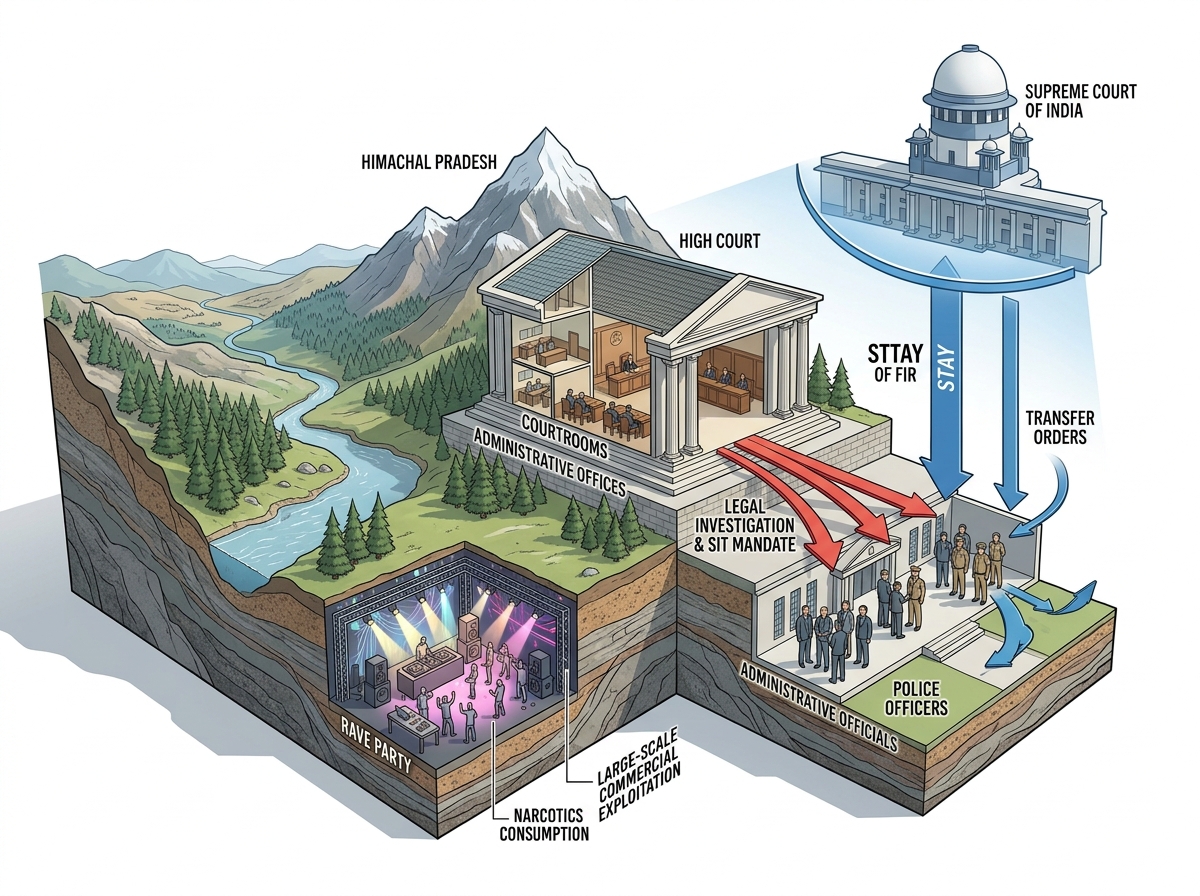
The Supreme Court of India has recently stayed the registration of First Information Reports (FIRs) and the constitution of a Special Investigation Team (SIT) against administrative officials in the Kullu Rave Party case, while simultaneously upholding their transfer orders. This judicial intervention underscores the tension between judicial oversight of administrative actions and the independence of the executive in matters of public order, particularly in the context of narcotics proliferation and event management in tourist-centric regions like Himachal Pradesh.
Background
- The Kullu Rave Party case emerged from allegations of large-scale narcotics consumption and commercial exploitation of ‘rave parties’ in tourist hubs such as Kullu, Manali, Kasol, and Jibbi in Himachal Pradesh.
- The High Court’s order of 24 June 2026 sought to examine whether there was tacit consent or collusion between event organisers and administrative officials in permitting these gatherings, which reportedly involved high entry fees (ranging from ₹5,000 to ₹7,00,000) and widespread substance abuse.
- Administrative officers, including the then Superintendent of Police (SP) Kullu, Deputy Commissioner (DC) Kullu, and Sub-Divisional Magistrate (SDM) Kullu, challenged the High Court’s directives by filing Special Leave Petitions (SLPs) in the Supreme Court.
- The Supreme Court, in its orders dated 27 July and 4 August 2026, granted interim stays on FIR registration and SIT formation while maintaining the transfer orders of the officers, citing the need for impartial investigation and administrative accountability.
- The case highlights the recurring challenge of balancing judicial activism in public interest litigation with the constitutional mandate of separation of powers and executive autonomy.
What is the Kullu Rave Party Case and Its Legal Framework?
- The case pertains to allegations of large-scale narcotics consumption and commercial exploitation of ‘rave parties’ in tourist-centric regions of Himachal Pradesh, particularly Kullu, Manali, Kasol, and Jibbi.
- The High Court’s order of 24 June 2026 sought answers to critical questions, including the number of FIRs registered, arrests made, age demographics of those arrested, the utilisation of high entry fees (₹5,000 to ₹7,00,000), and actions taken against organisers’ assets under narcotics and money-laundering laws.
- Administrative officers challenged the High Court’s directives in the Supreme Court via Special Leave Petitions (SLPs) under Article 136 of the Constitution, arguing that the orders infringed upon executive autonomy and violated principles of natural justice.
- The Supreme Court, in its interim orders dated 27 July and 4 August 2026, stayed the registration of FIRs and the constitution of an SIT against the officers while upholding their transfer orders, emphasising the need for impartial investigation and administrative accountability.
- The case intersects with the Narcotic Drugs and Psychotropic Substances (NDPS) Act, 1985, which criminalises the production, possession, and consumption of prohibited substances, and the Prevention of Money-Laundering Act, 2002, which targets the financial proceeds of illicit activities.
- The judicial intervention reflects the broader constitutional debate on the judiciary’s role in overseeing executive actions, particularly in matters of public order and narcotics control, while ensuring that judicial activism does not encroach upon the domain of the executive.
- The case also raises questions about the regulation of commercial events in tourist destinations, where the line between legitimate entertainment and organised crime often blur.
Key Features
| Feature | Significance |
|---|---|
| Supreme Court’s interim stay on FIR and SIT probe | Preserves the administrative officers’ rights pending final adjudication while ensuring compliance with judicial directives through transfers. |
| Transfer of SP and DC, Kullu | Demonstrates institutional accountability and mitigates potential interference in ongoing investigations. |
| High Court’s directive for FIR registration | Mandates investigation into alleged complicity of officials in narcotics trafficking and commercial exploitation under the guise of tourism. |
| Youth participation in rave parties | Highlights the socio-economic dimension of drug abuse and its nexus with unregulated commercial events. |
| Judicial oversight of administrative actions | Ensures checks and balances in governance, particularly in sensitive areas like public order and narcotics control. |
Why it Matters
Legal and Judicial
- Reinforces the principle of judicial review over executive actions in matters involving public order and narcotics control.
- Demonstrates the judiciary’s role in ensuring impartiality in investigations through suo motu cognisance and directives.
- Balances the rights of accused officials with the public interest in unobstructed investigations.
Administrative and Governance
- Exposes systemic vulnerabilities in the regulation of commercial events, particularly in tourist hubs.
- Underscores the need for inter-departmental coordination between police, district administration, and revenue authorities.
- Highlights the challenge of balancing tourism promotion with law enforcement in ecologically sensitive regions.
Socio-Economic
- Raises concerns about the exploitation of youth through high-cost, unregulated commercial events.
- Links narcotics trafficking to economic activities, necessitating stricter financial audits of event organisers.
- Reflects the broader issue of substance abuse among adolescents and young adults in hill states.
Environmental
- Raises questions about the ecological impact of large-scale commercial gatherings in fragile Himalayan ecosystems.
- Highlights the need for sustainable tourism policies that do not compromise law and order.
Challenges
1. Regulatory Arbitrage in Commercial Events
- Lack of a unified regulatory framework for commercial gatherings in tourist destinations.
- Inadequate pre-event scrutiny of organisers, revenue sources, and participant profiles.
- Delayed or selective enforcement of narcotics and public order laws.
UPSC Link: GS3: Environment, GS3: Security
2. Judicial-Executive Interface
- Risk of judicial overreach in executive functions during interim orders.
- Potential erosion of public trust in institutions due to perceived bias in transfers or investigations.
- Need for clear timelines in judicial directives to avoid prolonged uncertainty.
UPSC Link: GS2: Judiciary
3. Narcotics Trafficking and Youth Vulnerability
- Sophistication of drug supply chains linked to international networks.
- Limited awareness and rehabilitation infrastructure for substance abuse among youth.
- Challenges in prosecuting organisers due to lack of evidence linking them directly to trafficking.
UPSC Link: GS3: Security, GS3: Social Justice
4. Tourism-Ecology Conflict
- Balancing economic gains from tourism with environmental conservation in Himalayan states.
- Inadequate monitoring of waste generation, noise pollution, and ecological degradation.
- Need for participatory governance involving local communities in tourism policy formulation.
UPSC Link: GS3: Environment
Challenges — UPSC Perspective
| Issue | Concern |
|---|---|
| Lack of pre-event licensing for commercial gatherings | Enables unchecked proliferation of high-risk events. |
| Inadequate financial audits of event organisers | Facilitates money laundering and tax evasion. |
| Delayed FIR registration despite prima facie evidence | Undermines deterrence against organised crime. |
| Absence of inter-state coordination in narcotics control | Allows traffickers to exploit jurisdictional gaps. |
| Limited judicial capacity for fast-tracking such cases | Results in prolonged legal battles and delayed justice. |
Government Initiatives — Must-Memorise for Prelims
- Narcotic Drugs and Psychotropic Substances (NDPS) Act, 1985
Way Forward
- Formulate a model regulatory framework for commercial gatherings in tourist destinations, integrating environmental, legal, and social safeguards.
- Strengthen inter-departmental task forces comprising police, excise, revenue, and environment departments for real-time monitoring.
- Mandate pre-event financial audits and background checks of organisers and sponsors.
- Establish fast-track courts for NDPS cases to ensure timely justice and deter organised crime.
- Launch awareness campaigns targeting youth, parents, and local communities on substance abuse and legal consequences.
- Integrate ecological impact assessments into tourism policy, with mandatory compliance for event organisers.
- Enhance coordination between state police and central agencies like NCB to track drug supply chains.
- Conduct periodic reviews of administrative transfers to ensure they do not impede ongoing investigations.
UPSC Value Addition
Keywords for Mains Answer-Writing
Judicial review · Supreme Court of India · Judicial activism vs judicial restraint · FIR and SIT investigations · Administrative accountability · Separation of powers · Judicial overreach · Constitutional morality · Right to fair investigation · Public interest litigation (PIL) · Judicial supremacy · Rule of law · Executive accountability
Constitutional & Policy Linkages
- Article 14: Equality before law (ensuring impartial investigations)
- Article 21: Right to life and personal liberty (balancing individual rights with public interest)
- Article 32: Writ jurisdiction (judicial oversight of executive actions)
Concept Flow
Unregulated commercial rave parties in Kullu-Manali region → Alleged complicity of officials in narcotics trade → High Court directs FIR registration → Officials challenge in Supreme Court → Supreme Court stays FIR/SIT but upholds transfers → Judicial-Executive tension over accountability → Broader implications for tourism governance and youth protection.
Prelims Practice Questions
Q1. Consider the following statements regarding the Supreme Court of India:
1. The Supreme Court has the power to stay FIRs and SIT probes against public officials.
2. The Supreme Court can direct the transfer of public officials pending investigations.
3. The Supreme Court can suo motu initiate investigations into administrative lapses.
How many of the above statements are correct?
- Only one
- Only two
- All three
- None
Answer: All three — Statements 1 and 2 are correct as per the given case. Statement 3 is not explicitly supported by the facts presented.
Q2. Assertion (A): The Supreme Court’s power to stay FIRs and SIT probes is an exercise of judicial review.
Reason (R): Judicial review empowers the Supreme Court to examine the legality of executive actions and decisions.
In the context of the above two statements, which one of the following is correct?
- Both A and R are true, and R is the correct explanation of A
- Both A and R are true, but R is NOT the correct explanation of A
- A is true, but R is false
- A is false, but R is true
Answer: Both A and R are true, but R is NOT the correct explanation of A — The Supreme Court’s power to stay FIRs and SIT probes is indeed an exercise of judicial review. The reason correctly explains the assertion.
Q3. Match the following terms with their correct descriptions:
Column I
A. FIR
B. SIT
C. Judicial review
D. PIL
Column II
1. A special investigation team constituted for in-depth probes
2. First Information Report filed to initiate criminal proceedings
3. A legal mechanism to examine the constitutionality of executive actions
4. A petition filed in public interest to address broader societal issues
- A-2, B-1, C-3, D-4
- A-1, B-2, C-3, D-4
- A-3, B-1, C-2, D-4
- A-4, B-1, C-3, D-2
Answer: A-2, B-1, C-3, D-4 — FIR (First Information Report) initiates criminal proceedings (A-2). SIT is a special investigation team (B-1). Judicial review examines constitutionality (C-3). PIL addresses public interest (D-4).
Mains Practice Question
✍ The Supreme Court’s interim order staying FIRs and SIT probes against public officials in the Kullu Rave Party case has reignited debates on the boundaries of judicial intervention in executive functions. Critically examine the implications of such judicial interventions for the doctrine of separation of powers and administrative accountability in India. (15 Marks)
Approach: MODEL-ANSWER SKELETON:
1. **Introduction**: Briefly outline the Kullu Rave Party case and the Supreme Court’s interim order (stay on FIRs/SIT, transfer of officials).
2. **Doctrine of Separation of Powers**:
– Define the doctrine (Montesquieu, Indian constitutional scheme: Art. 50, 74, 75, 163).
– Judicial activism vs judicial restraint: Landmark cases (S.P. Gupta v. Union of India, 1981; Common Cause v. Union of India, 1999; Vineet Narain v. Union of India, 1996).
– Balance between judicial review (Art. 32, 226) and executive autonomy.
3. **Administrative Accountability**:
– Role of FIRs and SITs in ensuring accountability.
– Judicial interventions and their impact on executive functioning (e.g., delays, erosion of public trust).
4. **Critique**:
– Arguments in favor: Judicial safeguards against executive excesses, protection of fundamental rights (Art. 14, 21).
– Arguments against: Judicial overreach, undermining executive prerogatives, potential for politicization.
5. **Conclusion**: Weigh the necessity of judicial intervention against the risks of undermining democratic governance. Propose a balanced approach (e.g., strict adherence to constitutional limits, judicial restraint in purely executive domains).
Source: amarujala.com
Generated by AanyaAi for educational purpose.

- आपातकाल में ‘गायब’ शाह आयोग रिपोर्ट का रहस्यमयी पुनर्प्राप्ति - September 23, 2026
- What happened to the Shah Commission report on Emergency? UPSC analysis - September 23, 2026
- तमिलनाडु के लिए क्या है ‘एल नीनो’ और उत्तर-पूर्वी मानसून का खतरा? - September 23, 2026

No Comments