


31 Jul Supreme Court Stays NSE Under RTI Act: Key Implications for UPSC Aspirants
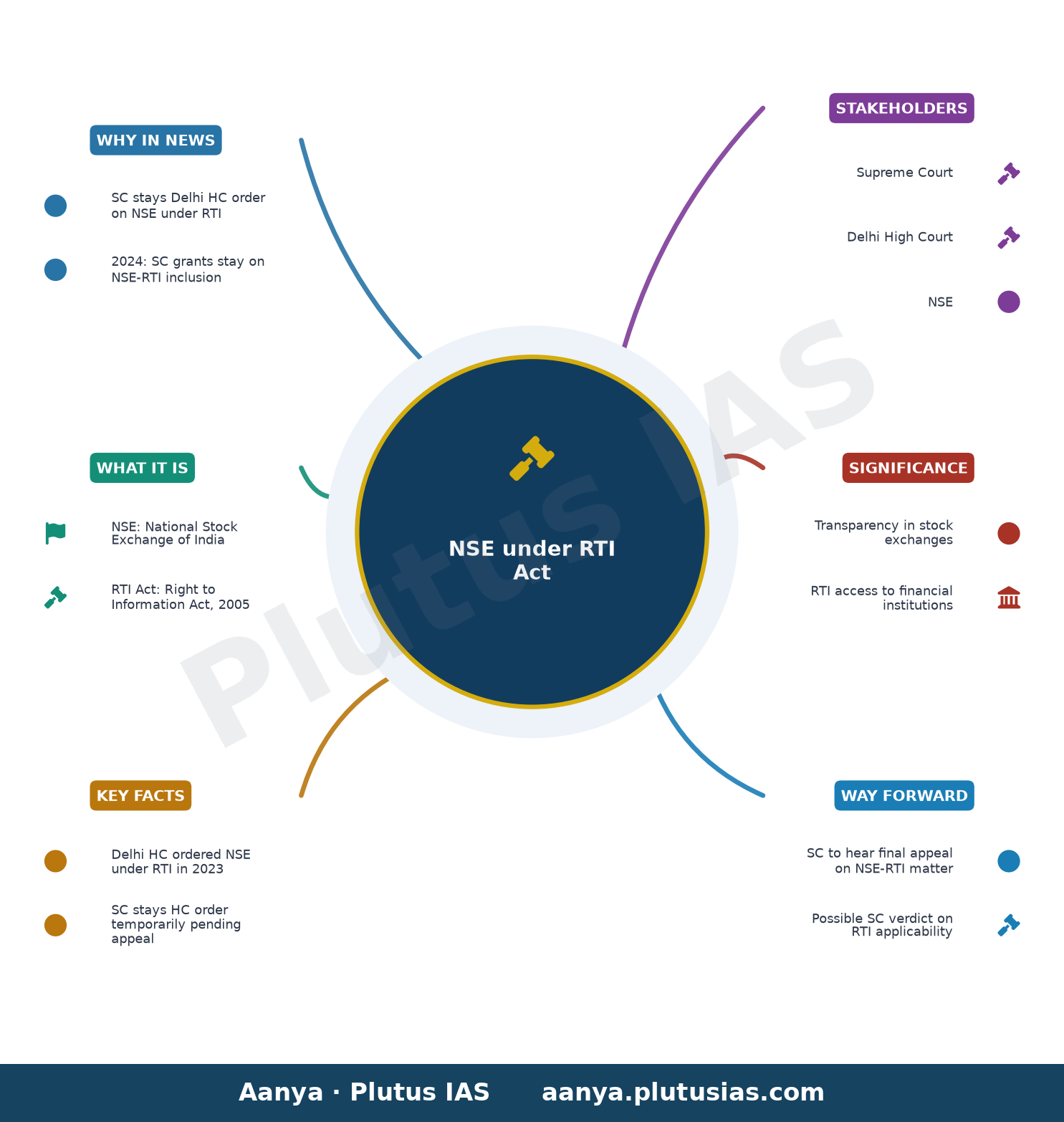
✎ Supreme Court stays Delhi HC order, keeping NSE temporarily outside RTI ambit pending final verdict.
Relevance for UPSC & State PCS: Polity
The Supreme Court has stayed the Delhi High Court’s order directing the National Stock Exchange (NSE) to be brought under the ambit of the Right to Information (RTI) Act, 2005. The apex court’s interim order came in response to an appeal filed by the NSE, challenging the High Court’s judgment that declared the exchange a “public authority” under Section 2(h) of the RTI Act. The NSE had argued that it is a private entity governed by the Securities and Exchange Board of India (SEBI) and does not receive substantial funding from the government, thus not qualifying as a public authority. The Supreme Court’s stay order highlights the ongoing debate over the scope of the RTI Act, particularly concerning entities that perform public functions but operate with private ownership structures.
This case is significant for UPSC and State PCS aspirants as it touches upon critical aspects of constitutional and administrative law, including the definition of a “public authority” under the RTI Act. The Supreme Court’s decision will set a precedent for whether entities like stock exchanges, which regulate market activities but are not directly controlled by the government, can be subjected to RTI scrutiny. For aspirants, understanding such judicial interpretations is crucial, as questions on RTI and public authority definitions frequently appear in both prelims and mains examinations. The case also underscores the balance between transparency and the autonomy of regulatory bodies, a theme often tested in governance and polity segments.
The Delhi High Court’s earlier ruling had expanded the ambit of the RTI Act by including the NSE within its scope, reasoning that it performs public functions such as regulating securities markets and ensuring investor protection. However, the Supreme Court’s stay order suggests a more cautious approach, emphasizing the need to examine the extent of government control and funding before classifying an entity as a public authority. This nuanced interpretation is relevant for aspirants studying the RTI Act’s provisions, particularly Sections 2(h) and 12, which define public authorities and their obligations under the law.
For State PCS aspirants, the case highlights the practical implications of RTI in governance, especially in states where regulatory bodies similar to the NSE operate. The Supreme Court’s eventual verdict could influence how such entities are held accountable, impacting transparency in financial and economic governance. Aspirants should focus on the interplay between regulatory autonomy and public accountability, as questions on RTI’s application to non-governmental bodies are increasingly common in competitive examinations. The case also serves as a reminder of the dynamic nature of judicial interpretations in constitutional law, a key area of study for civil services aspirants.
Source: ndtv.com
Practice Questions
Q1. Which constitutional body recently stayed an order to bring the National Stock Exchange (NSE) under the Right to Information (RTI) Act?
- The Parliament of India
- The Supreme Court of India
- The Securities and Exchange Board of India (SEBI)
- The Ministry of Finance
Answer
The Supreme Court of India — The Supreme Court of India stayed an order by the Central Information Commission (CIC) that directed the National Stock Exchange (NSE) to come under the ambit of the Right to Information (RTI) Act. This decision highlights the legal complexities involved in extending RTI to regulatory bodies.
Q2. What was the primary reason cited by the Supreme Court for staying the order to bring the NSE under the RTI Act?
- To prevent interference in market operations
- To avoid burdening the NSE with excessive RTI requests
- To examine the legal jurisdiction and applicability of RTI to stock exchanges
- To protect the commercial interests of listed companies
Answer
To examine the legal jurisdiction and applicability of RTI to stock exchanges — The Supreme Court stayed the order primarily to examine the legal jurisdiction and applicability of the RTI Act to stock exchanges like the NSE. This indicates a need for clarity on whether regulatory bodies like stock exchanges fall under the purview of RTI.
Generated by AanyaAi for educational purpose.

- यूएन महासभा में भारत के विदेश मंत्री जयशंकर के उच्चस्तरीय दौरे का महत्व - September 21, 2026
- मध्य प्रदेश: हाईकोर्ट ने बलात्कार मामले में आरोपी को डीएनए सबूत के आधार पर किया दोषमुक्त - September 21, 2026
- MP High Court Acquits Rape Convict Due to Negative DNA Evidence - September 21, 2026

No Comments