


05 Aug Supreme Court to Decide Upcoming Bypoll Timeline Under Section 151A on Sept 22
✎ Section 151A of the Representation of the People Act, 1951, mandates that by-elections to fill vacancies in Parliament or State Legislatures must be conducted within six months if the remaining term of the member is one year or…
Subject Relevance — Where This Topic Fits
- GS Paper II — Polity and Governance (Constitutional Provisions, Election Commission of India, Judicial Review) | GS Paper III — Role of Constitutional Bodies
- Prelims: Representation of the People Act, 1951, Section 151A, Election Commission of India, By-elections, Judicial Review of Electoral Processes
- Essay: The Role of the Judiciary in Ensuring Electoral Integrity: Balancing Constitutional Mandates and Statutory Interpretations
Quick Revision: Section 151A of the Representation of the People Act, 1951, mandates that by-elections to fill vacancies in Parliament or State Legislatures must be conducted within six months if the remaining term of the member is one year or more.
Why is this in the news?
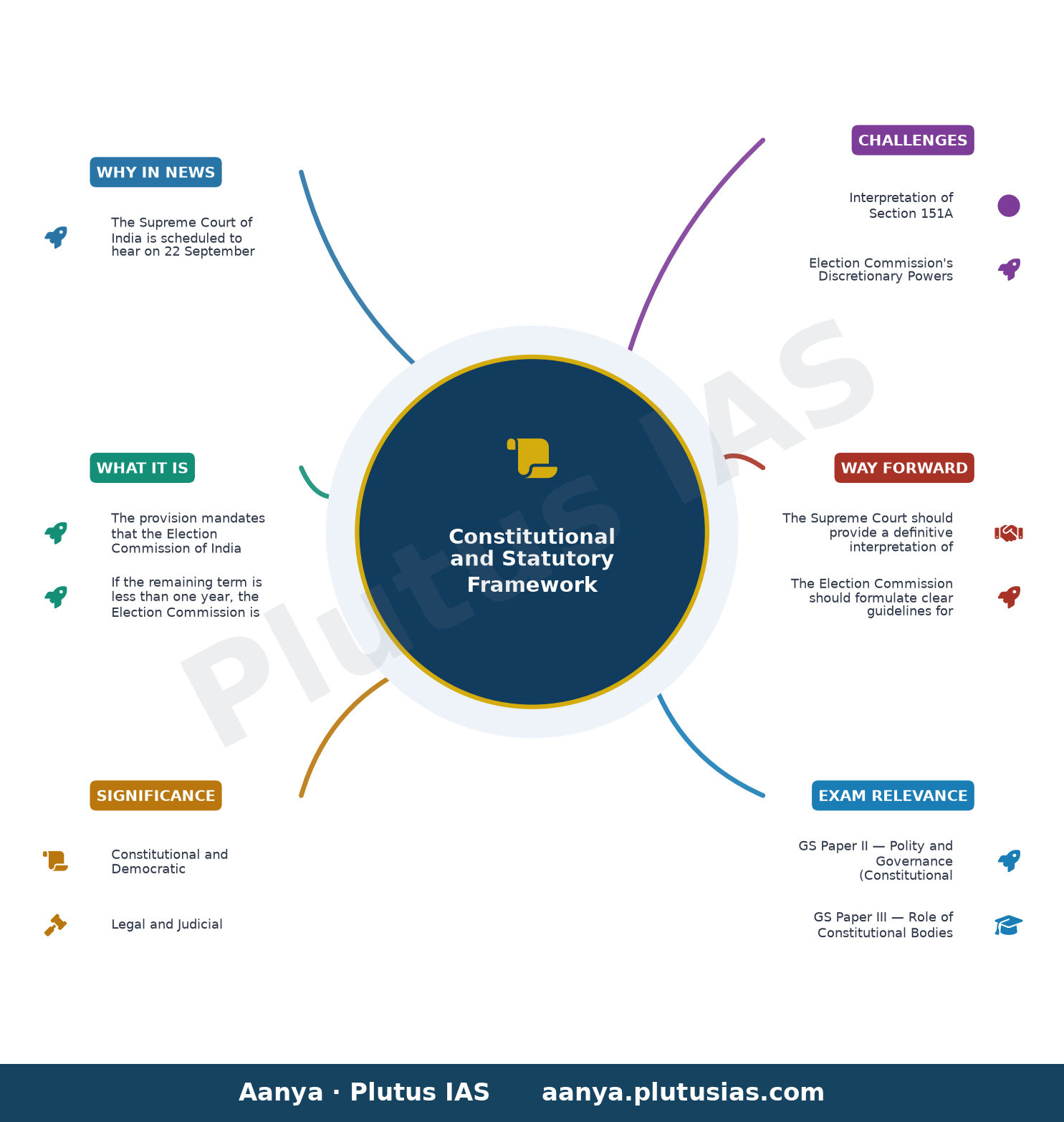
The Supreme Court of India is scheduled to hear on 22 September 2026 a critical case involving the interpretation of Section 151A of the Representation of the People Act, 1951. The case pertains to the timeline for conducting by-elections to fill vacancies in Parliament and State Legislatures, and the role of the Election Commission of India in determining such timelines. The hearing arises from a Bombay High Court order directing immediate by-elections for a Lok Sabha seat, which the Election Commission challenged before the Supreme Court, citing the need for a uniform interpretation of the statutory provisions.
Background
- The Representation of the People Act, 1951, is the primary legislation governing the conduct of elections to Parliament and State Legislatures in India.
- Section 151A was inserted into the Act to prescribe the timeline for conducting by-elections to fill vacancies arising due to death, resignation, or disqualification of members.
- The provision mandates that the Election Commission must conduct a by-election within six months from the date of occurrence of a vacancy if the remaining term of the member is one year or more.
- The Bombay High Court, in March 2023, directed the Election Commission to conduct an immediate by-election for the Pune Lok Sabha constituency following the death of a sitting MP, interpreting the provisions of Section 151A liberally.
- The Supreme Court, in January 2024, stayed the Bombay High Court’s order and indicated that it would lay down guidelines for the conduct of by-elections in cases of vacancies.
What is Section 151A of the Representation of the People Act, 1951?
- The provision mandates that the Election Commission of India shall hold a by-election to fill a vacancy in Parliament or a State Legislature within six months from the date of occurrence of the vacancy, provided that the remaining term of the member is one year or more.
- If the remaining term is less than one year, the Election Commission is not statutorily bound to conduct a by-election, though it may do so at its discretion.
- The provision aims to ensure that the democratic process is not unduly delayed and that the representation of the people is maintained without prolonged gaps.
- The Election Commission has historically adopted a pragmatic approach, considering factors such as the proximity to the next general elections, administrative feasibility, and the impact on the electoral process before deciding on the timing of by-elections.
- The provision has been a subject of judicial scrutiny, particularly concerning its interpretation in cases where vacancies occur close to the end of a member’s term.
- The Supreme Court’s impending judgment is expected to clarify the scope and ambit of Section 151A, ensuring consistency in the conduct of by-elections across the country.
- The case also raises questions about the balance between the Election Commission’s administrative discretion and the judiciary’s role in ensuring adherence to statutory timelines.
Key Features
| Feature | Significance |
|---|---|
| Section 151A of the Representation of the People Act, 1951 | Mandates the Election Commission to conduct bye-elections within six months where the remaining term of a member exceeds one year, ensuring continuity of representation. |
| Bombay High Court’s Order (March 2023) | Directed the Election Commission to conduct an immediate bye-election for the Pune Lok Sabha seat following a vacancy, challenging the Commission’s discretionary interpretation of Section 151A. |
| Supreme Court’s Interim Stay (January 2024) | Restrained the Bombay High Court’s order, citing the need for uniform guidelines on bye-election timelines and the interpretation of Section 151A. |
| Election Commission’s Role | Responsible for determining the necessity and timing of bye-elections, subject to judicial review, ensuring adherence to constitutional and statutory provisions. |
| Judicial Interpretation of Statutory Provisions | Critical for resolving ambiguities in electoral laws, ensuring consistency in the application of Section 151A across jurisdictions. |
Why it Matters
Constitutional and Democratic
- Ensures the continuity of representative democracy by mandating timely bye-elections, preventing prolonged vacancies in legislative bodies.
- Upholds the principle of ‘no taxation without representation’ by ensuring elected representatives are in place for governance and accountability.
- Prevents the concentration of power in the hands of a few by maintaining the constitutional strength of legislative bodies.
Legal and Judicial
- Clarifies the scope and limitations of the Election Commission’s discretionary powers under Section 151A, reducing judicial ambiguity.
- Establishes precedents for the interpretation of electoral laws, guiding future judicial and administrative decisions.
- Reinforces the judiciary’s role in safeguarding electoral processes and democratic institutions.
Administrative
- Provides a structured framework for the Election Commission to conduct bye-elections, reducing administrative delays and inefficiencies.
- Ensures uniformity in the application of bye-election timelines across states and Union Territories, promoting fairness and transparency.
- Enhances public trust in electoral processes by ensuring timely and predictable resolutions to vacancies.
Challenges
1. Interpretation of Section 151A
- Lack of clarity in the phrase ‘remaining term of one year or more’ leading to inconsistent applications by the Election Commission.
- Potential for arbitrary delays in conducting bye-elections, undermining democratic representation.
- Judicial inconsistency in interpreting statutory provisions, as evidenced by the Bombay High Court’s order and the Supreme Court’s stay.
UPSC Link: GS-II: Constitutional and Statutory Bodies
2. Election Commission’s Discretionary Powers
- Risk of selective application of bye-election timelines, raising concerns about fairness and transparency.
- Challenges in balancing administrative efficiency with constitutional mandates, particularly in high-stakes vacancies.
- Need for clear guidelines to prevent misuse of discretion, ensuring accountability and public trust.
UPSC Link: GS-II: Constitutional and Statutory Bodies
3. Judicial Overreach vs. Judicial Activism
- Tension between judicial intervention and the Election Commission’s constitutional mandate to conduct elections.
- Risk of judicial activism undermining the independence of electoral bodies, particularly in politically sensitive cases.
- Need for a balanced approach to ensure judicial review does not encroach upon administrative autonomy.
UPSC Link: GS-II: Judiciary and Judicial Review
4. Political and Social Implications
- Prolonged vacancies in legislative bodies may lead to governance deficits, particularly in critical policy areas.
- Risk of political manipulation in the timing of bye-elections, particularly in marginal seats or during election cycles.
- Public perception of electoral fairness may be eroded by perceived delays or inconsistencies in bye-election processes.
UPSC Link: GS-II: Parliament and State Legislatures
Challenges — UPSC Perspective
| Issue | Concern |
|---|---|
| Ambiguity in Section 151A | Leads to inconsistent applications by the Election Commission, creating legal and administrative uncertainties. |
| Selective Application of Bye-Election Timelines | Raises concerns about fairness and transparency, particularly in politically sensitive vacancies. |
| Judicial Intervention in Electoral Processes | Potential for judicial overreach, undermining the independence of the Election Commission. |
| Governance Deficits Due to Prolonged Vacancies | May result in reduced legislative effectiveness and accountability in governance. |
| Public Trust in Electoral Processes | Erosion of confidence in the electoral system due to perceived delays or inconsistencies. |
| Political Manipulation of Bye-Election Timelines | Risk of timing vacancies to influence electoral outcomes or avoid political costs. |
Way Forward
- The Supreme Court should provide a definitive interpretation of Section 151A to eliminate ambiguities and ensure uniform application across jurisdictions.
- The Election Commission should formulate clear guidelines for determining the ‘remaining term’ and the necessity of bye-elections, in consultation with legal experts and stakeholders.
- Parliament should consider amending Section 151A to incorporate precise definitions and timelines, reducing judicial and administrative discretion.
- Judicial bodies should adopt a balanced approach to judicial review, ensuring that interventions do not undermine the autonomy of electoral institutions.
- Political parties and civil society should advocate for transparency and accountability in the conduct of bye-elections, particularly in high-stakes vacancies.
- The Election Commission should publish annual reports on bye-elections, including timelines, reasons for delays, and steps taken to address them.
- Constitutional literacy programs should be initiated to educate citizens on their rights and the importance of timely bye-elections in maintaining democratic governance.
UPSC Value Addition
Keywords for Mains Answer-Writing
Representation of the People Act, 1951 · Section 151A of the Representation of the People Act · By-elections timeline · Election Commission of India · Supreme Court of India · Constitutional interpretation · Vacancy in legislative seats · Pune Lok Sabha by-election case · Bombay High Court judgment · Judicial review of electoral laws · Federalism and electoral governance · Constitutional morality in elections
Constitutional & Policy Linkages
- Article 324: Election Commission’s constitutional mandate to superintend, direct, and control elections.
- Article 83(2): Duration of Parliament’s term, emphasizing the need for continuity in representation.
- Article 172: Duration of State Legislatures’ terms, reinforcing the principle of timely representation.
- Article 325: Prohibition of discrimination in electoral rolls, ensuring inclusivity in bye-elections.
Concept Flow
Vacancy in legislative seat → Interpretation of Section 151A (remaining term ≥ 1 year) → Election Commission’s decision on bye-election timing → Potential judicial review → Supreme Court’s final interpretation → Uniform application of bye-election timelines → Ensuring continuity of representation and democratic governance.
Prelims Practice Questions
Q1. Consider the following statements regarding Section 151A of the Representation of the People Act, 1951:
1. It mandates the Election Commission to conduct a by-election within six months if the remaining term of a member is one year or more.
2. The provision applies only to the Lok Sabha and not to State Legislative Assemblies.
3. The Supreme Court has recently stayed a Bombay High Court order directing immediate by-election for a Pune Lok Sabha seat.
How many of the above statements are correct?
- Only one
- Only two
- All three
- None
Answer: Only two — Statement 1 is correct as per Section 151A. Statement 2 is incorrect as the provision applies to both Lok Sabha and State Legislative Assemblies. Statement 3 is correct as the Supreme Court stayed the Bombay High Court order in January 2024.
Q2. Assertion (A): The Election Commission of India has the sole discretion to decide the timeline for conducting by-elections under Section 151A of the Representation of the People Act, 1951.
Reason (R): The Supreme Court has not yet interpreted the exact scope and limits of the Election Commission’s powers under this section.
Options:
A. Both A and R are true, and R is the correct explanation of A.
B. Both A and R are true, but R is NOT the correct explanation of A.
C. A is true, but R is false.
D. A is false, but R is true.
Answer: ? — Assertion (A) is false because the Election Commission does not have sole discretion; the Act mandates a timeline. Reason (R) is true as the Supreme Court is set to interpret the provision on 22 September 2026.
Q3. Match the following provisions of the Representation of the People Act, 1951 with their corresponding sections:
Column I (Provision) | Column II (Section)
1. Disqualification for corrupt practices | A. Section 123
2. Time limit for by-elections | B. Section 151A
3. Powers of Election Commission | C. Section 169
Options:
A. 1-A, 2-B, 3-C
B. 1-B, 2-A, 3-C
C. 1-C, 2-B, 3-A
D. 1-A, 2-C, 3-B
Answer: ? — 1-A (Disqualification for corrupt practices is under Section 123), 2-B (Time limit for by-elections is under Section 151A), 3-C (Powers of Election Commission are under Section 169).
Mains Practice Question
✍ The Representation of the People Act, 1951, through Section 151A, seeks to ensure the timely conduct of by-elections to fill vacancies in legislative bodies. Critically examine the constitutional and legal framework governing this provision, with particular reference to the recent judicial intervention by the Supreme Court. Also, analyse the implications of the Election Commission’s interpretation of this section on the federal structure of electoral governance in India. (15 Marks)
Approach: MODEL-ANSWER SKELETON:
1. **Introduction (2 Marks)**: Define the purpose of Section 151A and its constitutional context under Article 324 (superintendence, direction, and control of elections).
2. **Legal Framework (4 Marks)**:
– Text of Section 151A: Mandate for by-elections within six months if remaining term is ≥1 year.
– Role of Election Commission: Statutory body under Article 324, but subject to judicial review.
– Reference to recent Bombay High Court judgment (March 2023) directing immediate by-election for Pune Lok Sabha seat.
3. **Judicial Intervention (5 Marks)**:
– Supreme Court’s stay on Bombay High Court order (January 2024) and listing of the case for interpretation on 22 September 2026.
– Key legal questions: Whether the Election Commission has discretion to delay by-elections beyond six months; whether the provision is mandatory or directory.
– Reference to constitutional principles: Separation of powers, judicial review of electoral laws, and constitutional morality.
4. **Federal Implications (3 Marks)**:
– Impact on federalism: Centre-state relations in electoral governance.
– Potential for inconsistent interpretation across states leading to unequal treatment of vacancies.
– Need for uniformity and clarity in electoral timelines.
5. **Conclusion (1 Mark)**: Balanced view on the need for judicial clarity while preserving the Election Commission’s autonomy within constitutional limits.
Source: amarujala.com
Generated by AanyaAi for educational purpose.

- Harivansh Leads India at 153rd IPU Assembly in Tanzania - October 3, 2026
- अमेरिका में व्यापार मिशन: भारत की बड़ी योजना, जानिए क्या है सरकार की रणनीति - October 3, 2026
- Nasha Mukt Bharat: Youth Role in Polity & Governance for UPSC & PCS - October 3, 2026

No Comments