


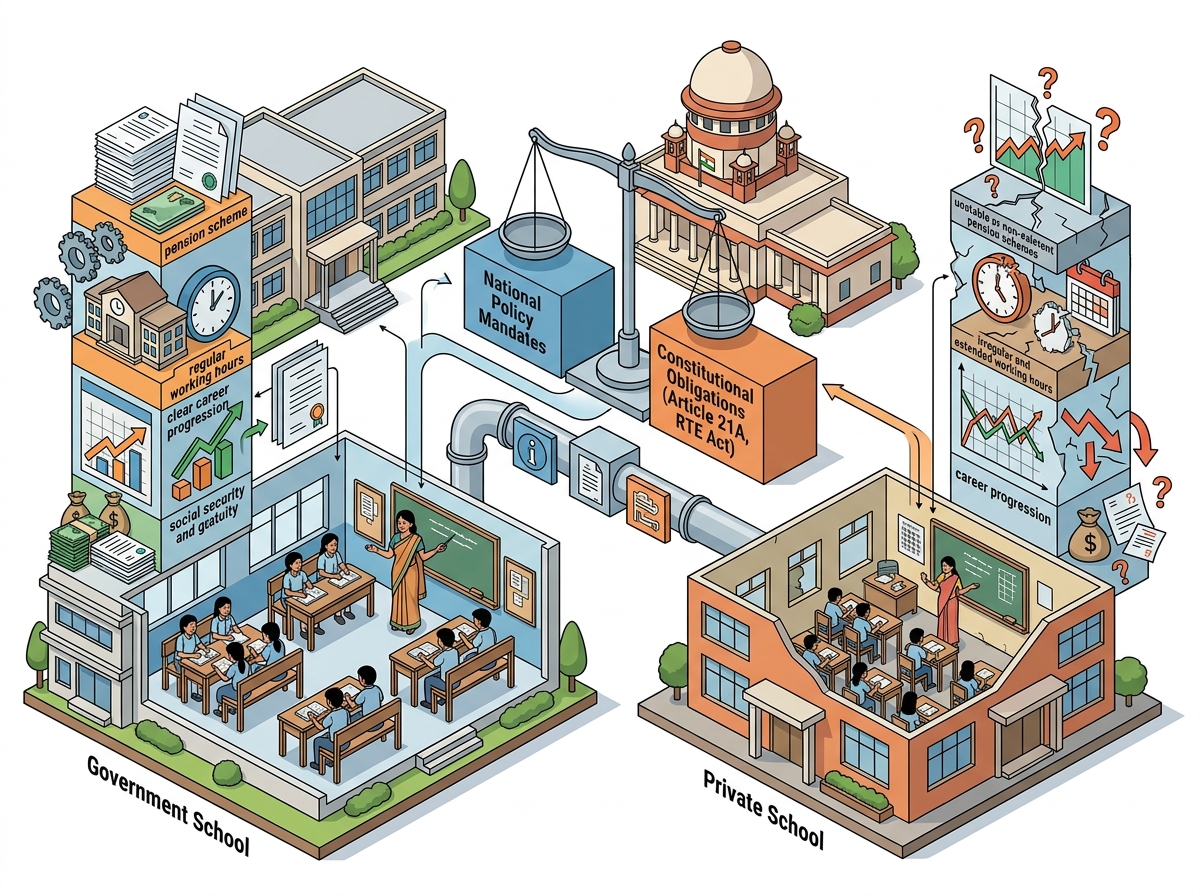
10 Sep Supreme Court to Hear Plea for National Policy for Private School Teachers’ Welfare
✎ The Supreme Court’s decision to hear the plea underscores the constitutional imperative (Article 21A) to ensure equitable education infrastructure, which includes protecting the rights and welfare of private school teachers…
Subject Relevance — Where This Topic Fits
- GS Paper II — Fundamental Rights and Directive Principles of State Policy | GS Paper III — Issues Relating to Development and Management of Social Sector/Services relating to Education
- Prelims: Article 21A, UDISE+, NCTE, Right to Education Act 2009, National Education Policy 2020, Social Security for Unorganised Sector Workers
- Essay: The Role of Judiciary in Ensuring Social Justice: A Case Study of Private School Teachers’ Welfare
Quick Revision: The Supreme Court’s decision to hear the plea underscores the constitutional imperative (Article 21A) to ensure equitable education infrastructure, which includes protecting the rights and welfare of private school teachers through a national policy framework.
Why is this in the news?
The Supreme Court of India has agreed to hear a petition seeking the formulation of a national welfare policy for private school teachers, highlighting the absence of a comprehensive legal and institutional framework to address their social security, retirement benefits, and grievance redressal mechanisms. This judicial intervention underscores the constitutional obligation under Article 21A to ensure equitable access to quality education while safeguarding the rights of educators in the private sector.
Background
- Unlike government school teachers, private school teachers in unaided institutions often lack formalised social security benefits such as provident funds, gratuity, and pension schemes, despite their critical role in delivering education.
- The Right to Education Act, 2009, mandates free and compulsory education for children aged 6–14 but does not explicitly extend social security protections to private school teachers.
- The National Education Policy (NEP) 2020 emphasises teacher empowerment and professional development but does not prescribe a uniform welfare framework for private school educators.
- The absence of a dedicated institutional mechanism for grievance redressal and welfare monitoring of private school teachers has led to systemic inequities in their employment conditions.
- Judicial precedents, including the Supreme Court’s interpretation of Article 21A, have reinforced the state’s obligation to ensure equitable educational opportunities, which implicitly includes safeguarding the rights of educators.
What is the proposed ‘National Welfare Policy for Private School Teachers’?
- The petition seeks the establishment of a ‘National Private School Teachers’ Welfare Board’ or an equivalent institutional framework to oversee the uniform implementation of welfare schemes such as provident funds, gratuity, and pensions for private school teachers.
- The policy aims to standardise social security benefits across states and union territories, ensuring parity with government school teachers where applicable.
- A dedicated grievance redressal mechanism is proposed to address issues such as delayed salary payments, unfair termination, and workplace harassment.
- The policy would align with constitutional directives under Article 21A (Right to Education) and Article 41 (Directive Principles of State Policy on securing work, education, and public assistance in cases of unemployment, old age, sickness, and disablement).
- The proposed framework would integrate with existing schemes like the Employees’ Provident Fund Organisation (EPFO) and National Pension System (NPS) to ensure seamless coverage.
- The policy would also mandate regular audits and reporting mechanisms to monitor compliance and address gaps in implementation.
- The Supreme Court’s intervention reflects a judicial recognition of the need for a structured policy response to the welfare deficit faced by private school teachers.
- The policy’s design must balance fiscal feasibility with the constitutional mandate to ensure dignity and security for all educators.
Key Features
| Feature | Significance |
|---|---|
| Petition for a National Welfare Policy | Seeks uniform legal framework for private school teachers’ social security, welfare, and post-retirement benefits across India. |
| Proposed National Private School Teacher Welfare Board | Institutional mechanism to monitor implementation of uniform welfare schemes such as PF, gratuity, and pension for private school teachers. |
| Uniformity in Welfare Schemes | Ensures parity in social security benefits (PF, gratuity, pension) for private school teachers, reducing regional disparities. |
| Grievance Redressal Mechanism | Proposes a structured system for addressing complaints of private school teachers regarding service conditions and welfare violations. |
| UDISE+ Data Citation | Highlights the scale of the sector: 37.3 lakh private school teachers (without government aid) teaching 24.8 crore students across 14.72 lakh schools. |
Why it Matters
Constitutional & Legal
- Article 21A guarantees the right to education; its effective implementation relies on a stable, secure teaching workforce, including private school teachers.
- Lack of a national policy violates the principle of equity under Article 14, as teachers in different states face disparate welfare conditions.
- Judicial intervention underscores the judiciary’s role in ensuring constitutional rights are not undermined by regulatory gaps.
Economic
- A national welfare policy for private school teachers can enhance job stability, reducing attrition and improving educational quality.
- Standardised social security contributions (PF, gratuity) reduce financial insecurity for teachers, potentially increasing productivity.
- Uniform welfare schemes may reduce the burden on state exchequers by preventing ad-hoc state-level interventions.
Social
- Ensures dignity and social security for a significant segment of the teaching workforce, contributing to societal stability.
- Promotes gender and regional equity by ensuring uniform welfare standards across diverse geographies.
- Strengthens the professionalisation of teaching as a career, attracting and retaining talent in the education sector.
Governance
- Highlights the need for inter-state coordination to formulate and implement a cohesive national policy.
- Demonstrates the judiciary’s proactive role in addressing governance gaps through PILs when executive action is delayed.
- Emphasises the role of data (UDISE+) in policy formulation and monitoring.
Challenges
1. Fragmented Regulatory Framework
- Private schools in India are governed by diverse state-level regulations, leading to disparities in service conditions and welfare provisions.
- Absence of a central authority to enforce uniform standards exacerbates inequities across states.
UPSC Link: GS-II: Governance, Regulation of Private Entities
2. Financial Sustainability of Welfare Schemes
- Implementation of PF, gratuity, and pension schemes requires substantial financial commitments from private school managements.
- Risk of cost escalation may deter smaller private schools from complying, leading to sectoral distortions.
UPSC Link: GS-III: Public Finance, Social Sector Schemes
3. Definition and Scope of ‘Private School Teachers’
- Ambiguity in categorising teachers (e.g., aided vs. unaided schools, minority institutions) may complicate policy applicability.
- Constitutional protections for minority institutions (Article 30) may limit uniform policy enforcement.
UPSC Link: GS-II: Fundamental Rights, Minority Institutions
4. Implementation and Monitoring Challenges
- Lack of a dedicated institutional mechanism to monitor compliance and redress grievances at the national level.
- Potential resistance from school managements due to perceived administrative burdens.
UPSC Link: GS-II: Role of Judiciary, Administrative Reforms
5. Data Gaps and Sectoral Coverage
- Limited granularity in UDISE+ data on private school teachers’ service conditions and welfare needs.
- Exclusion of unrecognised or informal private schools from policy ambit may leave a segment of teachers unprotected.
UPSC Link: GS-II: Data Governance, Education Statistics
Challenges — UPSC Perspective
| Issue | Concern |
|---|---|
| Regulatory Fragmentation | Diverse state-level rules create inequities in welfare provisions for private school teachers. |
| Financial Burden on Schools | Implementation of PF/gratuity schemes may impose unsustainable costs on private institutions. |
| Constitutional Constraints | Article 30 protections for minority institutions may limit uniform policy enforcement. |
| Sectoral Exclusions | Unrecognised or informal schools may remain outside the ambit of welfare schemes. |
| Monitoring Gaps | Absence of a national body to enforce compliance and address grievances effectively. |
Way Forward
- Formulate a national policy draft in consultation with NCTE, state governments, and private school associations to ensure feasibility.
- Establish a ‘National Private School Teacher Welfare Board’ under the Ministry of Education to oversee implementation and grievance redressal.
- Conduct a sectoral audit using UDISE+ data to identify gaps in welfare coverage and regional disparities.
- Develop a phased implementation roadmap with financial incentives for schools to adopt PF, gratuity, and pension schemes.
- Strengthen data collection mechanisms to track welfare scheme enrolment, contributions, and disbursements annually.
- Introduce a grievance redressal portal with multi-tiered resolution mechanisms (school-level → state-level → national-level).
- Explore public-private partnerships to subsidise welfare contributions for smaller private schools.
- Conduct periodic reviews of the policy’s impact on teacher retention, job satisfaction, and educational outcomes.
UPSC Value Addition
Keywords for Mains Answer-Writing
Private school teachers · Article 21A · Right to Education · National Council for Teacher Education (NCTE) · UDISE+ 2023-24 data · Social security for teachers · National Welfare Policy for Teachers · Judicial review of executive inaction · Constitutional obligations of the State · Institutional mechanisms for teacher welfare
Constitutional & Policy Linkages
- Article 14: Equality before law and equal protection of laws (applicability of uniform welfare standards).
- Article 21A: Right to education (requires a secure and motivated teaching workforce).
- Article 30: Cultural and educational rights of minorities (may limit uniform policy enforcement).
Concept Flow
Private school teachers lack uniform welfare provisions → Petition filed in Supreme Court seeking national policy → Court issues notices to Centre, states, NCTE → Policy proposal includes welfare board, PF/gratuity/pension schemes → Challenges: regulatory fragmentation, financial sustainability → Way forward: institutional mechanism, phased implementation, data-driven monitoring.
Prelims Practice Questions
Q1. Consider the following statements about the National Council for Teacher Education (NCTE):
1. NCTE is a statutory body established under the National Council for Teacher Education Act, 1993.
2. Its primary mandate includes the regulation and development of teacher education in India.
3. NCTE is empowered to grant recognition to teacher education institutions and courses.
4. NCTE is responsible for the formulation of national policies on teacher welfare.
How many of the above statements are correct?
- Only one
- Only two
- Only three
- All
Answer: All — Statements 1, 2, and 3 are correct as per the NCTE Act, 1993. Statement 4 is incorrect as NCTE’s mandate does not extend to formulating national policies on teacher welfare, which is a domain of the executive.
Q2. Assertion (A): The Supreme Court of India has the power to direct the government to frame a national policy for private school teachers.
Reason (R): The Constitution of India, under Article 32, empowers the Supreme Court to issue writs for the enforcement of fundamental rights.
Options:
A. Both A and R are true, and R is the correct explanation of A.
B. Both A and R are true, but R is not the correct explanation of A.
C. A is true, but R is false.
D. A is false, but R is true.
Answer: ? — Both the Assertion and Reason are true. The Supreme Court, under Article 32, can direct the government to act in furtherance of fundamental rights, including the right to education under Article 21A. The Reason correctly explains the Assertion.
Q3. Match the following pairs related to teacher welfare in India:
Column I (Institutional Mechanism) | Column II (Function)
————————————————-|———————————————–
A. National Council for Teacher Education (NCTE)| 1. Formulates national policies on teacher education
B. UDISE+ | 2. Collects and disseminates school education data
C. Article 21A | 3. Guarantees the right to free and compulsory education
D. National Welfare Policy for Teachers | 4. A proposed institutional mechanism for teacher welfare
Options:
A – 1, B – 2, C – 3, D – 4
A – 2, B – 1, C – 4, D – 3
A – 4, B – 2, C – 3, D – 1
A – 1, B – 3, C – 2, D – 4
Answer: ? — A matches with 1 (NCTE’s role), B matches with 2 (UDISE+ data collection), C matches with 3 (Article 21A guarantees right to education), and D matches with 4 (proposed national welfare policy for teachers).
Mains Practice Question
✍ Critically examine the constitutional and institutional dimensions of ensuring social security and welfare for private school teachers in India. In your answer, discuss the role of Article 21A, the obligations of the State, and the necessity of a ‘National Welfare Policy for Private School Teachers’. Also, evaluate the feasibility of establishing a ‘National Private School Teacher Welfare Board’ as proposed in the recent Supreme Court case. (15 Marks)
Approach: MODEL-ANSWER SKELETON:
1. **Constitutional Framework (4 Marks)**
– Article 21A: Right to Education and its implications for teacher welfare.
– State obligations under DPSP (Article 38, 39, 41) and judicial interpretations (e.g., Unnikrishnan case, 1993).
– Distinction between public and private school teachers in terms of constitutional protections.
2. **Institutional Mechanisms (4 Marks)**
– Role of NCTE in regulating teacher education but not welfare policies.
– UDISE+ data highlighting the scale of private school teachers (37.3 lakh) and gaps in welfare.
– Existing schemes (e.g., EPFO, NPS) and their limited applicability to private school teachers.
3. **Judicial Intervention and Policy Gaps (4 Marks)**
– Supreme Court’s power under Article 32 to direct policy formulation (e.g., Vishaka Guidelines).
– Recent Supreme Court case on national policy for private school teachers: judicial activism vs. separation of powers.
– Challenges in uniform policy due to federal structure and varying state regulations.
4. **Feasibility of National Welfare Board (3 Marks)**
– Advantages: Standardization of welfare benefits (pension, PF, gratuity), grievance redressal.
– Challenges: Financial burden on private schools, resistance from unaided institutions, need for legislative backing.
– Comparative examples: State-level boards (e.g., Kerala) and their effectiveness.
Balance of views: Proponents of uniform policy vs. advocates of state autonomy in education.
Source: amarujala.com
Generated by AanyaAi for educational purpose.
Related guides on our sites
- Best PSIR optional teacher for upsc
- Best teacher of PSIR optional for upsc
- Best PSIR optional teacher
- Best PSIR optional coaching for upsc

- हिमाचल में बाल पोषण योजना: अब सप्ताह में दो बार मिलेगा अंडा या फल - September 23, 2026
- Himachal Pradesh’s Nutritious Food Scheme: Eggs/Fruits Twice Weekly for 5.5L Students - September 23, 2026
- रिफाइनरी क्षेत्र के लिए ऊर्जा सुरक्षा और नेट-ज़ीरो लक्ष्य में संतुलन जरूरी: विशेषज्ञ - September 23, 2026

No Comments