


27 Jul Supreme Court to Re-examine Anti-Defection Law: Key UPSC Polity Issue
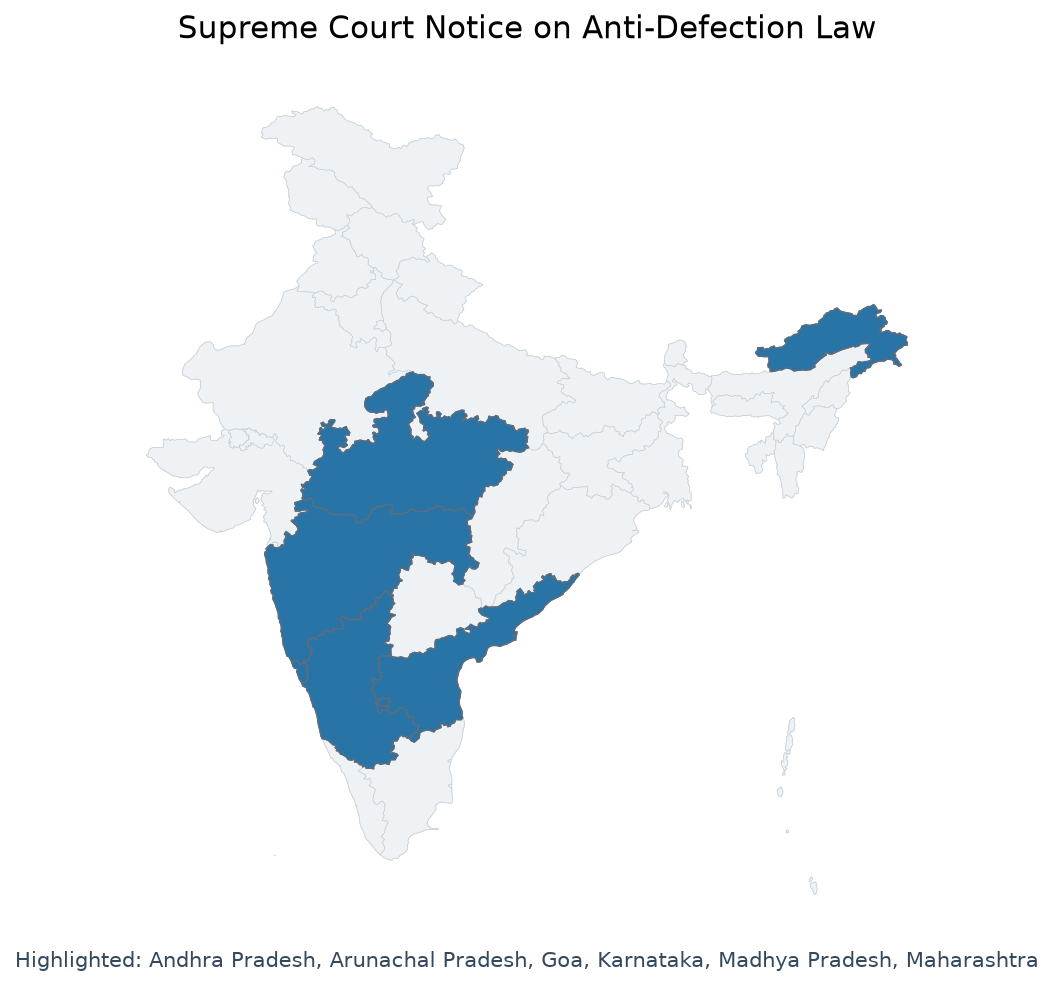
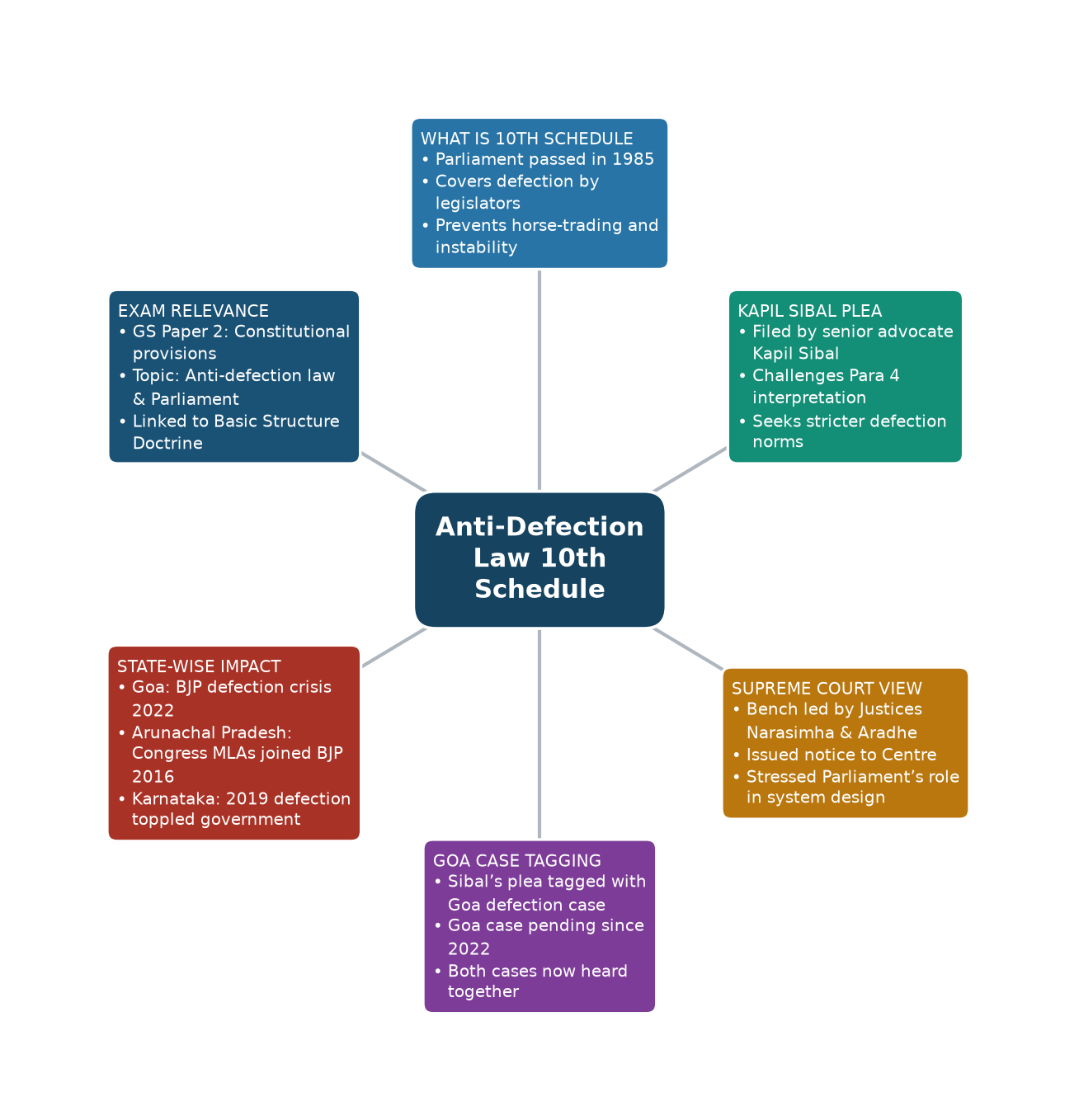
Map & concept mind-map: Supreme Court Notice on Anti-Defection Law
Subject Relevance — Where This Topic Fits
- GS Paper II — Constitutional and Non-Constitutional Bodies (Role of Judiciary, Parliament) | GS Paper II — Functions and Responsibilities of the Union and the States (Federalism)
- Prelims: Tenth Schedule of the Constitution, Anti-Defection Law (1985), Speaker’s discretion in disqualification, Floor test, Defection and horse-trading, Constitutional validity of defection provisions
- Essay: Ethical governance and the menace of defection in Indian democracy, Judicial activism vs. parliamentary sovereignty: Balancing constitutional roles
Quick Revision: The Tenth Schedule’s Paragraph 4 allows legislators to merge with another party without disqualification, enabling systemic defections; the Supreme Court’s scrutiny of this provision could redefine the balance between parliamentary sovereignty and judicial oversight in safeguarding democratic integrity.
Why is this in the news?
The Supreme Court has agreed to hear a petition filed by senior advocate and Rajya Sabha MP Kapil Sibal challenging the interpretation of Paragraph 4 of the Tenth Schedule of the Constitution, which allows legislators to merge with another party without disqualification. The Court has issued a notice to the Centre and tagged the plea with a pending case from Goa, underscoring the systemic concerns surrounding defection and its impact on democratic governance. The judicial intervention assumes significance in light of repeated instances of mass defections, horse-trading, and the subversion of electoral mandates across states in recent years.
Background
- The Tenth Schedule, inserted by the 52nd Amendment Act, 1985, popularly known as the Anti-Defection Law, was introduced to curb the menace of political defections and stabilise governments by preventing legislators from switching parties for personal or political gains.
- The provision has been criticised for enabling ‘split and merger’ tactics, where legislators collectively defect to another party without facing disqualification, thereby circumventing the intent of the law.
- Instances of defection have led to the collapse of governments in states such as Goa (2017), Arunachal Pradesh (2016), Karnataka (2019), Andhra Pradesh, Madhya Pradesh (2020), and Maharashtra (2019, 2022), raising concerns about the erosion of electoral mandates.
- The Supreme Court has previously adjudicated on the Tenth Schedule in cases like *Kihoto Hollohan v. Zachillhu* (1992), which upheld the law but left the interpretation of Paragraph 4 to the Speaker, a decision widely criticised for vesting excessive discretion in an executive authority.
- The current petition by Kapil Sibal challenges the constitutional validity of Paragraph 4, arguing that it violates the basic structure of the Constitution by facilitating defection and undermining the democratic process.
What is the Tenth Schedule and the Anti-Defection Law?
- The Tenth Schedule, inserted by the 52nd Constitutional Amendment Act, 1985, is a constitutional provision aimed at preventing political defections by legislators.
- It applies to both Parliament and State Legislatures and lays down the grounds for disqualification of members on the grounds of defection.
- Paragraph 2 outlines the grounds for disqualification, including voluntary renunciation of membership or voting against the party whip.
- Paragraph 4 is the focal point of the current debate, as it allows legislators to avoid disqualification if they merge with another party, provided they and their former party collectively join the new party.
- The Speaker of the House is the authority designated to decide on disqualification matters under the Tenth Schedule, a provision that has been contentious due to the Speaker’s political affiliations.
- The law was introduced to curb the practice of ‘Aya Ram Gaya Ram’ (frequent party-switching) that plagued Indian politics in the 1960s and 1970s, destabilising governments and undermining democratic principles.
- Critics argue that the law has failed to achieve its objective, as defections continue unabated, often facilitated by the very provisions meant to prevent them, such as Paragraph 4.
- The Supreme Court’s role in interpreting the Tenth Schedule is crucial, as it must balance judicial review with respect for parliamentary sovereignty and the separation of powers.
Key Features
| Feature | Significance |
|---|---|
| Tenth Schedule (Anti-Defection Law) | Constitutional provision inserted via the 52nd Amendment Act, 1985, to prevent political defections by legislators and maintain stability in representative democracy. |
| Paragraph 4 of the Tenth Schedule | Allows legislators to join another party without disqualification if the original party merges with another, often cited as a loophole enabling mass defections. |
| Judicial Review of Constitutional Provisions | Supreme Court’s authority to interpret constitutional provisions, ensuring their alignment with the basic structure doctrine and democratic principles. |
| Parliamentary Sovereignty vs. Judicial Intervention | Debate on whether Parliament or the judiciary should determine the operational framework for enforcing the Tenth Schedule. |
| Mass Defections and Government Instability | Instances where legislators switch parties, leading to collapse or formation of governments, undermining electoral mandates. |
Why it Matters
Constitutional and Democratic
- Preservation of electoral mandate by preventing arbitrary defections, ensuring representative democracy functions as intended by the Constitution.
- Maintenance of stability in legislative bodies, preventing political opportunism that disrupts governance.
- Upholding the basic structure doctrine by ensuring constitutional provisions do not facilitate undemocratic practices.
Legal and Judicial
- Clarification of the judiciary’s role in interpreting constitutional provisions, especially when parliamentary intent is ambiguous.
- Potential redefinition of the scope of Paragraph 4 to close loopholes exploited for mass defections.
- Reinforcement of judicial oversight in safeguarding democratic institutions from legislative malpractices.
Political and Governance
- Impact on party discipline and internal democracy within political parties, reducing incentives for horse-trading.
- Prevention of governance disruptions caused by frequent shifts in legislative majorities due to defections.
- Strengthening of public trust in electoral processes and representative institutions.
Challenges
1. Ambiguity in Paragraph 4
- The provision allows legislators to avoid disqualification by claiming party mergers, creating a legal grey area.
- Lack of clarity on what constitutes a ‘merger,’ leading to disputes and judicial interventions.
- Enables mass defections under the guise of mergers, subverting the intent of the Anti-Defection Law.
UPSC Link: Polity: Basic Structure, Tenth Schedule
2. Judicial vs. Parliamentary Roles
- Conflict between judicial interpretation and parliamentary sovereignty in defining the operational framework of the Tenth Schedule.
- Risk of judicial overreach if the Court redefines provisions without clear parliamentary intent.
- Parliament’s reluctance to amend the law due to political considerations, leaving judicial interpretation as the only recourse.
UPSC Link: Polity: Separation of Powers
3. Political Opportunism and Horse-Trading
- Defections driven by short-term political gains, undermining long-term governance stability.
- Instances of legislators switching parties to secure ministerial positions or other benefits.
- Erosion of party ideologies and principles due to opportunistic defections.
UPSC Link: Polity: Anti-Defection Law
4. Public Trust and Electoral Mandate
- Frequent defections lead to perceptions of corruption and lack of accountability in politics.
- Undermines the sanctity of electoral mandates by allowing legislators to switch allegiances post-election.
- Erodes citizen confidence in democratic processes and representative institutions.
UPSC Link: Polity: Electoral Reforms
Challenges — UPSC Perspective
| Issue | Concern |
|---|---|
| Loophole in Paragraph 4 | Permits defections under the guise of party mergers, defeating the law’s purpose. |
| Judicial Intervention | Risk of judicial overreach or underreach in interpreting constitutional provisions. |
| Political Opportunism | Defections driven by personal or party interests rather than democratic principles. |
| Governance Instability | Frequent shifts in legislative majorities disrupt governance and policy continuity. |
| Public Perception | Erosion of trust in political institutions due to perceived corruption and malpractices. |
Way Forward
- Clarify the definition of ‘merger’ in Paragraph 4 to eliminate ambiguity and prevent misuse.
- Parliament should proactively amend the Tenth Schedule to address loopholes and strengthen the law.
- Judicial interpretation should focus on the basic structure doctrine to ensure the law aligns with democratic principles.
- Political parties should enforce internal discipline and reduce incentives for defections.
- Constitutional bench of the Supreme Court should hear the case to provide authoritative interpretation.
- Public awareness campaigns to highlight the importance of the Anti-Defection Law in preserving democracy.
- Strengthen electoral reforms to reduce political opportunism and enhance accountability.
UPSC Value Addition
Keywords for Mains Answer-Writing
Tenth Schedule of the Constitution · Anti-Defection Law · Constitutional Provisions for Disqualification · Parliamentary Democracy · Floor Crossing · Supreme Court of India · Judicial Review · Legislative Assembly · Lok Sabha · Constitutional Morality · Political Ethics · Constitutional Amendments · Government Stability · Horse-Trading in Politics
Constitutional & Policy Linkages
- Article 102(2) – Disqualifications for membership of Parliament
- Tenth Schedule – Provisions as to disqualification on ground of defection
- Basic Structure Doctrine – Judicial review of constitutional amendments
Concept Flow
Election of legislators → Formation of government → Defections under Paragraph 4 → Judicial scrutiny → Supreme Court notice to Centre → Debate on parliamentary vs. judicial roles → Potential amendment or reinterpretation of the law → Strengthening of democratic institutions.
Prelims Practice Questions
Q1. Which of the following provisions of the Tenth Schedule of the Indian Constitution allows legislators to join another party without disqualification?
- Paragraph 2 (Disqualification on grounds of defection)
- Paragraph 3 (Exemption for splits in original party)
- Paragraph 4 (Merger of parties)
- Paragraph 5 (Decision of the Speaker/Chairman)
Answer: Paragraph 4 (Merger of parties) — Paragraph 4 of the Tenth Schedule permits legislators to avoid disqualification by claiming merger with another party, provided a minimum threshold of members supports the merger. This provision has been criticised for enabling large-scale defections under the guise of party mergers.
Q2. The Supreme Court, in the context of the Anti-Defection Law, has repeatedly emphasised that the interpretation of the Tenth Schedule falls within the domain of:
- The Parliament exclusively
- The Election Commission of India
- The Judiciary, as part of judicial review
- The President of India
Answer: The Parliament exclusively — The Supreme Court has consistently held that the formulation and implementation of systems under the Tenth Schedule, including the interpretation of its provisions, is a legislative function vested in Parliament. The judiciary may review the constitutionality but not substitute its policy judgment.
Q3. Which of the following states witnessed a government collapse or instability due to large-scale defections in the past decade?
- Goa, Arunachal Pradesh, Karnataka
- Kerala, Tamil Nadu, Odisha
- West Bengal, Punjab, Haryana
- Gujarat, Rajasthan, Uttar Pradesh
Answer: Goa, Arunachal Pradesh, Karnataka — States such as Goa, Arunachal Pradesh, Karnataka, Andhra Pradesh, Madhya Pradesh, and Maharashtra have experienced government instability or collapse due to defections in the last decade, as highlighted in judicial and political discourse.
Mains Practice Question
✍ Critically examine the efficacy of the Tenth Schedule of the Constitution in preventing defections and ensuring stability in Indian parliamentary democracy. Suggest reforms, if any, to strengthen the constitutional framework against political horse-trading.
Approach: Begin by outlining the constitutional provisions of the Tenth Schedule, particularly Paragraphs 2, 3, and 4, and their intended objectives. Analyse the practical challenges in implementation, such as the misuse of the merger clause (Paragraph 4) and the role of the Speaker as the adjudicating authority. Discuss judicial interventions, including landmark judgments like Kihoto Hollohan v. Zachillhu (1992), which upheld the Speaker’s discretion while acknowledging the need for judicial review. Evaluate the impact of defections on democratic governance, citing recent instances from states like Goa and Karnataka. Conclude by proposing reforms such as the removal of the merger clause, vesting adjudication in an independent constitutional authority, and strengthening transparency in party operations to curb horse-trading.
Source: bhaskar.com
Generated by AanyaAi for educational purpose.


No Comments