


08 Aug Supreme Court Verdict Boosts Tamil Nadu Doctors’ Super-Speciality Seats
Supreme CourtSuper-speciality seatsAll India QuotaGovernment doctorsReserved seats✎ The Supreme Court’s directive on super-speciality seats in Tamil Nadu reaffirms the primacy of merit-based admissions in AIQ counselling, while allowing limited flexibility for states to reclaim seats if qualifying percentiles…
Subject Relevance — Where This Topic Fits
- GS Paper II — Governance, Constitution, Polity, Social Justice and International Relations | GS Paper III — Issues related to Health, Human Resources and Development
- Prelims: All India Quota (AIQ) counselling, National Medical Commission (NMC), Directorate General of Health Services (DGHS), Supreme Court directives on medical admissions, Tamil Nadu Government Doctors Association (TNGDA), Super-speciality medical seats, service candidates reservation, qualifying percentile in NEET-SS
- Essay: The ethical dimensions of reservation policies in medical education: Balancing equitable access and meritocracy, Judicial activism in healthcare governance: The role of the Supreme Court in shaping medical admissions policy
Quick Revision: The Supreme Court’s directive on super-speciality seats in Tamil Nadu reaffirms the primacy of merit-based admissions in AIQ counselling, while allowing limited flexibility for states to reclaim seats if qualifying percentiles are reduced in subsequent rounds.
Why is this in the news?
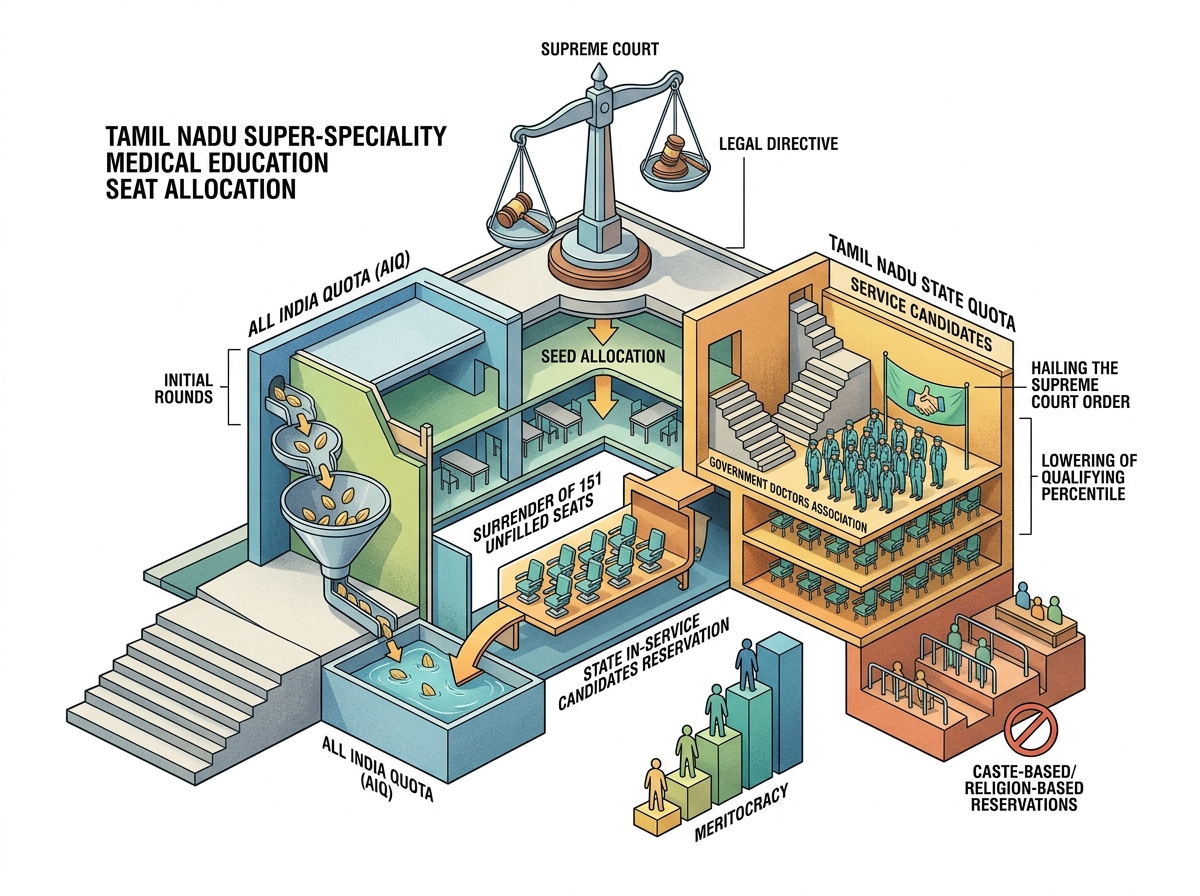
The Supreme Court’s recent directive on the surrender of 151 unfilled super-speciality medical seats reserved for service candidates in Tamil Nadu to the All India Quota (AIQ) has sparked significant debate. The Tamil Nadu Government Doctors Association (TNGDA) has welcomed the verdict, anticipating potential gains for government doctors if the qualifying percentile is reduced in subsequent AIQ counselling rounds. This development underscores the intersection of judicial intervention, healthcare policy, and the rights of in-service medical professionals in India’s complex medical education ecosystem.
Background
- The Supreme Court has consistently ruled against caste or religion-based reservations in super-speciality medical seats, affirming the principle of meritocracy in admissions.
- Tamil Nadu had secured a 50% reservation for service candidates in super-speciality seats following a prolonged legal battle, a policy unique to the state due to its historical emphasis on in-service medical education.
- The All India Quota (AIQ) system, managed by the Directorate General of Health Services (DGHS), allocates 50% of super-speciality seats in government medical colleges across India to candidates from all states, with the remaining 50% reserved for state quota candidates.
- The Tamil Nadu Government Doctors Association (TNGDA) has been advocating for the rights of in-service doctors, arguing that their service obligations justify preferential access to super-speciality training.
- The recent Supreme Court order directs Tamil Nadu to surrender 151 unfilled super-speciality seats reserved for service candidates to the AIQ pool, with the possibility of reclaiming 50% of these seats if the qualifying percentile is reduced in the second round of AIQ counselling.
What are Super-Speciality Medical Seats and the All India Quota (AIQ) System?
- Super-speciality medical seats refer to postgraduate courses in highly specialised fields such as Cardiology, Neurosurgery, and Paediatric Surgery, which require prior completion of a broad speciality like Medicine or Surgery.
- The All India Quota (AIQ) system was introduced to ensure equitable distribution of super-speciality seats across states, preventing concentration of seats in a few states and promoting national integration in medical education.
- Under the AIQ system, 50% of super-speciality seats in government medical colleges are allocated to candidates from all states based on their NEET-SS rank, while the remaining 50% are reserved for state quota candidates.
- States like Tamil Nadu have historically reserved a portion of super-speciality seats for in-service doctors (service candidates) to incentivise retention within the state healthcare system and address regional disparities in specialist availability.
- The Supreme Court’s rulings against caste or religion-based reservations in super-speciality seats are grounded in the constitutional principle of equality, as enshrined in Article 14, which prohibits discrimination in admissions.
- The AIQ counselling process is conducted in multiple rounds, with the qualifying percentile adjusted dynamically to fill vacant seats, ensuring optimal utilisation of available training opportunities.
- The recent Supreme Court directive on Tamil Nadu’s super-speciality seats highlights the tension between state-level reservation policies and the national AIQ framework, raising questions about the balance between equity and meritocracy in medical education.
Key Features
| Feature | Significance |
|---|---|
| Supreme Court directive on super-speciality seats | Ensures equitable distribution of seats between service candidates and general pool, upholding meritocracy while addressing historical inequities in medical education. |
| Reduction in qualifying percentile for AIQ counselling | Increases accessibility for candidates, potentially allowing more seats to revert to Tamil Nadu’s service quota if vacancies persist. |
| 50% reversion clause for vacant seats | Balances the interests of service doctors with national merit-based allocation, preventing complete exclusion of state quota candidates. |
| Tamil Nadu Government Doctors Association (TNGDA) response | Demonstrates collective advocacy by medical professionals, highlighting the socio-economic implications of seat distribution in super-speciality courses. |
| State government’s legal intervention | Reflects proactive measures by Tamil Nadu to secure constitutional rights of service doctors within the framework of national medical education policies. |
Why it Matters
Constitutional and Legal
- The Supreme Court’s order reinforces the principle of non-discrimination in super-speciality medical admissions, as established in prior judgments (e.g., *Indra Sawhney* and *M. Nagaraj*).
- The directive aligns with Article 14 (Right to Equality) and Article 15(4) (Special provisions for advancement of socially and educationally backward classes), ensuring reservations do not violate fundamental rights.
- The case underscores the tension between state-level reservations for service doctors and the national merit-based All India Quota (AIQ) system, requiring judicial balancing of competing interests.
Healthcare System
- Super-speciality seats reserved for service doctors are critical for retaining skilled medical professionals in government hospitals, addressing the acute shortage of specialists in public healthcare.
- Increased availability of super-speciality seats for Tamil Nadu’s service doctors could improve healthcare delivery in rural and underserved areas, reducing the burden on tertiary care institutions.
- The order may incentivise doctors to serve in government hospitals post-super-speciality training, strengthening the public health infrastructure.
Policy and Governance
- The case highlights the need for states to strategically navigate national policies while protecting local interests, particularly in education and healthcare.
- It exemplifies judicial activism in resolving inter-state disputes over resource allocation in professional education, setting a precedent for similar cases.
- The state government’s role in securing the order underscores the importance of political will in addressing systemic inequities in medical education.
Socio-Economic
- Service doctors in Tamil Nadu, often from economically weaker sections, benefit from reserved super-speciality seats, which enhance their career prospects and social mobility.
- The reduction in qualifying percentile for AIQ counselling may democratise access to super-speciality courses, benefiting candidates from diverse socio-economic backgrounds.
- The debate reflects broader concerns about the brain drain from government to private healthcare sectors, which the order seeks to mitigate.
Challenges
1. Balancing Meritocracy and Reservations
- The Supreme Court’s stance against caste/religion-based reservations in super-speciality seats conflicts with Tamil Nadu’s historical reservations for service doctors, creating a legal and ethical dilemma.
- Reducing the qualifying percentile to 40% risks diluting academic standards, potentially compromising the quality of super-speciality training.
- The 50% reversion clause may not fully address the demand for seats, leaving a significant gap between supply and aspirational needs of service doctors.
UPSC Link: GS2: Issues relating to development and management of Social Sector/Services relating to Health
2. Legal and Bureaucratic Delays
- Protracted legal battles over seat reservations delay policy implementation, exacerbating the shortage of specialists in government hospitals.
- Bureaucratic hurdles in reallocating seats post-counselling may lead to further vacancies, defeating the purpose of the Supreme Court’s directive.
- Tamil Nadu’s past lapses in handling such cases highlight the need for robust administrative mechanisms to prevent recurrence of disputes.
UPSC Link: GS2: Government policies and interventions for development in various sectors and issues arising out of their design and implementation
3. Equitable Distribution of Medical Resources
- The AIQ system prioritises national merit over state-level needs, often leaving states like Tamil Nadu with fewer seats for their service doctors despite higher demand.
- The order’s conditional reversion (50% of vacancies) may not suffice to meet the state’s requirements, necessitating further negotiations or policy reforms.
- Rural and remote areas in Tamil Nadu continue to face a shortage of super-speciality care, which reserved seats alone cannot fully address.
UPSC Link: GS2: Issues relating to Health
4. Political and Public Perception
- Perceived favouritism towards service doctors or general candidates can lead to public backlash, undermining trust in government healthcare policies.
- Media narratives around the issue may polarise opinions, complicating the state government’s efforts to balance competing interests.
- The association’s caution against reducing the qualifying percentile to 40% reflects concerns about public scrutiny and potential misuse of the provision.
UPSC Link: GS2: Role of Civil Services in a Democracy
Challenges — UPSC Perspective
| Issue | Concern |
|---|---|
| State vs. National Quota Conflict | Tamil Nadu’s demand for reserved seats clashes with the AIQ system’s merit-based allocation, creating a zero-sum scenario for super-speciality seats. |
| Qualifying Percentile Reduction | Lowering the percentile risks compromising academic rigour, potentially affecting the competency of super-speciality graduates. |
| Administrative Bottlenecks | Delays in seat reversion and counselling processes may lead to prolonged vacancies, defeating the purpose of the Supreme Court’s order. |
| Public Healthcare Gaps | Even with increased seats, rural and underserved areas may not benefit due to lack of infrastructure or willingness of doctors to serve in such locations. |
| Legal Precedents vs. State Policies | Supreme Court rulings against caste-based reservations in super-speciality seats limit Tamil Nadu’s ability to use reservations for service doctors. |
| Perception of Favouritism | Arguments for reducing the percentile to 40% could be misconstrued as lowering standards, inviting criticism from stakeholders. |
Way Forward
- Constitute a high-level inter-departmental committee comprising representatives from the Health Ministry, Medical Education Directorate, and TNGDA to draft a state-specific implementation roadmap within 30 days.
- Engage with the Directorate General of Health Services (DGHS) to expedite the second round of AIQ counselling and ensure timely reversion of 50% of vacant seats to Tamil Nadu.
- Explore the feasibility of introducing a state-level super-speciality entrance examination for service doctors, in compliance with Supreme Court guidelines, to reduce reliance on AIQ.
- Strengthen rural posting incentives for super-speciality doctors, including housing, professional development opportunities, and career progression pathways.
- Conduct a needs assessment to identify super-speciality specialties with the highest demand in Tamil Nadu’s public healthcare system and prioritise seat allocation accordingly.
- Leverage telemedicine and hub-and-spoke models to bridge gaps in super-speciality care delivery in rural and remote areas, reducing the pressure on physical seat allocation.
- Initiate awareness campaigns to educate service doctors about the revised counselling process and eligibility criteria for super-speciality seats.
- Collaborate with private medical colleges in Tamil Nadu to explore public-private partnerships for additional super-speciality training slots, subject to regulatory approvals.
UPSC Value Addition
Keywords for Mains Answer-Writing
All India Quota (AIQ) counselling · super-speciality medical seats · reservation in medical education · Supreme Court and medical admissions · Tamil Nadu Government Doctors Association (TNGDA) · service candidates reservation · qualifying percentile in NEET-SS · medical education policy · constitutional provisions for medical admissions · judicial interventions in medical admissions
Constitutional & Policy Linkages
- Article 14: Right to Equality (non-discrimination in super-speciality admissions)
- Article 15(4): Special provisions for advancement of socially and educationally backward classes (balancing reservations with merit)
- Article 21: Right to Health (indirect linkage via healthcare workforce availability)
Concept Flow
State government secures 50% reservation for service doctors in super-speciality seats through legal battles → Supreme Court directs surrender of 151 unfilled seats to AIQ → AIQ counselling leaves vacancies due to high qualifying percentile → Tamil Nadu seeks reduction in percentile to reclaim seats → Supreme Court permits 50% reversion of vacancies to state quota → TNGDA advocates for balanced implementation to avoid dilution of standards → State government formulates policy to operationalise reversion while addressing healthcare workforce shortages → Impact on public healthcare delivery and rural medical services.
Prelims Practice Questions
Q1. Consider the following statements regarding the All India Quota (AIQ) scheme for super-speciality medical seats in India:
1. The AIQ scheme was introduced to ensure equitable distribution of super-speciality seats across states.
2. The Supreme Court has ruled that there should be no caste or religion-based reservation in super-speciality medical seats.
3. The AIQ scheme mandates that 50% of super-speciality seats must be reserved for service candidates in all states.
How many of the above statements are correct?
- Only one
- Only two
- All three
- None
Answer: Only two — Statement 1 is correct as the AIQ scheme was introduced to ensure equitable distribution of seats. Statement 2 is correct as the Supreme Court has consistently ruled against caste/religion-based reservation in super-speciality seats. Statement 3 is incorrect as the 50% reservation for service candidates is not a nationwide mandate but a state-specific provision secured through legal battles.
Q2. Assertion (A): The Supreme Court has directed Tamil Nadu to surrender 151 unfilled super-speciality seats reserved for service candidates to the All India Quota (AIQ) pool.
Reason (R): The Supreme Court has consistently ruled that there should be no caste or religion-based reservation in super-speciality medical seats, including those reserved for service candidates.
In the context of the above two statements, which one of the following is correct?
- Both A and R are true, and R is the correct explanation of A
- Both A and R are true, but R is not the correct explanation of A
- A is true, but R is false
- A is false, but R is true
Answer: Both A and R are true, but R is not the correct explanation of A — Both the assertion (A) and reason (R) are true. The Supreme Court directed Tamil Nadu to surrender the seats as part of its broader stance against caste/religion-based reservation in super-speciality seats. However, the reason (R) is not the direct explanation for the specific directive in assertion (A), as the latter is tied to the state’s handling of unfilled seats.
Mains Practice Question
✍ Critically examine the constitutional and judicial framework governing reservation in super-speciality medical seats in India, with particular reference to the recent Supreme Court order on Tamil Nadu’s super-speciality seats. Also, analyse the implications of such judicial interventions for federalism in medical education policy. (15 Marks)
Approach: MODEL-ANSWER SKELETON:
1. **Constitutional Basis of Reservation**:
– Article 15(4) and 15(5) allow reservation for socially and educationally backward classes in educational institutions.
– Article 16(4) permits reservation in appointments and services for backward classes.
– The 93rd Constitutional Amendment Act, 2005, inserted Article 15(5) to enable reservation in private unaided institutions.
– However, super-speciality medical seats are governed by the Medical Council of India (MCI) / National Medical Commission (NMC) regulations, which historically allowed state-specific reservations.
2. **Judicial Precedents on Reservation in Medical Education**:
– **T.M.A. Pai Foundation v. State of Karnataka (2002)**: The Supreme Court held that private unaided institutions have the right to admit students without state interference, but state can regulate admissions for public interest.
– **P.A. Inamdar v. State of Maharashtra (2005)**: The Court ruled that minority and non-minority unaided institutions cannot be forced to admit students through state-determined quotas.
– **Modern Dental College v. State of Madhya Pradesh (2016)**: The Court upheld the validity of state-determined quotas in private unaided professional colleges, subject to reasonable limits.
– **Recent Orders on Super-Speciality Seats**: The Supreme Court has consistently ruled against caste/religion-based reservation in super-speciality seats, emphasizing meritocracy and national standards (e.g., NEET-SS qualifying percentile).
3. **Tamil Nadu’s Case and the Supreme Court Order**:
– Tamil Nadu secured 50% reservation for service candidates in super-speciality seats through a legal battle, citing the need to retain doctors in government service.
– The Supreme Court directed Tamil Nadu to surrender 151 unfilled seats to the AIQ pool, citing the absence of caste/religion-based reservation in super-speciality seats.
– The Court also directed that if the qualifying percentile is reduced in the second round of AIQ counselling, 50% of the vacant seats should revert to Tamil Nadu.
4. **Implications for Federalism in Medical Education**:
– **Centralization vs. State Autonomy**: The judiciary’s stance prioritizes national standards (e.g., NEET-SS) and uniformity in super-speciality admissions, potentially limiting state-specific policies.
– **Federal Tensions**: States like Tamil Nadu argue that their policies are necessary to address local healthcare workforce shortages, while the Centre emphasizes meritocracy and national integration.
– **Balance of Views**: Some scholars argue that judicial interventions ensure equity and prevent misuse of reservation, while others contend that states should have greater autonomy in designing policies aligned with local needs.
5. **Conclusion**:
– The Supreme Court’s order reflects a broader judicial trend towards meritocracy and uniformity in super-speciality medical admissions.
– However, it raises questions about the balance between national standards and state-specific needs in federal systems, particularly in sectors like healthcare where local context matters.
Source: The Hindu
Generated by AanyaAi for educational purpose.

- महाराष्ट्र में त्योहार जुलूसों पर बॉम्बे हाईकोर्ट का बड़ा फैसला: पटाखे, लेजर और संगीत पर रोक - September 24, 2026
- Bombay HC Bans Firecrackers, Music in Maharashtra Processions: Key UPSC Analysis - September 24, 2026
- तमिलनाडु में महिला कर्मचारियों के लिए सवैतनिक माहवारी अवकाश नीति पर HC का आदेश - September 24, 2026

No Comments