


08 Aug Supreme Court Verdict on Super-Speciality Seats: Historic Win for Tamil Nadu in AIQ Counselling
✎ The Supreme Court has ruled that if unfilled super-speciality seats (DM/MCh) in Tamil Nadu are not filled in the second AIQ counselling round, the DGHS cannot unilaterally reduce the percentile cut-off; instead, 50% of such seats…
Subject Relevance — Where This Topic Fits
- GS Paper II — Governance, Constitution, Polity, Social Justice and International Relations (Judicial Pronouncements and Federalism) | GS Paper III — Issues related to Health, Human Resource Development, and Public Policy
- Prelims: NEET-Super Speciality (DM/MCh), All India Quota (AIQ), DM/MCh in-service reservation, Directorate General of Health Services (DGHS), percentile cut-off, judicial review of medical admissions
- Essay: Federalism in healthcare governance: Balancing state autonomy and centralised admission policies, Judicial intervention in public policy: Ensuring equity in medical education admissions
Quick Revision: The Supreme Court has ruled that if unfilled super-speciality seats (DM/MCh) in Tamil Nadu are not filled in the second AIQ counselling round, the DGHS cannot unilaterally reduce the percentile cut-off; instead, 50% of such seats must revert to the state for allocation to in-service candidates.
Why is this in the news?
The Supreme Court of India has delivered a landmark verdict on the allocation of unfilled super-speciality medical seats (DM/MCh) in Tamil Nadu. The judgment addresses the surrender of 151 vacant seats to the All India Quota (AIQ) and mandates a structured process for subsequent counselling rounds, including the conditional reversion of seats to the state if the percentile cut-off is reduced. This ruling has significant implications for Tamil Nadu’s healthcare workforce planning and the rights of in-service doctors seeking super-speciality training.
Background
- Tamil Nadu reserves 50% of its DM/MCh super-speciality seats for in-service candidates, a policy aimed at retaining medical professionals within the state’s public health system.
- The All India Quota (AIQ) scheme, administered by the Directorate General of Health Services (DGHS), allocates 50% of super-speciality seats in government medical colleges across India, including Tamil Nadu, to candidates from any state based on NEET-Super Speciality merit.
- Historically, Tamil Nadu has faced challenges in filling these reserved seats due to limited participation of in-service candidates, attributed to factors such as lack of promotional opportunities, financial constraints, and reduced availability of super-speciality posts.
- The Supreme Court’s verdict is part of a broader judicial trend of reviewing medical admission policies to ensure fairness, equity, and alignment with constitutional principles of federalism and social justice.
What are Super-Speciality Medical Seats (DM/MCh) and the All India Quota (AIQ) Scheme?
- Super-speciality seats (DM/MCh) are postgraduate medical courses in highly specialised branches such as Cardiology, Neurosurgery, and Surgical Gastroenterology, requiring candidates to qualify NEET-Super Speciality (conducted by NBE).
- The All India Quota (AIQ) scheme was introduced in 2017 to allocate 50% of super-speciality seats in government medical colleges to candidates from any state, based on merit in NEET-Super Speciality, thereby promoting national integration in medical education.
- States like Tamil Nadu reserve a significant portion of these seats (50% in this case) for in-service candidates—doctors already employed in the state’s public health system—to address regional healthcare workforce shortages and ensure service continuity.
- The AIQ scheme is administered by the Directorate General of Health Services (DGHS) under the Ministry of Health and Family Welfare, Government of India, which conducts counselling and allocates seats based on merit and reservation policies.
- The percentile cut-off for AIQ counselling is determined by the DGHS based on the performance of candidates in NEET-Super Speciality, and reducing this cut-off can impact the availability of seats for in-service candidates.
- The Supreme Court’s intervention underscores the tension between centralised admission policies (AIQ) and state-level reservation policies, highlighting the need for a balanced approach that respects federalism while ensuring equitable access to super-speciality training.
Key Features
| Feature | Significance |
|---|---|
| Supreme Court verdict on super-speciality seats | Establishes a precedent for the equitable distribution of unfilled DM/MCh seats between state and All India Quota (AIQ) counselling, ensuring procedural fairness. |
| 50% reservation for in-service candidates in Tamil Nadu | Preserves institutional capacity-building by prioritising local medical officers for super-speciality training, aligning with state health workforce needs. |
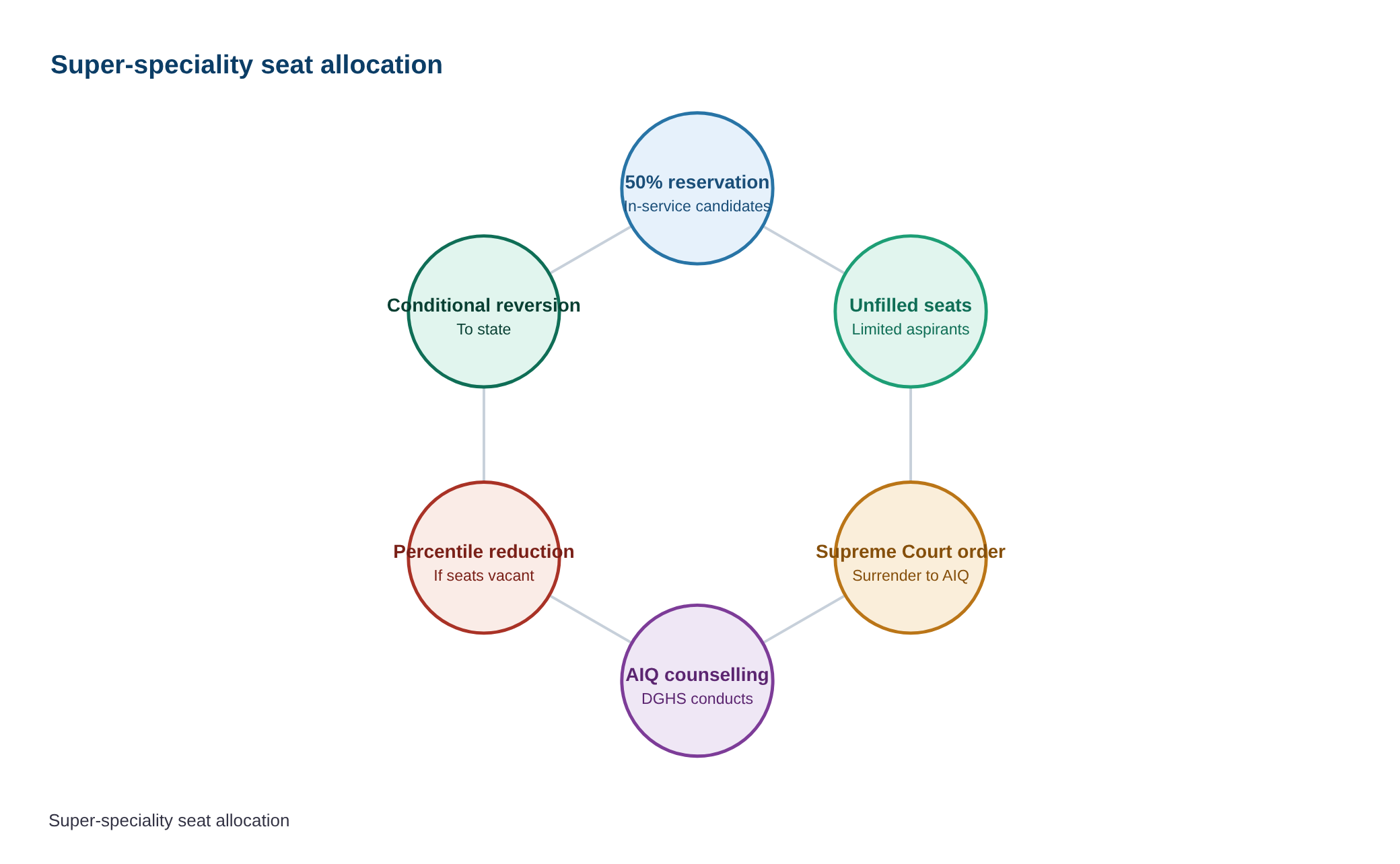
| Surrender of 151 unfilled seats to DGHS | Enables national-level redistribution of vacant seats, preventing wastage of critical medical training opportunities. |
| Second round of AIQ counselling with same percentile | Maintains standardised eligibility criteria, preventing arbitrary lowering of cut-offs that could undermine meritocracy. |
| Conditional reversion of 50% seats to Tamil Nadu if percentile reduced | Balances national and state interests by allowing Tamil Nadu to reclaim seats if national counselling fails to fill them, subject to DGHS discretion. |
Why it Matters
Judicial-Executive Interface
- The verdict exemplifies judicial intervention in resolving inter-state disputes over medical education governance, particularly in super-speciality seat allocation.
- It reinforces the Supreme Court’s role in safeguarding constitutional principles of equity and efficiency in public health administration.
- The ruling sets a legal framework for future cases involving state-specific reservations in medical admissions.
Health Workforce Policy
- The case underscores the need for Tamil Nadu to strengthen its in-service training programmes to reduce vacancy rates in super-speciality seats.
- It highlights systemic gaps in promotional opportunities and financial incentives for service doctors, which deter NEET super-speciality participation.
- The verdict indirectly pressures states to address structural issues in medical education infrastructure to prevent seat wastage.
Federalism in Health Governance
- The ruling navigates the tension between state autonomy (reservation policies) and national uniformity (AIQ counselling), a recurring theme in Indian federalism.
- It demonstrates how judicial interpretation can harmonise divergent state and central policies in critical sectors like healthcare.
- The case may influence future disputes over state-specific quotas in other professional education domains.
Challenges
1. Vacancy Persistence in Super-Speciality Seats
- Despite the verdict, Tamil Nadu faces recurring issues with unfilled DM/MCh seats due to lack of interest among service doctors in certain branches (e.g., Cardiothoracic Surgery, Paediatric Surgery).
- The reduction in NEET super-speciality aspirants suggests deeper systemic issues, including limited promotional avenues and financial disincentives for service doctors.
- Addressing these vacancies requires long-term policy interventions, such as targeted incentives and capacity-building in underserved specialities.
UPSC Link: GS2: Issues relating to development and management of Social Sector/Services relating to Health
2. Balancing State and National Interests
- The verdict creates a delicate equilibrium between Tamil Nadu’s reservation policy and the DGHS’s national counselling framework, which may not always align with state priorities.
- The conditional reversion of seats (50%) introduces administrative complexity, requiring seamless coordination between state and central authorities.
- Future disputes may arise over the interpretation of ‘unfilled seats’ or the criteria for percentile reduction, necessitating clear guidelines.
UPSC Link: GS2: Functions and responsibilities of the Union and the States
3. Meritocracy vs. Equity in Medical Admissions
- The ruling maintains the percentile threshold for AIQ counselling, but questions persist about whether this adequately addresses equity concerns for service doctors.
- The case highlights the trade-off between standardised national eligibility and state-specific affirmative action in super-speciality admissions.
- A potential challenge is ensuring that percentile reduction, if implemented, does not disproportionately disadvantage service candidates.
UPSC Link: GS2: Government policies and interventions for development in various sectors
4. Administrative and Logistical Hurdles
- The surrender and reversion of seats require meticulous tracking and coordination between Tamil Nadu’s health department and the DGHS, which may face bureaucratic delays.
- The DGHS’s expeditious completion of the second round of counselling is critical to prevent further seat wastage, but operational bottlenecks may persist.
- The verdict places additional administrative burden on state health departments to manage reclaimed seats and reintegrate them into local counselling processes.
UPSC Link: GS2: Role of civil services in a democracy
Challenges — UPSC Perspective
| Issue | Concern |
|---|---|
| Service doctors’ declining participation in NEET super-speciality | Systemic disincentives such as limited promotional opportunities and financial constraints deter service doctors from pursuing super-speciality training. |
| Administrative delays in seat reversion and counselling | Coordination gaps between state and central authorities may lead to inefficiencies in seat redistribution and counselling completion. |
| Disparities in seat fill rates across specialities | Certain branches (e.g., Cardiothoracic Surgery) consistently face vacancy issues due to perceived difficulty or lack of interest among aspirants. |
| Potential for percentile reduction to undermine service candidates | If the DGHS reduces the percentile post-counselling, service doctors may face heightened competition, reducing their chances of securing seats. |
| Legal ambiguity in defining ‘unfilled seats’ | Disputes may arise over whether seats are truly ‘unfilled’ or if they were rejected due to candidate preferences, complicating reversion processes. |
| Financial constraints in state health departments | Limited budgets may hinder Tamil Nadu’s ability to provide incentives or support for service doctors pursuing super-speciality training. |
Way Forward
- Tamil Nadu should conduct a comprehensive review of its in-service training programmes to identify gaps in promotional opportunities and financial incentives for super-speciality aspirants.
- The state must strengthen counselling and mentorship initiatives for service doctors, particularly in underserved specialities like Cardiothoracic Surgery and Paediatric Surgery.
- A joint task force involving the Tamil Nadu Health Department, Medical Council of India (MCI), and DGHS should be constituted to streamline seat reversion and counselling processes.
- The state should explore targeted financial incentives, such as stipends or loan waivers, to encourage service doctors to pursue super-speciality training.
- Clear SOPs should be developed for the conditional reversion of seats, including timelines and criteria for percentile reduction, to avoid administrative ambiguities.
- Collaborate with premier medical institutions (e.g., AIIMS, JIPMER) to create bridge programmes that ease the transition for service doctors into super-speciality training.
- Advocate for a national policy on state-specific reservations in super-speciality seats to provide legal clarity and reduce future disputes.
- Monitor the outcomes of the second round of AIQ counselling to assess the impact of the verdict and identify areas for further intervention.
UPSC Value Addition
Keywords for Mains Answer-Writing
All India Quota counselling · super-speciality medical seats · DM/MCh seats · State reservation policy for in-service candidates · Supreme Court verdict on medical admissions · Directorate General of Health Services · NEET-Super Speciality examination · medical education governance · health sector federalism · medical service cadre vacancies · counselling percentile dynamics · medical education policy · public health infrastructure · in-service reservation in higher education
Concept Flow
Tamil Nadu’s 50% reservation for in-service candidates in DM/MCh seats → Unfilled seats due to lack of aspirants in certain specialities → State government files writ petition in Supreme Court → Supreme Court directs surrender of unfilled seats to DGHS → DGHS conducts second round of AIQ counselling with same percentile → If seats remain vacant post-counselling, DGHS may reduce percentile → Conditional reversion of 50% seats to Tamil Nadu → State reintegrates reclaimed seats into local counselling processes → Long-term policy interventions to address systemic gaps in service doctor participation.
Prelims Practice Questions
Q1. Consider the following statements regarding the All India Quota (AIQ) counselling for super-speciality medical seats in India:
1. The AIQ counselling is conducted by the Directorate General of Health Services (DGHS).
2. States are required to surrender unfilled super-speciality seats to the AIQ pool after the first round of counselling.
3. The Supreme Court has recently directed that if seats remain vacant after the second round of AIQ counselling, the DGHS cannot reduce the percentile to fill them.
4. Tamil Nadu reserves 50% of its DM/MCh seats for in-service candidates.
How many of the above statements are correct?
- Only one
- Only two
- Only three
- All
Answer: All — Statements 1, 2, and 4 are correct. Statement 3 is incorrect because the Supreme Court directed that if seats remain vacant after the second round, the DGHS can reduce the percentile, but 50% of such seats must be reverted to the State pool.
Q2. Assertion (A): The Supreme Court has ruled that the Directorate General of Health Services (DGHS) must revert 50% of unfilled super-speciality seats to the State pool if the percentile is reduced after the second round of AIQ counselling.
Reason (R): This directive aims to balance the interests of in-service candidates and the State’s medical education policy.
Options:
A. Both A and R are true, and R is the correct explanation of A.
B. Both A and R are true, but R is not the correct explanation of A.
C. A is true, but R is false.
D. A is false, but R is true.
Answer: ? — Both the Assertion (A) and Reason (R) are true, and R correctly explains A. The Supreme Court’s directive ensures that the State’s reservation policy for in-service candidates is not undermined by the DGHS’s percentile reduction.
Q3. Match the following columns related to medical education governance in India:
Column I (Entity/Concept)
A. Directorate General of Health Services (DGHS)
B. All India Quota (AIQ) counselling
C. DM/MCh super-speciality seats
D. In-service reservation policy
Column II (Function/Characteristic)
1. Conducts counselling for 50% of undergraduate and postgraduate medical seats in India.
2. Manages the counselling process for super-speciality medical seats under AIQ.
3. Reserves 50% of super-speciality seats for serving doctors in the State.
4. A central agency under the Ministry of Health and Family Welfare responsible for health sector governance.
- A-4, B-1, C-2, D-3
- A-1, B-2, C-3, D-4
- A-3, B-4, C-1, D-2
- A-2, B-3, C-4, D-1
Answer: A-4, B-1, C-2, D-3 — The correct match is: A-4 (DGHS is a central agency under the Ministry of Health and Family Welfare), B-1 (AIQ counselling manages 50% of undergraduate and postgraduate seats), C-2 (DGHS conducts counselling for super-speciality seats under AIQ), D-3 (in-service reservation reserves 50% of super-speciality seats for serving doctors).
Mains Practice Question
✍ The Supreme Court’s recent verdict on the surrender of unfilled super-speciality medical seats (DM/MCh) to the All India Quota (AIQ) pool marks a significant intervention in the governance of medical education in India. Critically examine the implications of this judgment for (a) the federal balance in health policy, and (b) the reservation rights of in-service candidates. (15 Marks)
Approach: MODEL-ANSWER SKELETON:
1. **Context and Judgment Summary** (2 marks):
– Briefly state the Supreme Court’s directive: Tamil Nadu must surrender 151 unfilled DM/MCh seats to the AIQ pool after the first round, with 50% reverting to the State if seats remain vacant after the second round and the percentile is reduced.
– Reference the State’s 50% reservation for in-service candidates and the NEET-Super Speciality examination framework.
2. **Federal Balance in Health Policy** (5 marks):
– **State Autonomy vs. Central Control**: Discuss the tension between the State’s right to frame reservation policies (as per the Constitution’s 7th Schedule) and the Centre’s role in regulating medical education through AIQ counselling.
– **Judicial Intervention**: Highlight how the Supreme Court’s directive curtails State discretion in managing super-speciality seats, citing the Court’s role as the final arbiter of constitutional disputes (Art. 142).
– **Precedents**: Reference judgments like *T.M.A. Pai Foundation v. State of Karnataka* (2002) and *P.A. Inamdar v. State of Maharashtra* (2005) on the balance between State powers and central regulatory authority.
– **Critique**: Argue that excessive centralisation may undermine States’ ability to address local health workforce needs, especially in underserved specialities.
3. **Reservation Rights of In-Service Candidates** (5 marks):
– **Legal Basis**: Explain the constitutional and statutory basis for in-service reservation (e.g., Art. 15(4), 16(4), and State-specific policies like Tamil Nadu’s).
– **Impact of Judgment**: Analyse how the judgment protects or undermines the reservation rights of in-service candidates, particularly in high-demand specialities (e.g., Cardiology, Surgical Gastroenterology).
– **Data**: Reference the decline in service doctors appearing for NEET-Super Speciality and the lack of promotional opportunities as contributing factors.
– **Balancing Views**: Present arguments from both proponents (e.g., ensuring equitable access to super-speciality training for serving doctors) and sceptics (e.g., potential dilution of State-level priorities).
4. **Way Forward and Conclusion** (3 marks):
– **Collaborative Framework**: Propose a consultative mechanism between States and the Centre to reconcile federal tensions (e.g., through the National Medical Commission or inter-State agreements).
– **Policy Reforms**: Suggest measures to incentivise service doctors to pursue super-speciality training (e.g., career progression pathways, financial support).
– **Judicial Restraint**: Argue for judicial restraint in matters of State-level policy unless constitutional violations are evident, to preserve federalism.
**Key Terms to Include**: AIQ counselling, DM/MCh seats, in-service reservation, federalism, Art. 142, *T.M.A. Pai Foundation*, *P.A. Inamdar*, National Medical Commission, NEET-Super Speciality.
Source: The Hindu
Generated by AanyaAi for educational purpose.

- महाराष्ट्र में त्योहार जुलूसों पर बॉम्बे हाईकोर्ट का बड़ा फैसला: पटाखे, लेजर और संगीत पर रोक - September 24, 2026
- Bombay HC Bans Firecrackers, Music in Maharashtra Processions: Key UPSC Analysis - September 24, 2026
- तमिलनाडु में महिला कर्मचारियों के लिए सवैतनिक माहवारी अवकाश नीति पर HC का आदेश - September 24, 2026

No Comments