


08 Aug Supreme Court Verdict on Super-Speciality Seats: Tamil Nadu Doctors Hail Historic Ruling
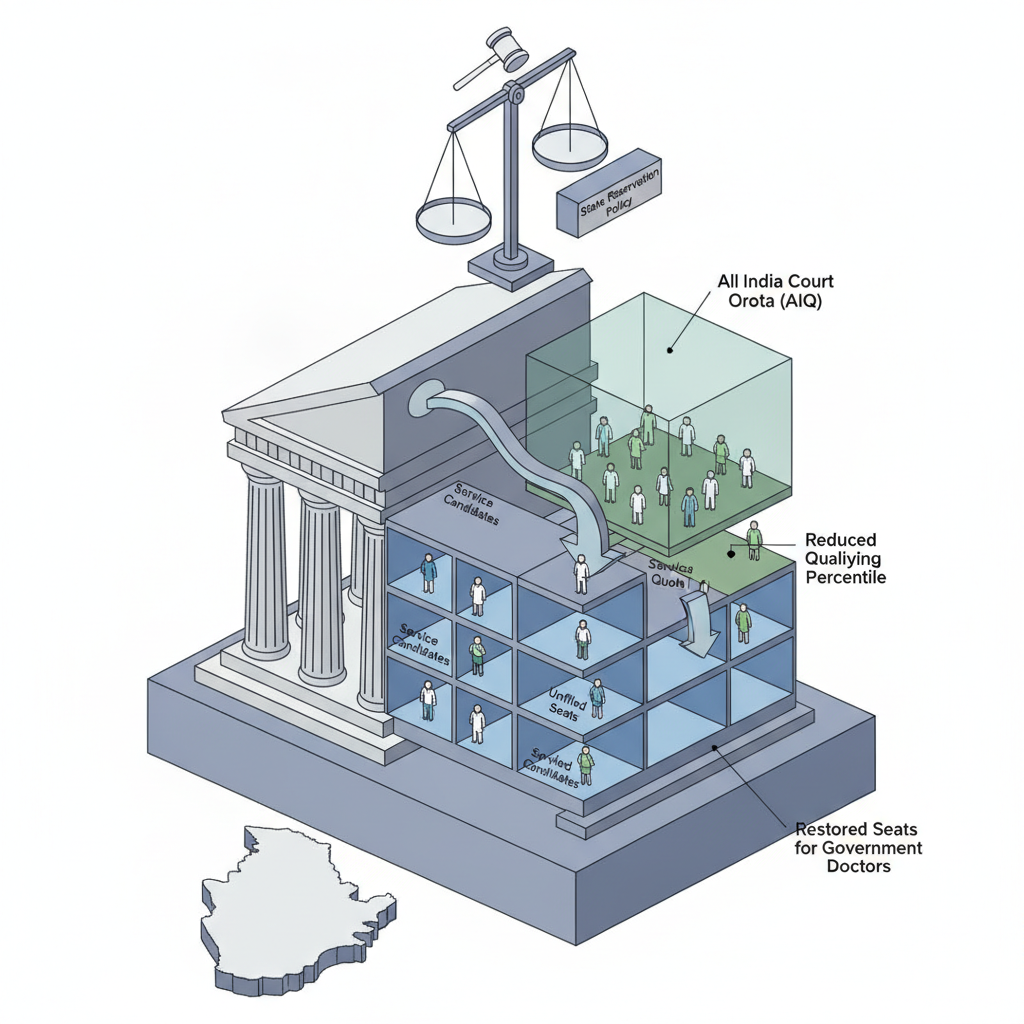
Supreme CourtAll India QuotaGovernment doctorsReservation policy✎ The Supreme Court’s directive mandates that 50% of surrendered super-speciality seats be reverted to Tamil Nadu if the qualifying percentile is reduced during AIQ counselling, balancing national meritocracy with state-level…
Subject Relevance — Where This Topic Fits
- GS Paper II — Governance, Constitution, Polity, Social Justice and International Relations (Judicial Pronouncements and Reservation Policies) | GS Paper III — Issues Relating to Health, Human Resources and Development
- Prelims: All India Quota (AIQ) counselling, super-speciality medical seats, NEET-SS, Directorate General of Health Services (DGHS), Tamil Nadu Government Doctors Association (TNGDA), service candidates reservation, qualifying percentile, judicial review of reservation policies
- Essay: The Role of Judiciary in Balancing Social Justice and Meritocracy in Medical Education, Federalism and Health Governance: Centre-State Dynamics in India
Quick Revision: The Supreme Court’s directive mandates that 50% of surrendered super-speciality seats be reverted to Tamil Nadu if the qualifying percentile is reduced during AIQ counselling, balancing national meritocracy with state-level health workforce retention.
Why is this in the news?
The Supreme Court’s recent directive to Tamil Nadu to surrender 151 unfilled super-speciality medical seats reserved for service candidates to the All India Quota (AIQ) has sparked significant debate. The Tamil Nadu Government Doctors Association (TNGDA) has welcomed the verdict, anticipating that a reduction in the qualifying percentile during the second round of AIQ counselling could restore 75–100 seats to government doctors. This development underscores the ongoing tension between state-level reservation policies and centralised medical admission processes, as well as the judiciary’s role in adjudicating such conflicts.
Background
- The Supreme Court has consistently ruled against caste or religion-based reservations in super-speciality medical seats, affirming a meritocratic approach in admissions.
- Tamil Nadu secured a 50% reservation for service candidates in super-speciality seats after prolonged legal battles, reflecting its commitment to retaining medical professionals within the state health system.
- Unfilled super-speciality seats reserved for service candidates in Tamil Nadu were directed to be surrendered to the AIQ pool, leading to a reduction in seats available for government doctors.
- The reduction in qualifying percentile during AIQ counselling could result in the reversion of a portion of these seats to Tamil Nadu, providing relief to service doctors.
- The TNGDA has cautioned against arguments advocating for the allocation of all 151 surrendered seats to service doctors, citing the risk of judicial overreach and potential setbacks in reservation policies.
What are Super-Speciality Medical Seats and the All India Quota (AIQ) System?
- Super-speciality medical seats refer to postgraduate courses in highly specialised fields such as Cardiology, Neurosurgery, and Oncology, which require candidates to possess a postgraduate degree in a broad specialty (e.g., MD in Medicine) before admission.
- The All India Quota (AIQ) system was introduced to ensure equitable distribution of medical seats across states, reserving 50% of seats in government medical colleges for candidates from any state, thereby promoting national integration and reducing regional disparities.
- The Directorate General of Health Services (DGHS), under the Ministry of Health and Family Welfare, conducts AIQ counselling for super-speciality courses via the National Eligibility-cum-Entrance Test for Super-Speciality (NEET-SS).
- The qualifying percentile for AIQ counselling is determined based on the performance of candidates in NEET-SS, with lower percentiles increasing the likelihood of seat allotment for service doctors in subsequent rounds.
- The Supreme Court’s directive in this case reinforces its earlier rulings that reservation policies in super-speciality seats must not be based on caste or religion, aligning with the constitutional mandate of equality under Article 14.
- Tamil Nadu’s reservation policy for service candidates in super-speciality seats was a hard-won legal victory, aimed at retaining doctors within the state’s public health system to address critical shortages in rural and underserved areas.
- The surrender of unfilled seats to the AIQ pool is a procedural requirement to ensure transparency and optimal utilisation of available medical training opportunities across the country.
UPSC Value Addition
Keywords for Mains Answer-Writing
Supreme Court judgment on super-speciality medical seats · All India Quota (AIQ) counselling · Government doctors’ reservation in medical education · Tamil Nadu Government Doctors Association (TNGDA) · Constitutional provisions on medical education · Reservation policy in super-speciality courses · Judicial activism in medical education policy · Service candidates in medical admissions
Prelims Practice Questions
Q1. Consider the following statements regarding the All India Quota (AIQ) scheme for medical admissions in India:
1. The AIQ scheme was introduced to ensure fair distribution of medical seats across states.
2. The scheme mandates that 50% of super-speciality seats in government medical colleges be reserved for service candidates.
3. The Supreme Court has ruled that caste or religion-based reservations cannot be applied in super-speciality medical seats.
How many of the above statements are correct?
- Only one
- Only two
- All three
- None
Answer: All three — Statement 1 is correct as the AIQ scheme was introduced to ensure equitable distribution of medical seats. Statement 2 is incorrect; the 50% reservation for service candidates is a state-specific policy in Tamil Nadu, not a nationwide mandate under AIQ. Statement 3 is correct as the Supreme Court has consistently ruled against caste or religion-based reservations in super-speciality seats.
Q2. Assertion (A): The Supreme Court has directed Tamil Nadu to surrender 151 unfilled super-speciality seats reserved for service candidates to the All India Quota (AIQ) pool.
Reason (R): The Supreme Court has held that reservations in super-speciality medical seats cannot be based on caste or religion, and thus the state-specific reservation policy must yield to the national AIQ framework.
Options:
A. Both A and R are true, and R is the correct explanation of A.
B. Both A and R are true, but R is not the correct explanation of A.
C. A is true, but R is false.
D. A is false, but R is true.
- A
- B
- C
- D
Answer: A — Both Assertion (A) and Reason (R) are true. The Supreme Court’s directive to Tamil Nadu to surrender 151 seats was based on the broader principle that reservations in super-speciality seats cannot be caste or religion-based, aligning with the national AIQ framework. Thus, R correctly explains A.
Q3. Match the following provisions with their respective contexts in medical education policy in India:
Column I (Provision) | Column II (Context)
1. Article 15(4) | A. Reservation for socially and educationally backward classes
2. Article 16(4) | B. Reservation for service candidates in super-speciality seats
3. AIQ Scheme | C. National pool for fair distribution of medical seats
4. Supreme Court ruling on super-speciality seats | D. Prohibition of caste/religion-based reservations
Options:
A. 1-A, 2-B, 3-C, 4-D
B. 1-A, 2-D, 3-C, 4-B
C. 1-B, 2-A, 3-D, 4-C
D. 1-D, 2-C, 3-A, 4-B
- A
- B
- C
- D
Answer: B — 1-A: Article 15(4) allows special provisions for socially and educationally backward classes. 2-D: Article 16(4) permits reservations in appointments but the Supreme Court has ruled against caste/religion-based reservations in super-speciality seats. 3-C: The AIQ Scheme is a national pool for fair distribution of medical seats. 4-B: The Supreme Court’s ruling on super-speciality seats pertains to the reservation policy for service candidates.
Mains Practice Question
✍ Critically examine the constitutional and judicial framework governing reservations in super-speciality medical seats in India. How does the recent Supreme Court order on Tamil Nadu’s super-speciality seats reflect the balance between state autonomy and judicial oversight in medical education policy? (15 Marks)
Approach: MODEL-ANSWER SKELETON:
1. **Constitutional Framework**:
– Article 15(4) and Article 16(4) as enabling provisions for reservations.
– Article 29(2) prohibits discrimination in admission to educational institutions.
– The 93rd Constitutional Amendment (2005) inserted Article 15(5) to allow reservations in private unaided institutions, including medical colleges.
2. **Judicial Precedents**:
– Supreme Court rulings in *T.M.A. Pai Foundation v. State of Karnataka* (2002) and *P.A. Inamdar v. State of Maharashtra* (2005) on the limits of reservations in private institutions.
– *Indra Sawhney v. Union of India* (1992) on the 50% cap on reservations.
– Recent judgments (e.g., *Neil Aurelio Nunes v. Union of India*, 2021) on the exclusion of creamy layer in OBC reservations.
– The Supreme Court’s consistent stance against caste/religion-based reservations in super-speciality seats (e.g., *State of Tamil Nadu v. Union of India*, 2023).
3. **State Autonomy vs. Judicial Oversight**:
– Tamil Nadu’s policy of reserving 50% of super-speciality seats for service candidates as a state-specific measure.
– The Supreme Court’s directive to surrender unfilled seats to the AIQ pool as an assertion of judicial oversight over state policies.
– The tension between Article 162 (executive power of states) and Article 141 (Supreme Court’s binding precedents).
4. **Recent Supreme Court Order (2026)**:
– The order directing Tamil Nadu to surrender 151 unfilled seats to the AIQ pool.
– The condition that 50% of vacant seats be reverted to Tamil Nadu if the qualifying percentile is reduced in the second round of AIQ counselling.
– The association of this order with the principle of non-discrimination in super-speciality seats.
5. **Balancing State Interests and National Policy**:
– Arguments for state autonomy in framing policies for service candidates (e.g., ensuring equitable distribution of medical services in rural areas).
– Counter-arguments on the need for a uniform national policy to prevent misuse and ensure meritocracy.
– The role of the AIQ scheme in ensuring fair distribution of medical seats across states.
6. **Conclusion**:
– The Supreme Court’s intervention reflects a cautious approach to balancing state autonomy with the need for a level playing field in medical education.
– The order underscores the primacy of judicial oversight in ensuring constitutional morality in reservations, even in state-specific policies.
Source: The Hindu
Generated by AanyaAi for educational purpose.

- 13 वर्ष से कम उम्र के बच्चों को सोशल मीडिया, गेमिंग प्लेटफॉर्म पर प्रतिबंध लगाने वाला विधेयक संसद में प्रस्तावित - August 8, 2026
- Bill to Ban Social Media, Gaming Accounts for Kids Under 13: UPSC Insights - August 8, 2026
- आंध्र प्रदेश में 52.4% बारिश की कमी, सभी जिलों में सूखे के संकेत - August 8, 2026

No Comments